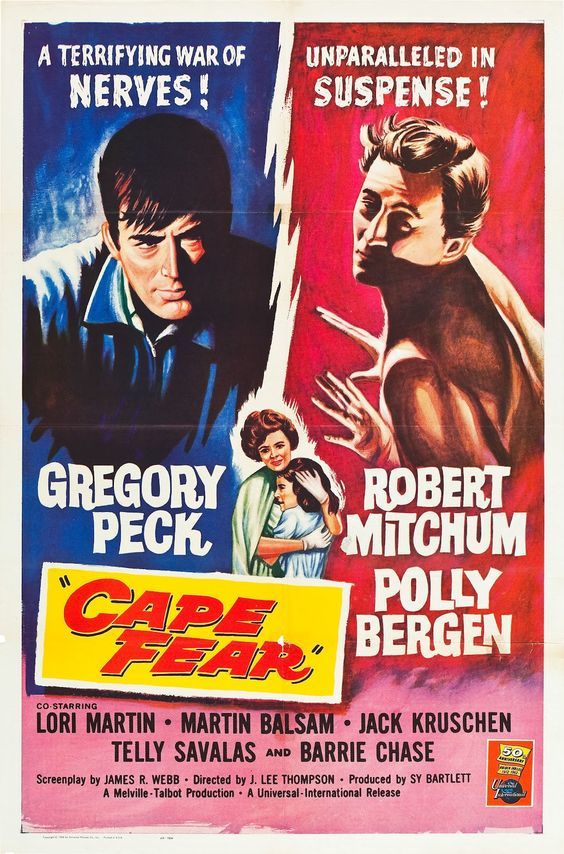
Cape Fear (1962)

cape fear poster

Gregory Peck is so linked in my mind to the simplicity and grace of Atticus Finch in To Kill a Mockingbird, that it is always surprising to see him in anything else. To find him in the gritty, dirty piece of film noir that is the original Cape Fear is something of a shock. Yet, as always he does a marvelous job, and some of that grace manages to shine through the grime.

The story is a pretty basic noir plot. Max Cady (Robert Mitchum) is an ex-convict who just got out of prison. He has come back to town to haunt Sam Bowden (Gregory Peck) who testified against Cady for attacking a woman. Cady has spent his time in prison studying the law. He manages to terrify Bowden and his family and still remain within the confines of the law.

Though Peck gets top billing, this is truly Robert Mitchum’s film. He plays Cady with a swagger and menacing smile that is simply magnificent. We can see inside his swarthy confident charm and see the evil, menacing psychopath. The brilliance of the role is that we rarely see the violence that hides just behind the mask. Yet it seethes and oozes out, ready to strike at any time.

Director J. Lee Thompson keeps the tension pumping throughout the 105-minute film. There is hardly a moment to relax before something else occurs to tense us right back up. Yet the tension doesn’t come from boogie men jumping out from behind closets. It is a slow, boiling tension that tightens as we imagine just what might happen. When the climax finally does occur it is almost a letdown.

The censors wouldn’t allow the bloodbath one might expect at the end of such a film as this, and so what we do get feels less exciting that I wanted.  Still, getting to the end is well worth the watching.

April Excursion


I love the French school system. They get two weeks off every couple of months. After much discussion on where we would go during the April break, we finally decided to see a good deal of France. I would have preferred Barcelona or Athens, but being the French girl that she is, Amy was adamant we see some more of this country. I agreed on the condition that we make it to the Normandy beaches. France conspired against us to actually make it to the beach, but at the time we thought we would make it without problem.

We started off headed towards Lille. One of our Indiana friends has been doing her year abroad there, and it seemed like a good starting point for our trip. Lille is a pretty little city in Northern France just off the Belgium border. There is nothing particularly famous or awe-inspiring there, but it is quaint, and very pretty. Many of the cities in this part of Europe have very tall, ornate bell towers. Lille has two on opposite sides of the town. The architecture there has many Flemish influences and many of the buildings have little star-step roofs that are quite beautiful.

It was very nice to visit with Kim and hear how her time in France has been going. Unfortunately, it rained for most of our visit, but there were enough dry spells to see the sights. We stayed in a larger hostel this time. Where in Rome our hostel was essentially an apartment rented out amongst other full-time renters with only two bedrooms for a myriad of people, Lille’s hostel was a rather large building with numerous rooms. We had our own room, though we had to share a bathroom with the remainder of the place. Oddly, someone had stolen or ripped out all of the seats on the toilets. It was very peculiar, and not very comfortable.

I have been in France too long. While checking our room for an additional day an English speaker was rather testily trying to get his room. Like many native English speakers, his idea of speaking to a French person was to speak English very loudly. Now, we had spoken to the lady behind the counter on several occasions and found her to be very pleasant. She spoke quite a bit of English and had spoken to us in both French and English. But this guy was just being obnoxious.

She misunderstood how many nights the man wanted and his response was to speak louder and actually pretend to strangle the woman! At this point, I could tell the woman was just stringing him along a bit. One of the joys of being French is having control of their own bureaucracy. She began asking for his passport and various other papers, simply because she could. She knew he needed the room, and she was holding that power over his head a bit for being rude.

It was an odd scene to me. As an English speaker, I felt as though I should feel sympathy towards this man. But, I’ve lived in France long enough to understand how the system works. I understand that there is often tons of paperwork and bureaucracy to get through. If you are patient, and follow orders it will go much faster. It also helps to speak what little French you know. I find the French are much more responsive if you try to talk to them in their own language. A simple “Bonjour” will go a long way. So, when this guy looked at me for a little sympathy, I gave him none. He just wasn’t working with the system.

image host
We took a day trip to Bruges, Belgium. Like Lille, there aren’t any major monuments or anything the average European tourist would want to visit. It is, however, a very touristy town in the Gatlinburg, TN kind of way. There were lots of souvenir shops, and plenty of corner cafés selling all of Belgium’s finer culinary delights (waffles, French fries, and chocolate.) The buildings were also Flemish-influenced, and the town square was very pretty. We climbed the 320-odd steps to the top of the bell tower and were treated to a lovely panoramic view.

image host

Our next train led us to Rouen. We stopped there figuring it was a good middle point for the next two stops we wanted to make: Giverny and the D-Day beaches. It is also the city made famous by having burned Joan of Arc at the stake and housing the cathedral made famous in a number of Monet paintings. They also have something like 9 churches of which we saw about 4.

The cathedral was beautiful, but very difficult to photograph. Especially since the main entrance is covered in construction facing. Lots of the city is taken over by Joan of Arc memorabilia, most of which is tacky. What I could see of the museum (via postcards and guidebooks) was just awful. They had wax figures and mannequins dressed like Joan leading a siege or being burned. The site where she was burned was pretty tame. There are but a few ruins remaining of the church left and virtually no posts describing what actually happened.

Nearby is a new church dedicated to the saint, and the remaining area is tourist crap.

We also visited a gravesite for the people who died of the black plague in the area. At the entranceway is a petrified dead cat, warning all who come into the area. On the building surrounding the little cemetery are wood carvings of skulls and the like. The actual site is less like a cemetery and more like a little park. There are no gravestones since the bodies were just piled onto each other.

North of Rouen is Caen. It is the closest city to the D-Day beaches and houses a big WWII museum as well as tours of the actual beaches. We decided to make a day trip of it and left our baggage in Rouen. We took a mid-morning train and headed straight to the museum. The packaged tours were very expensive so we decided we would just try to make it on our own. We figured they would surely have bus lines running out to the various beaches.

The museum was very fact-filled, but a little light on real pieces. There was very little to look at besides placards describing various events, and old photographs. Still, it took a few hours to visit. By the time we were finished, we were through. Checking the bus schedules we realized there was no way to make it to the beach and catch our train back to Rouen. After some debate about whether to stay the night in Caen and see the beaches in the morning, dirty and wearing the same clothes, or head back to Rouen and make the trip all over again the next day, we opted to just forget the whole thing. I was incredibly disappointed, but all other options seemed pretty bad.

Back in Roeun, we booked a train to Giverny the next day. Wandering back by the Rouen Cathedral we bumped into Amy’s coworker from the university in Strasbourg. Apparently, she is from Rouen and just happened to be out walking with her mother. Small world.

image host

We arrived in Giverny Monday afternoon, but most of France is closed on Mondays, including the Monet museums. We were actually staying in a town called Vernon, which is where the train stops, Giverny being too small for anything like that. Deciding to walk to Monet’s house anyway, we tied our shoes for what turned out to be about a 5-mile hike. It was a long journey by foot, but a beautiful one. The sun was finally shining and almost everyone in the town has a flower garden. Monday slipped away and we awoke early to head back into Giverny.

Monet’s gardens are astoundingly beautiful. His entire backyard is taken up by rows and rows of flowers of every color imaginable. The water lily pond is actually across the street so you take a little tunnel to get to it. It is quite a thing to see the actual pond and Japanese bridge that I’ve seen my entire life via Monet’s paintbrush. In Indiana, I even have one of the prints hanging over my television. It was a little too early in the Spring to be as flushed out as you see in the paintings, but it was still quite breathtaking. We had arrived early enough as well, to avoid the rush of tourists, and were able to stop and enjoy the view.

The next day we trained home. It was a long and expensive trip. We were not able to see everything we had hoped, and it wasn’t the sort of trip you think about when you think about European vacations, but it was nice to see a lot more of the country I’ve called home for the last 7 months.

Tonight I Sing My Song Again…

I'm back. We visited our friend Kim in Lille who took us into Bruges, Belgium. Then we headed to Rouen where Joan of Arc was burned at the stake, and Monet painted his famous pictures of the Cathedral there. We caught the WWII museum in Caen, but unfortunately were not able to make it to the D-Day beaches or Mont Sant Michel. We did go to Giverny where Monet had his home and the beautiful water lily pond still exists. I will have pictures posted and a longer, detailed version of our trip up soon.

There are some more reviews coming soon. I read a couple of books on the trip, and saw some movies before we left, I'll try to get to those in a few days. For now I am exhausted and rather broke. Europe is expensive.

Stay tuned….

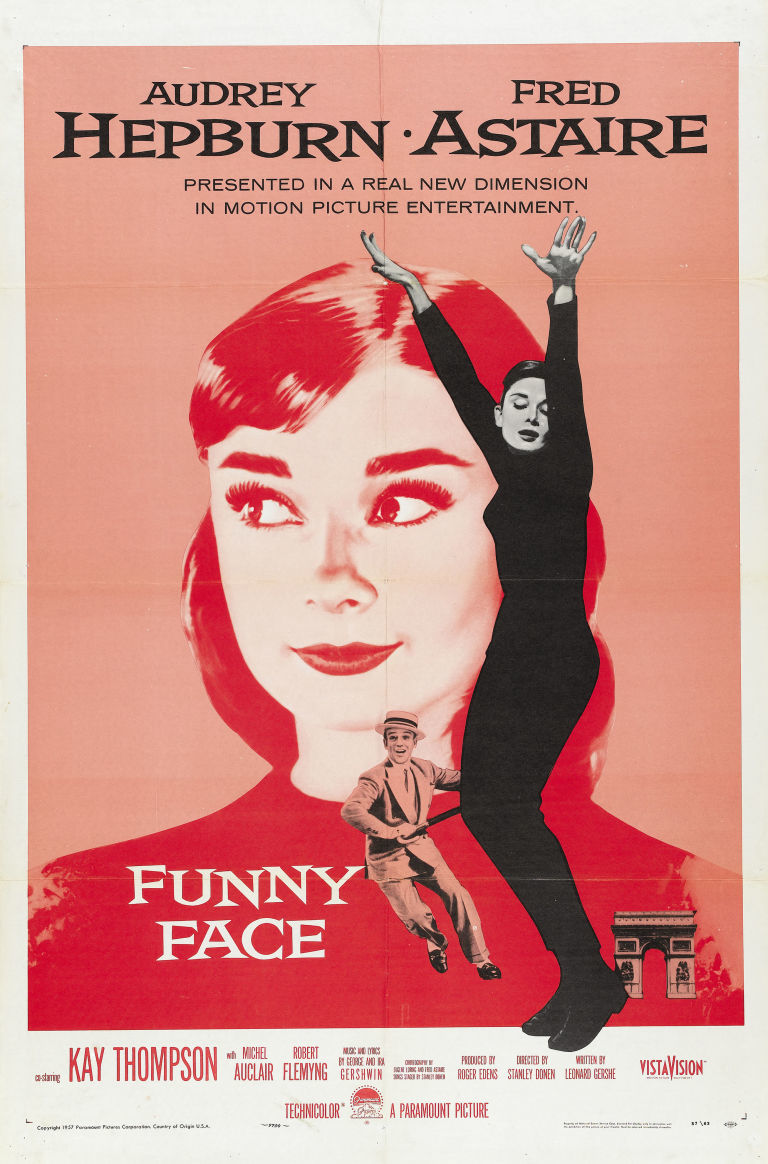
Funny Face (1957)

funny face poster

I hate to admit that it was a pop song that made me fall in love with Audrey Hepburn. It was the spring of 1996 and Deep Blue Something’s “Breakfast at Tiffany’s” was all over the radio. One dull afternoon in the life of a college student, a friend of mine admitted that she had actually never seen the film. I sheepishly admitted the same, and we went straight out and rented it. I immediately fell madly in love with the style, class, and beauty that is Audrey Hepburn. In the many years following, I have done my best to nurture that one-sided love, and try to watch any film with Ms. Hepburn when I get the chance. Recently I sat down and watched Audrey and Fred Astaire in Funny Face.

It is a film that is notable for being a musical in which Audrey actually sings. A feat she was famously not able to duplicate in My Fair Lady (1964). It is a soft, kind sort of voice a simple boy could fall in love with, but one can see why Mr. Cukor opted for another one to sing for Eliza Doolittle.

The Gershwins have once again created some wonderful songs. Mixed with exuberance, humor, and a sweetness that no other songwriter has ever matched, George and Ira created some of the world’s greatest songs. The stand out here is the simple sweet closer, “S’Wonderful,” but “How long has this been going on?” and the title number are just lovely. Ira’s silly, unbelievable rhymes are in full order here as well. In “Bonjour Paris” he manages to rhyme the philosopher Jean-Paul Sartre with Montmartre.

Being not only an Audrey Hepburn picture, but also starring Fred Astaire, there are plenty of dance routines. Only one number is what I would consider exceptional and that is a number between Hepburn and Astaire while photographing a wedding scene outside a lovely French church. The setting is beautiful (though shot in soft lighting for some reason) and the routine flows beautifully and with much charm.

The plot as it is, centers around Hepburn playing a bookish, intellectual named Jo Stockton, and a women’s magazine photographer, Dick Avery (Astaire) trying to convince Stockton to pose for him. She agrees only as a ruse to go to Paris and meet the inventor of a new philosophy, empathicalism. Of course, they fall in love. There is nothing really new or all that interesting in the story, but it is set in Paris which gives it some very beautiful backgrounds in which to tell it.

Call me a heretic, but I’ve never been much of a fan of Fred Astaire. He has a fine singing voice, and his dancing is always excellent, but there is something about him as an actor and leading man that rubs me the wrong way. He does a decent job here, but ask me who I’d prefer to see play opposite Audrey and I’d choose Bogart, Cooper, Peck, or Grant any day of the week over Astaire. (Editors Note: I no longer share this opinion with my younger self, I love Fred Astaire (Mat, March 2023).

Funny Face is a fun, harmless musical. The Gershwin tunes are a pleasure, the story is…well, fodder for the songs and dance numbers, but fair enough for what it is. But the real reason to watch the picture is the one, Audrey Hepburn. While I am embarrassed that it took a silly pop song for me to see the light around that graceful woman, I am forever grateful for that three minutes of bubblegum, for it gave me the joy that is Audrey.

Unbelievable

The florescent light above our kitchen sink has not worked properly since we moved in. After a few minutes of illumination, it will start blinking on and off until it finally decides to stay permanently off. We have switched bulbs, jiggled, wiggled, and finagled it to no avail. I have taken it apart and made sure all of the connections were connecting. Nothing I could do would ever make it work differently. We finally broke down and got a friends husband, who also happens to be an electrician, to come over and give it a look. Within a few minutes he worked his magic and it now works like a charm.

As our luck would have, the very next day, our bathroom light started acting the same way. It continues to blink on and off, and eventually gives out entirely! So, the lamp that was taking the place of the faulty kitchen light has now been moved into the bathroom.

Next week, I will be without the use of the computer. Amy and I are taking another trip. This time we will be visiting our friend, Kim, in Lille. We also plan to take a minor excursion into Belgium and then make it to Normandy. If we have the time, and money, we may venture towards the center of France and visit a few of the castles there.

American Beauty (1999)

american beauty poster

The first time I saw American Beauty it was the last in a three consecutive weekend movie run. The other two films were Fight Club and Bringing Out the Dead. All three films are about men trying to come to terms with what it means to be a man in America in this day and age. Fight Club finds meaning in deconstructing everything down to basic needs, and feeling through pain. Bringing Out the Dead gives meaning to its character through drug use, (Editors note: that’s totally not what these films are about – I totally missed the points when I wrote this) but it was in American Beauty that I found some sense of hope.

In the film, Lester Burnham (Kevin Spacey) plays a middle-aged, middle-class suburbanite, with seemingly everything he could desire. He has a good, well-paying job, a beautiful wife (Annette Bening), a large luxurious house, and a lovely daughter (Thora Birch). Yet, with all of this, he is not happy. In fact, all of these things are not quite what they seem. His employer is facing cutbacks, and he may soon lose his job. His marriage is in shambles, and his daughter openly hates him. Early, we see him masturbating in the shower – in a voiceover he states this is the high point of his day. All is not well in the house of Burnham.

All of this changes when Lester meets Angela (Mena Suvari), his daughter Jane’s gorgeous, cheerleader friend. On first seeing Angela during a cheer routine, Lester feels a special, lustful connection. Later that night, Lester overhears Angela playfully telling Jane that if he would only work out, he would be sexy. His lust over this teenage vixen becomes the catalyst for the film and Lester’s very life.

Soon after Lester quits his job, in fact, he bilks the company for a year’s salary by threatening to disclose scandalous information that he has become privy to. He begins smoking pot, and buys a hot rod. He plays with remote control cars, takes a job at a fast food joint, and starts working out. In every way, he reverts back to his teenage years. Even the soundtrack begins blaring out classic rock tunes from the 1970s. Finally after years, decades even, of feeling low, miserable, and not alive, he feels great.

This reversion back to his glory days is only the beginning. It is a reversion back to the days when he had fun when he felt alive. But he is not a man who will stop there. This is just the beginning point to a lifelong conversion of living a full life, as opposed to a life full of the right things, but that is ultimately empty. Or it would be if he was not shortly dead (this is not nearly the spoiler you might think it is, for Lester announced his death within the first minutes of the film.) Toward the end of the film, we can see that Lester is already outgrowing his childish behavior. When he yells at his daughter, he immediately feels the sting of regret. When given the chance to indulge in his lusts, he backs away, understanding that it is not right. Just as the music changed to classic rock with the first change, here it has changed again, turning into the same classic rock being covered by newer, contemporary artists.

Many will probably say that using the lust for a teen, and illicit drug use as a catalyst for change, is not a change for the better. I can already hear my mother scolding me for having seen the movie, much less reviewed it from 2,000 miles away in Oklahoma. Yet, here it works and works well. I don’t believe the film is saying that these things should be the means to a change, these things only served as means for this character to break free from the rut that had become his life. There is a telling scene where Lester and his wife are overcome with sexual desire. As he dips his wife to kiss her, she stops the embrace because he is near to spilling his glass of wine on an expensive couch. An argument ensues with Lester proclaiming that “it’s just a couch,” while his wife is horrified at the thought of ruining said couch. There lies one of the central themes of the film. That these characters are so wrapped up in the material that they lose sight of the better pleasure of life, including lovemaking.

It is not a perfect film. The Burnham’s neighbor, Col. Fritts (Chris Cooper) seems a caricatured archetype. He plays a hateful, homophobe who really carries deep-rooted homosexual tendencies. It is too outlandish to be considered real. Though it must be said the part is played marvelously by Chris Cooper. Jane’s speech about being a freak too may move the young kids who consider themselves the nonconformist, shy type, but it is too after-school special for my tastes.

I’ve left out some of the best scenes and an important character, Ricky Fitts (Wes Bentley). He plays the drug-dealing son of Col. Fritts, who likes to record everything on his video camera. There is a moving scene in which he and Jane watch an old tape he recorded of a plastic bag floating through the air. It is a moving, poetic scene that conjures up thoughts of the futility of life and its very beauty. It is that type of movie. It creates beautiful, moving, simple scenes that bring a sense of hope to live, while at the same time, showing the ultimate horror of living it.

I Am Charlotte Simmons by Tom Wolfe

i am charlotte simmons
Every few years or so, Tom Wolfe creates a massive tome documenting sections of American society. In 1988, he detailed New York City during the Wall Street boom in Bonfire of the Vanities. In 2001 he turned his satiric eye to the capital of the South, Atlanta, GA, with A Man in Full. In 2004 he deconstructed another part of American culture, that of the university.

I Am Charlotte Simmons is set at the fictional Dupont University. It is a setting of higher learning as prestigious in its intelligentsia as Harvard or Princeton, with an athletic department as fearsome as the University of Texas, or Stanford. Like New York and Atlanta, it is full of a great many sub-cultures with their own social statuses. Wolfe again skewers them with a journalist’s eye for details.

Within Dupont University there are several classes of society. There are fraternities and sororities filled with alcoholic, sex-obsessed frat boys and their counterpart sorority girls, who are perfectly dressed, coiffed, manicured, and accessorized. There are “student-athletes” who are set apart from all other students on campus with private dorms, dumbed-down classes (taught by professors who understand the needs for the “program”), and of course, plenty of lavish gifts bestowed upon them. Then, there are the students daring to come to the university to actually get an education. These students are at the lower end of the social totem pole. Nerds and geeks who want to use the university for its intended purpose. But these poor lads are not complete social outcasts. For this, Wolfe gives characters with no other purpose than to be losers. There are groups of girls who line the dormitory hallways blocking the paths of others only to grasp a little of their coolness and gossip about anyone with something resembling a life.

Charlotte Simmons enters Dupont from the mountains of North Carolina. She is a beautiful, intelligent prodigy from the sticks. She comes to this bastion of the social milieu, naïve, morally pure, and with Southern good cheer. The nearly 700 pages within this novel detail her freshman year trying to find her place in all of this.

Wolfe again writes from the perspective of different characters. When chronicling one character, the reader understands their thoughts and perspectives. Here, he gives us insight into several characters. There is JoJo Johanssen, a star basketball player being outplayed by an incoming freshman. Next, there is Hoyt Thrope, the coolest of cool frat boys, who is rich, suave, and completely one-dimensional. We also understand the perspective of Adam, a poor, intellectual, and radical member of the school newspaper. Of course, much of the novel is written from Charlotte Simmon’s perspective. An interesting turn of perspectives occurs when two or more of these characters interact with each other. Suddenly we see one of the characters from another point of view.

The novel does a great job of giving details to the nuances of the fictional university. Wolfe is the reporter chronicling American college life. Yet, he is also the constant satirist drilling into the ultimate contradiction of a university doing everything but educating. There are several beautiful passages detailing the state of the once grand and beautiful fraternity houses. The large, ornate tables have long since been stained and chipped by countless beer games. The antique, gorgeous library now houses pizza boxes, beer cans, and a lone television, without a book to be found.

At its heart, this is a coming-of-age story. Charlotte Simmons must become an adult woman. Wolfe lets us know that she is an intellectual prodigy. He writes her with the ability to become an intellectual giant. She is also a pure, naïve country girl. When the novel begins, she is a virginal, teetotaling young lady who is shocked, SHOCKED at the foul language coming from the mouths of her peers. Also from the beginning, we know that within the pages of the novel Charlotte will lose her innocence. Intuitively, we understand that Wolfe must crush her under the pressure of her peers. We hope she will be able to put herself together, into a stronger self, before the last page.

A large part of the novel focuses on Charlotte’s desire to find a boyfriend. There are three boys vying for her attention. Hoyt is the good-looking, incredibly popular forerunner. He is suave and incredibly charming and quickly goes after Charlotte’s affections. Adam brings with him a stunning intellect that wows Charlotte and gives her the intellectual challenges she came to Dupont for in the first place. JoJo is a sweet, kind-hearted basketball star who cannot be overlooked.

Who she winds up with at the end of the novel, I found to be a large fault. It is almost as if Wolfe wants to surprise the reader with the least acceptable candidate. Throughout the novel, Charlotte belittles and is annoyed with this character. In order to end the novel, we are found with Charlotte throwing away so much of what she had worked for. Some of this had been destroyed by bad decisions, but we do not see where it is destroyed so much that she will accept where she is by the novel’s end.

It is discouraging, and yet believable that Charlotte is so enveloped with the need to be popular. Certainly, the need to fit in, to find kinship with our fellow people, is a universal need. Yet Charlotte concentrates so deeply on this need, it is disappointing to see. She notes that in high school she was able to be above the worldly throng, yet almost immediately she is going against her own beliefs merely to fit in.

Out of place in this novel is the lack of God. Charlotte is from the rural mountains of North Carolina, practically the buckle in the Bible Belt. Her morals abound from Christian ideology. She mentions that her mother is from the Church of Christ Evangelical denomination. Yet, rarely is there mention of God or faith. The first mention of the divine comes from Charlotte fearing the wrath of her momma’s God. The way the passage reads we understand she fears the wrath of her momma over the wrath of that God. Later, when Charlotte has all but been destroyed, she prays to God over and over again to take her away from this earthly plain. Yet, by the novel’s end, Charlotte ruminates over her disbelief in an eternal soul. It is not difficult to believe that even a rural North Carolina intellectual could pull away from her mother’s belief in God. But, to have the character seem unscarred by this belief (or unbelief), seems more from the writer’s own intellectualism, than one based on the character.

Tom Wolfe has again created a masterful work of satire. His journalistic eye gathers enormous details about the structure of American collegiate life. He seems to be trying to shock his audience where there is none left. There have been far too many MTV Spring Break specials to find any shock in college students drinking and indulging in casual sex. However, he gives a bravado performance detailing their escapades. In the same manner, he fails at bringing perfect insight into the nature of someone like the titular character. He glances over any religious turmoil that would certainly be central to her character. Even with these flaws, I Am Charlotte Simmons is a beautiful read. There is much that is spot-on correct in the current university scene, and there is much to enjoy while reading.

No Water No Cry

Once again this morning our water was turned off, that makes it six times since we’ve been here, I believe. I have no idea why they need to turn it off so often. We were awakened by some insistent hammering, and drilling this morning, that must be a part of it. Unfortunately, the hammering didn’t come early enough. The water was turned off at 8:30 and we had forgotten about the notice we received yesterday, so we slept right through. Ugh, no water is miserable. No shower, no drinks, no washing of the dishes from the previous night, no flushing the toilet. The notice said it would be back on at 12:30. We decided to sit down and watch American Beauty to pass the time. It finished right on the 12:30 nose. “Ahhhh,” we said, looking ever so forward to a long shower.

“It’s not working!” cried Amy from the bath. Indeed, she was correct, our water was still not working. Hoping it would only be off for a few more minutes we began straightening the place up. Ten minutes later and it was still off. I settled in to read a book, and Amy checked her e-mail. Thirty minutes of this and no water in sight. Amy moved to the couch to stare at the side of my head, while I picked up my French homework.

Two o’clock came and we were still as greasy as ever. Amy had to be at work at 3, in desperation, we called our friend Elizabeth. Thankfully, she was home and allowed us to jaunt over and clean up. It felt like everybody in France was out on the street gawking at the greasy Americans as we walked over.

It is now just past three o’clock, and we still do not have any water, but at least I’m clean.

Boring Details About My Day

It has been absolutely gorgeous here again for the last several days. My now daily walks to the park are gaining me a red face and a slimmer belly. There are few things better than being able to pull your belt a notch tighter.

Along with my park walks, I have nabbed what I feel, are some very good photographs.

It looks like we’ll be taking a bit of a tour of France next week. Amy has a two-week vacation from school so we thought we’d go visit the other regions in France. We hope to hit Lille, Normandy, and a few castles in the middle of the country. More details will come when we have them.

Astute observers will notice I have fewer links on my blog these days. There are several reasons for this. They are a pain in the butt to install, and I figure you guys can go to Google and search for that stuff on your own if you like. I had originally planned to have interesting and well-researched links, but that takes far too much time than I care to give to the project. Also, Google search rankings go down whenever you link to a site that doesn’t link back to you.

Speaking of Google, my blog counter gives me information on how people get to my blog. This includes linking here, or what web search they came from. Two of my favorites are searches for a popular ice cream chain “Brusters,” except the searchers misspell the name to read “Brewsters.” The other searches involve a picture I took at a German Mcdonald’s.  The picture consists of a window advertising a bar located in the Mcdonald’s and has the naked silhouette of dancing girls, the kind normally seen on truck flaps (you can view the picture here). The funniest of these searches involved Yahoo, where someone searched for “naked silhouette” and came to my site. From there I got several links from Yahoo mail. Presumably, the anonymous searcher found the picture so interesting he had to e-mail it to his buddies.

My little stint on blogcritics.org is going quite well. They are getting upwards of 40,000 visitors a day and so my reviews/essays are being read by a lot more people than I ever generate on this little piece of cyberspace. That’s a bit exciting and rather daunting.

Well, my friends, I believe that is the boredom for today.

The Little Sister by Raymond Chandler

the little sister

Raymond Chandler once wrote that Dashiell Hammett “Gave murder back to the kind of people that commit it for reasons, not just to provide a corpse.” In his essay “The Simple Art of Murder,” he continues to praise Hammett while berating Agatha Christie types who set murders at tea parties and ended them by bringing all the suspects into one room while the detective ran over all the clues before them, causing the killer to jump out and confess. Chandler set out to write Fiction, with a capital “ART”, that it happened to involve pimps, drug fiends, mobsters, and lots of murders is secondary.

It is difficult to review a single work of Chandlers, they all kind of fuse into a sort-of biography for his singular detective, Phillip Marlowe. His novels are very similar, in that they involve the seedier aspects of the city, are all told in the first person by Marlowe, always include various crimes, usually murder, and are filled with an assortment of double-crossing, corrupt folks. But, novels are not the same in the way novels by the likes of Dean Koontz or Mary Higgins Clark are the same. Where they seem to have a dozen storylines and can simply fill in different character names and settings. No, though Chandler’s stories are similar in many ways, they differ in the means by which they are told. Like the way snowflakes look the same in one drift, but upon observation are each different. Or the way in which dollar bills are the same aesthetically, but are spent in a million different ways. Chandler’s writing sparkles amidst the slums and degenerates he writes about. His dialogue sparkles as Marlowe’s sarcasm cracks your lips into a smile.

The Little Sister starts with a little nebbish girl, from nowhere-Kansas who asks Marlowe to help her find her brother. From there the plot involves Cincinnati mobsters, Hollywood agents, starlets, and a few ice picks sticking out of a few necks. As always, Chandler’s plot gets very complicated very fast. The joy of the novel is not in trying to figure out who is who, and who did what, but in the way Chandler lets the mystery unfold. The murders are always at the center of the story, but there is something else hanging near, something more akin to great literature, than dirty detective stories.

By the time he wrote The Little Sister, Chandler had written several screenplays for Hollywood pictures. He seemed to not like the experience one bit. There is plenty of cynicism directed toward Tinseltown here. The agents are like kings who will sell souls faster than Doctor Faustus and the starlets are empty, callous girls who sell sex like McDonalds sells French fries.

Reading The Little Sister was a little sad for me since it is the last Chandler novel that I had not read. There are still his short story collections to look forward to. It feels like the end of an era. His novels still swarm around in my head, and give me hope as a writer. Here is someone who wrote stories, not just to entertain, but to try to find something more-Literature or Art- and maybe, in doing so helped us to understand what it means to be a writer.