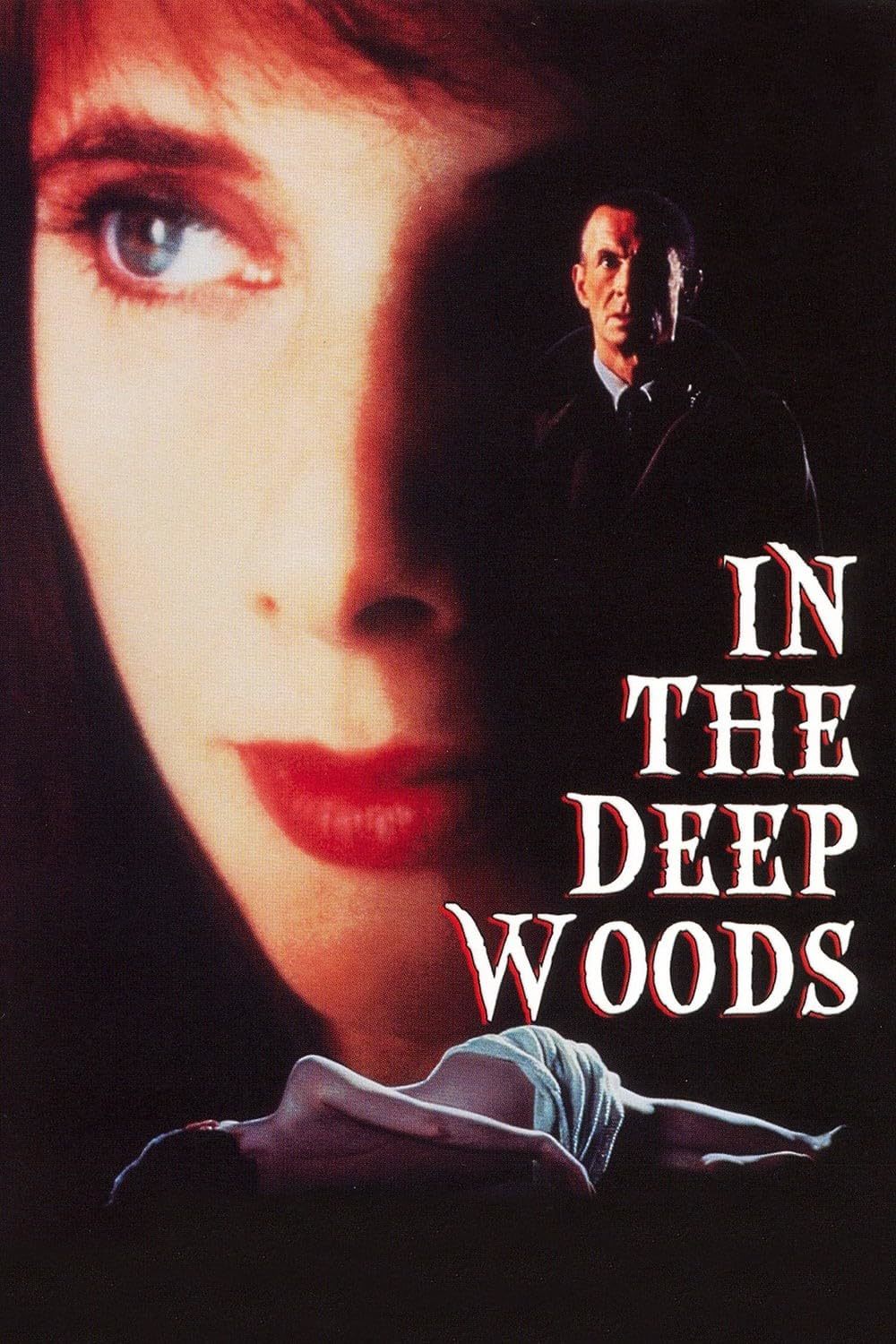
Murder Mysteries in May: In the Deep Woods (1992)

poster

The thing about finding movies on the internet to watch is that you don’t always know where the movies came from. I mean there are the usual bad rips, or hardcoded subtitles, or the audio is the wrong language type of thing to deal with, but what I’m talking about is not necessarily knowing what kind of movie you’re about to watch. Is this a prestige Hollywood movie, or some straight-to-video release? Did it have a sizeable budget or were they working on a shoestring? It if has named actors, at what point in their career was this movie made? Were they famous when they made it?

Obviously, for a lot of movies, this is almost automatically known by me. I watch a lot of movies, I pay attention to movie reviews and news. In the vast majority of the films I watch I have some idea of what I’m getting into.

But not always.

Sometimes it is a surprise. Case in point: In the Deep Woods stars Rosanne Arquette, Anthony Perkins, Will Patton, and Amy Ryan. These are people I know. These are people I like. Those last two might not be household names, but I bet you’ve seen them in something. But Arquette and Perkins were stars.

It was made in 1992 which is a little late in Perkins’s career (in fact this was his last film) and a little early for Ryan (in fact this was her first film), but Will Patton had established himself as a solid character actor and Arquette was at the height of her powers.

Not that I was paying that much attention to the date of release when I picked this movie, I saw those names and some decent reviews on Letterboxd and pressed “play.”

What I didn’t realize is that this was a made-for-TV movie. Made for NBC in 1992. TV is different now. TV gets big budgets, big movie stars, and big prestige. In 1992 movies made for broadcast television were usually pretty lame.

Oh well, live and learn, and all that.

Arquette plays Joanna Warren a children’s book author. There is a serial killer on the loose who is dragging women into the woods, I mean The Deep Woods, and doing terrible things to them. Joanna might be his next victim (well, probably not his next victim because that would build our climax a little too quickly, but it is a safe bet he’ll go after her in the last act.

Perkins is the creepy old dude who might be a private investigator who might have some sort of relationship with one of the victims. He might have been hired by her parents. He lies a lot. The film plays up his potential to be the actual killer.

Patton plays the police detective assigned to the case. He keeps creeping on Joanna, asking her out on dates even though she repeatedly turns him down. The film periodically plays up his potential to be the actual killer.

Amy Ryan is Joanna’s sister, I think, or maybe just a friend. Her husband gets a little play as the potential killer, but mostly she’s just a gal pal Joanna can talk to amongst all the creepy dudes.

My favorite part of the film is that the killer is supposedly some kind of mastermind. He’s brutally killing these girls but leaving no clues, no fingerprints or DNA and there are definitely no witnesses. And yet the film continually shows us his crimes (well shows us as much as a TV movie from the early 1990s was allowed to show us) and it is often in daylight, and in public. One time we see him grab a girl in a busy parking lot. Two seconds before he grabs the lady we see extras walking around. Yet no witnesses.

This is a dumb movie. There are a few noir/Giallo touches that are nice, and Perkins is enjoyable – I mean his character is ridiculous, constantly obfuscating his motives for no reason – but he’s enjoyable to watch.

But watching it got me to thinking about made-for-TV movies from this era. This was before prestige TV. This was when television was considered a lesser medium than cinema. This was before streaming. Thirty-minute sitcoms and hour-long dramas ruled television. Now again they’d make a mini-series or a feature-length movie to show on a Monday night. Sometimes they’d get real celebrities to star in them. Their budgets were usually small and they tended to cater to the biggest possible audience. A serial killer movie fits that bill.

Thinking about In the Deep Woods in that context. Had I watched it at a time when there weren’t a thousand awesome shows in my queue and when I often watched whatever happened to be on. I might not have hated it. It would still be a long way from good, but I bet I’d enjoyed myself.

Murder Mysteries in May: Murder Most Foul (1964)

poster
Margaret Rutherford played Miss Marple, the Agatha Christie crime solver, in four films (well, technically she has an uncredited cameo in The Alphabet Murders, but it’s just a gag). I’ve seen three of them and they are all delightful.

Murder Most Foul is the third film in that series. It finds Miss Marple on the jury in a murder case. One in which everyone thinks the man on trial is guilty. Even the judge pushes for a guilty verdict. But Marple has her doubts. So much so that she hangs the jury.

Naturally, she investigates. Clues lead her to a theatrical troupe (who have just performed a mystery based on an Agatha Christie story, Murder She Said – which was the first film in this series). She suspects the dead girl was blackmailing an actor in the troupe. Naturally, she finds a way to join them.

As always with this type of thing the cast is an eclectic group, each with their own secrets and possible motives for murder. Marple does her best to snoop them out.

Margaret Rutherford plays Marple as an eccentric, dotty old lady, who loves murder mysteries and uses her knowledge of them to solve real-life ones.

I think I liked Murder She Said slightly more than this one, though I’d put it on par with Murder at the Gallop. Though they do tend to get jumbled up in my mind. They are all very slight, but thoroughly enjoyable.

Murder Mysteries in May: The Alphabet Murders (1965)

poster

The challenge for anyone adapting a murder mystery originally written many decades ago is how to make it relevant to modern audiences. All too often there is a need to remove racist, sexist, or homophobic content. Famously Agatha Christie wrote a novel that she originally titled Ten Little N—- (after an old minstrel song that plays an important part in the plot). Even in 1940, Americans knew this title was unacceptable and it was redubbed And Then There Were None for its US release. For a while, it was renamed Ten Little Indians in most markets (and there are at least a couple of movie adaptations with that title), but these days everyone has changed it to And Then There Were None.

But beyond dealing with words and ideas that are no longer acceptable, adaptations must decide if they want to keep the original time period or update it to modern times. Are there language or plot points that now seem archaic? Etc. and so forth.

The Alphabet Murders, based on an Agatha Christie novel from 1936, chose to modernize the story in every conceivable way. The film is so very 1960s it hurts.

It begins with Tony Randall playing Tony Randall an actor who is about to star in the film we are about to watch. He winks at the camera and introduces the film. Then with a flash of editing, he’s changed into Hercule Poirot the famed Belgium detective. But he’s still winking at the camera and telling us to leave him alone. For he is in London and surely no crime will follow him there.

The rest of the film has that same winking, and cuteness to it, though no one else breaks the third wall. There is more than a little Inspector Clouseu to Randall’s portrayal of Poirot and it should be noted that the Pink Panther series was two films into its run by this point, and quite successful.

I’ve never read the book – got a few chapters in and then got distracted, nor seen any of the other adaptations of it (I’ve seen bits and pieces of a couple of them – maybe this story just doesn’t grab me like it should) but from what I do know this is a very loose adaptation of the novel. Here some serial killer is murdering people who have the same letter for both of their initials and is doing so in alphabetical order.

But the mystery takes a back seat to the comedic shenanigans and the comedy just never works. The setting and the look of the film are all swinging in ’60s London which is fun, but strange for a Poirot movie. Robert Morley is Hastings, a recurring character in Christie’s novels. He normally acts as a Dr. Watson-type character to Poirot’s Sherlock Holmes, but here he’s an English copper who does not know Poirot at all.

I suppose if you know nothing about Poirot and are looking for a silly 1960s crime story then this might work for you. But as someone who has seen many Poirot adaptations, this just fell flat for me.

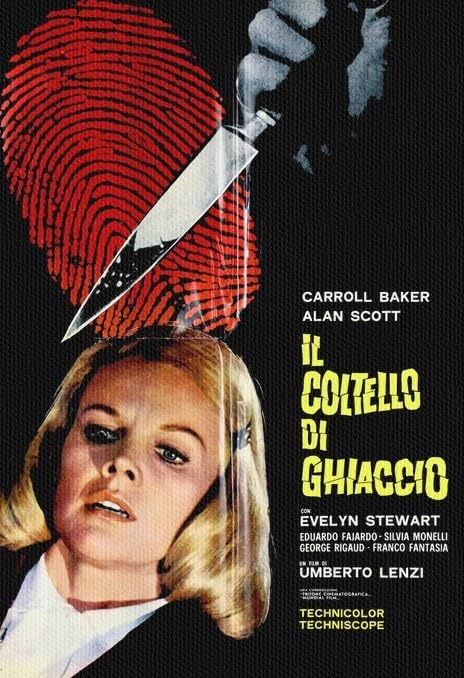
The Friday Night Horror Movie: Knife of Ice (1972)

poster

I knew that I was going to watch a Giallo some Friday this month when I dedicated it to murder mysteries. The name Giallo comes from the yellow coloring of the cheap paperback mysteries that were for sale in Rome at the time. Filmmakers started adapting them in lurid, violent ways, which turned them into horror films, but at their heart, they are murder mysteries.

I had not meant this Giallo to have been directed by Umberto Lenzi, the Italian genre director who now leads the director field in my stats for the year with me having now seen four of his films in 2024. I never would have guessed he’d be leading the pack in the middle of May. But life, and my film watching, is just full of surprises.

This one stars Carroll Baker (who made three other films with Lenzi) as Martha a woman who witnessed her parents die in a horrible accident when she was but a child, rendering her mute.

Now in her twenties, she lives with her uncle in a beautiful estate in the Spanish countryside. One day her cousin Jenny (Evelyn Stewart), who is a famous singer shows up. Then she gets herself murdered by a knife-wielding maniac.

The police note that another woman was found dead in a ditch not far away. It must be the work of a sex maniac. Later they’ll find remnants of a black mass and decide the murders aren’t that of a sex maniac, but of a satan worshipper.

More murders pile up and it appears as if Martha may be the next victim. The police inspector put three officers around her house for protection. It is the worst protection I’ve ever seen in a film. One guy takes shelter in an underground crypt (her house is next to a cemetery). Another one tells her that his replacement is running late so he just takes off without waiting. The last guy gets a call stating there is an accident nearby so he takes off, leaving her alone.

There are lots of twists and turns and the killer’s reveal is a big (and rather dumb) twist that will likely surprise everyone. Lenzi is a good enough director to keep you from getting bored, but just. There are some cool images (one involving some fog-covered streets is particularly nice) and some well-directed kills, but the story is mostly dull. There’s nothing particularly special about it.

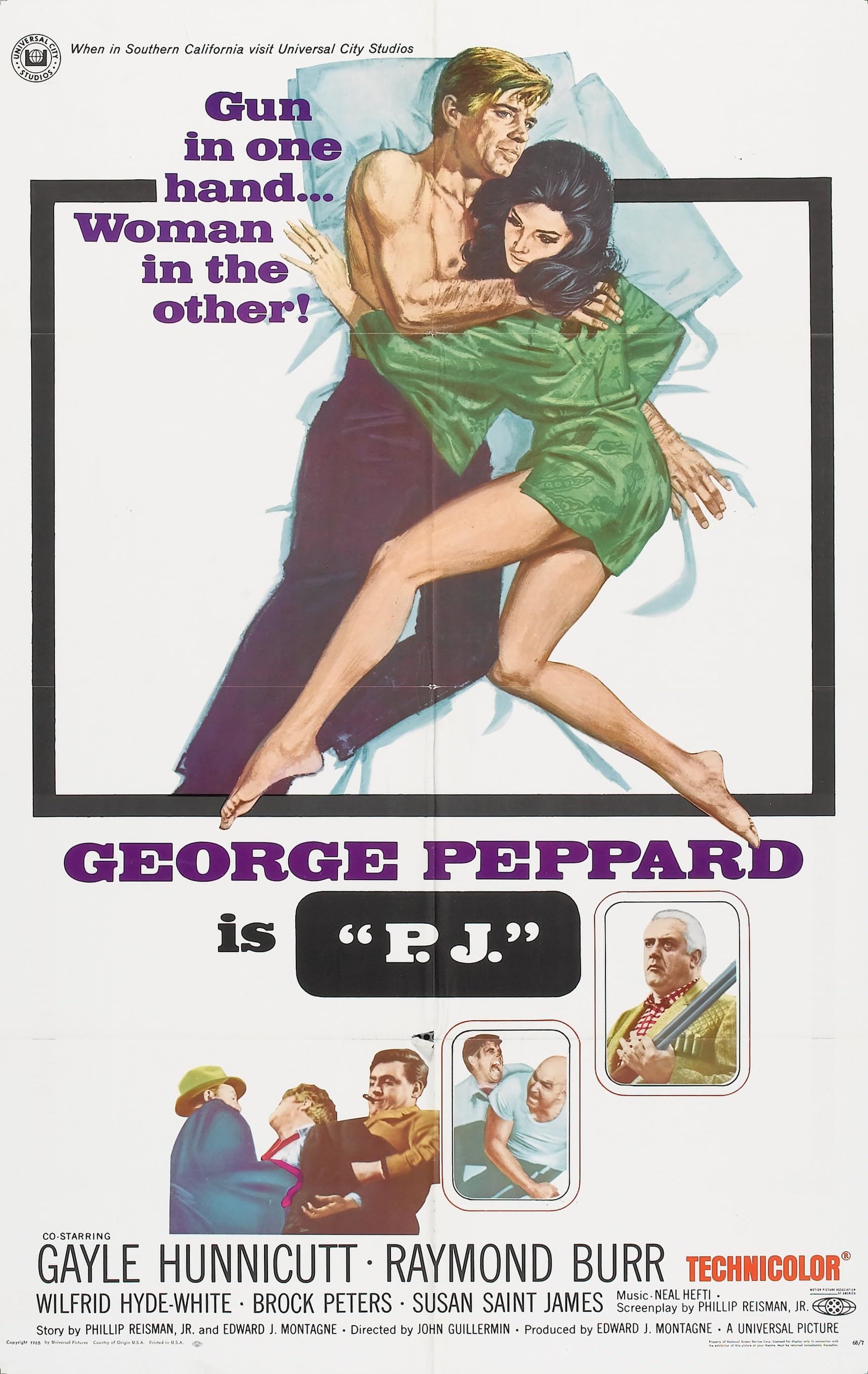
Murder Mysteries in May: P.J. (1968)

poster

The movies of the 1960s remind me a lot of the movies from the 1980s. Both decades featured a lot of neon-colored, flashy, stylish films without a lot of depth to them.

There were massive cultural changes taking place in the ’60s, the studio system was dying while the Production Code was lessening its grip. All of this changed the ways movies were made and the types of films audiences wanted to see. The 1980s brought in the blockbuster age and the advent of home video created a surge of low-budget, straight-to-video releases.

I don’t quite have an over-arching thesis about this, although I do think there are also similarities in the decades that followed – the 1970s and the 1990s, but I’ll save that ramble for another day.

What I’m really thinking about is Marlowe and P.J., two detective films that are very much 1960s movies, but that both throwback to all those film noirs from the 1940s.

With P.J., George Peppard plays the titular Phillip Marlowe-esque down-on-his-luck private eye. He’s so far gone he doesn’t even have an office, just a bar he frequents where the bartender keeps his messages.

He is tasked by millionaire William Orbison (a deliciously sleazy Raymond Burr) to play bodyguard to his mistress Maureen (Gayle Hunnicutt) who has been getting some threatening letters.

Orbison takes the mistress and his wife (and P.J. and his business partner Grenoble) to the Bahamas for a little relaxation. When Grenoble finds himself murdered P.J. realizes he’s been set up. He was hired to become the fall guy.

Through a myriad of twists and turns he eventually clears his name and proves who did the murdering.

I’ll be honest, I watched this movie about a week ago and I’ve watched another eight films since then. The details of this one have grown hazy. I had to look up the plot and scroll the images on IMDB to remember anything about it. But I do remember liking it. I guess it just wasn’t all that memorable.

George Peppard is good. I’d only seen him in Breakfast at Tiffany’s but he’s incredibly charming and he works well as a private detective who’s both charming and headstrong. I love watching Raymond Burr play a heavy, especially one as slimy as he is here. I grew up watching him on Perry Mason reruns so it’s a lot of fun seeing him play someone so completely different.

The music and the feel of the film are very swingin’ ’60s. At one point there are a couple of girls in bikinis dancing in a giant martini glass. So, yeah, it is definitely worth watching, even if I can’t remember the details.

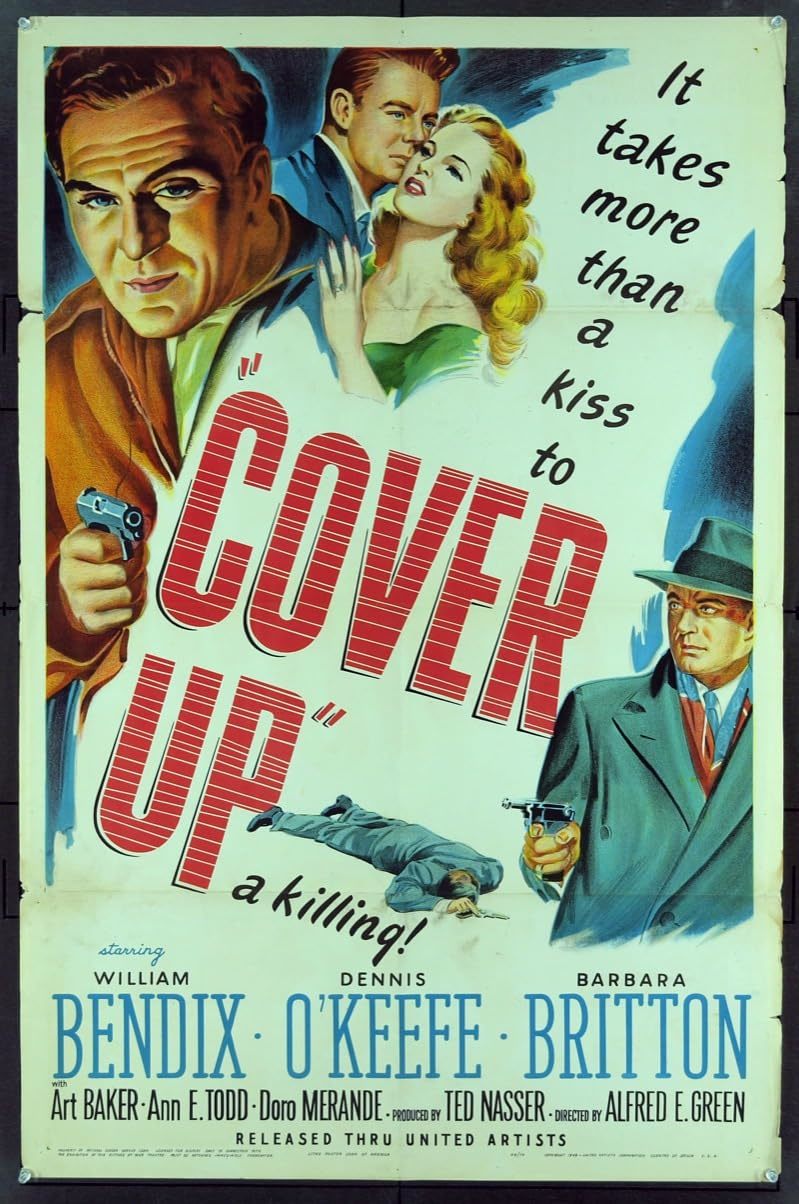
Murder Mysteries In May: Cover Up (1949)

poster

In my review of the 1935 adaptation of The Glass Key, I mentioned a scene in the 1942 remake that starred William Bendix. In that scene, Bendix plays a thug who gets to slap around Alan Ladd’s character. He does so with such gusto that he nearly steals the movie. It made me an instant fan.

I’ve since watched 11 films starring the actor where he’s mostly played tough guys, loveable lugs, and the like. He was a bigger man physically, and not exactly handsome so he fits the role of the heavy, but there is a goofy warmth to him, which makes him interesting.

In Cover Up he plays Larry Best the sheriff of a small, Midwestern town investigating a murder. Except he doesn’t seem all that interested in investigating it at all.

It is actually an insurance investigator, Sam Donovan (Dennis O’Keefe) who does most of the investigating. The dead man was shot and the sheriff ruled it a suicide. The trouble is the gun is nowhere to be found, and there are no powder burns on the body which would indicate being shot at close range. When Sam pushes Larry for answers he just shrugs it off. In fact, no one in the town seems all that interested.

Turns out the dead man was good and hated by pretty much everyone. Clearly, he was murdered and clearly, it is being covered up. Almost everyone in town is helping with the cover-up because whoever killed him is well-liked and the dead man deserves to be dead. To a normal investigator, this would be enough. Suicide prevents an insurance pay out and that’s that.

But Sam is no normal investigator. He pursues the matter strongly even if murder means a double indemnity payout. The film owes a clear debt to Double Indemnity but it is nowhere near as good.

Naturally, there is a girl. Anita Weatherby (Barbara Britton) becomes the love interest. She’s also the daughter of one of the prime suspects. But there is little heat between her and Sam and almost no cleverness to their dialogue. Even my beloved William Bendix doesn’t add much. He’s fine, but rather more reserved than usual.

The mystery is serviceable and it is set at Christmastime which adds a nice holiday theme to what is really a rather cozy film noir. That’s the thing, it isn’t a bad film, it is exactly the kind of movie you might throw on during the holidays while you are at your in-laws, full of ham and good cheer.

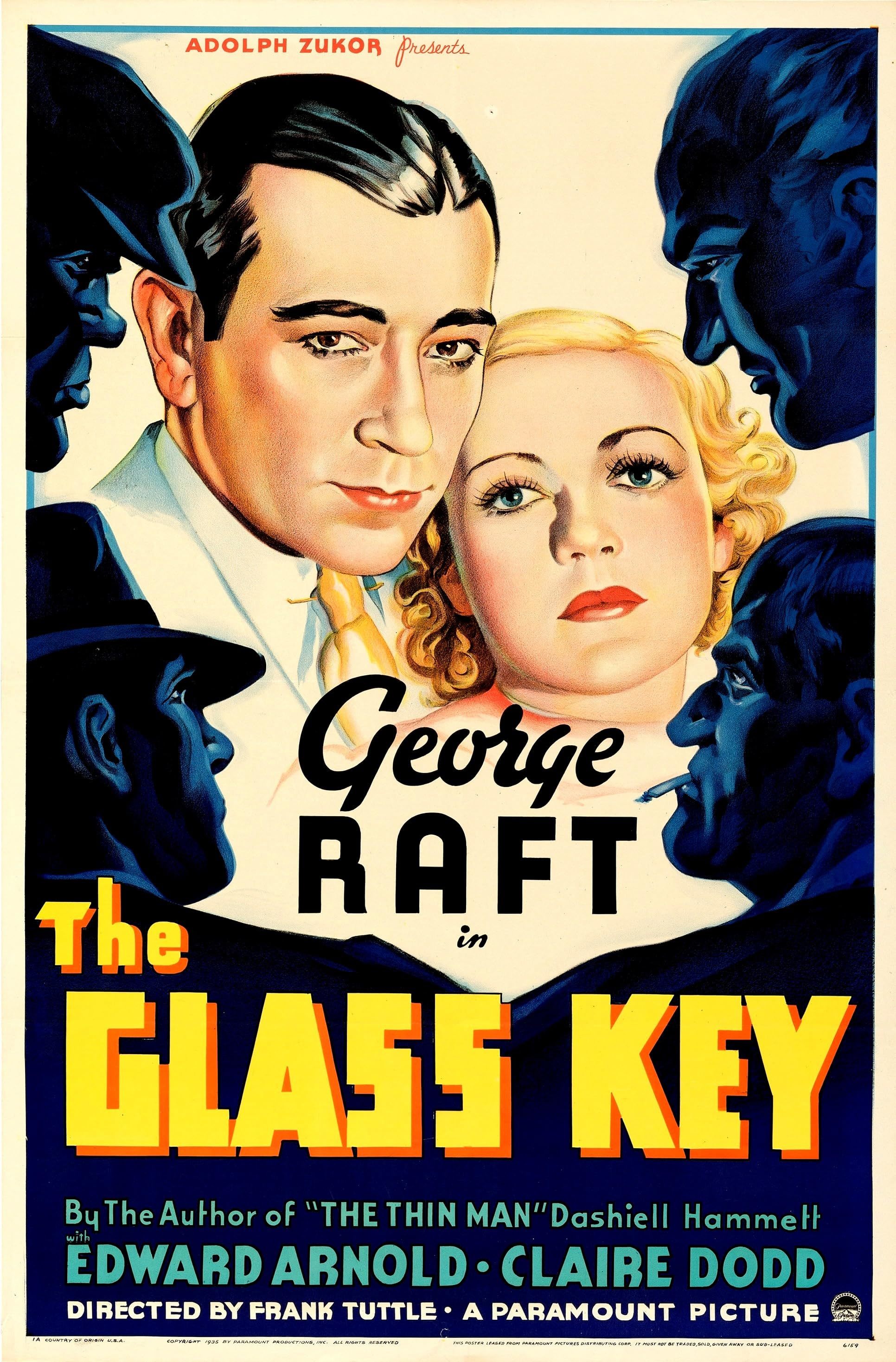
Murder Mysteries In May: The Glass Key (1935)

poster

It is easy to declare nowadays that Hollywood has run out of ideas, that all they do is remake older movies, or create endless sequels. But the truth is Hollywood has always bastardized itself. This is certainly true with the crime genre. There were actually two adaptations of The Maltese Falcon made before the famous one with Humprey Bogart.

Another Dashiel Hammet novel, The Glass Key was made into two films. The superior one, starring Alan Ladd, Vernonica Lake, and Brian Donlevy was made in 1942. This one was made just four years after the book was published. It isn’t bad, but if you are going to watch just one version of the book, watch the 1942 film. Actually watch the Coen Brothers Miller’s Crossing, which isn’t a direct adaptation, but it was certainly inspired by it.

Anyway, this one stars George Raft as Ed Beaumont the right hand mand of Paul Madvig (Edward Arnold) a gangster who controls pretty much everything is a smallish unnamed city. Pauls in love with Janet Henry (Claire Dodd) whose father is running for state senate. Beaumont thinks Janet is a grifter, using Paul in order to use his political sway to win her father the election. This causes tension between Paul and Beaumont.

When Janet’s brother gets murdered things get even more tense. Paul and Beaumont have it out and Beaumont seems to leave Paul for his rival.

The story is classic (like I said it greatly infuenced the Coen Brothers but it also inspired Akira Kurosawa’s Yojimbo, which was then remade as the Clint Eastwood Western A Fistful of Dollars).

This adaptation feels more brutish than the 1942 remake. It also feels like a proto film noir. Some of the pieces of that genre are here, but not quite polished (the remake is one of the classics of the genre).

I generally like George Raft, but he’s not exactly a world class actor. He tends to be a little wooden, which works okay in his gangster pictures, but Ed Beaumont is a guy who knows all the angles and holds his cards close to his chest. Raft just doesnt’ have the nuance to pull it off.

Claire Dodd is nice, but she’s not in the same league as Veronica Lake. There is a scene in both films where Beaumont is worked over by a gangster’s goons. In the remake one of them is played by William Bendix and he’s just terrific. That scene is one of my all-time favorites. Here its pretty much forgettable.

I’d say this is worth watching if you like the Hammett story or the 1942 film. But the remake is by far the superior film so if you haven’t seen that I’d head that way immediately.

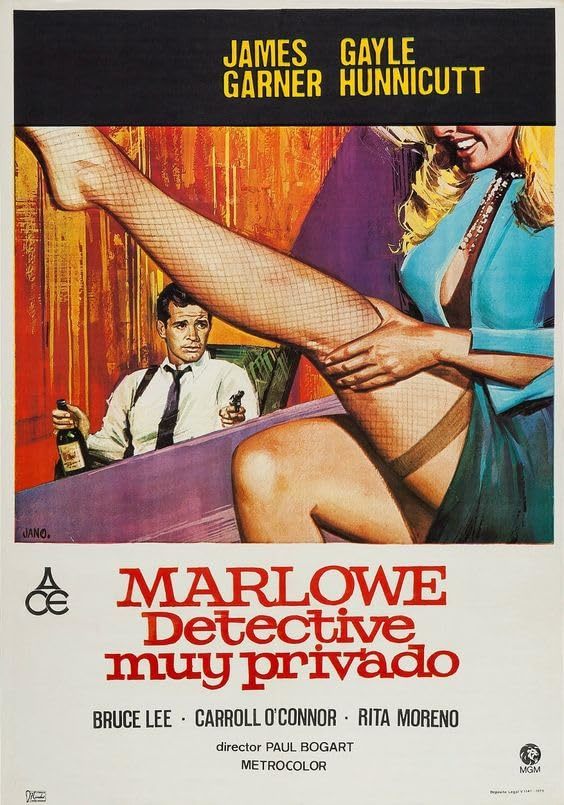
Murder Mysteries In May: Marlowe (1969)

poster

Phillip Marlowe is, perhaps, the quintessential hard-boiled detective. He is smart and tough. He has a moral code, but isn’t afraid to get his hands dirty. He works alone. He’s a hard drinker and plays chess by mail. It may take him a while, but he always solves his case. Humphrey Bogart’s portrayal of Phillip Marlowe in The Big Sleep is, perhaps, the quintessential cinematic depiction of the hard-boiled detective in film noir.

That character and Bogart’s portrayal of him, influenced countless detectives in countless movies throughout the 1940s and 1950s. But as the 1950s turned into the 1960s that hard-boiled film noir style was, well, going out of style.

In 1973 Robert Altman adapted Raymond Chandler’s The Long Goodbye with Elliott Gould as Marlowe. Altman has a lot of fun throwing this 1930s detective into the wild 1970s. Gould plays him as a sort of Rip Van Winkle, a man who has awoke from a long sleep only to find himself in a world he no longer understands. He kind of wanders, mumbling through the whole film, while the entirety of the uninhibited 1970s California sprawls out before him. It is a fantastic movie.

Marlowe sits somewhere between Bogart in The Big Sleep and Gould in The Long Goodbye. It is very much set in the late 1960s. The skirts are short, the music psychedelic, there is ample use of split screen and hippies abound. But the story sticks pretty close to the classic mold.

James Garner plays Marlowe like, well, James Garner, with a smirk to his delivery and a tongue planted firmly in his cheek. He’s smooth and slick, and rather delightful.

The plot is adapted from Chandler’s novel The Little Sister and finds Marlowe being hired by a squeaky young girl from Kansas to find her brother, lost in the big city of angels. There are mobsters and television stars, murders with ice picks, a strip tease act from Rita Moreno, and Bruce Lee tearing up Marlowe’s office.

It doesn’t always work. At times it feels more like a schtick than a fully thought-out movie. Altman’s film never has that problem. I love me some James Garner and he mostly works for me here, but in the same way that the film sometimes feels like a schtick, his act doesn’t always work for Phillip Marlowe.

But it is a fascinating time capsule of a movie, trying to move the film noir forward, making it current for the times. It is also quite a bit of fun.

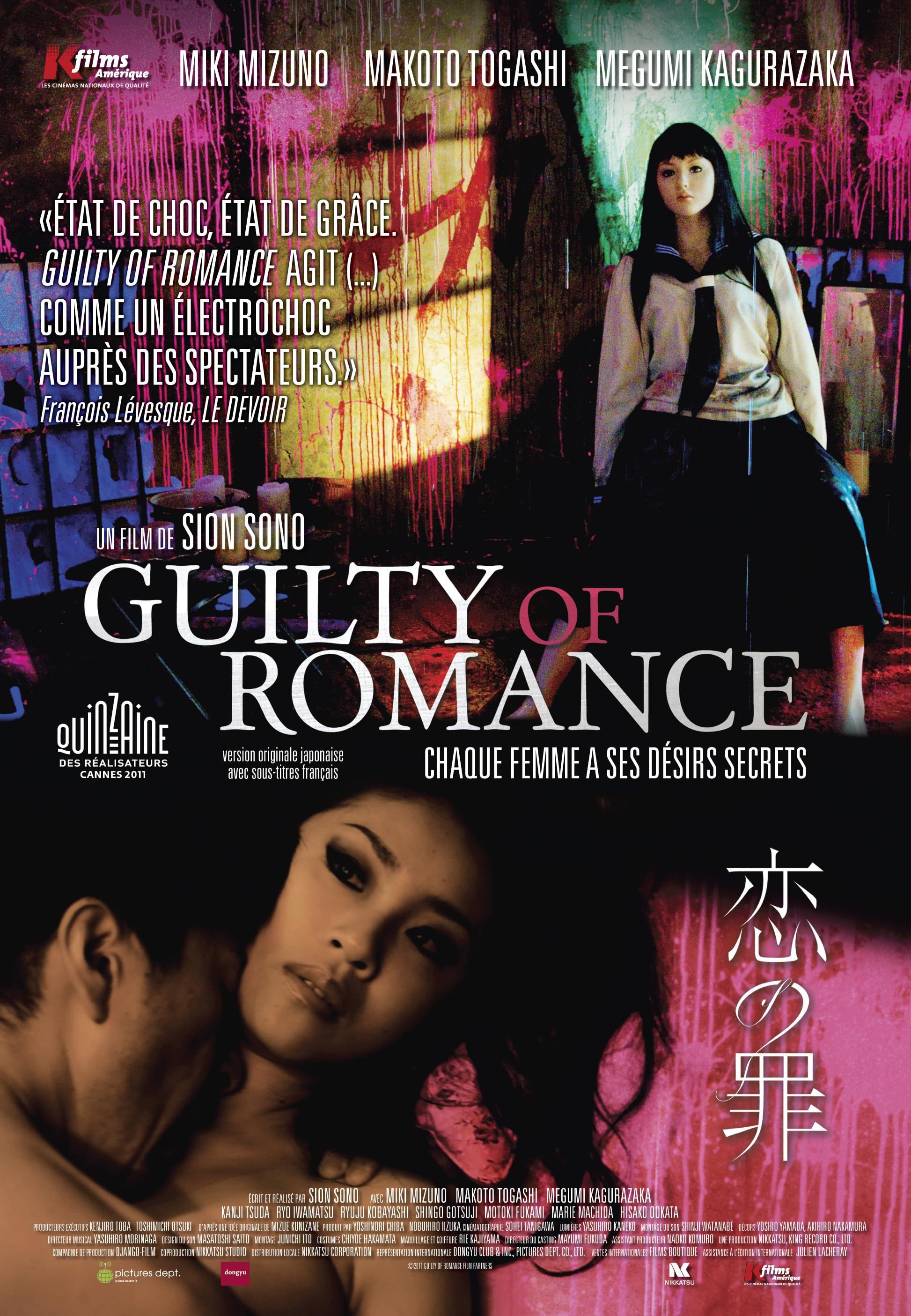
The Friday Night Horror Movie: Guilty of Romance (2011)

poster

When you watch as many movies as I do you are sometimes going to venture into the strange. You’re gonna watch a few films that make you say “What the Hell did I just watch?” I’m not entirely sure I liked Guilty of Romance. I’m definitely sure I didn’t quite understand it. But I’ll never say I was bored watching it.

It begins with a grizzly murder. A young woman has been dismembered inside a rundown flat in the Love Hotel district of Tokyo. Parts of her body are wearing a pretty red dress with the missing parts being replaced by mannequin pieces. Other sections of the corpse are fitted out in the same manner but in a schoolgirl uniform. The head and sex parts are missing.

Police detective Kazuko Yoshida (Miki Mizuno) is on the case. The story intercuts the investigation with that of bored housewife Izumi Kikuchi (Megumi Kagurazaka). She’s married to a famous novelist. He’s an exacting husband. He leaves at the same time every morning and returns promptly in the evening. When he arrives he expects his slippers to be waiting for him in the entryway and to be placed in a precise manner. He complements her tea-making skills in a way that lets us know he’s chastised her about it before. When she places some Japanese soap (not the French stuff he likes) in the bath, he berates her.

Their marriage seems to be without romance, love, or satisfying sexual encounters. She’s approached by a woman in a shop who claims to be a talent agent. Izumi is pretty enough to be a model she says. The photos turn out to be softcore in nature. Later she meets Mitsuko Ozama (Makoto Togashi) a sex worker who convinces Izumi to join her in that work.

In some ways, the film is about this repressed woman, living a very traditional lifestyle, diving deeper and deeper into sexual liberation.

Kazuko is more modern and liberated. She’s a police detective, a working woman in a field dominated by men. She’s also married, to a man who seems perfectly nice. But she’s had affairs as well. Currently, she’s involved with a man who likes to play domination games.

There is a lot more to the story but to delve any deeper would be to spoil it. The murder mystery takes second shelf to all of the sexual shenanigans. Director Sion Sono is interested in the ways women must navigate their own sexuality, and society’s demands upon it.

It is a deeply weird, subversive film. At times I was quite uncomfortable watching it. Especially early on when Izumi is being pushed into sexual acts she’s clearly not ready for. But the film wants us to be uncomfortable. This isn’t sex for titillation, there is always a reason behind it. I’m not always sure I understand those reasons or can get behind them fully, but I’m glad I watched it.

Recommended, but not for the faint of heart.

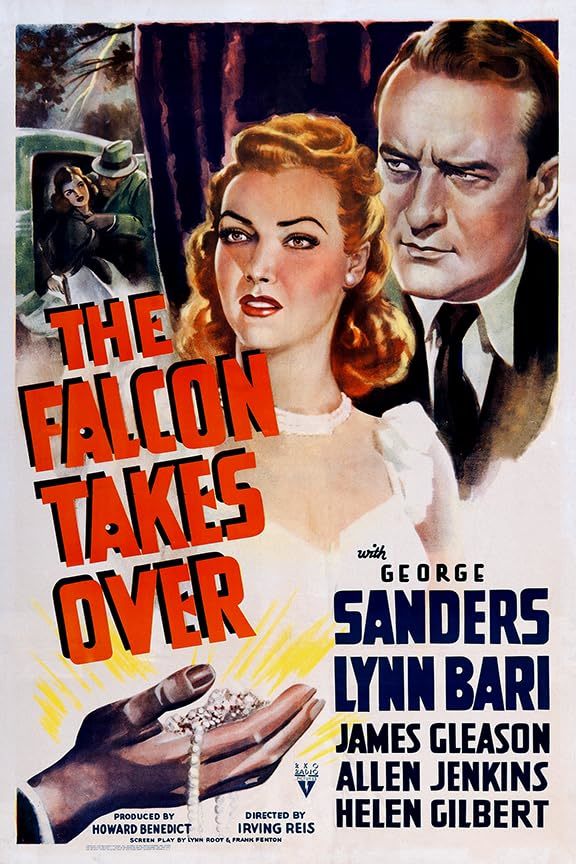
Murder Mysteries In May: The Falcon Takes Over (1942)

poster

A good murder mystery needs a good detective. Well, not necessarily a detective as mysteries have been solved by police detectives, private detectives, federal agents, spies, newspaper reporters, priests, and little old ladies. But whoever is solving the mysteries must be good. Also interesting.

Interesting detectives in good stories often find themselves in ongoing series, solving murders over and over again. Great ones become iconic and get adapted for decades. Consider Sherlock Holmes and Hercule Poirot. Sometimes a detective will be quite popular for some time and then be forgotten. Lost to time.

The Falcon was a suave English gentleman detective created by Michael Arlen. He was adapted into sixteen films – the first three starred George Sanders as Gay “The Falcon” Lawrence. In the remaining films Gay’s brother Tom (portrayed by George Sanders’s real-life brother Tom Conway) became the star.

All of the films were b-movies (and I’m using the original sense of the word – films designed to be the second half of a double feature) but popular ones.

I searched for the first two films (The Gay Falcon and A Date with the Falcon) but couldn’t find them streaming anywhere. So I settled on this one, the third in the franchise.

It is very loosely based on the Raymond Chandler novel Farewell, My Lovely. Moose Malloy (Ward Bond) a big, dumb, brute escapes from prison and shows up at a swank nightclub looking for his girl, Velma (Helen Gilbert). The club used to be a dump when she worked there and now nobody remembers who Velma is. In his anger Moose barges inside and questions the manager so fiercely he kills him. He forces a man named Goldie (Allen Jenkins) to drive him away.

Goldie just happens to be the Falcon’s right-hand man. Moose lets Goldie go and after he’s questioned by the police and is removed as a potential suspect he and the Falcon go Moose hunting.

The plot takes a lot of twists and turns with a stolen jade neckless, blackmail, and more murder all showing up. A cute reporter (Anne Revere) joins our hereoes to add a romance angle.

I’m a huge Raymond Chandler fan and his story helps the film a lot. Everything else going on makes me wonder if I’d enjoy these films very much at all. I love George Sanders but he’s fairly bland here. The Falcon is much more akin to Nick Charles in the Thin Man Films (svelte, sophisticated, and light-hearted) than Chandler’s hard-boiled, rough-and-tumble Phillip Marlow. I suspect me knowing the source material hindered things a big as the Falcon doesn’t jive with my notions of who the detective should be in this story.

But it goes off well enough. It is very light, and fun. Allen Jenkins is having a blast, and gets all the best lines. It is a perfectly fine Saturday afternoon type movie and worth watching if you like that sort of thing.