Blackout Noir: Guilty Bystander (1950)

guilty bystander poster

My ambition often far exceeds my abilities. Inevitably, whenever Noirvember rolls around, I get excited and watch numerous noirs in the first week or so of the month. I’ll happily write a few reviews, but then life gets in the way. I have other official things to write, or I get stressed out over some work thing, or I’m just tired. I’m tired all the time these days. The days roll by, and I put off writing more noir reviews, and after a while I need something non-noir to watch. Then all of a sudden the month is over, and I’ve not written or watched nearly as many noirs as I wanted.

This month I thought it would be fun to write a whole series of reviews covering the Criterion Channel’s collection of Blackout Noirs. I got really excited about that and watched several of them. I wrote some of the reviews, and then that fatigue kicked in and I got distracted, and here I am trying to write something about Guilty Bystander, a movie I watched a week and a half ago. 

So, you’ll have to forgive me if this review is a little light on the details.  My memory has faded on some of the specifics of this particular film.

I can say that Guilty Bystander was made in 1950 and was directed by Joseph Lerner. It was made on a shoestring budget. According to noir aficionado Eddie Mueller, the filmmakers couldn’t afford to purchase the requisite filming permit to shoot in New York, so they often shot incognito or bribed police officers to look the other way.

This imbues the film with a real on-the-streets quality. And if you want to know what the seedier sides of New York City looked like in 1950, this film is for you.

Zachary Scott stars as Max Thursday, an alcoholic ex-cop who is living in a flophouse, working as the house detective. One night his ex-wife Georgia (Faye Emerson) comes to him in a panic. Their son Jeff and her brother Fred have gone missing. Georgia’s friend Dr. Elder (Jed Prouty) has advised her not to talk to the police just in case this is a case of kidnapping. 

A drunk Max visits Dr. Elder and gets into a fight with him. The good doctor knocks him unconscious, and Max awakes to find himself in police custody because Elder has found himself dead and Max now finds himself suspect #1.

Georgia gives him an alibi, and Max is on the hunt. The plot is standard noir stuff, and the film mostly plods along. I’ve liked Zachary Scott in the films I’ve seen him in, and he’s pretty good here. The script doesn’t do him any favors, but Joseph Lerner’s direction is on point, and the on location stuff is good. There is a scene in a subway tunnel that’s thrilling (and makes one wonder if they actually got permission to shoot down there).  

It is a film worth seeing if you are a noir fan, all others should not apply.

Blackout Noir: Blackout (1957)

murder by proxy

A broke and down American, Casey Morrow (Dane Clark), is quietly getting drunk by himself. He’s approached by a beautiful heiress named Phyllis Brunner (Belinda Lee). She says she’ll pay him $500 to marry her. A smart man would immediately think something is fishy, but film noirs aren’t filled with smart men. He accepts, and she plies him with more drinks. He awakes the next morning in a strange apartment owned by Maggie Doone (Eleanor Summerfield). She says she found him last night stumbling about, dead drunk, so she took him in and let him crash. She’s an artist and has a painting of Phyllis on an easel.

They are alerted by the newspapers that Phyllis’ father was brutally murdered last night with a fireplace poker. Casey finds blood on his coat. He has no memory of what happened to him after Phyllis made her offer and gave him some more drinks.

Blackout (also known as Murder By Proxy) is a tidy little British b-noir, directed by Hammer stalwart Terrence Fisher.

The police will naturally suspect Casey, as Mr. Brunner was quite rich, and as he’s now married to Brunner’s only child, he’ll take control of the estate. The police will never believe Casey’s story of how Phyllis propositioned him on her own, so naturally, he takes it upon himself to try and find out what really happened.

It is here that what starts out as a rather excellent film turns a little more pedestrian. Casey will track people down and ask a lot of questions and get far too many easy answers. Because this is a film noir, we know that Phyllis has something to do with it. He’ll figure that out too, but also because this is a noir, he’ll keep falling for her act. Guys in noirs always get suckered in by a beautiful dame. It is such a shame too because Maggie is clearly the better woman, and she falls in love with him the moment she takes him in that first night.

The detective work never quite thrills or travels down new paths for this sort of thing, but it is still quite entertaining. I am reminded of Terrence Fisher’s work in numerous Hammer Horror films. Those weren’t typically great, but they were sturdily made and enjoyable enough. So it is here. It is a very good film. It doesn’t quite reach great status, but if you are a fan of film noir, I wouldn’t miss it.

Blackout Noir: Black Angel (1946)

black angel

A man goes to see his ex-wife on their anniversary. She refuses to see him. She has the doorman turn him away. She still refuses even when he’s sent up a fancy brooch. As he’s walking out, another man comes into the hotel asking to see the woman. He’s let up with no problem. The first man goes to a bar and gets drunk. Later, a third man comes to the hotel and is let up to see the woman. He finds her lying on the floor dead. While there he hears someone sneak out. He notices that the brooch she was holding in her hand when he first came in is now missing.

Black Angel was directed by Roy William Neill, who is best known for directing most of the Sherlock Holmes films starring Basil Rathbone. It is a loose adaptation of a novel of the same name by Cornell Woolrich. I was twenty minutes into it before I realized I had seen it before.

The first man is called Martin Blair, and he’s played by Dan Duryea. The guy who found her dead is Kirk Bennett (John Phillips), he’s a married man who was having an affair with the dead lady. But things turned sour, and she was blackmailing him to conceal the affair. The cops figure that’s the motive and arrest him. He’s convicted and sentenced to die in the gas chamber.

Kirk’s wife, Catherine (June Vincent), believes her husband to be innocent and starts her own investigation into the matter. She’ll eventually connect with Martin, and he’ll tell her about the second guy, the one he saw entering the dead woman’s room. That guy is Marko, and he’s played by Peter Lorre, so you automatically know he did it. Catherine and Martin know he did it, too, but they have to prove it. They figure that proof is in a safe inside his upstairs office at the club he owns. They get a gig there as a lounge act.

It is all nicely done, and there are a couple of good and tense scenes with Peter Lorre, but it never quite connected with me. This was Duryea’s first starring role, and he’s good in it. He’s a washout and a drunk who finally sobers up when he meets Catherine. Finding her husband’s killer gives him purpose, and he naturally falls in love with her, which gives him even more purpose. But she’s still in love with her husband. That creates a bit of drama. Peter Lorre is always good, but he’s not given a lot to work with here.

It is a fine movie and worth watching if you are a fan of film noir.

Blackout Noir: The Blue Gardenia (1953)

blue gardenia poster

Three women live together in a ridiculously large apartment. Seriously, there is a kitchen, a bathroom, and this massive living area, but no bedrooms. The ladies all sleep on pull-out-style beds in the gigantic living room. A room that could have easily been converted into at least a couple of bedrooms. I think the film wants us to believe these ladies aren’t rich; they can only afford a studio apartment for the three of them. But it also needs to block them in interesting ways. The three of them need to be filmed in different spaces and not be all crowded together. So we get this gigantic living space.  

Sorry, that kind of thing drives me a little crazy. Now where was I?

Oh yes, these three women – Crystal (Ann Southern), Sally (Jeff Donnell), and Norah (Anne Baxter)—all work for a telephone company as operators. They have varying relationships with men. Crystal is dating her ex-husband (because when they were married, he had all the faults of a husband, but now that they’re just dating, he has all the perks of a boyfriend). Sally mostly stays home reading detective novels, (but when the phone rings, she announces – “If that’s for me, I’m in! No matter who it is.”) Norah is in love with a man stationed in Korea. 

All three are constantly hit on by Harry Prebble (Raymond Burr), a skeezy pinup girl artist, who tries his luck with any and all girls. He’s the kind of guy who doesn’t care who he makes it with as long as he’s making it with someone.

When Norah gets a letter from her boyfriend telling her he’s met someone else, she agrees to go out with Harry. He takes her to the titular restaurant and plies her with drinks. She has a good time, and he takes her home.  Before he can make his moves, she passes out on the couch. But he’s not the type of guy to let a little blackout rob him of a good time. She wakes up enough to fight him off. She picks up a fireplace poker, and…the film fades to black. The next morning she finds herself in bed with no memory of what happened. He doesn’t wake up at all. He’s found dead by the maid.

The rest of the film finds Norah trying to figure out just what happened, all the time thinking she must have killed him. This probably counts as a spoiler, but about 40 minutes into the film, I turned to my wife and said, “I don’t think she killed him.” Norah is just too nice. She’s too good of a girl to have killed a man like that. And the fact that the film faded to black before we ever saw her strike a blow made me think there must have been someone else.

At some point Casey May (Richard Conte) enters the picture. He’s a journalist chasing the story. After writing a few front-page stories (and here’s another point of contention for me – all the front pages on his newspaper are just headlines printed in massive type; there are no pictures, no actual story, just headlines. What a waste of space.) But I’m digressing again. Where was I? Oh yes, after writing a few front-page stories, he needs a new angle and decides to write an open letter to “An Unknown Murderess,” where he asks her to turn herself in to him and promises the paper will pay for her defense (as long as she gives him an exclusive interview).

She’ll eventually call him, and naturally there will be a romance angle that enters the picture. The film concludes abruptly and all too neatly. It is rare that I complain about a film being too short, but this one really could have used an extra half hour. I mentioned earlier about how I thought she didn’t do it; I could have gotten behind Casey and Norah doing a little investigating trying to find out who the real murderer was. Instead they just throw a solution at us and roll credits. It’s too bad too, because up until then I was really enjoying the film.

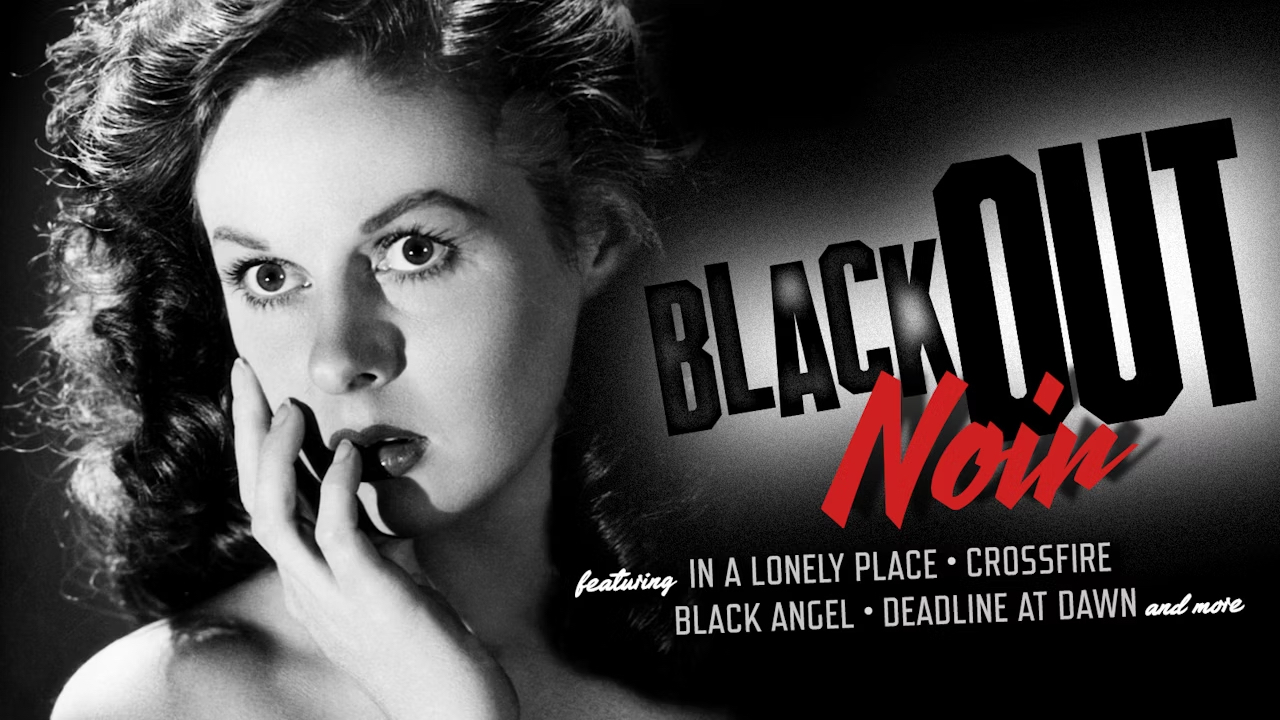
Blackout Noir on the Criterion Channel

blackout noir

I had an enormous amount of fun watching and talking about all the Giallos on the Criterion Channel last year, so I thought it would be fun to do another series like that.

Today is thh start Noirvember, which brings together one of my favorite film genres with my favorite season. To celebrate, the Criterion Channel has put together what they are calling Blackout Noir. These are film noirs in which the main character has blacked out due to too much drink, amnesia, or some other thing, and awakens to find something terrible has happened. Or, as they put it:

Among the most agonizingly intense films in the history of film noir are those that adopt the point of view of characters tormented by amnesia, memory holes, and drunken blackouts, leaving them to grasp in the dark in search of an often terrifying truth. Waking up unexpectedly in a stranger’s bed is one thing . . . putting on your coat to leave and discovering a bloodstain on it is another

I was going to be watching lots of film noirs this month anyway, so I thought it would be fun to watch and review all of these films. I’ve actually not seen most of these films, so that should be doubly fun.

Here’s the full list:

The Blue Gardenia (1953)
Black Angel (1946)
Blackout (1954)
Guilty Bystander (1950)
Framed (1947)
In a Lonely Place (1950)
Crossfire (1947)
Deadline by Dawn (1946)