The Amityville Horror (1979) is one of those movies that I want to like more than I actually do. It has a good cast – James Brolin looking all masculine in his flannel shirts and beard, Margot Kidder is just lovely and Rod Steiger is doing his best Max Von Sydow in The Exorcist (1973) impression. I like the idea of haunted house movies and this has the coolest looking haunted house ever. But ultimately I find the film to be a bit of a slog. It isn’t scary, or eerie. It isn’t even very moody.
When watching a horror movie from the 1940s I have no problem overlooking hoary old special effects like objects moving across a room or curtains billowing without wind. But in modern movies (and yes I’m counting 1979 as a modern movie as it premiered in my lifetime and feels much more modern than say something like The Uninvited (1944) or House on Haunted Hill (1959)) similar effects just seem silly. The Amityville Horror employs a lot of silly effects that just aren’t scary or all that interesting.
Still, every few years I find myself drawn to it. Like I said I love the idea of it.
Over the last couple of years, I’ve been watching a lot more horror films than I used to. This is mostly due to my creating this concept of the Friday Night Horror Movie. If I have to watch a horror movie (or more than often, two or three horror movies) every Friday then I’m going to naturally watch a lot of horror movies. One of the things I’ve been doing is watching a lot of horror sequels. It is a genre that naturally produces a lot of sequels and I’m finding it quite fun to watch them all in order. I’ve now seen all of the Friday the 13th films, the Nightmare on Elm Street movies, the entire Halloween franchise, and more.
This now brings us to The first two Amityville Horror sequels (there are technically a whole lot of sequels to The Amityville Horror because you cannot copyright the name of the town so anyone who wants to can throw Amityville in their name and tie it to the franchise. But the first two sequels are official and I watched them today.
But first, let’s briefly recap the original film. A newly married couple (played by Brolin and Kidder) along with their children move into a big, historical old house on Long Island. Quickly strange things begin to occur that can’t be naturally explained. By the film’s end, it is clear something has possessed the house and is trying to kill them. That something is the evil spirit that caused Ronald DeFeo, Jr. to kill his entire family with a rifle just one year prior.
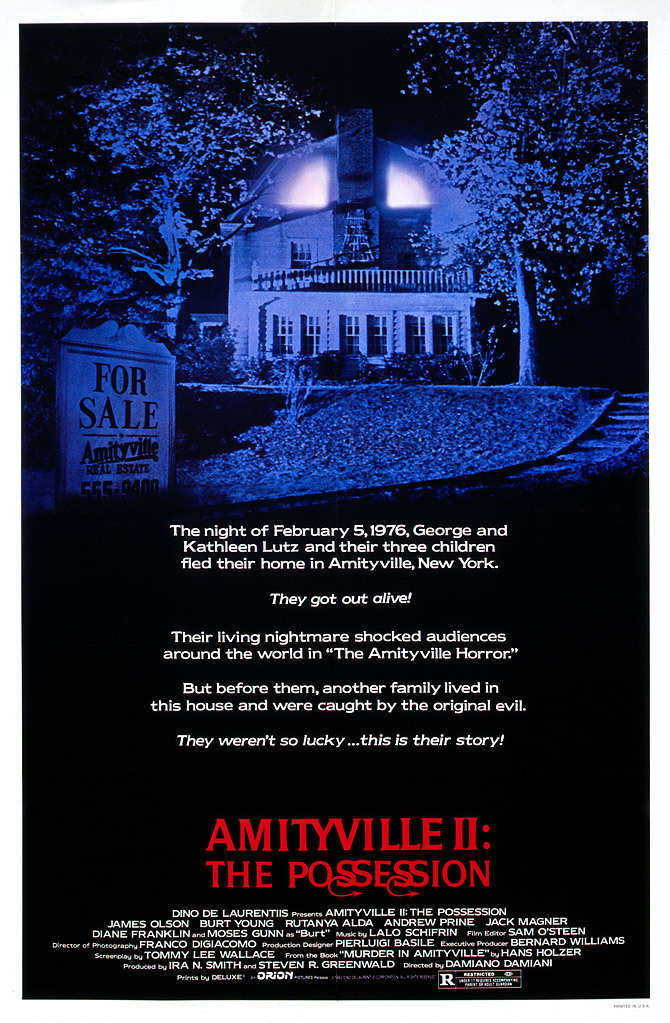
Amityville II: The Possession is sort-of the story of what caused Ronald Jr to commit those murders. I say sort-of because in this film the family is called the Montelli’s and the murders happen in a slightly different manner than we see them occur in the first film.
But where The Amityville Horror was filled with classic haunted house tropes and was all the more dull for it, Amityville II just absolutely goes for it. There is no slow build-up, and no time to develop characters, it just takes off and hardly slows down to catch its breath. It begins once again with a new family moving into the house. But right off the bat, we realize this family is already messed up. The father (Burt Young) is abusive. He yells at the kids constantly and threatens to beat them, he actually does beat the wife and it is implied he forces himself on her. The kids are moody and angry.
On their first night they experience a mysterious banging on the door and a freaky drawing appears on the two small children’s bedroom wall. Soon enough the oldest boy (Jack Magner) becomes possessed. He starts hearing voices telling him to kill his family, he yells at his mom and seduces his sister.
It gets weirder from there. If the original played it safe then the sequel throws off the rails and just goes for it. Most of the script, especially the dialogue, is pretty bad, but I love that all of the actors and the direction just completely go all out.
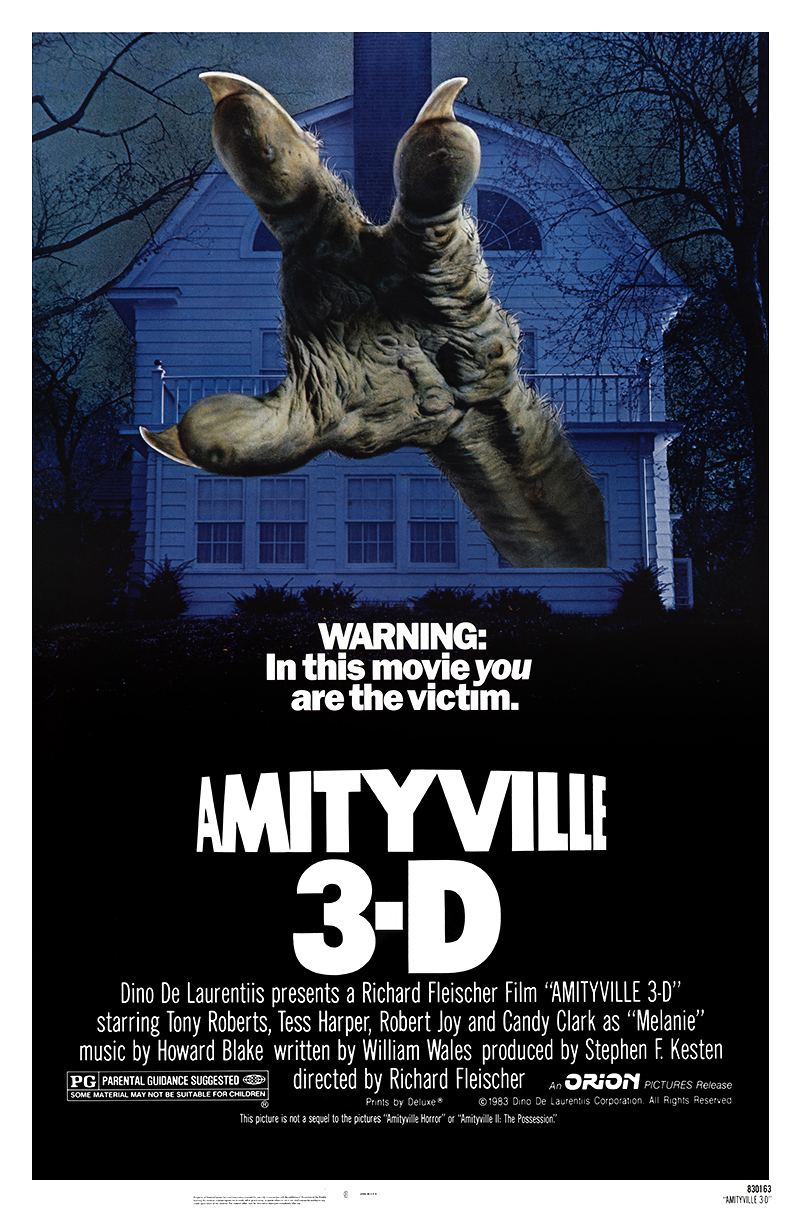
Amityville 3-D (1983) is much more reserved, but I kind of liked it more than the other two. It is a for-real sequel in that it takes place after the events of the other films. By this point the house is famous, or maybe I should say notorious. It has set vacant for years because no one in their right mind would buy it.
Naturally, our film’s hero does just that. He is John Baxter (Tony Roberts) a journalist working for a magazine that specializes in debunking supernatural con artists. He and his coworker Melanie (Candy Clark) debunk a pair of hoaxsters working out the Amityville House and afterward, John decides to buy the place (he’s getting a divorce and it is being sold dirt cheap).
You know the story by now, weird stuff starts happening. What I like about this film is that John comes to the house knowing its history and he doesn’t care. He’s a skeptic. Because of this, the film rolls out its supernatural stuff very slowly. Some of the mysteries and even a couple of deaths happen outside of the house. For sure, supernatural events and gorey deaths happen, but it takes its time with them. The film is more the mood piece the original wanted to be, but here it is quite successful at it.
It was directed by Richard Fleischer who made great films like 20,000 Leagues Under the Sea (1954), Compulsion (1959), and my favorite Soylent Green (1973). This is a man who knows how to direct a film, not the usual hacks that wind up directing the third film in a horror franchise.
As the title implies it was originally shot in 3-D. While there are the usual effects you find in that type of film (various objects flying at the screen, long objects being turned slowly toward the camera) Fleisher and his cinematographer Fred Schuler make the best of the format. Their use of depth of field is masterful. There is almost something in the foreground – a lamp, a tree, anything – that gives the characters or other objects in the screen depth. Shots indoors often take place in a place that allows you to see down a hall or into other rooms. Characters move in and out of frame, etc. It must have been really something to have seen in 3-D, but even in 2-D it looks really cool.
The rest of the filmmaking is very good as well. The actors are quite good and I found the entire thing a pleasure to watch.


 themidnightcafe.org