
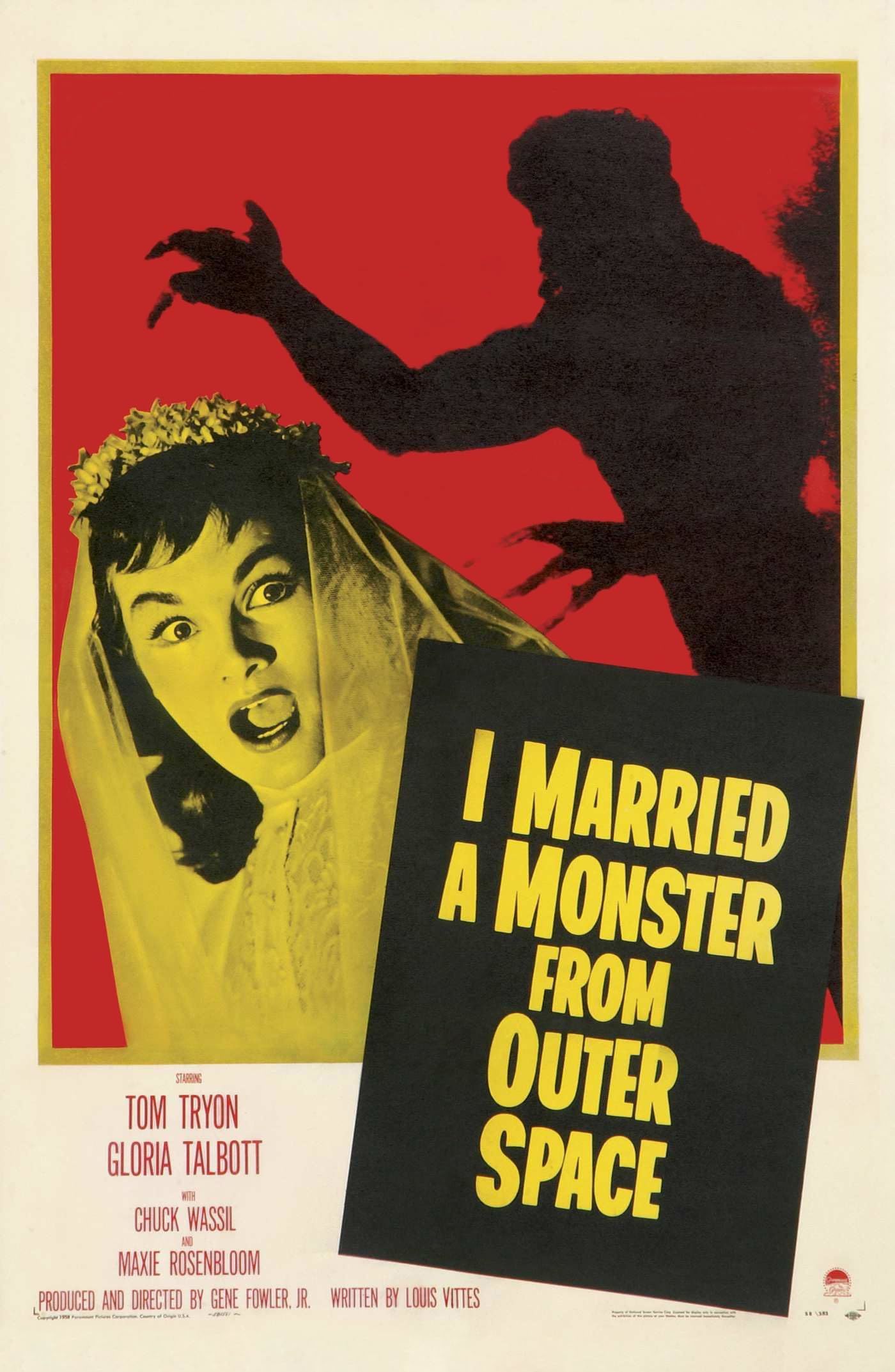
They say that horror movies reflect the anxieties and fears of a culture at the time of release. If that’s true then I Married a Monster From Outer Space says a lot about America in the late 1950s. Made on a shoestring budget and initially run as the b-side in a double feature with The Blob, it nevertheless dips its toes in anticommunist rhetoric and the changing roles of women in the post-war decade.
Marge Farrell (Gloria Talbott) is a nice girl set to marry Bill (Tom Tryon) a nice guy. The night before their wedding he is attacked by an alien monster who then takes Bills form. The alien follows through with the wedding, but a year into their marriage Marge is beginning to suspect something is wrong.
Bill rarely goes out. He’s stopped drinking. Dogs bark at him, and cats hiss. Worst of all she’s still not pregnant. The doctor assures her it isn’t because anything wrong with her, but maybe Bill should come in for a few tests.
One night she notices Bill get out of bed and leave the house. She follows him down the road, into a field, where she sees him enter his spaceship and take his true form.
Marge runs to the chief of police who swears he believes her, but behind her back indicates she’s overworked, tired, or just plain crazy.
She confronts Bill who admits everything. His planet, along with all the women folk was destroyed by their son. They found Earth to be hospitable and hope to colonize it. They can apparently have sex with human women, but as yet cannot figure out how to impregnate them.
Marge runs to her doctor who makes comforting motions that he believes her, but he doesn’t do anything about it. Bill indicates there are more just like him, and they’ve taken over the bodies of other men in the town.
Fully realizing she cannot tell which men are aliens and which are human, she still runs to other men for help. Never once thought she could just form an army of women to destroy the aliens.
During World War II women had to fill the gaps left by the men in the workforce. They got jobs in factories, making weapons, and manufacturing goods. They made money and enjoyed an autonomy rarely found before the war. When the men came home some of them were reluctant to go back to the way things were.
This film seems to indicate that maybe they should.
It can also be read as an anti-communist film. The monsters look just like us, that’s the same line of fear Joseph McCarthy had been spreading for years.
If you take this a little further the men whom the aliens have taken over are mostly childless. They have failed the American ideal of masculinity. The men who destroy them are family men, good, old-fashioned manly men. True Americans. Marge is smart and tough, in today’s parlance she’s a badass. But she’s more than happy to take a backseat to the men and let them save the day. By the time the credits roll, she’s happy to go back to being a happy housewife.
Or maybe this is all a load of bollocks. Maybe it is just a silly little science-fiction horror film, riffing on Invasion of the Body Snatchers that came out a few years prior.
I’ll say this: the effects look good for what they are. At 78 minutes it doesn’t overstay its welcome. All of that stuff I just wrote is fun to theorize about, but I’m not sure it makes for an enjoyable watch. For a low-budget sci-fi flick from the 1950s, you could do a lot worse. But it isn’t the first film in that genre that I’d recommend.
 themidnightcafe.org