
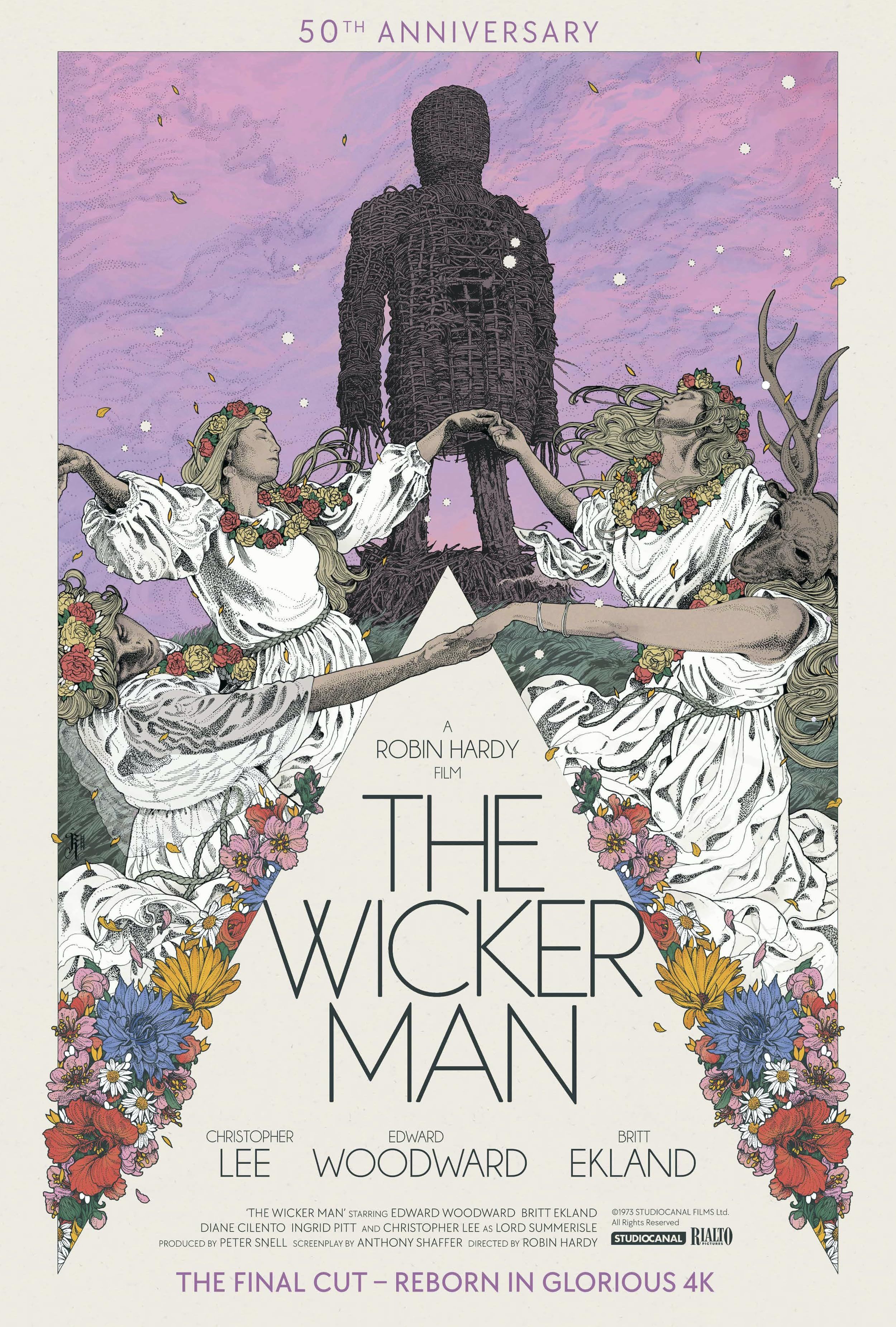
The Friday Night Horror Movie: The Wicker Man (1973)

The Wicker Man

A very conservative and deeply Christian police Sergeant receives a letter stating that a young girl has gone missing from a small, remote island off the coast of Scotland. He travels there by himself and discovers a strange pagan community where the children are taught about the phallic symbolization of the May Pole, where teenagers dance naked around a fire, and adults openly fornicate in a park in the evening.

The Sergeant, Neil Howie (Edward Woodward) is utterly shocked by all of this, but he’s a dutiful police officer and stays until he gets to the bottom of things. Not only are the villagers engaged in a litany of sins, but they are utterly unhelpful to his investigation. At first, they claim they have never seen the girl in their lives, but then it changes to how she was on the island but died tragically, and then…well it is best not to spoil things.

The Wicker Man has become a cult favorite and one of the premier films in the subgenre known as Folk Horror. It is also a truly strange little film. It is almost a musical as the villagers often break into goofy little folk songs and dance about (often naked). There is a very real sense of dread flooding the film. The camera is often tilted at odd angles making everything just slightly off. The villagers are ever so strange and are led by Lord Summerisle (Christopher Lee is one of his most interesting performances) who seems to take glee in making the Police Sergeant feel out of sorts.

There is a scene in which a woman puts a frog inside a child’s mouth to help her with a sore throat. A shop owner has a bottle full of foreskins. Britt Ekland plays the pretty daughter of the pub proprietor and at one point she sings a silly song whilst dancing in her room stark naked as an attempt to seduce the Sergeant. She beats wildly on his wall while he, soaked in sweat attempts to resist.

It is all a bit off-putting at first, but if you can roll with what it’s doing it is a rollicking good time. Not at all scary in the traditional sense, but it creates a wonderful sort of mood.
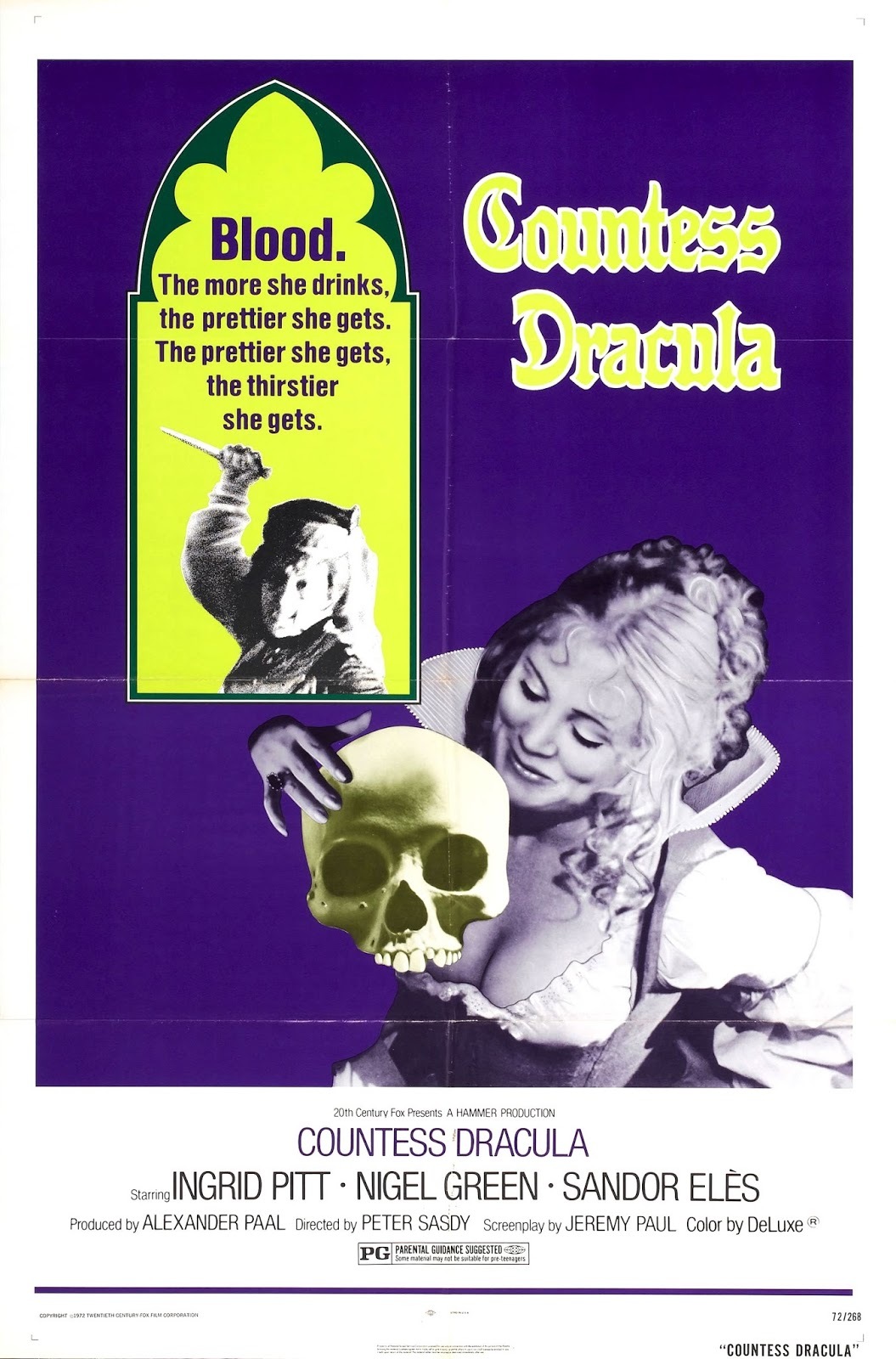
The Friday Night Horror Movie: Countess Dracula (1971)

countess dracula

I don’t remember the first time I became aware of Hammer Horror. They seem to be a part of my forever memory, but I suspect I actually came to know them rather late. Presumably, I heard some chatter about Hammer Horror after I became a fan of the Univeral Monster Movies, which would put it sometime after college. But it was years later that I actually watched any of their films. Letterboxd notes the first Hammer film I ever watched was Dracula (1958) in February of 2014. I watched The Curse of Frankenstein (1957) not long after that, but it wasn’t until 2020 that I watched a third film and from there I started watching Hammer Horror with some regularity.

What I’ve come to realize is that I tend to find Hammer films to be rather dull. Their stories often have a staid quality about them. Oh, eventually there is some bloodletting, some murders, maybe a monster or two, and a bit of horror. But they often (not always) take their time getting there. They tend to be very British in their melodrama. There are a lot of costumes, and talking, and ideas of decorum before the horror begins, and even then it always comes back to the drama.

But the thing is, I still kind of love these films. They are gorgeous to look at. The set designs – mostly creaky old castles, and magnificent gothic mansions – are impeccable. Their cinematographers are genius, filling each scene with color and shadows, fog and light. And those costumes, my goodness those costumes are simply fabulous. So, while I am sometimes a little bored with the stories, I never grow tired of just watching these films.

Despite its title, Countess Dracula has nothing to do with the Dracula legend, (and Christopher Lee and Peter Cushing are nowhere to be found) but is a loose retelling of the Countess Báthory story. She was a real person who lived in the late 1500s, was accused of killing hundreds of young women (and of bathing in their blood). Her story influenced a great many of the Dracula stories over the years so in that way you can consider this film a Dracula movie.

Anyway, in this story Countess Elisabeth Nádasdy (Ingrid Pitt, sadly dubbed for some dumb reason) discovers that drinking the blood of young women will restore her to youth and beauty. She does so and then must pretend to be her own daughter so as not to cause a stir in the village.

The real daughter, Ilona (Leslie-Anne Dow) was sent away when she was very young. When she returns to the castle, Elisabeth has her kidnapped and held captive so as to not be found out.

Meanwhile, Elisabeth seduces a young Lieutenant (Sandor Elès) all the while continuing to murder young maidens from the village (after killing a prostitute and bathing in her blood she realizes for the magic to work they must be virgins). In case you are wondering, all of the main servants in the household seem perfectly okay with their mistress regularly murdering people.

Eventually, things come to a head, but it takes its time to get there. I think I’ve made the plot sound much more exciting than it actually is. There is a lot more romancing than I’ve let on, and palace intrigue. There are a lot of scenes of people sitting around talking, and far too little bathing in blood.

But again, I still kind of loved it. I’m a big fan of Ingrid Pitt. She’s a marvelous horror icon and despite the painful voice dubbing she does some good work here. The sets are fantastic and the lighting is superb. There is a scene where Elisabeth is despairing over once again turning into an old hag. She wanders around her fabulously large, and perfectly lit bedroom in a flowing white gown and it’s like a dream.