Blackout Noir: Guilty Bystander (1950)

guilty bystander poster

My ambition often far exceeds my abilities. Inevitably, whenever Noirvember rolls around, I get excited and watch numerous noirs in the first week or so of the month. I’ll happily write a few reviews, but then life gets in the way. I have other official things to write, or I get stressed out over some work thing, or I’m just tired. I’m tired all the time these days. The days roll by, and I put off writing more noir reviews, and after a while I need something non-noir to watch. Then all of a sudden the month is over, and I’ve not written or watched nearly as many noirs as I wanted.

This month I thought it would be fun to write a whole series of reviews covering the Criterion Channel’s collection of Blackout Noirs. I got really excited about that and watched several of them. I wrote some of the reviews, and then that fatigue kicked in and I got distracted, and here I am trying to write something about Guilty Bystander, a movie I watched a week and a half ago. 

So, you’ll have to forgive me if this review is a little light on the details.  My memory has faded on some of the specifics of this particular film.

I can say that Guilty Bystander was made in 1950 and was directed by Joseph Lerner. It was made on a shoestring budget. According to noir aficionado Eddie Mueller, the filmmakers couldn’t afford to purchase the requisite filming permit to shoot in New York, so they often shot incognito or bribed police officers to look the other way.

This imbues the film with a real on-the-streets quality. And if you want to know what the seedier sides of New York City looked like in 1950, this film is for you.

Zachary Scott stars as Max Thursday, an alcoholic ex-cop who is living in a flophouse, working as the house detective. One night his ex-wife Georgia (Faye Emerson) comes to him in a panic. Their son Jeff and her brother Fred have gone missing. Georgia’s friend Dr. Elder (Jed Prouty) has advised her not to talk to the police just in case this is a case of kidnapping. 

A drunk Max visits Dr. Elder and gets into a fight with him. The good doctor knocks him unconscious, and Max awakes to find himself in police custody because Elder has found himself dead and Max now finds himself suspect #1.

Georgia gives him an alibi, and Max is on the hunt. The plot is standard noir stuff, and the film mostly plods along. I’ve liked Zachary Scott in the films I’ve seen him in, and he’s pretty good here. The script doesn’t do him any favors, but Joseph Lerner’s direction is on point, and the on location stuff is good. There is a scene in a subway tunnel that’s thrilling (and makes one wonder if they actually got permission to shoot down there).  

It is a film worth seeing if you are a noir fan, all others should not apply.

Blackout Noir: Blackout (1957)

murder by proxy

A broke and down American, Casey Morrow (Dane Clark), is quietly getting drunk by himself. He’s approached by a beautiful heiress named Phyllis Brunner (Belinda Lee). She says she’ll pay him $500 to marry her. A smart man would immediately think something is fishy, but film noirs aren’t filled with smart men. He accepts, and she plies him with more drinks. He awakes the next morning in a strange apartment owned by Maggie Doone (Eleanor Summerfield). She says she found him last night stumbling about, dead drunk, so she took him in and let him crash. She’s an artist and has a painting of Phyllis on an easel.

They are alerted by the newspapers that Phyllis’ father was brutally murdered last night with a fireplace poker. Casey finds blood on his coat. He has no memory of what happened to him after Phyllis made her offer and gave him some more drinks.

Blackout (also known as Murder By Proxy) is a tidy little British b-noir, directed by Hammer stalwart Terrence Fisher.

The police will naturally suspect Casey, as Mr. Brunner was quite rich, and as he’s now married to Brunner’s only child, he’ll take control of the estate. The police will never believe Casey’s story of how Phyllis propositioned him on her own, so naturally, he takes it upon himself to try and find out what really happened.

It is here that what starts out as a rather excellent film turns a little more pedestrian. Casey will track people down and ask a lot of questions and get far too many easy answers. Because this is a film noir, we know that Phyllis has something to do with it. He’ll figure that out too, but also because this is a noir, he’ll keep falling for her act. Guys in noirs always get suckered in by a beautiful dame. It is such a shame too because Maggie is clearly the better woman, and she falls in love with him the moment she takes him in that first night.

The detective work never quite thrills or travels down new paths for this sort of thing, but it is still quite entertaining. I am reminded of Terrence Fisher’s work in numerous Hammer Horror films. Those weren’t typically great, but they were sturdily made and enjoyable enough. So it is here. It is a very good film. It doesn’t quite reach great status, but if you are a fan of film noir, I wouldn’t miss it.

Noirvember: Cairo Station (1958)

cairo station

Cairo Station is a film that’s been popping up in my feeds and suggestion lists for a while now. The story sounded interesting, and that black and white poster with the train running above a man and woman covered in oil is a good one, but something about it kept making me put off watching it. Somehow, I think the fact that it was an Egyptian film put me off of it. That’s weird because I’m a fan of foreign films; I dedicate an entire month to them in February. But I don’t think I’ve ever seen an Egyptian film. I’m not super familiar with Middle Eastern or African cinema either. 

I want to know more about their culture and cinema, but it also feels a little daunting to dive in. It feels a little like work, and I’m lazy, so I put it off. But finally this week I decided to give it a try. I’m glad I did, as it turned out to be a terrific film.

It is a little slow in the going. For the first fifteen minutes or so, it sets up its stories and its characters. I almost turned it off around then. I couldn’t quite get a grip on it. It is a film full of people. It lives at the titular train station, and it follows the hustle and bustle of numerous people working there. The main focus is on Qinawi (Youssef Chahine, who also cowrote and directed the picture), a poverty-stricken young man with a lame foot. He becomes obsessed with Hannuma (Hind Rostom), a beautiful young woman who sells cold drinks to train passengers. She’s engaged to Abu Siri (Farid Shawqi), a robust, fiery man who is attempting to organize all the train workers into a union. 

There is a lot of politics in the film. It deals with these poor workers trying to survive. But because it is set at a train station, we get glimpses of all sorts of classes. It is a microcosm of Egypt at this time. I think, in part, this is why it took me a minute to climb into the film. In some ways the film is universal; the working class struggles everywhere, but in other ways it is a very Egyptian film, set in a very particular moment in their history. 

Qinawi’s obsession with Hannuma is sexual in nature. His handicap and poverty cause him to be mocked by most women. But while his lame foot makes it difficult for him to get around, he’s still a man in the prime of his life. He still has desires. Hannuma is beautiful and boisterous, full of life. She’s flirty and sexual. She’s also nice to Qinawi, which makes him think he has a chance. That goes into some dark territory, which I won’t spoil, and it makes Qinawi more of an anti-hero than a sympathetic character.

It is shot like a classic noir with stark black and white photography emphasizing the shadows and grit of the train station. It feels like a politically tinged melodrama with sharp edges. It may have taken me a long while to finally watch the film, and it took me a little while to get into it, but once it had me in its clutches I sank right in.

Blackout Noir: Black Angel (1946)

black angel

A man goes to see his ex-wife on their anniversary. She refuses to see him. She has the doorman turn him away. She still refuses even when he’s sent up a fancy brooch. As he’s walking out, another man comes into the hotel asking to see the woman. He’s let up with no problem. The first man goes to a bar and gets drunk. Later, a third man comes to the hotel and is let up to see the woman. He finds her lying on the floor dead. While there he hears someone sneak out. He notices that the brooch she was holding in her hand when he first came in is now missing.

Black Angel was directed by Roy William Neill, who is best known for directing most of the Sherlock Holmes films starring Basil Rathbone. It is a loose adaptation of a novel of the same name by Cornell Woolrich. I was twenty minutes into it before I realized I had seen it before.

The first man is called Martin Blair, and he’s played by Dan Duryea. The guy who found her dead is Kirk Bennett (John Phillips), he’s a married man who was having an affair with the dead lady. But things turned sour, and she was blackmailing him to conceal the affair. The cops figure that’s the motive and arrest him. He’s convicted and sentenced to die in the gas chamber.

Kirk’s wife, Catherine (June Vincent), believes her husband to be innocent and starts her own investigation into the matter. She’ll eventually connect with Martin, and he’ll tell her about the second guy, the one he saw entering the dead woman’s room. That guy is Marko, and he’s played by Peter Lorre, so you automatically know he did it. Catherine and Martin know he did it, too, but they have to prove it. They figure that proof is in a safe inside his upstairs office at the club he owns. They get a gig there as a lounge act.

It is all nicely done, and there are a couple of good and tense scenes with Peter Lorre, but it never quite connected with me. This was Duryea’s first starring role, and he’s good in it. He’s a washout and a drunk who finally sobers up when he meets Catherine. Finding her husband’s killer gives him purpose, and he naturally falls in love with her, which gives him even more purpose. But she’s still in love with her husband. That creates a bit of drama. Peter Lorre is always good, but he’s not given a lot to work with here.

It is a fine movie and worth watching if you are a fan of film noir.

Blackout Noir: The Blue Gardenia (1953)

blue gardenia poster

Three women live together in a ridiculously large apartment. Seriously, there is a kitchen, a bathroom, and this massive living area, but no bedrooms. The ladies all sleep on pull-out-style beds in the gigantic living room. A room that could have easily been converted into at least a couple of bedrooms. I think the film wants us to believe these ladies aren’t rich; they can only afford a studio apartment for the three of them. But it also needs to block them in interesting ways. The three of them need to be filmed in different spaces and not be all crowded together. So we get this gigantic living space.  

Sorry, that kind of thing drives me a little crazy. Now where was I?

Oh yes, these three women – Crystal (Ann Southern), Sally (Jeff Donnell), and Norah (Anne Baxter)—all work for a telephone company as operators. They have varying relationships with men. Crystal is dating her ex-husband (because when they were married, he had all the faults of a husband, but now that they’re just dating, he has all the perks of a boyfriend). Sally mostly stays home reading detective novels, (but when the phone rings, she announces – “If that’s for me, I’m in! No matter who it is.”) Norah is in love with a man stationed in Korea. 

All three are constantly hit on by Harry Prebble (Raymond Burr), a skeezy pinup girl artist, who tries his luck with any and all girls. He’s the kind of guy who doesn’t care who he makes it with as long as he’s making it with someone.

When Norah gets a letter from her boyfriend telling her he’s met someone else, she agrees to go out with Harry. He takes her to the titular restaurant and plies her with drinks. She has a good time, and he takes her home.  Before he can make his moves, she passes out on the couch. But he’s not the type of guy to let a little blackout rob him of a good time. She wakes up enough to fight him off. She picks up a fireplace poker, and…the film fades to black. The next morning she finds herself in bed with no memory of what happened. He doesn’t wake up at all. He’s found dead by the maid.

The rest of the film finds Norah trying to figure out just what happened, all the time thinking she must have killed him. This probably counts as a spoiler, but about 40 minutes into the film, I turned to my wife and said, “I don’t think she killed him.” Norah is just too nice. She’s too good of a girl to have killed a man like that. And the fact that the film faded to black before we ever saw her strike a blow made me think there must have been someone else.

At some point Casey May (Richard Conte) enters the picture. He’s a journalist chasing the story. After writing a few front-page stories (and here’s another point of contention for me – all the front pages on his newspaper are just headlines printed in massive type; there are no pictures, no actual story, just headlines. What a waste of space.) But I’m digressing again. Where was I? Oh yes, after writing a few front-page stories, he needs a new angle and decides to write an open letter to “An Unknown Murderess,” where he asks her to turn herself in to him and promises the paper will pay for her defense (as long as she gives him an exclusive interview).

She’ll eventually call him, and naturally there will be a romance angle that enters the picture. The film concludes abruptly and all too neatly. It is rare that I complain about a film being too short, but this one really could have used an extra half hour. I mentioned earlier about how I thought she didn’t do it; I could have gotten behind Casey and Norah doing a little investigating trying to find out who the real murderer was. Instead they just throw a solution at us and roll credits. It’s too bad too, because up until then I was really enjoying the film.

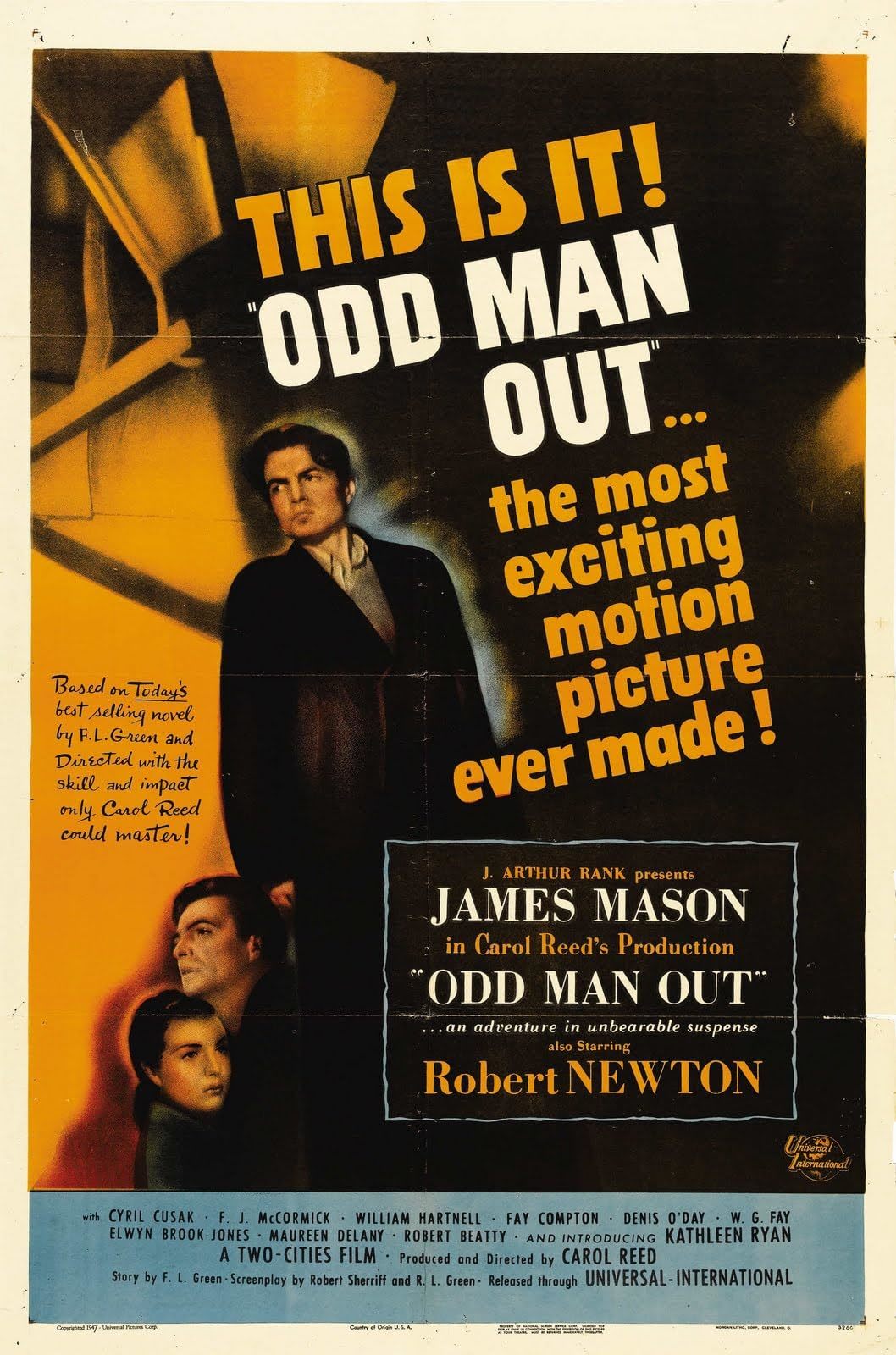
Noirvember: Odd Man Out (1947)

odd man out poster

Sometimes people suggest that The Third Man which was directed by Carol Reed and stars Orson Welles in a pivotal role was also secretly directed by Welles. Or that at the very least Welles gave Reed plenty of advice. The Third Man indeed contains the types of skewed camera angles and shrewd use of shadows and light that Welles so loved, but anyone suggesting that Carol Reed was incapable of such things has apparently never watched Odd Man Out. For it contains many such moments and it came out three years before The Third Man.

Odd Man Out stars James Mason as Johnny McQueen, an Irish Nationalist leader who becomes wounded after a botched robbery attempt. The film follows along as his friend and the police scour the city looking for him, while continually checking back on him as he hides out in an air raid shelter, a local pub, and finally an artist’s residence.

What is remarkable about the film (besides the filmmaking itself which is brilliant) is how much the film makes us care about all of these characters. Johnny is a criminal. He commits that robbery for the money, not out of desperation or need (there are political motivations, but the film never delves into what they are). He kills a man while fleeing the crime scene. While the film shows him remorseful for that act it never once lets us forget it. But it also makes us feel and care for him as a person.

Thematically the film delves deep into that question as to how we are as a society to deal with and react to a criminal – a fugitive from justice.

A couple of elderly women see Johnny fallen on the street. They think he has been hit by a truck. They take him in and attempt to patch him up. But once they realize he has been shot, and thus who he is, they change. They are no longer helping a wounded man but are aiding and abetting a criminal.

A priest asks for information about Jonny’s whereabouts. He won’t protect him from the police but would like to hear his confession. A local street hood tries to sell his hiding place to the highest bidder. An artist wants to paint him as he dies. Johnny’s girl Kathleen (Kathleen Ryan) will do anything to save him, even risk her life.

The film takes us through all of these interactions with great care and style. It doesn’t so much judge these characters as it asks us to ponder their dilemmas. Shot in stark black and white it makes great use of its sets, its location settings, shadows, and lights. It is breathtaking to look at. It is the sort of film that makes you think maybe Orson Welles learned a thing or two from Carol Reed.

It made for the perfect conclusion to Noirvember.

Noirvember: Rusty Knife (1958)

rusty knife poster

I’ve mostly been watching American noir this Noirvember, but I wanted to get into something Japanese before the month was over. Rusty Knife is one of the films in Criterion’s Nikkatsu Noir set. Nikkatsu is one of Japan’s oldest, and most popular film studios. But by 1958 their popularity had waned due to the influx of Hollywood movies in Japan. To compete they started putting out American style crime stories.

It is set in Udaka, a new city made incredibly prosperous incredibly fast in Japan’s post-war industrial boom. With economic growth comes a criminal element ready to take advantage of both the city’s prosperity and its still-developing political machinery. The film follows Yukihiko Tachibana (Yūjirō Ishihara) an ex-convict just released from prison who wants to make a go of straight life.

Tachibana was in prison for murdering a man he thought had raped his wife which caused her to commit suicide. But as the film progresses he’ll learn it was much more complicated than just one man doing something heinous for his own pleasure.

To make things even more complicated before he went to prison Tachibana and two other guys, while out committing a burglary, witnessed the murder of a politician. It was gangsters that did it, making it look like a suicide. When they realize Tachibana and his friends saw the whole thing the head gangster, Katsumata (Noaki Sugiura) pays them off for their silence.

The police have been trying to put Katsumata in prison for years. When they learn that Tachibana and his friends witnessed the politician’s murder they pressure them to become witnesses.

At first, Tachibana refuses. He might be going straight but he’s no snitch. But as he learns more about his wife’s assault and Katsumata’s hand in it things become more complicated.

I liked Rusty Knife pretty well, but there was nothing to really distinguish it from the many other similar crime films I’ve watched in my lifetime. It says some things about Japan in the years that followed World War II, but again I’m not sure it says it any better than numerous other films from the era.
It is worth watching if you are a fan of this type of cinema as it does everything well. It just isn’t the best at what it does.

Noirvember: So Long at the Fair (1950)

so long at the fair poster

Vicky Barton (Jean Simmons) a young Englishwoman and her brother Johnny (David Tomlinson) travel to Paris for the Exhibition. They check into a nice hotel. They speak to the owner and the porter. The porter is miffed because Johnny gives him an English shilling for a tip.

They go to Montmartre for dinner and the Moulin Rouge for entertainment. They keep bumping into another Englishman, George Hathaway (Dirk Bogarde), and his two companions. His companions are staying at the same hotel and later that night he’ll borrow money from George to pay the cabbie.

Everyone goes to bed and when Vicky wakes up the next morning she finds that George is nowhere to be found. Not only that but his room doesn’t seem to exist. His room number, 19, is a bathroom and not a bedroom at all. No one at the motel will ever admit that they ever saw him. She arrived alone they say.

This story is based on an old urban legend. Usually, it involves a mother and daughter, but they’ve changed it to siblings here. It has been adapted into various stories over the years and it was the inspiration for Alfred Hitchcock’s The Lady Vanishes.

In the Hitchcock film, an elderly lady disappears from a train, and someone she only just met has to look for her. In that film the protagonist starts to think she’s gone crazy, that she only imagined the old lady. Which works because she didn’t really know the woman in question.

It seems much more difficult to convince someone that they don’t have a brother. Luckily, the film finds some clever ways to get past that. When she goes to the British consolute he says he believes her but that she’ll have to find evidence. He suggests finding someone else who saw her with her brother.

She remembers that a woman saw them together and that she was going to be at the exhibition. But something quite unusual (which I won’t spoil) happens to her keeping her from testifying.

The police chief likewise says that he believes her and goes to the hotel to question the owner. But again without evidence, there isn’t much he can do.

Enter George Hathaway again. Naturally, he helps the poor girl sort out exactly what has happened. It all leads to a surprising conclusion that is also somehow disappointing. They find a clever way to explain why they not only had to make Johnny disappear but his room too. It also satisfies questions of why they left her alone (except for the gaslighting).

And yet while it is clever, and it does explain everything, I found it not at all satisfying.

The film doesn’t amp up the mystery angle of the story very much. We know exactly who is involved, we just don’t know why. Vicky never seems to be in any real danger either. Instead, it is a story about a woman placed in an incredibly strange situation trying to understand what has happened and why no one will believe her.

On that front, it mostly worked for me. Jean Simmons is quite good and I always love Dirk Bogarde. He’s one of those actors that every time I watch him in a film I want to find him in other things.

In the end, it was a pretty good film, but I still prefer the Hitchcock version of this legend.

Noirvember: Dear Murderer (1947)

dear murderer

A man walks into a darkened house. He closes the curtains before turning the lights on. If he is a burglar he is a strange one, for he doesn’t take anything. He just looks around. He seems especially interested in some old letters, and flower cards that say simply “Love Always.”

He is Lee Warren (Eric Portman) and he lives in this house with his wife Vivien (Greta Gynt). He’s been away in America for many months on business. Those love letters are not from him, but from Vivien’s lover Richard Fenton (Dennis Price)

Lee devises the perfect way to murder Fenton and make it look like suicide. Even better he tricks Fenton into writing a letter that makes it sound like he’s killed himself over Vivien’s unwillingness to divorce Lee.

He almost gets away with it, too. Trouble is, Vivien had already broken it off with Fenton before Lee had even come home. There was only a brief affair and Fenton would not have killed himself over her. In fact, Vivien already has a new lover, Jimmy Martin (Maxwell Reed). Lee devises a new plan, with a little work, he can make it appear that Jimmy murdered Fenton and it was he that made it look like a suicide.

As this is a movie made in 1947 and is a film noir you can probably guess how well this works out for him.

This is a very British noir. It has little of that biting, cynical dialogue that comes with so many American noirs. The exchanges here are more polite, but still cutting. At one point Lee notes that he rather likes Fenton and under different circumstances, they might become friends. Later, Lee has a second change of heart and sabotages his own perfect murder because of his own feelings.

It has that detached British feel to the filmmaking as well. Like the camera is just an observer and we are an audience watching these strange events occur without ever needing to feel anything about them.

That’s not to say that this isn’t good. I mean it isn’t great, but it is an enjoyable watch. Greta Gynt is especially fun as a sort-of femme fatale who uses men to suit her needs and has no other use for them. Consider it middle-shelf noir.

Noirvember: Targets (1968)

targets poster

In August of 1966 Charles Whitman, after stabbing his wife and mother to death, climbed a clock tower at the University of Texas at Austin and shot over 30 people with a rifle.

Two years later Peter Bogdanovich directed his first movie. Famed producer Roger Corman told Bogdanovich he could make any movie he liked under two conditions. First Boris Karloff owed him two days worth of work so the film would have to utilize that. Second, he had to use clips from Corman’s own film with Karloff, The Terror (1963). Other than that he could do what he wanted (within the budget constraints of course.)

Targets blends a slightly autobiographical tale of Karloff as an aging horror actor who finds real life’s horrors to be more than he can take, and a Charles Whitman-esque “average man” who goes on a shooting spree. The way that these two separate stories merge is quite fascinating.

Karloff is Byron Orlok an elderly actor who starred in the type of horror movies Karloff used to star in. But he finds he no longer has an audience. Those old films seem dated and cheesy to modern audiences. Real life with its relentless real violence is much scarier than those old movies. He announces he’s going to retire, much to the chagrin of Sammy Michaels (Peter Bogdanovich) a director who has just written a part specifically for Orlok.

During these scenes, we watch Orlok watch scenes from The Terror, and later we’ll see him watch himself in The Criminal Code (1933). It is quite a treat to watch Karloff watching himself on screen.

Orlok is unrelenting in his decision to retire but does agree to make an appearance at a drive-in theater where one of his films will be shown.

Meanwhile, Bobby Thompson (Tim O’Kelly) is a seemingly normal young man. He has a pretty wife and a perfectly average set of parents with whom they live in a nice little house. He likes to go hunting with his father. He likes guns.

The film gives us hints that not all is well with the Thompsons. Nothing dramatic, but his interactions with his wife are bland. His conversations with his parents are empty. We watch them sit around the television laughing blankly at some broad comedy.

Then he kills his wife and mother, loads up a bag full of weapons, sits atop an oil storage tank, and begins taking potshots at cars on a nearby highway. When the cops arrive he escapes, making his way to a drive-thru playing some old film starring Byron Orlok.

Bogdanovich shoots all of this with a low-key style. He wisely doesn’t make any overt statements about movies and violence, allowing the viewer to draw their own conclusions.

It is a fascinating film and one that amazes me that it ever got made. There aren’t a lot of people who could take that mandate from Roger Corman and make something at all watchable, that Bogdanovich turned it into something great is a minor miracle.