
Noirvember: No Way Out (1950)

now way out poster

Dr. Luther Brooks (Sidney Poitier) is the first African American doctor at the county hospital. He’s assigned to the prison ward where his first patients are the racist Biddle brothers who have just been brought in after a botched robbery.

Both brothers were shot in the leg. Ray (Richard Widmark) fixes up easily, but George (Harry Bellaver) seems to have unrelated symptoms. Luther does all he can for him, including administering a spinal tap, but ultimately George dies in the hospital. Ray, who did nothing but throw racial insults at Dr. Brooks while he was working lays the blame for his brother’s death at his feet.

Luther’s boss clears him of any wrongdoing, but Luther is rattled just the same. Maybe there was something he could have done differently. Maybe the racist insults clouded his judgment. An autopsy is the only way to be sure. But he can’t get that without a member of the family’s approval. Naturally, Ray doesn’t want to grant that approval, but maybe his sister will.

The film spends a lot of time with Luther’s family. He is a good man and his family are good people. But they are black in a time and place where that makes life difficult. Even with Luther’s success life can be hard.

Ray and his friends are planning an attack on Luther and his family. The African American community hears about this and they plan their own pre-emptive attack. Luther speaks to the hospital’s elevator operator about this and advises caution, that they should be better than them. Which prompts this response from the operator:

“Ain’t it asking a lot for us to be better than them when we get killed just trying to prove we’re as good?”

Poitier played in a lot of films like this during this time period. He played good African Americans awash in a sea of racism. He was a great actor, perhaps the prominent black actor of his time. This was a period when America was legally segregated, but that was slowly beginning to change. I’m no historian so I’ll leave that discussion to others but it is interesting to watch films like this try to deal with institutional racism on an artistic level.

Not all of the films Poitier played in like this were good, but this one is terrific. I love how it spends a lot of time with Luther and his family. It is a slice-of-life portrayal of these people in this place at this specific time, and the every-day, working-class racism that pervades their lives.

But it is also a pretty terrific little thriller. Richard Widmark is as terrifying as Ray. They say he often apologized to Poitier after a scene of him spitting racism at him. It can feel a little dated at times, but at the same time, it remains quite contemporary.

Noirvember: Night and the City (1950)

night and the city

Harry Fabin (Richard Widmark) is a man constantly on the run – from gangsters, and bookkeepers, loansharks and anyone else he owes money to or has otherwise schemed. He’s always got something cooking, some way to make a fast buck, get rich, and live a life of luxury. The ironic thing is if he actually put the energy he uses on these schemes and put them to legitimate work, he’d have a comfortable life.

Night and the City begins with Harry on the run. He’s making the slip past some unknown assailants across the streets of London. He winds up at Mary Bristol’s (Gene Tierney) flat. She loves him, but she’s tired of his constant hustling. Taking none of his crap, she simply asks him how much he wants this time.

Harry has a part-time gig working for Phil Nosseross (Francis L. Sullivan) smooth-talking out-of-town businessmen into coming to Nosseross’ club, The Silver Fox. One night out looking for chumps he wanders into a wrestling match where he becomes entranced by Gregorious the Great (Stanislaus Zbyszko). He isn’t in the ring but rather is complaining loudly about how fake everything is. Turns out he’s one of the great Greco-Roman wrestlers and these days everything is more WWE than real.

Harry hatches a plan to use Gregorious to become the wrestling magnate of London. Trouble is the current magnate is also Gregorious’ son Kristo (Herbert Lom). The father is angry with the son for getting involved in what he thinks of as entertainment and not real wrestling.

Harry needs money to get everything set up and he borrows it from Mrs. Nosseross (Googie Withers) who wants to divorce Mr. Nosseross but can’t until she’s got herself set up somewhere else. So she lends money to Harry so he can get more money from Mr. Nosseross (he won’t lend Harry money until he has some money himself to put down) which she will use to start a new nightclub.

The plot gets more convoluted from there. But I was never confused. Directed by the great Jules Dassin things run smoothly and clearly. There are some great exterior scenes overlooking most of the popular London spots, but much of the action takes place underground, it dirty bars, back alleys, and run-down gyms.

There’s a terrific wrestling sequence towards the end between Gregorious and another man. It isn’t staged with any flair, it is just two men trying to beat the other one into submission, but it is brutally effective.

I wish Gene Tierney had more to do that look upset at Harry, but she does get a wonderful scene towards the end that makes it all worth while.

Night in the City is a great movie, and a fantastic example of what film noir can be.

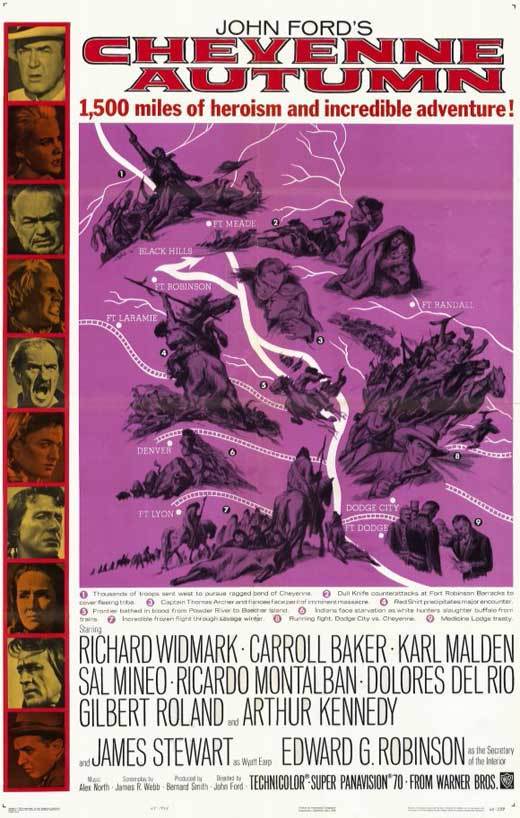
Westerns In March: Cheyenne Autumn (1964)

cheyenne autumn poster

John Ford made some of the greatest westerns ever made. From Stagecoach (1939) to My Darling Clementine (1946), The Man Who Shot Liberty Valence (1962) to The Searchers (1956) Ford proved over and over again to be a master of his craft, and of telling stories about the wild west and the men (and women) who tamed it.

Unfortunately, like so many western filmmakers at the time his films were not always kind to the Indians. All too often the Native Americans in western movies were faceless savages bent on raping and killing the white man. They were rarely made into full characters and very little attention was paid to the fact that the white man was invading the Indian’s territory and homeland.

In later years Ford seemed to have recognized his flaws in this area and at least in some ways he tried to make amends. In The Searchers John Wayne plays a pretty repugnant racist and his quest to rescue his niece, who has been captured by some Comanche Indians, allows the film to raise questions about the inherent racism of Manifest Destiny and America’s unrelenting quest to capture the entire country.

With Cheyenne Autumn, Ford’s last western and his penultimate film as a director, he depicts the historical event of the Northern Cheyenne Exodus in 1877 where a group of Indians decided to move from Oklahoma Territory back to their homeland in Wyoming. His depiction of the Indians is sympathetic and demonstrates just how awful the American government treated them.

Unfortunately, the film is overlong, rather dull, and still a bit racist. The two main Indian characters, Red Shirt and Little Wolf are played by Sal Mineo and Ricardo Montalban respectively – two very much not Indian actors (Mineo was of Italian descent and Montalban was Mexican born). The film’s focus likewise is on the white characters with the Indian characters playing second fiddle in their own story.

I could be more forgiving of most of this if the film was actually any good. Instead, it is slow, plodding, and contains one of the most unnecessary side stories I’ve ever witnessed.

The film begins with the Cheyenne on a reservation in Oklahoma. The land is arid and infertile. The people are sick and starving. Some delegates from Washington are supposed to meet them and discuss what can be done. But they don’t show and the Cheyenne decide to go home.

The trip is long and arduous. They must travel in desolate areas so as to not be seen by one of the many Army Forts along the way. Starving, some of them decide to turn themselves in at one of those forts. Though the Captain is sympathetic to their needs he has orders to turn them right around and send them home. Sickness, starvation and the brutal winter weather be damned.

There is some business about the press drumming up hysteria by printing falsehoods about the number of Cheyenne on the march and their ill intentions. Many of the soldiers on the ground (led by Richard Widmark) tend to be sympathetic to the plight of the Cheyenne but have their hands tied by forces in Washington.

Etc. and so on. Ford shot some of it in and around Monument Valley and Arches National Park and he gives the scenery his usual widescreen glory. But the story just never congeals into something interesting.

At one point, out of nowhere comes a scene with James Stewart playing Wyatt Earp and Arthur Kenney as Doc Holiday. It has absolutely nothing to do with the rest of the film and is completely comic in tone (the rest of the film is utterly dramatic) and then it just ends and we never see them again.

Somewhere buried in there is a film that could have been great. The story of the Cheyenne’s exodus is a fascinating one and could make an excellent film. This is not that film and what we’re left with is the thought that Ford’s legacy left a whole lot of other films that are far greater than this one.