
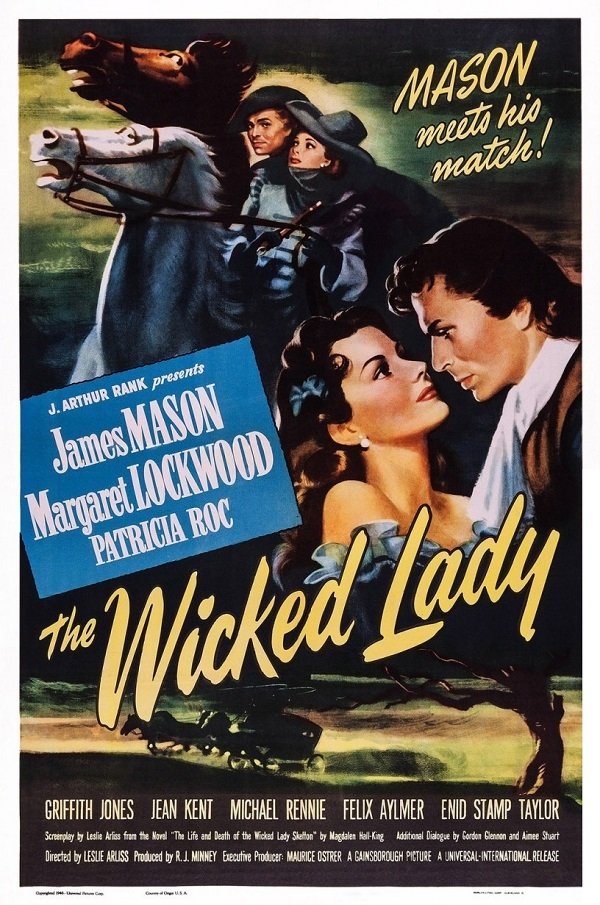
The Wicked Lady was an enormous hit at the time. It broke box-office records in Britain. Hilariously, before it could be shown in the United States several scenes had to be reshot because the American censors couldn’t handle the bountiful bosoms heaving out of the (period-appropriate) dresses.
It is easy to see why it was such a success in 1945. The story is about a proper lady who steps out of her boring life and becomes a highwayman. Women at the time could have seen it as a story of independence, of throwing off the shackles of oppression instituted by the culture of the time.
What I think is so interesting about this type of film is that because it is set in the past certain types of people could watch it, recognize that it is a liberating film, but then think to themselves “Look at how far we’ve come” and pat themselves on the back. But those in the know would recognize how far we still have to go.
And now, of course, we can look at this film made in 1945 and think similar things.
Our film begins with Caroline (Patricia Roc) preparing for her marriage to Sir Ralph Skelton (Griffith Jones). They do not truly love each other but they have a deep kinship and both need marriage partners. The night before their marriage Caroline invites her dear friend Barbara (Margaret Lockwood) to their home. She being a treacherous, scheming woman immediately sets her eyes on Sir Skelton and uses her feminine charms to win him away from Caroline. They soon marry, leaving Caroline in the lurch.
Barbara assumed Sir Skelton’s riches and station would bring her happiness but soon finds herself bored. Country living doesn’t suit her and Sir Skelton does not like venturing into the city. When she learns that one room in the mansion has a secret passageway leading to the gardens she moves in and quickly begins sneaking out at night acting as a highwayman – robbing coaches in a mask. From there she meets Jerry Jackson (James Mason) a notorious highwayman and the two begin working together. Barbara loves the life of crime and becomes cutthroat about it. Jackson might be a thief, but he has a code. He never uses real violence. Barbara is willing to kill.
One of the things I love about this film is that Barbara is not a good woman who has temporarily lost her way. She’s not some bored housewife who went looking for a little excitement and got into a spot of trouble. She is a lost woman. Irredeemable, and loving it. She enjoys the crime, she likes the violence. I’m not sure what that does to my theory that this is a liberating, feminist film.
I feel like I’m making this movie sound better than it actually is. Honestly, I found it rather dull. Margaret Lockwood is a lot of fun to watch, she seems to be loving playing this character who is joyously evil. But James Mason seems out of place and Patricia Roc and Griffith Jones are a bit bland. The action is mostly off-screen (the actual robberies we do see are dully filmed) so what’s left is a lot of people talking about them and various romances that don’t have any heat.
It isn’t a bad film, and it is interesting for the reasons I describe. Obviously, people at the time just loved it. They actually remade it in 1983 with Faye Dunaway and Alan Bates. I’d be interested to see how they updated it.
 themidnightcafe.org