Foreign Film February: Biutiful (2010)

biutiful

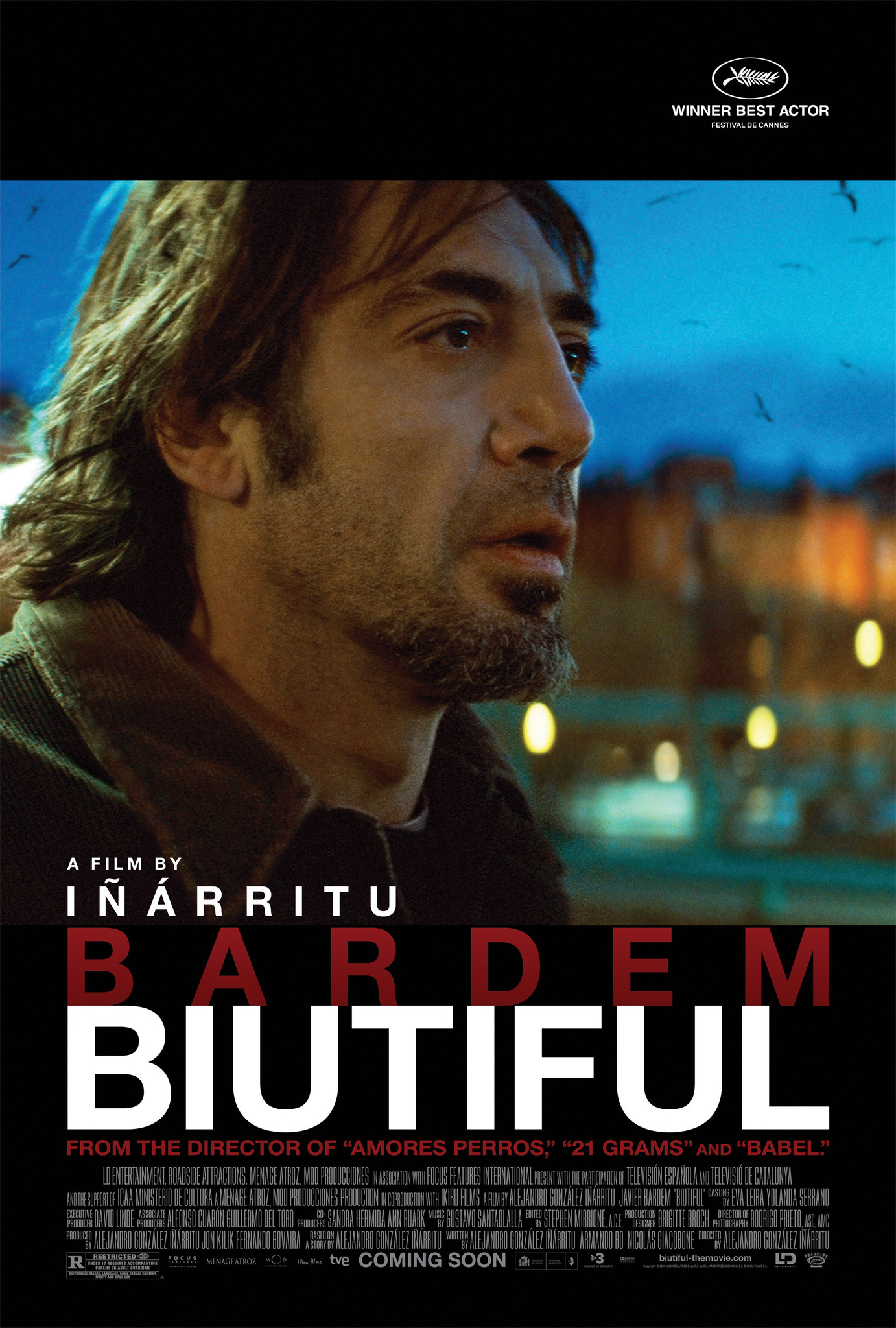
Uxbal (Javier Bardem) is a decent man living a bad life. He’s a low-level criminal living in a shabby apartment in Barcelona. He manages a group of street vendors who sell knock-off Gucci bags and other fake products. He’s also in charge of some Chinese illegals who make those goods. He’s exploiting humans for profit, but he also seems to care, at least a little. When he realizes the Chinese immigrants are cold, sleeping together in a rundown basement he procures them some heaters (the cheapest he can buy, a decision that will haunt him later in the film). He seems to love his young children deeply. He tries to be kind to his ex-wife who sometimes works as a prostitute, and is bipolar, but his tolerance has limits.

Director Alejandro González Iñárritu keeps things close to the streets. This isn’t your tourist brochure of Barcelona. The city is dirty, corrupt, full of violence, and a struggle just to survive. Uxbal is a decent man, and Bardem’s portrayal of him is sympathetic, but he also makes a living off the backs of the downtrodden. The film gives him cancer, and a short time to live which makes him even more sympathetic. The plot is really about him trying to put his life in order.

It is also mostly a bore. It drags on for over two hours and the movie never gives us enough reason to stick with it for that long. I’ve enjoyed some of Iñárritu’s films, but this one is a misfire. Barden gives a great performance, his face is so full of hurt and resignation, but otherwise, I found it a bit of a slog.

Foreign Film February: Scandal (1950)

scandal

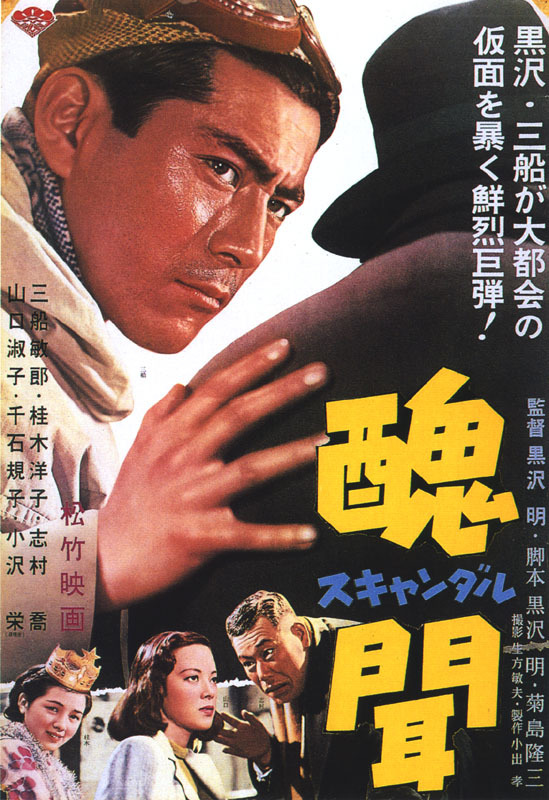
Akira Kurosawa is one of my favorite film directors of all time. I’ve not seen all of his films, in fact, I’ve only seen about half of them (17 of 32 if you are counting) but out of all I’ve seen, there hasn’t been a bad one. All of them have been good, and many have been truly great. Scandal is my least favorite of the films that I’ve seen. It isn’t a bad film by any means, but when compared to his masterpieces it just doesn’t hold up.

Toshiro Mifune plays Ichirō Aoye an artist who, as the film begins is out in the countryside painting some mountains. A woman, Miyako Saijo (Shirley Yamaguchi), comes walking up the path carrying her luggage. She says she missed her bus and is staying at a nearby hotel. Ichirō says he is staying at the same hotel and he’ll give her a lift. They climb on his motorcycle and zoom away. Later that day, after they have both showered, he visits her in her room. They are both wearing robes and they hang their towels over her balcony rail. They have a friendly chat and at one point she draws close to him as he points out a nice walking trail she might take. It is at that moment a tabloid newspaper photographer snatches a picture.

The photo is sold to a tabloid rag which puts the photo on the front page and insinuates a secret romance between the two characters. Miyako is a famous singer and the story becomes quite a scandal. While Ichirō and Miyako discuss what to do they meet Hiruta (Takashi Shimura) a shambling, down-on-his-luck lawyer who says he’d like to represent them in a lawsuit against the magazine. Miyako declines but Ichirō is taken in by the man’s earnestness. When he meets Hiruta’s daughter, who is bedridden with TB but retains a cheerful attitude, he agrees to let Hiruta represent him.

Hirutu is a good man, but drowning in debt and is unable to afford good care for his daughter. When a lawyer for the magazine offers him a bribe to throw the case, he reluctantly agrees. The story unfolds in a way that aligns pretty directly with Kurosawa’s usual gentle humanism.

It is a decent story and it is told well. But compared to Kurosawa’s other works it falls short. There is nothing particularly surprising or interesting about how it unfolds, and the direction, while adequate, isn’t particularly special. I kept thinking about High and Low, Kurosawa’s fantastic crime drama from 1963. Much of that story takes place inside the house of the main character. It centers on one room. Kurusawa’s placement of the camera in that film, and the way it moves make that room feel claustrophobic or expansive depending on the mood he’s trying to create. It is a masterclass in direction. I kept hoping for something similar in Scandal, especially in the courtroom scenes, but the setups are all basic. The sort of placement you’d find in any courtroom drama airing on broadcast television. Again, it isn’t bad, it just doesn’t feel like a Kurosawa film.

In the end, it is still worth watching, especially if you are a fan, but this is definitely a lesser Kurosawa.

Foreign Film February: Micmacs (2009)

micmacs

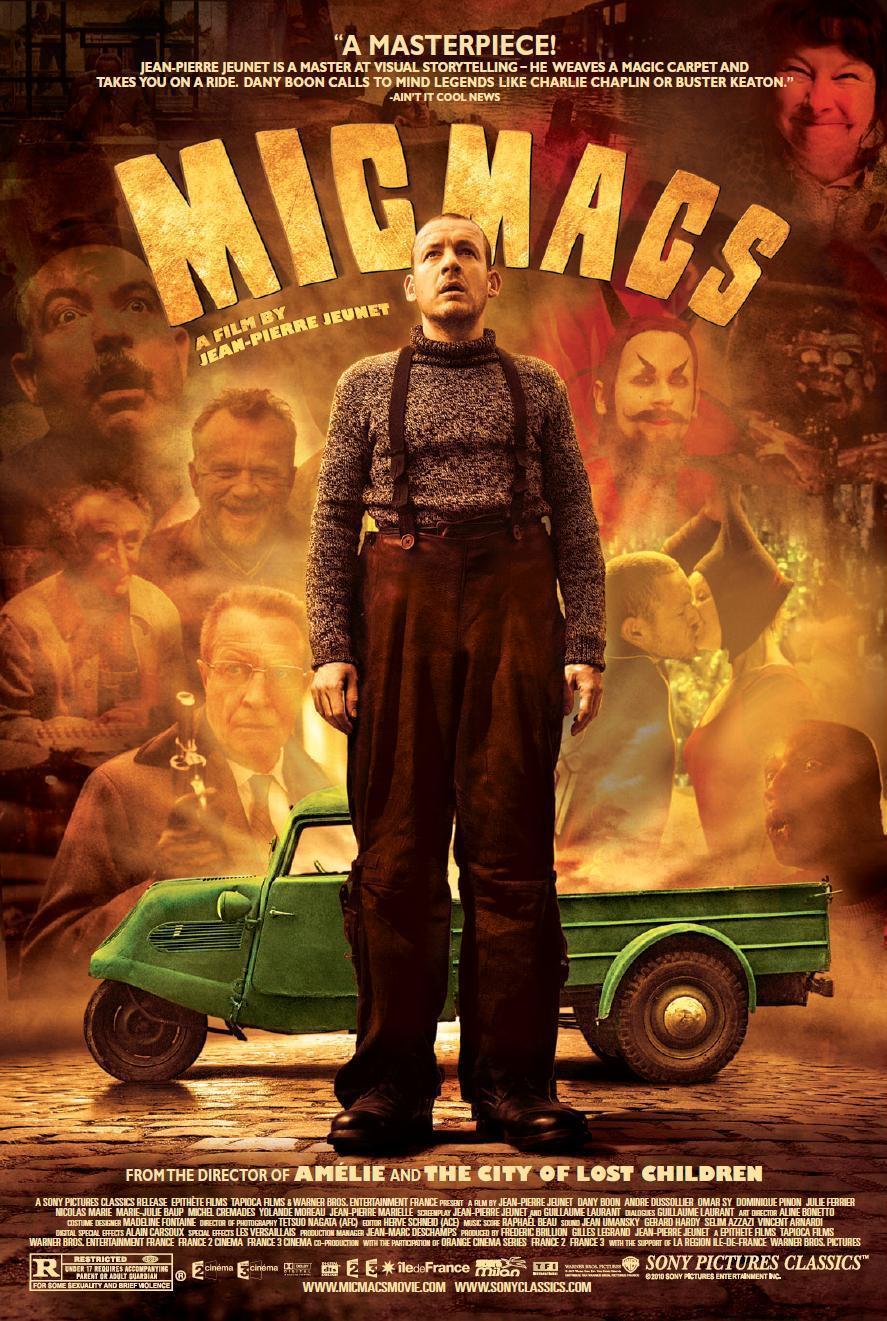
While working at a video store, Bazil (Danny Boon) is hit in the head by a stray bullet. The surgeons decide to leave it inside his skull for removing it might cause brain damage. Leaving it in may eventually cause it to lodge deeper into his brain, killing him, but it is worth the risk. As a boy, Bazil’s father was killed by a land mine.

Once released from the hospital, Danny finds that the video store has replaced him. Homeless, he wanders the streets of Paris until, one day, he is greeted by Slammer (Jean-Pierre Marielle) who takes him to his clubhouse located in the bowels of a junkyard. There he introduces him to a group of misfits who scavenge the city for their livelihoods.

One day Bazil realizes that the company that made the bullet that is still lodged in his head sits across the street from the company that made the land mines that killed his father. A plan is hatched to have his revenge on the owners of both companies.

Micmacs was directed by Jean-Pierre Jeunet and it has all of his hallmarks as a filmmaker – it blends fantastic elements into an otherwise normal story, its characters are full of odd-ball quirks, it is adventurous, funny, and romantic. His visual style is all over it as well.

Like a lot of non-French speakers, I suppose, I first came to Jeanuet’s films through Amelie, his beautiful and charming 2001 film starring Audrey Tautou and Mathieu Kassovitz. I immediately fell in love. I then went back and watched his earlier, darker films Delicatessen and City of Lost Children. Loved them and became a big fan. But because he is French and the films he’s made since Amelie have not been as popular his films have become increasingly difficult to find and watch over here. They’ve also not been as good.

Micmacs is a good example of what I mean. It has most of the ingredients that usually make for a good Jeanuet film. It is filled with quirky characters and humorous incidents, there is a little action and a little romance, but it never quite gels. The biggest problem comes from how the characters feel like their quirks and not actual people. They are even named after their quirks – Elastic Girl, Calculator, Buster, and so on. They are all interesting and performed well but we don’t get to know them. Jeanuet films are always filled with these types of characters and quirks and after a while, that cuteness wears a little thing.

There is a lot to like about the film. Bazil’s attempts to get revenge are ridiculous in their complexity and wonderfully fun in the way the film pulls them off. The characters might not be fully realized but they are enjoyable to watch. Etc.

If you’ve never seen a Jeunet film then I’d start with Amelie (or Delicatessen if you are not romantic at heart). Then I’d move to the films surrounding Amelie and once those are exhausted, and if you decide you are a fan, I’d move to Micmacs and his later works.

Foreign Film February: The Bicycle Thieves (1948)

the bicycle thieves

The Bicycle Thieves is generally considered one of the greatest films ever made. It topped the Sight & Sound (often considered the best, or most important of these types of polls) list in 1952, the first time they made a poll. It has since slipped further and further down that list, but it is still highly regarded amongst critics directors and cinephiles.

It has been on my list of films to watch for a very long time, but I’ve always put it off. It has always seemed to me to be a film that would be difficult to watch – in that way important films can sometimes feel like homework. I knew I’d need to be in the right mood to watch it and that mod never seemed to come. It is part of and is often considered the best example of, the Italian Neorealism movement. As the name implies these are films that were designed to be as realistic as possible. They were shot on location, used non-professional actors, were generally about the working class, and dealt with social and political themes.

I am not the biggest fan of the genre. Cinema works best to me when it is, at least somewhat, unrealistic. I don’t necessarily mean it needs to be pure fantasy or science fiction. Simple plots about real people can still bedazzle us with unique camera movements, or music, or stylistic choices. I love the cinematic aspects of cinema and so a more naturalistic handle on the material isn’t as interesting to me. I don’t want to belabor that point, as I could come up with plenty of naturalistic films that I love, but The Bicycle Thieves’ neorealism is one of the things that kept me from watching it.

Until today.

Like almost every film that is universally beloved, I liked The Bicycle Thieves quite a lot. There is a reason certain films are considered the best of the best, and it is rare that I really dislike any of them. But I definitely didn’t love this one.

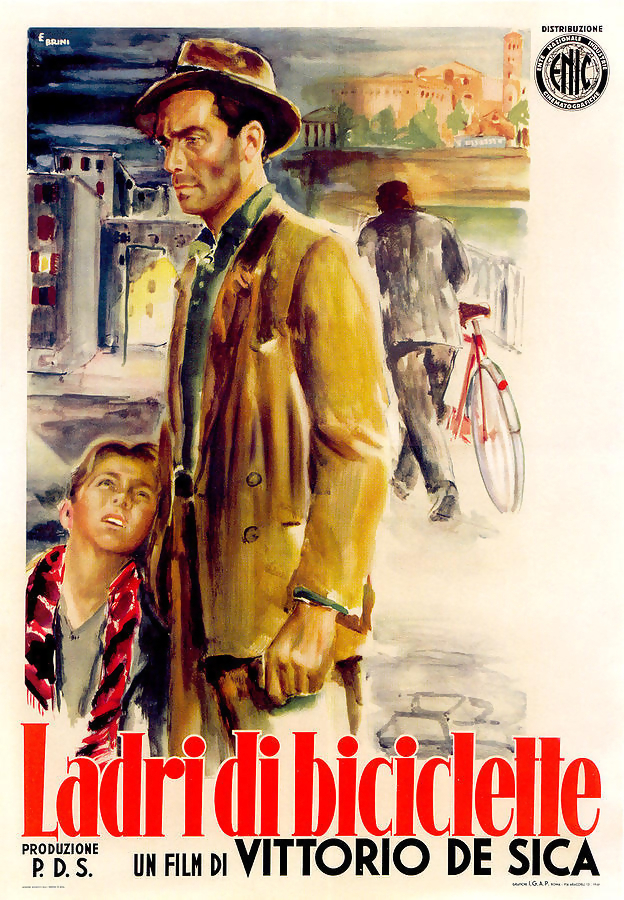
The plot is simple. In post-war Italy Antonio (Lamberto Maggiorani) is desperate for work He stands in line with dozens of others every day hoping the employment office will have something for him. On this day it does, he’s offered a job putting up advertisement posters throughout Rome. But he needs a bike, it is necessary for the job.

Antonio has a bike, but it was pawned. His wife tears off the sheets from their bed and folds most of their linen up. They take it to the pawn shop and sell it. The camera follows the worker as he climbs a ladder and places their linen in a huge pile with hundreds of other sheets they have purchased. They use the money to buy back the bike (which likewise is in the shop next to a long line of other bikes. Pawning one’s stuff is necessary for so many just to survive another day.)

She visits a Wise Woman, kind of a fortune teller, to pay her respects since earlier the Woman had told her that he would get a job. Antonio leaves the bike in the street and follows her up. We expect the bike to be gone when he returns but the film is playing with us, the bike is still there. It does get stolen on the first day on the job. While Antonio is putting glue on the poster a young man swipes it.

The rest of the film follows Antonio and his young son as they wander the streets of Rome looking for it. They go to the police but all they can do is take a report. His friend shows him some open-air markets where thieves often try to sell stolen bikes. He eventually runs into the thief but without proof that he stole the bike, there is nothing anyone can do. As the day goes on Antonio gets increasingly desperate and exasperated.

I won’t spoil the ending but the final moments are incredibly moving.

Director Vittorio De Sica shoots the film naturalistically. He shot on location in Rome. All of the actors were not professionals. The camera acts as an observer and there is nothing splashy about any of the filmmaking. It is a simple story told simply. This was startling to audiences at the time who had grown accustomed to the style and glitz of Hollywood films. It was exciting to see a film stripped down to its essence. Or so I’m told. Watching it now, that excitement has been washed away. What we’re left with is a very nice story, one that can be quite moving even. But not one I’ll be voting for as the best ever made.

I will admit that had I watched it in a different way my feelings may be different. Had I watched it in a movie theater where I could pay sole attention to it instead of my bedroom where distractions abounded I might have tuned into its simple pleasures more. Or were I in a different headspace I may have found the story more emotionally engaging. But for now, I can only recognize that it is a good film, but perhaps not entirely for me.