The Friday Night Horror Movie: House of Usher (1960)

house of usher poster

As a producer, Roger Corman helped launch the careers of Francis Ford Coppola, Martin Scorsese, Jack Nicholson, Peter Bogdanovich, and Jonathan Demme. His films were very low-budget, often exploitive, but they almost always made money. He famously developed a strategy as a producer and distributor that allowed directors to have full creative control (within budget, of course) as long as they had a scene of violence and/or sex every fifteen minutes.

He’s produced an astonishing 512 films in his life (and at the age of 96 IMDB lists at least one upcoming project with his name on it). And though with a few exceptions, he stopped directing in the early 1970s he managed to helm over fifty films.

The most famous of those films are a series of eight films (very) loosely based on the writings of Edgar Allan Poe. House of the Usher was the first of those adaptations. It is a good one.

Phillip Winthrop (Mark Damon) travels to the titular House of Usher, a grand, decaying, gothic old mansion, to visit his fiance Madeline Usher (Myrna Fahey). He is told by the family butler, Bristol (Harry Ellerby) that she is very ill and bedridden. When he demands to see her anyway he is taken to see her brother Roderick (Vincent Price)

Roderick is afflicted with an illness that enhances all of his senses so that the slightest noise, or light, or rough surface drives him to near madness (well, as we’ll see later to total madness). He says his sister is afflicted with the same illness and tells a tale of their entire bloodline being infected with madness so intense it has affected the house itself.

He begs, no he demands that Phillip leave the house but he refuses. This only serves to drive Roderick further into madness and in turn, he drives Madeline to the very edge. Roderick is so intent in his belief that Madeline should not leave the house, nor marry, nor have children that he is prepared to murder her himself.

Corman makes great use of his sets. The mansion is sprawling with a seemingly endless set of rooms, hallways, and secret corridors. As Roderick’s insanity grows the house begins to crumble.

I’m used to watching gothic horror films being shot in stark black and white with great shadows overcoming the scenes, so it is surprising to see this in full, glorious color. It looks magnificent. There is a dream sequence toward the end that is saturated in color and even a bit psychedelic.

Mark Damon is a bit stiff, and Myrna Fahey is just ok, but good golly is Vincent Price great in this. I’m a huge fan of the actor and he’s full-throttling the role as only he can but it works oh-so-well here.

It is a bit slow to get going as these types of gothic melodramas can be, but once it gets into gear it’s a great deal of fun to watch.

The Friday Night Horror Movie: The Brides of Dracula (1960)

brides of drcula

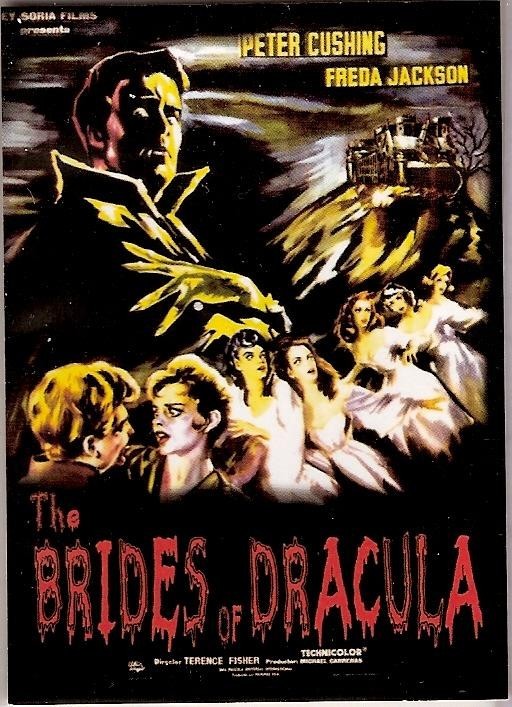
Some of the best Hammer Horror films are the ones where they essentially remake the classic Universal Horror movies. Remake isn’t really the right word for the Hammer versions of the classic Universal Monsters (Frankenstein, Dracula, The Mummy, and the Wolfman) often differ greatly from their Universal origins. The Hammer films were much more violent and sexual than the original films, and just as stylish. They all appear a bit tame by today’s standards, but realizing that many of them were made in the late 1950s and early 1960s it is fairly astounding that they got away with so much.

The Brides of Dracula is the first sequel to Horror of Dracula (1958) (they made several more). Christopher Lee was great in that one as Dracula, but he died at the end so they couldn’t put him in this sequel (he is very much missed here and so he shows up again, despite being dead, in the next movie). Peter Cushing does return as Dr. Van Helsing.

A French school teacher, Marianne (Yvonne Monlaur) takes a position at an all-girls school in Transylvania. She takes the usual rickety coach through the usual creepy woods in the usual middle of the night. When they stop off at a little village for a bite to eat, the coach driver gets spooked and abandons her.

The innkeepers fret about, warning Marianne that she can’t possibly stay the night in their village alone. Just about that time in walks Baroness Meinster (Martita Hunt). She’s old and creepy but kindly offers to put Marianne up for the night in her castle. Despite the innkeeper’s warnings, she agrees.

There she finds a strange servant and the Baroness’s son Baron Meinster (David Peel) locked in his room and chained to the wall. The Baroness warns that he is ill and maybe a bit crazy, but he’s nice to Marianne, and handsome so she unlocks him.

Of course, he’s a vampire. Of course, he pretty quickly starts turning the pretty ladies of the village into his brides and has his eyes on Marianne.

This is where Van Helsing comes in. He does his usual thing which eventually leads to a showdown with the vampire. I won’t spoil it but it has one of the best vampire kills in all of vampire moviedom.

The thing is I generally find Hammer Horror films to be slightly tedious in terms of plot and pacing. The Brides of Dracula is no different. The plot just kind of plods along. It takes ages for a vampire to show up and ages still for Van Helsing to come along. Even then the action is often broken up by too much talking.

But the real thing is that I don’t ever really mind. I love Hammer Horror movies. They always build these incredible sets and costumes. They light it spectacularly with all of these lovely reds, blues, and greens. Their films always look amazing. The men are always dressed in these fabulous suits and the women are draped in the most marvelous flouncy gowns.

I love Peter Cushing (he is so much more than Grand Moff Tarkin in Star Wars. He’s surprisingly athletic in this film, running and jumping all over the place. I love Christopher Lee, too and he is greatly missed in this movie (try as he might but David Peel is the palest of imitations).

So, yeah, plotwise The Brides of Dracula isn’t great, but it is so much fun to look at and watch I don’t really mind.

The Friday Night Horror Movie: The Hunt (2020)

the hunt movie poster

A group of strangers wake up in an isolated forest with gags locked in their mouths. They stumble about until they find a large crate in the middle of a field. Inside the crate, they find a whole bunch of weapons. They find the key to their gags on the ground. As they are unlocking their gags and grabbing the weapons someone starts shooting at them. Several are killed and the rest scatter and run. They are being hunted.

The Hunt is an update on the classic story The Most Dangerous Game but with a lot of unnecessary and rather clunky political satire thrown in.

It was directed by Craig Zobel from a script by Nick Cuse and Damon Lindelof. It was produced under Blumouse Production and it has that same dull slickness that so many of his films contain. It looks good and its production values are nice but there isn’t a distinct directorial voice. It is entertaining, but ultimately forgettable.

The hunters pretty quickly take care of most of their prey, leaving only Crystal (Betty Gilpin) as the last one standing. They apparently didn’t do their homework as she is one tough cookie and has been in more than one fight before.

Gilpin is wonderful in this and she makes it all worth watching. She’s tough and savvy, and there is a little more than a glint in her eye as she takes down her attackers one by one. I’m a fan of The Most Dangerous Game stories (and there have been a lot of adaptations of the 1924 short story by Richard Connell) and I enjoyed seeing it in this modern update.

The hunters here are rich, liberal elites and they are preying on poor, illiterate rednecks whom they seem as contemptible (or deplorable if you will). The film tries to satirize both sides but its humor is too broad and blunt to actually be funny. My favorite bit comes when the hunters are choosing their prey by looking through a slide show of potential victims, all of whom have online profiles they disagree with. It is mostly white, bearded dudes but then a black guy in a cowboy hat shows up. Immediately the response is that they can’t hunt a black guy but then someone chimes in that they’ll get in trouble if they don’t have some diversity.

They bang the satiric drum throughout the film, mocking both sides with broad strokes so much that it distracted me completely from the pretty good humans hunting humans thriller aspects of the film.

The cast is filled with names you likely know – Emma Roberts, Ike Barinholtz, Sturgill Simpson, Macon Blair, Ethan Suplee, Glenn Howerton, and Hilary Swank – most of whom are making glorified cameos, many of which are promptly killed. I love when movies do that, and I love how those early deaths give the movie a feeling of anything can happen.

Of course, it then settles down into relative predictability, but for at least a few minutes I thought they were going off the rails in really interesting ways.

Like I said it ultimately winds up being an enjoyable but forgettable film. Gilpin absolutely makes it worth a watch.

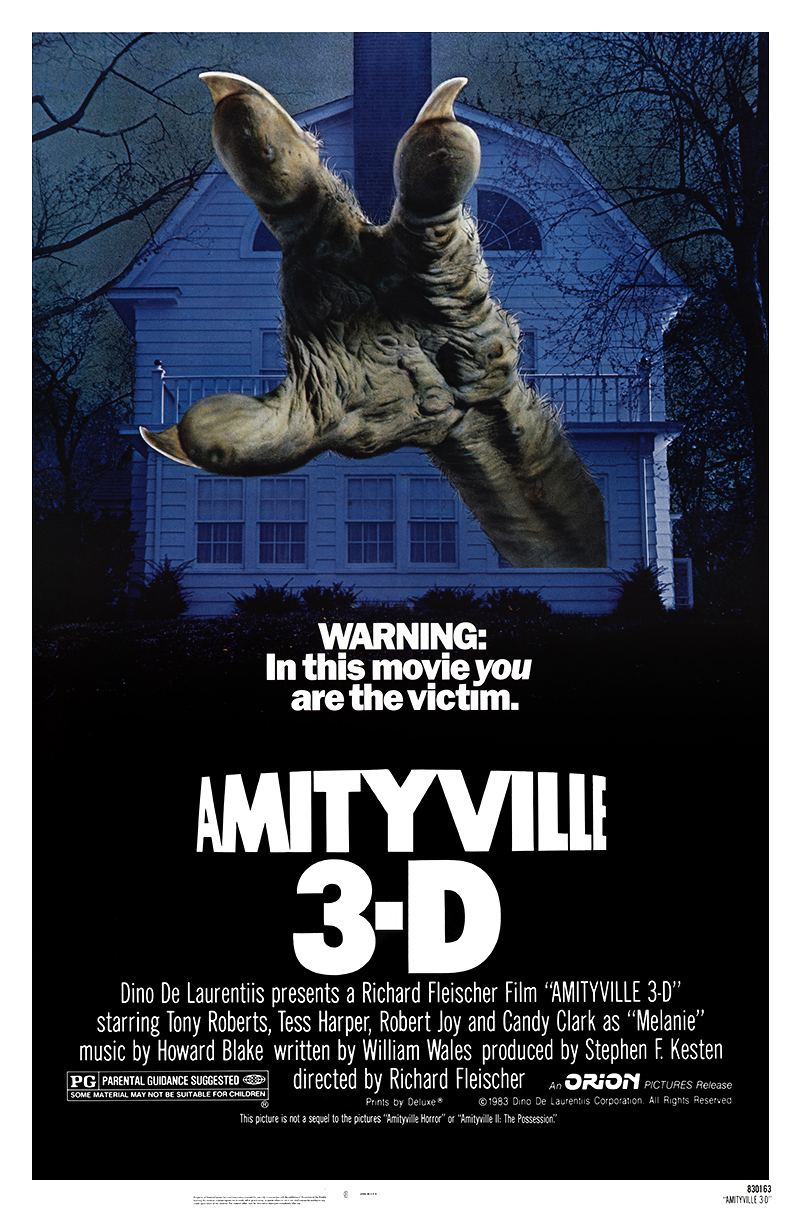
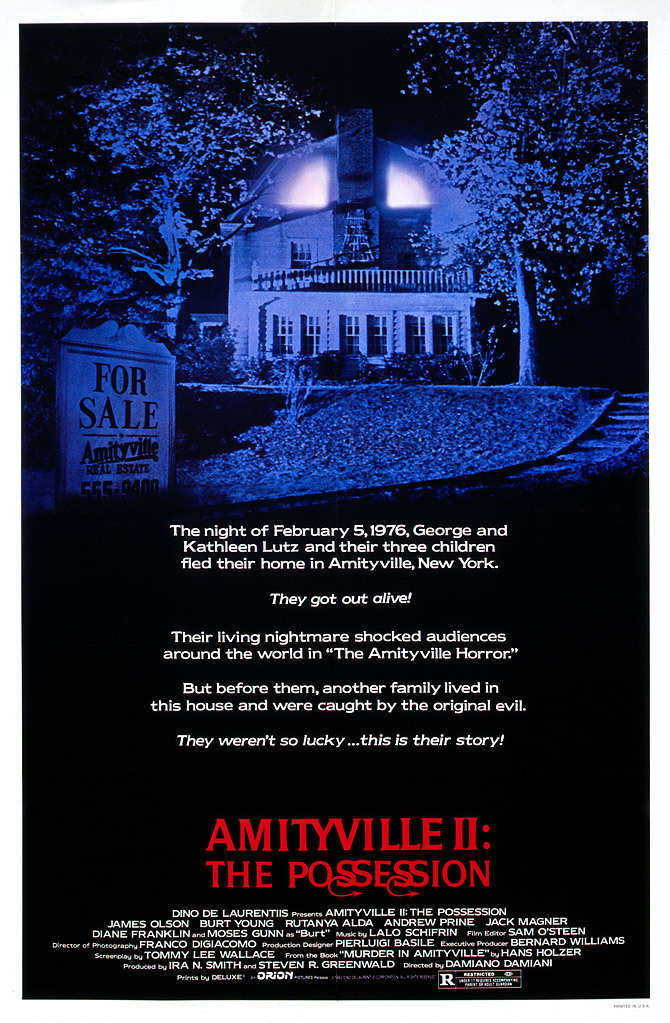
The Friday Night Horror Movie(s): Amityville II: The Possession (1982) & Amityvlle 3-D (1983)


imgboximgbox

The Amityville Horror (1979) is one of those movies that I want to like more than I actually do. It has a good cast – James Brolin looking all masculine in his flannel shirts and beard, Margot Kidder is just lovely and Rod Steiger is doing his best Max Von Sydow in The Exorcist (1973) impression. I like the idea of haunted house movies and this has the coolest looking haunted house ever. But ultimately I find the film to be a bit of a slog. It isn’t scary, or eerie. It isn’t even very moody.

When watching a horror movie from the 1940s I have no problem overlooking hoary old special effects like objects moving across a room or curtains billowing without wind. But in modern movies (and yes I’m counting 1979 as a modern movie as it premiered in my lifetime and feels much more modern than say something like The Uninvited (1944) or House on Haunted Hill (1959)) similar effects just seem silly. The Amityville Horror employs a lot of silly effects that just aren’t scary or all that interesting.

Still, every few years I find myself drawn to it. Like I said I love the idea of it.

Over the last couple of years, I’ve been watching a lot more horror films than I used to. This is mostly due to my creating this concept of the Friday Night Horror Movie. If I have to watch a horror movie (or more than often, two or three horror movies) every Friday then I’m going to naturally watch a lot of horror movies. One of the things I’ve been doing is watching a lot of horror sequels. It is a genre that naturally produces a lot of sequels and I’m finding it quite fun to watch them all in order. I’ve now seen all of the Friday the 13th films, the Nightmare on Elm Street movies, the entire Halloween franchise, and more.

This now brings us to The first two Amityville Horror sequels (there are technically a whole lot of sequels to The Amityville Horror because you cannot copyright the name of the town so anyone who wants to can throw Amityville in their name and tie it to the franchise. But the first two sequels are official and I watched them today.

But first, let’s briefly recap the original film. A newly married couple (played by Brolin and Kidder) along with their children move into a big, historical old house on Long Island. Quickly strange things begin to occur that can’t be naturally explained. By the film’s end, it is clear something has possessed the house and is trying to kill them. That something is the evil spirit that caused Ronald DeFeo, Jr. to kill his entire family with a rifle just one year prior.

Amityville II: The Possession is sort-of the story of what caused Ronald Jr to commit those murders. I say sort-of because in this film the family is called the Montelli’s and the murders happen in a slightly different manner than we see them occur in the first film.

But where The Amityville Horror was filled with classic haunted house tropes and was all the more dull for it, Amityville II just absolutely goes for it. There is no slow build-up, and no time to develop characters, it just takes off and hardly slows down to catch its breath. It begins once again with a new family moving into the house. But right off the bat, we realize this family is already messed up. The father (Burt Young) is abusive. He yells at the kids constantly and threatens to beat them, he actually does beat the wife and it is implied he forces himself on her. The kids are moody and angry.

On their first night they experience a mysterious banging on the door and a freaky drawing appears on the two small children’s bedroom wall. Soon enough the oldest boy (Jack Magner) becomes possessed. He starts hearing voices telling him to kill his family, he yells at his mom and seduces his sister.

It gets weirder from there. If the original played it safe then the sequel throws off the rails and just goes for it. Most of the script, especially the dialogue, is pretty bad, but I love that all of the actors and the direction just completely go all out.

Amityville 3-D (1983) is much more reserved, but I kind of liked it more than the other two. It is a for-real sequel in that it takes place after the events of the other films. By this point the house is famous, or maybe I should say notorious. It has set vacant for years because no one in their right mind would buy it.

Naturally, our film’s hero does just that. He is John Baxter (Tony Roberts) a journalist working for a magazine that specializes in debunking supernatural con artists. He and his coworker Melanie (Candy Clark) debunk a pair of hoaxsters working out the Amityville House and afterward, John decides to buy the place (he’s getting a divorce and it is being sold dirt cheap).

You know the story by now, weird stuff starts happening. What I like about this film is that John comes to the house knowing its history and he doesn’t care. He’s a skeptic. Because of this, the film rolls out its supernatural stuff very slowly. Some of the mysteries and even a couple of deaths happen outside of the house. For sure, supernatural events and gorey deaths happen, but it takes its time with them. The film is more the mood piece the original wanted to be, but here it is quite successful at it.

It was directed by Richard Fleischer who made great films like 20,000 Leagues Under the Sea (1954), Compulsion (1959), and my favorite Soylent Green (1973). This is a man who knows how to direct a film, not the usual hacks that wind up directing the third film in a horror franchise.

As the title implies it was originally shot in 3-D. While there are the usual effects you find in that type of film (various objects flying at the screen, long objects being turned slowly toward the camera) Fleisher and his cinematographer Fred Schuler make the best of the format. Their use of depth of field is masterful. There is almost something in the foreground – a lamp, a tree, anything – that gives the characters or other objects in the screen depth. Shots indoors often take place in a place that allows you to see down a hall or into other rooms. Characters move in and out of frame, etc. It must have been really something to have seen in 3-D, but even in 2-D it looks really cool.

The rest of the filmmaking is very good as well. The actors are quite good and I found the entire thing a pleasure to watch.

The Friday Night Horror Movie: Taste of Fear (1961)

taste of fear

On Friday nights me and the family usually go upstairs to my room and watch Doctor Who. Afterward, the wife and daughter remain in our room to watch Youtube videos, while I go downstairs and watch a horror movie. Tonight, the daughter is staying over at a friend’s house. Which leaves me and the wife here alone.

Friends, I have to admit I didn’t know what to do with myself. We were too tired and poor to really go out for a date night. It is too hot outside to go to the park or anything. So, we had a little dinner and watched a movie. Two movies, actually.

Because I am a creature of habit I could only watch a horror movie tonight. That’s just what I do on Friday nights. Also, I write this article and I couldn’t let you all down, could I? I know every single one of my readers waits for me to tell them what horror movie I watch on Friday nights. 🙂

But my wife doesn’t like horror movies. So, I had to find something she could enjoy as well. Enter Hammer Studios. They made a whole lot of horror movies in the 1960s and 1970s that are not too scary, or gore-filled but are also a lot of fun. My wife can enjoy that sort of thing, and actually quite likes Hammer Horror as a genre.

The first film we watched was Dracula: Prince of Darkness (1966) which is the third film in Hammer’s Dracula series and the second to star Christopher Lee as the vampire (the second film The Brides of Dracula (1960) doesn’t actually have Dracula in it at all). It wasn’t great and since we decided to watch another film after that one, and it is actually quite good, I’ve decided to talk about it instead.

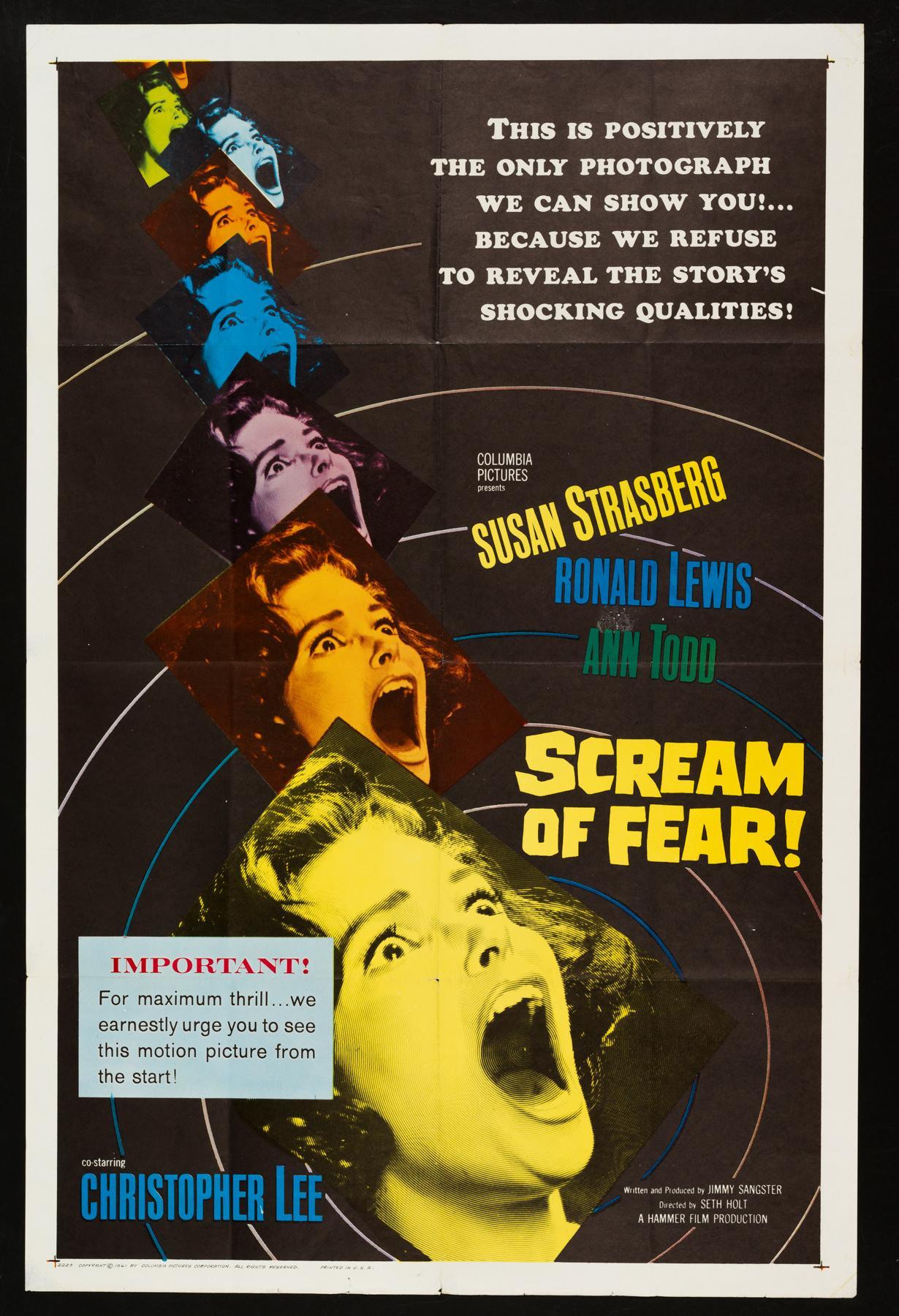
Taste of Fear (sometimes called Scream of Fear) is a wonderful bit of gothic psychological horror. It stars Susan Strasberg as Penny Appleby a wheelchair-bound heiress who has been away from home for ten years. When her father summons her she returns to his estate on the French Riviera. Strangely, when she arrives she finds that her father has just left on business. Stranger still, that night she sees a light on in the no longer used summer cottage attached to the estate. Upon investigating she finds the corpse of her father sitting in a chair.

Fleeing, she accidentally falls into the pool and knocks herself unconscious. When she awakes she is assured by everyone that it was all just a hallucination caused by fatigue and too much wine. As an avid moviegoer, I know at this point she’s being gaslit, but the reasons why are unclear.

The film has a lot of fun (very slowly) unveiling those reasons. Penny continues to see and hear things that make her believe her father is at the house, but no one will believe her. Well, almost no one. The chauffeur (Ronald Lewis) eventually does and becomes the love interest. The film gives us so many twists and turns that it is hard to know what is real and what isn’t. Just when I thought I knew what was happening the film mixed things up and I was completely surprised.

It is a bit of a slow burn, it takes its time to get interesting, but it is beautifully shot in black and white and is filled to the brim with atmosphere and mood. Once things do take off it becomes really quite wonderful.

The Friday Night Horror Movie: Bloody Hell (2020)

bloody hell poster

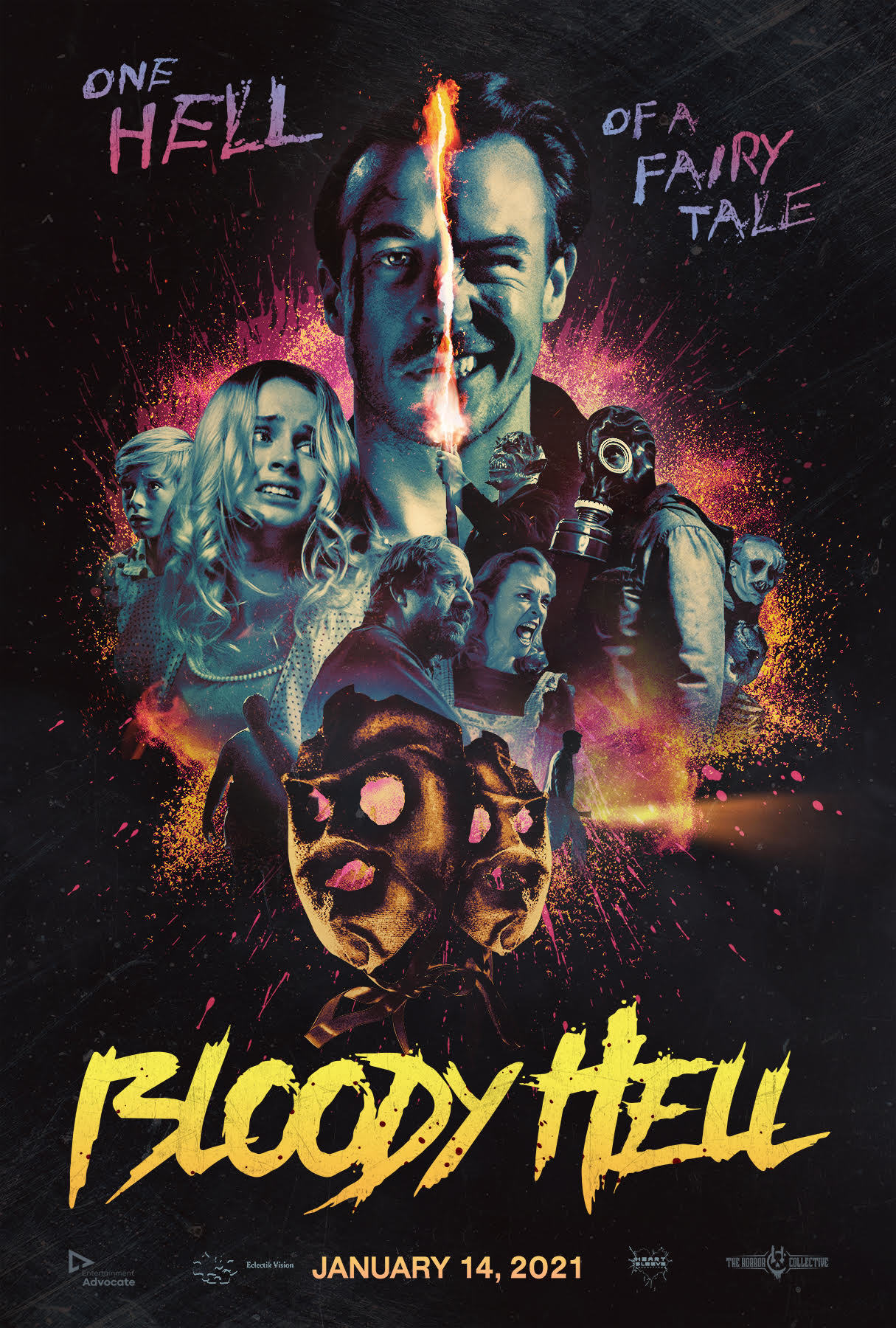
After accidentally killing a woman while trying to thwart a bank robbery, Rex (Ben O’Toole) is sentenced to eight years in prison. Upon release, he decides to go to Finland to escape the media circus (the trial made him famous) and start a new life.

At the airport, he is noticed by a strange couple who keep staring at him and talking about him in Finish. In Finland, just arriving at the airport, he takes a cab. The driver puts releases some gas into the back cabin knocking Rex out. He awakes to find himself tied up in the basement of the strange couple’s house, with one of his legs cut off.

To tell much more of the plot would be to spoil much of the film’s fun. And it is a fun film, despite all the horror, dismemberment, killing, and gore. Rex talks to himself and this is displayed by having him literally talk to himself, as in the actor plays a more sarcastic version of Rex which we literally see as two people. That allows for a lot of humorous back and forth, which works better than it should.

The family consists of a mother and father, and twin sons who are all murderous psychopaths. But there is also Alia (Meg Foster) who understands how screwed up her family is but has not been able to escape. Naturally, she becomes a love interest of sorts.

For the most part, the film deftly mixes its thriller/horror moments with some pretty funny comedy and a surprising amount of whimsy. When Alia first talks to Rex and realizes he might be her salvation we whip into a fantasy sequence with her dancing with Rex in a beautiful field while romantic music plays. That sequence will get a hilarious replay towards the end of the film with some imaginative changes.

It doesn’t always work. The back and forth between Rex and his imagination can be a little grating at times. The family drifts a little too far into cartoonishness, especially at the end. But I found it quite enjoyable. Horror comedy is difficult to pull off and Bloody Hell does it better than most.

The Friday Night Horror Movies: 12 Feet Deep (2017)

12 feet down poster

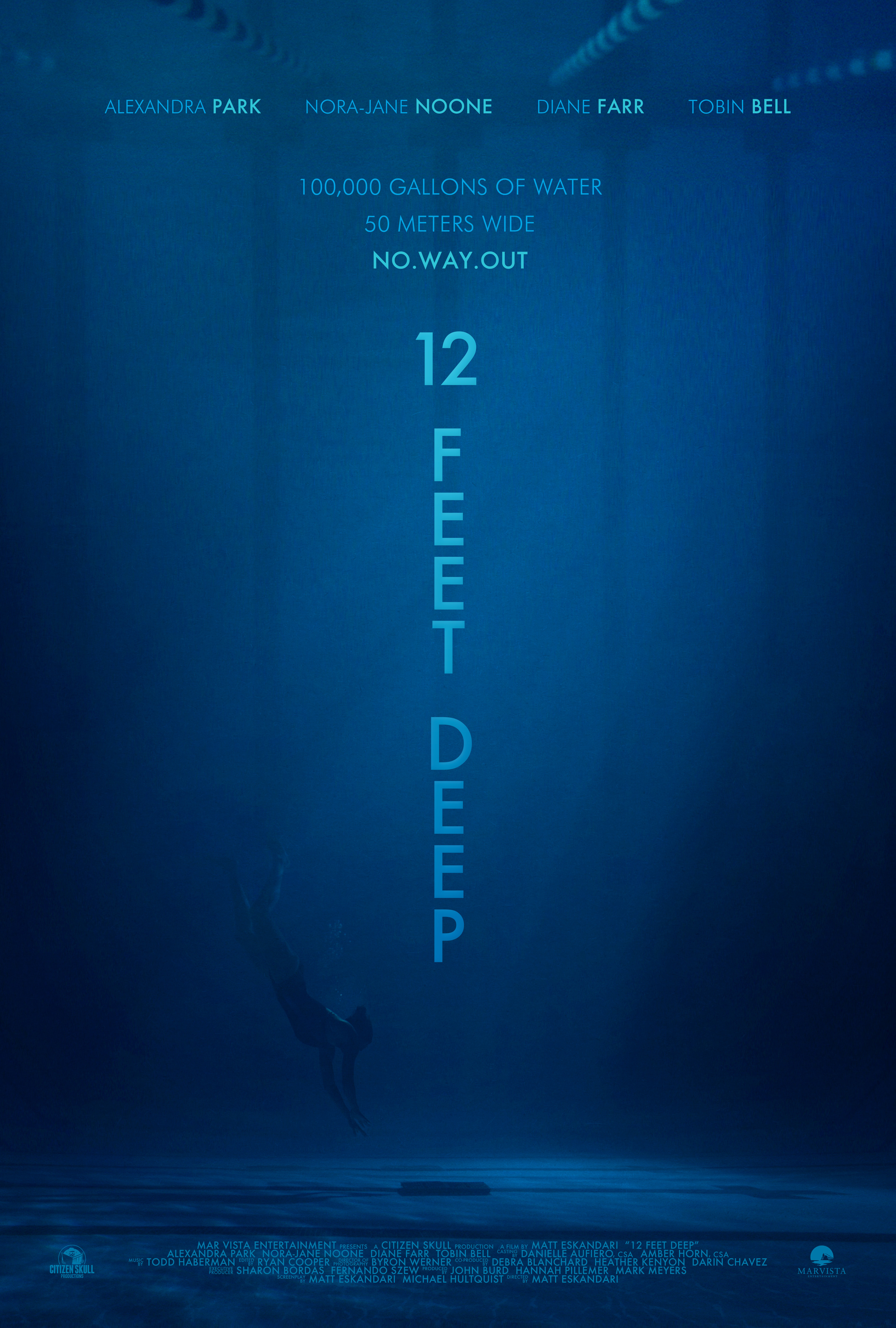
Two estranged sisters, Bree (Nora-Jane Noone) and Jonna (Alexandra Park) go swimming at an indoor public pool. Before the official closing time the crotchety pool manager (Tobin Bell) yes to everyone to leave. They are closing for the holiday weekend and he wants to have an early start on it.

As they are leaving Bree realizes she’s lost her engagement ring. Jonna finds it at the bottom of the pool, stuck in a grate at the bottom of the pool. They both dive in to retrieve it. At the same time, the manager engages the pool cover and locks it up. The girls are stuck inside the pool for the long weekend.

That’s a pretty interesting premise for a film. The trouble is there is only so much tension you can ring out of two girls in a pool. The cover keeps them trapped but there is plenty of air and while a few days stuck there would be difficult it likely isn’t deadly. So it has to find new or different things to keep the viewer interested.

The film initially tries to do that by upping the emotional conflict between the two girls. Jonna is a drug addict, three months clean, who has just returned from rehab. Bree has a burn scar on her arm from a childhood trauma that slowly gets revealed as the film goes on.

But that really isn’t enough to keep an audience interested, especially when you want to bill your film as a thriller/horror. It also isn’t that well done. The writing for these scenes just isn’t strong enough.

The film seems to understand this, having the girls at one point joke that all they need to make it a perfect night would be for sharks to enter the pool. Honestly, I think I would have preferred some sharks.

Eventually, we learn that Bree is diabetic and she needs an insulin shot or she’s going to go into a coma. That creates a little tension, but it still isn’t enough.

Enter Clara (Diane Farr) an ex-con who was working for the pool, but just before the girls got trapped we were treated to a scene where she was caught stealing from the lost and found and got fired for it. She sees the situation as something that could be advantageous for her.

She steals Bree’s phone and what little cash she had in her purse. Then demands the PIN for her bank card. Then this, then that. She’s just awful and becomes the film’s Big Bad.

But the film keeps going back to the sisters talking. Bearing their souls. Getting down to the bottom of their dark past. Then when that gets boring Clara will come back to do something terrible.

The movie isn’t bad enough to be outright awful. It is adequately directed – Matt Eskandari gets good use out of the pool’s geography and the two leads are good enough for the material. But it also isn’t very good. It is a film that is trying just a little too hard to be deep and emotional but it never quite connects in that fashion. Then it undercuts itself by having Clara do something completely over-the-top or allowing Bree to slip into unconsciousness.

It also isn’t very scary or horrific. It is labeled as horror which is why I watched it and why I’m writing this piece, but it just barely skates into that territory.

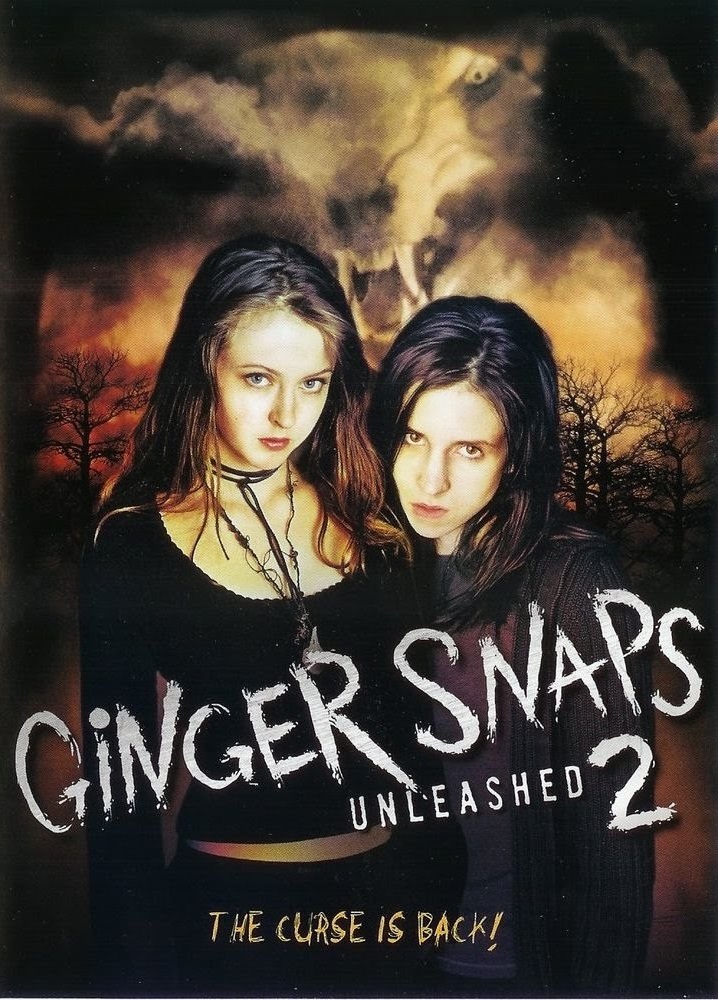
The Friday Night Horror Movie: Ginger Snaps 2: Unleashed (2004)

ginger snaps 2 poster

Ginger Snaps (2000) is a wonderful coming-of-age horror film about two angst-filled, sarcastic teenagers who form a death pact before one of them gets bitten by a werewolf and begins to change.

Its sequel finds one of the girls, Brigitte (Emily Perkins) stuck in a rehab clinic after she overdoses on the wolfsbane she’s been injecting to keep her own transformation at bay.

At the clinic, she meets Tyler (Eric Johnson) who trades whatever the girls are addicted to for sexual favors, and Ghost (Tatiana Maslany) a young ward of the clinic who quickly realizes that Brigitte is a werewolf and becomes her only friend.

The film loses a lot of what made the original so great – mainly the bond between the two sisters and their withering takes on suburban life in high school. Ginger (Katharine Isabelle) does appear in the film, but only as a hallucination and she’s more foreboding than fun). Ghost doesn’t provide nearly the same punch.

Yet, it is still an enjoyable film. It relies more on the drama of whether or not Brigitte will escape the clinic and stop her full transformation into a werewolf than horror tropes. Though there is a werewolf stalking her, looking for a mate.

The first film used the werewolf transformation as a commentary on puberty, this film critiques the ways in which men tend to prey on young women.

When the horror does come it is appropriately violent, and gory. Overall it isn’t quite as great as the first one, but it’s still carries quite a bite.

The Friday Night Horror Movie: Special Effects (1984)

special effects movie poster

There is a question that, I suppose, needs to be asked here. What, exactly, is a horror movie? Sometimes that’s easy to define. Horror movies have ghosts or monsters in them. Vampires, blobs, werewolves and other creatures of the night fill the screen of many a horror film. But what about more pedestrian horror? Movies in which the villain is human.

Jason Vorhees is just a man in a hockey mask with a machete (at least in the early films, he later becomes superhuman and virtually unkillable). But there are lots of crime movies with higher body counts. No one would argue that the Friday the 13th movies are anything other than horror, but serial killer movies are often called thrillers.

Maybe that’s because there usually isn’t a police detective trying to solve the case of the Jason killings. But then there are a lot of Italian horror films, giallos especially, that plotwise are basically police procedurals.

Maybe horror movies are more gore-filled. But that doesn’t always track either because some cop flicks concentrate on the extreme violence of their killers. And plenty of horror films have very little gore or none at all.

I don’t have an answer here. It is a big debate that I won’t solve in these pages. I mention it because tonight’s Friday Night Horror movie could be considered more of a thriller than a horror, but it does carry the horror genre label on IMDB and that’s what I thought it was coming into it, so that’s what we’re gonna keep calling it.

Andrea Wilcox (Zoë Lund) left her husband Keefe (Brad Rijn) and small child in Texas to go to New York City and pursue an acting career. Though she’s willing to sleep with producers and directors and anybody who will give her a part she’s only able to find jobs doing nude modeling and the like.

When Keefe comes to get her back and bring her home she lies and says that her career is starting to take off. Why, she has a meeting that evening with Neville (Eric Bogosian) a famous movie director. She does in fact go to his house that evening and literally begs him to at least take a look at her.

He does look at her, then sleeps with her, and secretly films the encounter, and strangles her to death. He cleans her up, puts her inside Keef’s car, and dumps it at Coney Island.

The cops immediately suspect Keef and arrest him. Neville hires an expensive attorney and gets him free on bail. He then decides to make a movie about Keef and Andrea. He gets Keef to play himself and finds an amazing Andrea look-alike in a woman named Elaine (also played by Zoë Lund) to play Andrea.

Things get weird from there.

B-movie auteur Larry Cohen mixes Vertigo (1958) with Body Double (1984) and bits of Peeping Tom (1960) into a sleazy cauldron of awesome. He has Brian DePalma’s flair for taking Hitchcockian ideas and amping up the sex and violence, but very little of either director’s sense of style. Though he does create some really interesting sets, especially Neville’s giant apartment filled with mirrors and water.

The film really is more thriller than horror as Neville takes his movie ideas to extremes and is more than willing to kill again to maintain his cinematic goals.

Special Effects wasn’t at all what I was expecting when I put it on, but I found it to be quite enjoyable.

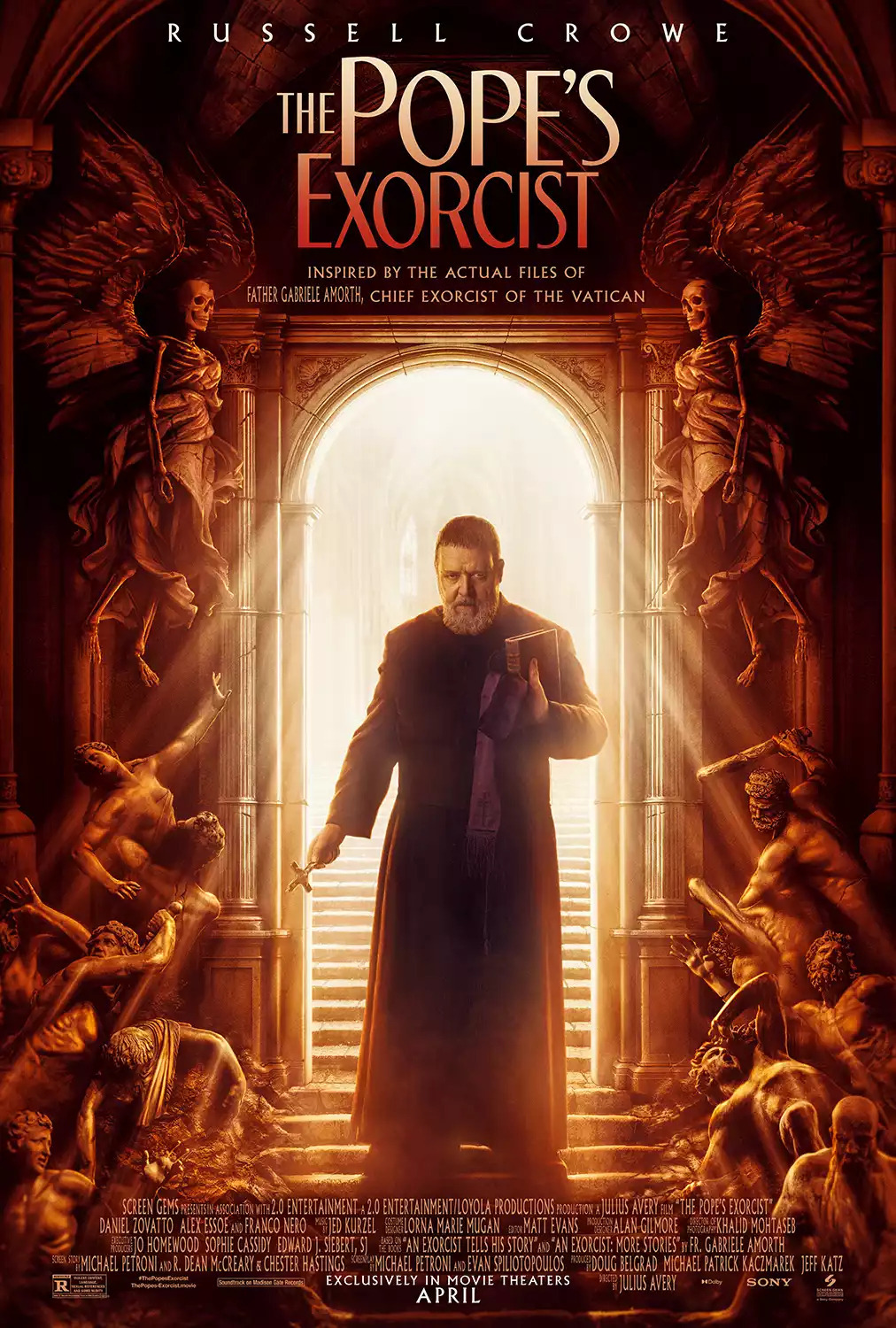
The Friday Night Horror Movie: The Pope’s Exorcist (2023)

the popes exorcist poster

I love going into a movie completely blind. Not knowing anything about a film before watching it can lead to beautiful surprises. It can also lead to utter befuddlement and disappointment.

The only thing I knew about The Pope’s Exorcist before watching it tonight was that it starred Russell Crowe. Well, I knew it was a horror movie, and I was pretty sure it was going to involve some exorcism, but that’s it.

Honestly, I kind of thought it was going to be about the Pope getting demon-possessed and Russel Crowe was going to save him. I didn’t really think about the details of how that might work – how the head of the Catholic Church could get possessed – but it sounded kind of cool. It still does.

But no, the title refers to the fact that Russel Crowe’s priest – Father Gabriele Amorth, who was a real person – was hired directly by the Pope and would, in fact, be his personal exorcist were he to be possessed. But that doesn’t happen here. Instead, a demon possesses a little boy (Peter DeSouza-Feighoney).

Though Amorth was a real person and he was the official exorcist for the Diocese of Rome, the actual story is completely made up. Although one could easily argue it was mostly stolen from The Exorcist (1973). The boy does all the things demon-possessed kids do in these types of movies. He curses, he blasphemes, he sexualizes his mother, turns crosses upside down, etc.

There is also a mom (Alex Essoe) and an older sister (Laurel Marsden) and a tragic backstory (the dad was killed in a car accident, the boy saw it happen). But all of that is very bland and the film doesn’t really care about any of it.

Russel Crow plays Amorth like a jokester who carries a lot of pain. His performance reminded me of his character in The Nice Guys (2016). He periodically, though not often enough, lays down these great little sly jokes. I wish they’d leaned into that aspect a lot more. I rally wish I’d watched The Nice Guys again, that movie is terrific. Mostly this film is a very serious slog.

They don’t do anything new with the possession angle, but do spend a lot of time having Amorth and his newfound buddy Priest Esquibel (Daniel Zovatto) dig up the church’s sins (the Spanish Inquisition and the child abuse scandals) and blaming them on the devil.

It all concludes in a big sloppy, CGI mess that is as incoherent as it is dumb.