The Friday Night Horror Movie: Dream Demon (1988)

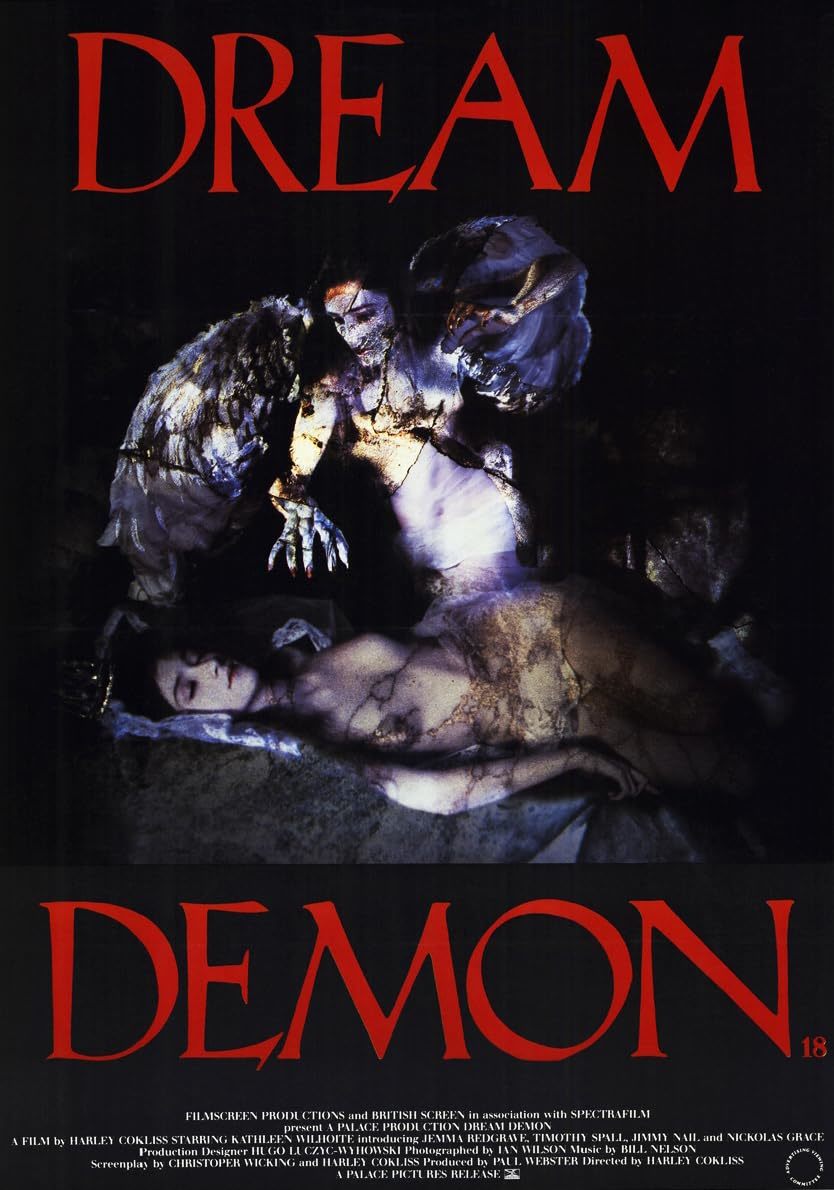
poster

A beautiful, upper-class schoolteacher prepares to marry her military hero husband. But instead of saying “I Do” she declares that she cannot marry him. He rebukes her with a slap to the face. She responds in kind and knocks his head plumb off of his body. She flees the church with her white wedding gown covered in bright red blood.

This is a dream of course. Diana (Jemma Redgrave) will have many more of them before the film ends. Many, many more of them. I’d say a good 2/3rds of the film is dream sequences.

The dreams aren’t particularly scary, or even all that inventive. While watching this I kept thinking that if someone like David Lynch had directed it, Dream Demon would be a true classic. He’d create nightmares that we’d be talking about for decades. Instead, we get a lot of long hallways, a creepy basement, and the occasional man on fire.

Despite all of this I still quite liked the movie. What the dreams lack in imagination they make up for in beauty and mood. They are all shot with dramatic, shadowy lighting and wonderfully moody colors. They are…well…dreamy.

The plot outside of the dreams involves Diana trying to understand why she is having these dreams. Is she just nervous about getting married like her therapist suggests, or is there something more nefarious happening? Despite the title of the film, there isn’t anything supernatural going on, although it does owe a great debt to A Nightmare on Elm Street made just a few years earlier. But sadly, there is nothing akin to Freddy Krueger stalking her dreams. The film could really use a good villain.

There are a couple of obnoxious paparazzi types hanging around and one of them (played by the great Timothy Spall) features in some of the dreams, getting more and more grotesque with each one. But they ultimately don’t amount to much.

She’s helped by Jenny (Kathlene Wilhoite) an American who says her biological parents used to live in Jenny’s house, but she was adopted as a young girl and has no memory of them.

The two begin sharing dreams, each living inside the other’s nightmares and they begin to be afraid that they will never escape them.

Unlike a lot of movies of this sort, neither girl makes any real effort to stay awake. They don’t drink coffee by the gallon or try to remain standing or anything. Diana falls asleep a the drop of a hat. She’s constantly nodding off while sitting on the couch or anywhere else. Despite the fact she’s terrified of what she might dream of.

The resolution is as unimaginative as the dreams, and yet again I still quite enjoyed the film. There is a mood that the film is vibing on that I found to be pretty great.

The Friday Night Horror Movie: The Devil Rides Out (1968)

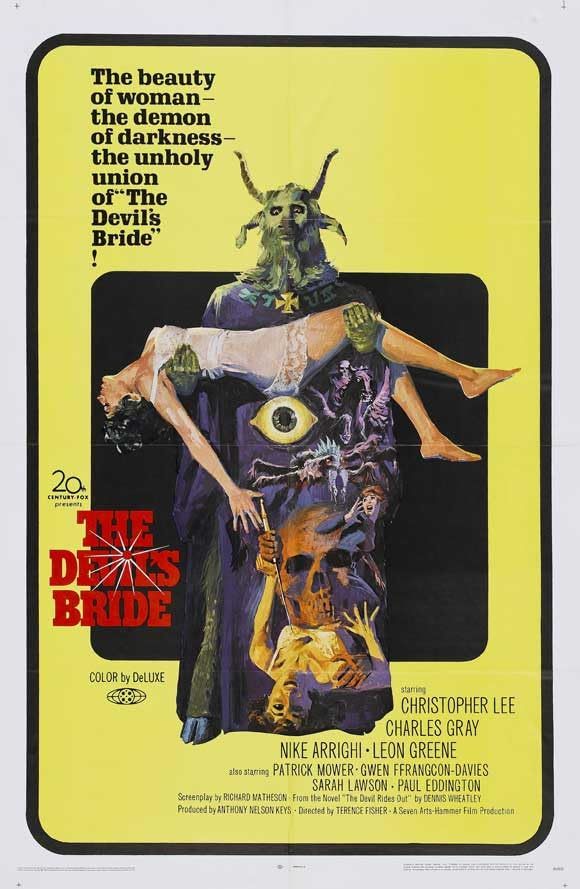
poster

I am 100% a fan of Hammer Horror. I love the production designs, the sets and costumes, and the way their films looked. I love their stable of great British actors including Peter Cushing and Christopher Lee. I’ve watched something like 28 of the 70 or so films the studio made in the horror genre. So again I say I am a fan.

But I have to admit, that while I love a great many things about these films, I often find them rather dull. The films look gorgeous, and there is often a wonderful amount of sex and violence for a 1960s production, but the plots often have this staidness to them. There is a lot of boring talking and exposition that takes place that just causes me to nod off.

The Devil Rides Out (or The Devil’s Bride if you prefer) kept me completely enthralled from start to finish. It is quite wonderful throughout.

Christopher Lee stars as Nicholas, Duc de Richleau (who was apparently a recurring character in a popular series of novels from 1933 to 1970) a nobleman with a sturdy education and who is well-versed in the occult.

When his friend Rex Van Ryn (Leon Greene) returns home from a long voyage they decide to stop at their mutual friend Simon Aron’s (Patrick Mower) house. There they are met by a strange group of people Simon calls his Astronomy Club, but whom Richleau quickly deduces is a satanic cult.

They manage to rescue him from the house but almost immediately lose him again. They rescue him a second time, this time from a Satanic Orgy/Baptismal ceremony where a goat-headed Satan has been summoned. They also rescue Tanith Carlisle (Niké Arrighi) who was also supposed to be Satanically baptized that night.

Simon and Tanith are both somewhat under the spell of the head Satanist Mocata (Charles Gray). He can sometimes mind-control them into doing things for him (and sometimes he can’t depending on the needs of the script).

It is all a bit silly, but it won me over by the power of the performances (especially Christopher Lee who is always great, but especially wonderful here). Unlike a lot of Hammer films which tend to lean into their silliness, The Devil Rides Out is completely serious in its presentation and it is all the better for it.

There is a scene in the back half of the film in which Richleau creates a circle of protection that he and his cohorts must stand in to resist the power of Mocata. It begins with most of his friends being skeptical. It is a bit silly to think a chalk circle with some Latin written in it will protect them from anything. But then there is a loud knocking on the door and the sound of Simon yelling to be let in. Then a giant spider attacks, followed by Death riding a horse. The effects are cheap and goofy, but somehow effective. By the end, everyone is terrified, including me.

It is a scene that shouldn’t work. In the hands of less competent people, it wouldn’t work. And yet it is one of my favorite scenes in all of Hammer Horror. The entire film is like that. It shouldn’t be as good as it is, but somehow it is all pulled off magnificently.

The Friday Night Horror Movie: Late Night With The Devil (2023)

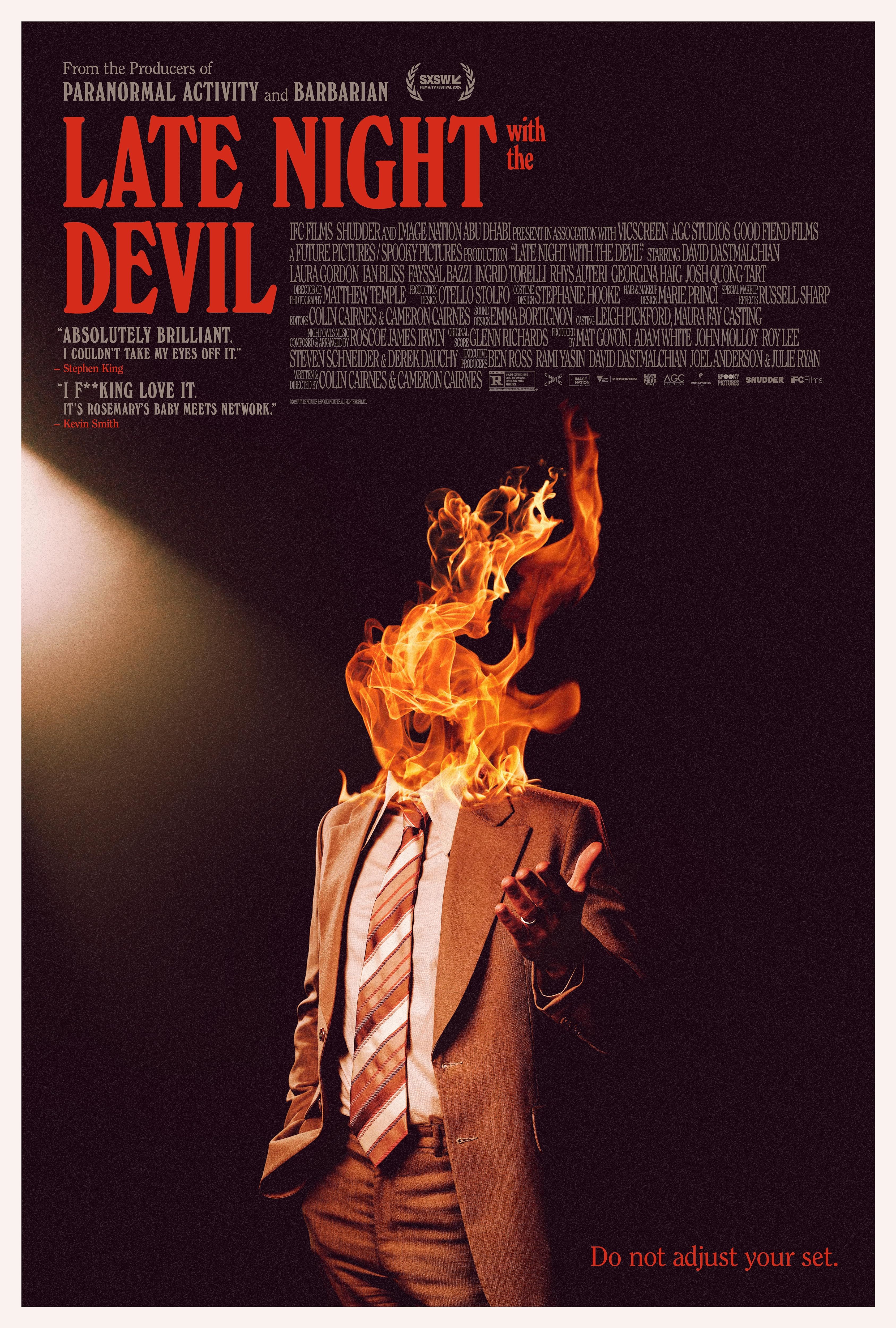
poster

Late Night With The Devil is a sort-of found found-footage horror film about a late-night talk show that goes horribly wrong one Halloween night. Other than a short intro setting things up the entirety of the film takes place in real-time as we are watching tapes of the show from 1977. During what would be the commercial breaks we see behind-the-scenes footage as the host, guests, and crew relax, prep, and talk about the show without the cameras sending images to the world.

Night Owls with Jack Delroy is a typical late-night show from the 1970s. Think The Tonight Show with Johnny Carson a show the movie references several times as Night Owls is never able to gain the same ratings Carson does.

It is hosted by Jack Delroy (a terrific David Dastmalchian). The film’s introduction lets us know he’s incredibly ambitious and constantly let down that his show doesn’t get better ratings. After his wife dies of cancer (the episode in which she appears, clearly very sick and telling stories of their relationship gives the show its highest ratings to date) he is a changed man. The show never recovers and is on the verge of cancellation.

The Halloween Episode that we watch is a last-ditch effort to get the ratings they desperately need. Guests for the night include a hokey medium called Christou (Fayssal Bazzi), Carmichael Haig (Ian Bliss) a former magician turned skeptic, and June Ross-Mitchell (Laura Gordon) a parapsychologist who has brought with her Lily D’abo (Ingrid Torelli) a teenaged girl who survived a Church of Satan-esque cult and now is believed to be possed by a demon.

It is well made. The sets and costumes look very much like how a talk show circa the 1970s looks. They have the feel of everything exactly right. There are some nice jump scares but mostly it creates an increasingly creepy mood that eventually blows up into holy-crap territory.

I liked a lot of it, but I gotta admit I just don’t love this type of found-footage horror movie. I saw The Blair Witch Project in the theaters and absolutely loved it. But that film showed us edited versions of the found footage. Or at least they periodically stopped the cameras allowing us to jump forward in time, skipping the boring bits.

Films like this, which exist in real time become tedious to me. We see the opening credits to Night Owls and then we watch it unfold just as a real audience might have watched it from home. The behind-the-scenes footage during the commercial breaks is shot in black-and-white and breaks things up a bit, but it still unfolds in real-time.

There is an opening monologue filled with the types of dumb jokes all these shows have. There is a sidekick who riffs along with Jack. Cristou, the first guest talks like any of those so-called psychics you can find on late-night television and morning Zoo radio programs.

Obviously, any horror movie had to build towards the scares. You don’t start things immediately off with the horror or you have nowhere to go. But making me sit through a late-night talk show, something I have come to loathe in real life, just isn’t the way to go to win my heart.

It does get there in the end. It gets terrifically scary as the tension revs up and the demon possession seems more and more real. It is definitely worth watching, especially if you are a fan of found footage films. For me I can’t help but feel a little disappointed, even while recognizing the skill by which is it made.

The Friday Night Horror Movie: Immaculate (2024)

poster

For various reasons, I don’t watch a lot of modern films. I almost never go to the theater anymore and at home I tend to go for classic movies or movies with at least a decade or two under their belt. I do watch new movies every now and again. Ones that get rave reviews eventually make it to my queue, but more often than not they don’t get watched until they are at least a few years old.

There isn’t a judgment hidden in that paragraph. I’ve got nothing against new movies, many of them are quite good, I’ve just become a classic movie fan. I like the history of those old movies. I like that even when I watch a bad movie that was made way before I was born it feels like it was worth watching. It helps me understand cinema better. Whereas when I watch a bad modern movie I feel like I’ve just wasted my time.

Watching a lot of old movies and not watching a lot of new ones tends to skew my perceptions of what’s popular. I miss a lot of trends. I don’t necessarily know all the new stars and filmmakers. I keep my nose in pop culture enough that I tend to know names and faces, but I haven’t always seen the films and shows from the newest, hottest celebrities.

This is the long way around to say I’ve only seen one other movie starring Sydney Sweeney (I think I’ve seen her in a couple of other films but in small roles where she wasn’t particularly noticeable).

I’ve been hearing Ms. Sweeney’s name a lot lately. For a hot minute, it seemed like she was everywhere. I’m not exactly sure why, I don’t pay that close attention to pop culture buzz. She was on Saturday Night Live I think and then there was something about her cleavage and her fame skyrocketed.

A few months ago I saw her in Reality, a pretty good movie based on a real-life story about a woman leaking secret documents to the media. I didn’t even realize it was Sweeney until the credits rolled. She was good in it and I made a note to check her out in other things.

This has been an even longer way around to say I just watched Sydney Sweeney star in Immaculate, a pretty okay horror film with an absolutely brilliant ending.

I’m tired. It has been a long day which concluded a long week. I ramble when I’m tired. Sorry.

In Immaculate Sweeney plays Sister Cecilia a Catholic novice who has just arrived at an Italian convent where she is to take her vows. She’s an American with no connection to Italy. She doesn’t even speak the language. But her previous church floundered due to lack of attendance and Father Tedeschi (Álvaro Morte) talked her into coming to Italy.

We get bits and pieces of her backstory. A near-death experience as a child left her feeling God has a plan for her, but she hasn’t quite figured out what that might be. It is never clear if her piousness is real and deeply felt, or if it stems from her need to find purpose.

At one point in the film another nun tells her that this convent is not the place to find herself, it is a place of hard work and devotion. Sister Cecilia swears she understands but she lacks conviction.

Strange things are afoot at the nunnery. Director Michael Mohan fills the screen with most of the tropes from this type of gothic religious horror film. If you are a fan you’ve seen most of what happens here before, and probably in better form. There are creepy nuns, creepier people in dark robes, disturbing priests, candle-filled rituals, and lots of jump scares.

Cecilia finds herself pregnant. She swears she’s never had sex before and we believe her as that’s where the title of the film comes from. I won’t spoil how this happened, but let’s just say the convent is more of a cult than a church (I’ll let you make your own jokes about how all churches are cult-like).

The thing is for the first two-thirds of the film’s run time it is all kind of tame. It isn’t bad necessarily, but it isn’t all that thrilling either. Like I say I’ve seen this done before, better. I never quite buy into Cecilia’s arc. I never felt like she was a true believer. But who she really is, isn’t explored very deeply.

But here’s the other thing, make it through those boring parts. The end is worth it. Sweeney is much more comfortable with the scream queen aspects of this role than the faith-filled parts. As things start to unravel (and boy do they unravel) I start to see why she’s become such a star. It concludes with a long take that’s really quite something.

And that’s all I’ll say about that.

The Friday Night Horror Movie: The Silence of the Lambs (1991)

poster

Music has the ability of searing into your brain as memories. We all have songs that immediately take us to a particular place and time whenever we hear them. Movies can do that but to a lesser extent. I remember movies for their plots, or their direction, or some other thing, but rarely do they bring me back to the time in which I watched them.

I don’t actually remember watching The Silence of the Lambs for the first time in the theater, but I remember why I watched it. My brother is four years older than me. He was dating a girl named Jennifer at the time. He had just graduated high school but she was still a junior. Unsurprisingly, I was not a popular kid in school, but she was. She liked me. Her popularity rubbed off on me a little bit, by proxy. I wanted to impress her.

They watched The Silence of the Lambs on a date and came back raving about it. Somehow, I talked my mother into letting me see it. I was 15 at the time, and usually not allowed to watch rated R movies.

I did like the movie, but I didn’t love it. But wanting to make Jennifer think I was cool I pretended like it was my new favorite. I faked it so well that my mother bought me the novel by Thomas Harris for Christmas.

I wasn’t much of a reader at the time, but I devoured that book. I read it three times over the Christmas break. The novel is more of a procedural than the movie. It digs pretty heavily into the behavioral science and forensics of catching a serial killer. I loved that stuff. I’ve always been fascinated by serial killers and the book was like catnip to me.

I watched the movie again when it came out on home video and for the first time, I realized how a book can enhance a film. So many little details were filled in by the book that the movie somehow seemed better by knowing them.

It has remained a favorite of mine. The DVD was the first one I’d ever purchased that was put out by the Criterion Collection.

Every time I watch it my appreciation deepens.

I’m not the only one who thinks it is a masterpiece. It made Anthony Hopkins a star. It swept the Oscars that year winning Best Picture, Best Actor and Actress, Screenplay, and Director.

Hopkins’s performance is a thing of legend. He’s only in it for a small amount of the film’s runtime, but he made Hannibal Lecter an icon of the horror genre. He’s terrifying. He’s also immensely quotable. I found myself saying his dialog along with him in every scene.

Real quick, the plot, for the few of you who may not know it. Jodie Foster plays Clarice Starling, an FBI trainee. She’s tasked by Behavioral Science director Jack Crawford (Scott Glenn) to interview Hannibal Lecter, a notorious serial killer and cannibal, currently behind bars at a hospital for the criminally insane. He calls it an interesting errand, but really he’s hoping Lecter might shed some light on catching Buffalo Bill a man who is currently killing women and skinning them.

Clarice and Hannibal form a kinship of sorts – she tells him personal stories about her life and he gives her some insight into Buffalo Bill. Then Clarice investigates and eventually captures the killer.

It was hugely influential, nearly every serial killer movie and TV show that follows owes a debt. But what I love is that director Jonathan Demme isn’t all that interested in the genre. He’s telling a much more human story. The film often uses character POV shots to let us see what others (mostly Clarice) are looking at. It gets you inside their skin. Jason Bailey over at Flavorwire has an excellent essay on the use of POV in the movie.

Multiple times Demme shows how men ogle Clarice when she passes by. There is a famous scene at the beginning of the movie where she gets on an elevator surrounded by taller men who stare down at her. Or another one where a group of men jog past her and then turn around to look at her ass.

At a funeral home, about to perform an autopsy on one of Buffalo Bill’s victims, Crawford says something to a cop about not wanting to discuss such a heinous crime around…then he glances over at Clarice. It is a tactic meant to allow the two men to move away from the crowd of cops, but the camera lingers on Clarice’s face showing her disappointment and anger. Later she calls Crawford out on it, noting that while he may not be sexist himself, moments like that indicate to the men present that sexist behavior is okay.

Over and over Demme shows us how difficult it is for a woman to get any respect at the F.B.I. And how Clarice has to be tough and smart just to stay afloat. Call it a feminist serial killer movie.

But it is also thrilling. The scenes with Buffalo Bill are terrifying. He’s wild and camp while Lecter is subdued and intellectual. Both are nightmares come alive.

I could go on and on. I love this movie fully. It is so smart and entertaining, thrilling and scary – bolstered by terrific performances, a great script and subtle direction. One of my absolute favorites.

The Friday Night Horror Movie: Knife of Ice (1972)

poster

I knew that I was going to watch a Giallo some Friday this month when I dedicated it to murder mysteries. The name Giallo comes from the yellow coloring of the cheap paperback mysteries that were for sale in Rome at the time. Filmmakers started adapting them in lurid, violent ways, which turned them into horror films, but at their heart, they are murder mysteries.

I had not meant this Giallo to have been directed by Umberto Lenzi, the Italian genre director who now leads the director field in my stats for the year with me having now seen four of his films in 2024. I never would have guessed he’d be leading the pack in the middle of May. But life, and my film watching, is just full of surprises.

This one stars Carroll Baker (who made three other films with Lenzi) as Martha a woman who witnessed her parents die in a horrible accident when she was but a child, rendering her mute.

Now in her twenties, she lives with her uncle in a beautiful estate in the Spanish countryside. One day her cousin Jenny (Evelyn Stewart), who is a famous singer shows up. Then she gets herself murdered by a knife-wielding maniac.

The police note that another woman was found dead in a ditch not far away. It must be the work of a sex maniac. Later they’ll find remnants of a black mass and decide the murders aren’t that of a sex maniac, but of a satan worshipper.

More murders pile up and it appears as if Martha may be the next victim. The police inspector put three officers around her house for protection. It is the worst protection I’ve ever seen in a film. One guy takes shelter in an underground crypt (her house is next to a cemetery). Another one tells her that his replacement is running late so he just takes off without waiting. The last guy gets a call stating there is an accident nearby so he takes off, leaving her alone.

There are lots of twists and turns and the killer’s reveal is a big (and rather dumb) twist that will likely surprise everyone. Lenzi is a good enough director to keep you from getting bored, but just. There are some cool images (one involving some fog-covered streets is particularly nice) and some well-directed kills, but the story is mostly dull. There’s nothing particularly special about it.

The Friday Night Horror Movie: Guilty of Romance (2011)

poster

When you watch as many movies as I do you are sometimes going to venture into the strange. You’re gonna watch a few films that make you say “What the Hell did I just watch?” I’m not entirely sure I liked Guilty of Romance. I’m definitely sure I didn’t quite understand it. But I’ll never say I was bored watching it.

It begins with a grizzly murder. A young woman has been dismembered inside a rundown flat in the Love Hotel district of Tokyo. Parts of her body are wearing a pretty red dress with the missing parts being replaced by mannequin pieces. Other sections of the corpse are fitted out in the same manner but in a schoolgirl uniform. The head and sex parts are missing.

Police detective Kazuko Yoshida (Miki Mizuno) is on the case. The story intercuts the investigation with that of bored housewife Izumi Kikuchi (Megumi Kagurazaka). She’s married to a famous novelist. He’s an exacting husband. He leaves at the same time every morning and returns promptly in the evening. When he arrives he expects his slippers to be waiting for him in the entryway and to be placed in a precise manner. He complements her tea-making skills in a way that lets us know he’s chastised her about it before. When she places some Japanese soap (not the French stuff he likes) in the bath, he berates her.

Their marriage seems to be without romance, love, or satisfying sexual encounters. She’s approached by a woman in a shop who claims to be a talent agent. Izumi is pretty enough to be a model she says. The photos turn out to be softcore in nature. Later she meets Mitsuko Ozama (Makoto Togashi) a sex worker who convinces Izumi to join her in that work.

In some ways, the film is about this repressed woman, living a very traditional lifestyle, diving deeper and deeper into sexual liberation.

Kazuko is more modern and liberated. She’s a police detective, a working woman in a field dominated by men. She’s also married, to a man who seems perfectly nice. But she’s had affairs as well. Currently, she’s involved with a man who likes to play domination games.

There is a lot more to the story but to delve any deeper would be to spoil it. The murder mystery takes second shelf to all of the sexual shenanigans. Director Sion Sono is interested in the ways women must navigate their own sexuality, and society’s demands upon it.

It is a deeply weird, subversive film. At times I was quite uncomfortable watching it. Especially early on when Izumi is being pushed into sexual acts she’s clearly not ready for. But the film wants us to be uncomfortable. This isn’t sex for titillation, there is always a reason behind it. I’m not always sure I understand those reasons or can get behind them fully, but I’m glad I watched it.

Recommended, but not for the faint of heart.

The Friday Night Horror Movie: Malignant (2021)

poster

It is time for both the Friday Night Horror Movie and Murder Mysteries in May. One would think it would not be difficult to find a film that fits both of those descriptions. Murder is horrific after all. But for tonight, I found it nearly impossible. The trouble, I’m realizing is that since mysteries and crime stories are some of my favorite genres, I’ve seen a lot of them. I wanted to watch something I’d never seen before and that proved difficult. I was probably using the wrong search terms.

I eventually landed on Malignant. It was directed by James Wan who has helmed several horror films I’ve enjoyed (namely The Conjuring and Insidious). Even when I’m more ambivalent about his films (namely the Saw franchise) I’m always impressed with his craft as a filmmaker. He definitely knows how to move a camera and create some true cinematic scares.

The basic synopsis of the film – woman begins having visions of terrible murders only to realize they are coming true – has been done many times before, but that type of thing can be effective and with Wan at the helm, I figured it would at least be interesting.

I was wrong. So very, very wrong.

In general, I’d say picking on a film’s plot holes (both real and imagined) is one of the lazier forms of criticism. A film is more than a plot and a great movie can overcome bits in the story that don’t make logical sense. But I also realize that when a film isn’t working for me I tend to get angry at those holes in the plot.

Malignant is a very stupid movie. So much of what happens either doesn’t make sense or is just completely bonkers. But the thing is Malignant is also a film that completely understands how utterly ridiculous it is. Few films from major studios are allowed to have such a ludicrous premise and are given the chance to just completely go for it.

Had I been in a better mood, had I been less tired, or had I been with some friends who enjoyed dumb, stupid, ridiculous horror films I might have allowed myself to just go with it and have a good time. As it is, I could barely make it through.

The Friday Night Horror Movie: X-Ray (1981)

poster

It wouldn’t be the Awesome ’80s in April without at least one dumb slasher. You may not believe this when I tell you, but I’ve actually grown rather particular when it comes to watching dumb slashers. I no longer have the patience for low-budget, dumb slashers if they are poorly made or have no sense of style.

I have this thing on my streaming service device that lets me browse through every movie ever made. I can sort by genre, or the year it was made. I can browse by actor or popularity, etc. It gives me a brief synopsis, and details on who stars in the film and even connects to YouTube to let me view the film’s trailer.

Tonight I sorted by year, clicked on 1981, and then went looking for horror films. I skipped past the big ones, the popular films, the ones I’ve seen already – films like The Evil Dead, Halloween II, and Scanners. I found a couple of films that looked interesting but when I watched the trailer I could see they were cheaply made and looked bad.

Finally, I landed on X-Ray (also known as the superior title of Hospital Massacre). It looked like a dumb slasher flick, but the trailer indicated it was well-lit and had a sense of style so I found a copy and hit Play.

The plot is simple. Susan Jeremy (Barbi Benton) stops by the hospital to get some test results. She can’t find her doctor and is detained by another one. Everyone who looks at her test results and x-rays makes disturbing faces as if she’s ready to die right then and there, but they won’t tell her anything. She’s forced to take more tests and stay overnight. It is Kafka-esque in its absurdity. Also, a crazed killer is on the loose.

When she arrives at the hospital no one seems to know where her doctor is. She’s told to look for her on the eighth floor. The elevator takes her to the ninth floor where she’s met by some creepy dudes in masks who say that the construction on that floor is making the air toxic. On her way back down the elevator gets stuck.

Her doctor isn’t in her office. A friendly medical student directs her to another doctor who looks over her test results and frowns. She’ll have to stay and take more tests he says. He makes her strip down and does a full examination of her body. He takes some blood.

The blood sample comes back and the doctor makes more frowny faces. He talks to the nurses in hushed tones. Over and over Susan asks what’s going on, is there something wrong? But the hospital staff won’t tell her anything. Just that she needs to stay overnight for observation. She’s put in a room with half a dozen other women, all of whom leer at her and openly discuss how she must be dying.

Meanwhile, the psycho killer is brutally stabbing anyone who gets in his way. It was he who switched her lab results and x-rays to indicate she was terribly sick. It was he who killed her original doctor.

In the opening scene, which amounts to a flashback we see young Susan making fun of a young boy who gave her a Valentine’s Day card (naturally this film takes place on a Holiday as Halloween and Friday the 13th had proven to be very popular and profitable). So we know who the killer is and what his motivation is, though we aren’t supposed to be able to figure out which adult in the hospital he is (it isn’t actually that difficult to guess.)

When Susan realizes a killer is on the loose she tries to tell the doctors and the nurses but they don’t believe her. They give her a sedative and tie her down. There is a feminist reading of this film where Susan is being treated like every woman everywhere – always being controlled by the men around her, never, ever listened to. I’m not sure the film is smart enough to have pulled that off on purpose but that reading mostly works.

It is well-lit. The Cinematography isn’t deserving of any awards but it looks good. A part of me always scoffs when films like this have hospitals lit by lamps and pin lights instead of the huge fluorescent real hospitals use, but it’s stylish and looks nice on the screen. Director Boaz Davidson has a sense of style, and there are several striking images. My favorite is when the killer holds a sheet up in front of him and is brightly lit from behind. It makes no sense plot wise but it sure looks cool.

The story is nonsense. The killer’s motivations are dumb even for this type of movie. His method of gaslighting her makes no logical sense since his ultimate plan is to just kill her. Etc., and so forth. It is a dumb slasher. But like I say it has some style and it looks good (and it does have some depth if you want to read it that way) and sometimes that’s what you want on a Friday night.

The Friday Night Horror Movie: Child’s Play (1988)

childs play

Out of all the classic 1980s horror icons – Jason, Freddy Kreuger, Michael Myers, Pinhead, etc – the only one I had never paid any attention to was Chucky. I don’t really know why. I was too young in 1988 to have seen the original in theaters, and it may have come too late in the cycle of ’80s horror films to have had the same cultural cache, or at least the same influence on me. Most of those other franchises had just about petered out by the time Child’s Play hit the screen. The exception would be the Hellraiser franchise which got its start in 1987, but I didn’t watch it until 2012.

Or maybe the Child’s Play films didn’t get the same late-night cable TV airplay as the others. Like I say, I don’t really know why I never got around to watching Child’s Play.

I rectified that tonight and while I’m glad I did, I can’t say that I’m all that upset it took me this long to get to it.

Chucky, the knife-wielding, homicidal doll (voiced by the always wonderful Brad Dourif) is an iconic character. I’m definitely familiar with him but that familiarity comes from seeing clips from all the movies and various commercials or specials or whatever.

The thing about the first film in a long-running franchise is that it is often more subdued than the subsequent films. Sequels have a tendency of ramping things up. So it is with Child’s Play. I was surprised at how long it takes for Chucky to really show himself.

First, there is a scene demonstrating how the crazed killer’s soul got into the doll. Then we have to introduce the family he’s going to terrorize. There’s the mom Karen (Catherine Hicks) and the little boy Andy (Alex Vincent). The boy precocious and smart. He’s introduced by fixing his mother breakfast in bed which consists of an overflowing (and over-sweetened) bowl of cereal and a huge blob of butter on burnt toast. He wants a Good Guy doll for his birthday but she can’t afford one. Later some homeless dude has one for sale for cheap.

At first the doll talks in its normal voice. Everything is normal about it. Then the babysitter gets pushed out the window of their high-rise apartment. Andy says Chucky scared her and she fell. Andy says Chucky speaks to him (and his language is pretty filthy).

No one believes Andy, including police detective Mike Norris (Chris Sarandon). We get a few POV shots from Chucky’s perspective and a glimpse of him moving around, but for a good chunk of the film we don’t really see him in action.

This isn’t to say the film would be improved if Chucky were to be seen early on wreaking murderous havoc. I suspect we’ll get more of that in the sequels. Rather I’m simply stating how surprising it was to me to find the story weaving a mystery for the characters about whether or not Andy was making Chucky up or not, even though as an audience we know the doll lives.

It makes sense from the perspective of the filmmakers. They didn’t know this was going to turn into an iconic franchise. They were just trying to make a scary movie about a killer doll. They needed an actual story, with plausible characters. Later it can have films with more murdering mayhem, but the first film in a franchise needs grounding.

Or something. That concept makes sense in my mind, but honestly, watching it was a little bit of a drag. I wanted more Chucky, not more story, more grounding. Once the doll does come out it is pretty cool. The animatronics are great, and while he’s not in full-on shite talking mode yet, he gets in a few good lines. And the ending is pretty great.

I’ll definitely be checking out those sequels.