31 Days of Horror: The Blob (1988)

the blob poster

As I wrote in this week’s Pick of the Week, I love 1950s-era science fiction/horror films. They are oh-so-very cheesy, but often they are made by good craftsmen and they can be quite enjoyable to watch.

The 1980s saw a string of those old movies being remade. John Carpenter turned The Thing From Another World (1951), an actually pretty great Cold War metaphor into his masterpiece, The Thing (1982). David Cronenberg turned the wonderfully silly The Fly (1958) into one of the all-time great body horror films. (We could also mention Phillip Kaufman’s Invasion of the Body Snatchers, but that would bring us back to 1978 and I want to stick to the 1980s.)

In 1988 Chuck Russell got into the game and remade the goofy The Blob into a goopy, gnarly little horror film. It is my least favorite of these films, but it is still pretty great.

One of my favorite things about the film is that it introduces several characters in the beginning, people who give off Main Character Energy whom you figure will make it to the end of the film, and then it brutally murders them within the first half hour. It gives the movie that Game of Thrones feeling where nobody is really safe.

A meteorite lands just outside of a small town in California. Inside it is some gelatinous goo that feeds on human flesh and grows bigger every time it does.

The film takes time with its characters. It gives us some nice beats letting us understand them a little bit, even when it kills them soon after. This gives the movie the feeling of something more than just a big glob of goo murdering everyone.

Those kills are pretty sweet though. The special effects crew do a great job of making the blob look, well not realistic in any way, but effectively cool. The kills are varied and violent and bloody.

The plot gets pretty silly – there is a whole thing about a government agency swooping in to keep the blob safe in order to use it as a biological weapon (or did they invent it in the first place?), and the acting (led by Kevin Dillon and Shawnee Smith) is less than stellar. But mostly it is a lot of fun.

31 Days of Horror: 2024

image host

This will be the third year in a row for me writing about horror movies in October. I’ve been watching horror movies in October for a lot longer than that, and I did a hashtag on Twitter (when I still posted to Twitter) for a couple of years before I started blogging it. This was one of the first themes I did when I started doing non-music posts again at The Midnight Cafe and it remains one of my favorites.

For some reason, I always try to write about horror movies in October every single day of the month. With all my other themes I only write about them a couple of times a week at best. I guess because it is “31” Days of Horror my brain tells me I need to write 31 articles. I probably will miss a few, but be ready for lots of horror talk. I hope you enjoy it as much as I do.

31 Days of Horror: Halloween II (2009)

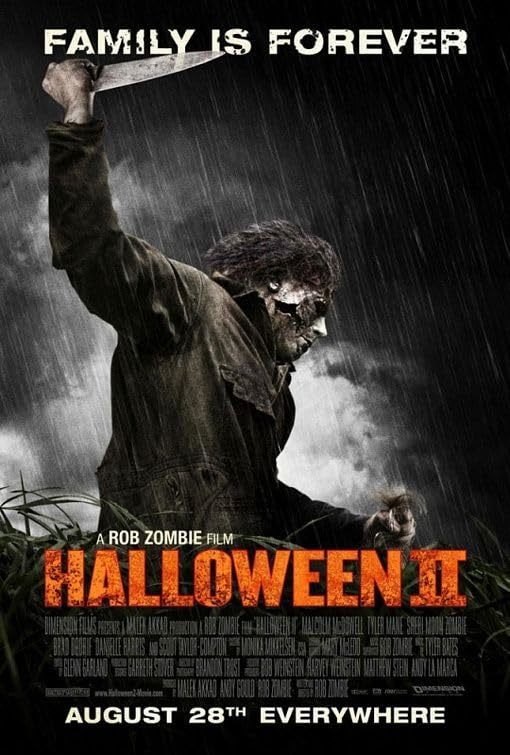
halloween 2

John Carpenter’s original Halloween (1978) essentially created the slasher craze of the 1980s. It either popularized or outright invented many of the tropes of the genre – a final girl, deaths coming to those who are promiscuous or otherwise “sinful”, killers’ point of view shots, etc. – and created a slew of knock-off holiday-themed horror films and generally influenced a decade of horror films.

It was followed by seven sequels and then was remade by Rob Zombie, that remake got a sequel and that was followed by the David Gordon Green trilogy which pretended none of the sequels happened and set the story 40 years after the original.

Rob Zombie remade the original film in 2007 and as I noted in my review, it is pretty terrible. Its sequel improves upon the first one a great deal, but it still isn’t great.

Scout Taylor-Compton returns as Laurie Strode some two years after the events of the original film (or the remake of the original film, or…whatever). She’s having a rough time. She’s in therapy, she’s taking a myriad of pills, and she’s having nightmares about Michael Myers every night. In a word, she was deeply traumatized by the events of Halloween night two years ago.

Now, horror movies about trauma may have been new in 2007. Certainly, a great many slasher sequels had the Final Girl return as bad as ever. They were able to shake off the events of the first film and come back after the evil villain with renewed vigor. But that isn’t reality. Surviving an attack by a vicious killer is traumatizing. It likely takes years, decades even, to overcome such a thing.

It is refreshing to have a horror movie’s protagonist have to deal with the trauma of the first film. Or it was back in 2007. I guess. In 2023 it feels like every horror film is about trauma. Hell, even Avengers: Endgame was about trauma. Certainly, the David Gordon Green Halloween films were about trauma. So watching this film now, and seeing how it deals with trauma feels a little old hat.

It isn’t as if Rob Zombie was doing something really interesting with the idea either. As mentioned, Laurie is in therapy, she’s popping pills, she has nightmares, she dresses like a punk goth, and covers her room in hard rock posters and “edgy” things like anarchist symbols and the number “666.” That isn’t a bad thing for this type of horror film, but it isn’t exactly original either.

It doesn’t help poor Laurie Strode that Doctor Loomis (Malcolm McDowell) is back in town pimping another book about Michael Myers. In this film, he is a shallow huckster, trading stories about the murders for fame and fortune. His new book gives the audience new details that have come to light since his last one, including how Laurie Strode is actually Angel Myers, Michael’s sister. When Laurie finds this out it sends her spiraling farther into despair.

Meanwhile, Michael has apparently spent the last two years wandering the countryside, hiding out in old farms, eating the raw corpses of animals he’s killed, and waiting around for the second anniversary to come find Laurie and finish what he’s started.

In Carpenter’s original Michael Myers was the face of evil. He was an emotionless, soulless, killing machine. There is a scene in the original film in which he stabs someone to death, his knife holding the corpse to the wall, and Myers crocks his head just a little as if admiring what he’s done.

Zombie spent the first film examining just exactly what made Michael Myers a killer, completely destroying what made Carpenter’s character so terrifying. He drops most of that with this sequel though his mother (Sheri Moon Zombie) and a version of himself as a child (Chase Wright Vanek) continue to haunt him like memory specters.

What saves this film are some truly scary kill scenes, and some wonderful, even beautiful imagery. The carnage is a bit too visceral and gory for my tastes these days, but there is no doubt he blocks them in really interesting ways.

If you strip away all of the Halloween stuff, if you just look at it as a horror film, as a slasher, I think it is pretty good. But as another entry in the Halloween franchise, it doesn’t really work for me. It is a great improvement on Zombie’s first entry, but there are so many other better films in this series I don’t see myself ever returning to this one.

31 Days of Horror: Halloween (2007)

image host

John Carpenter’s original Halloween (1978) didn’t invent the slasher genre. It has its roots in the Italian Giallo and films like Black Christmas (1974) came out earlier and contain all the elements of the genre. But Halloween really set the template for what slavers would become, and its immense popularity meant that it would be copied over and over again throughout the next decade.

It remains the greatest slasher ever made and is a truly great horror film. Much of this comes down to Carpenter’s economic direction. In just over 90 minutes he tells a complete story without an ounce of fat. It isn’t that the film is nonstop thrills either. There is a lot of exposition, we spend a lot of time just hanging out with the characters. But Carpenter makes them count. He lets us get to know the characters, especially Laurie Strode (Jamie Lee Curtis in a career-defining role), which allows us to actually care for them when the horror comes.

As Doctor Loomis (a wonderful Donald Pleasence) constantly lets us know Michael Myers is evil personified. The film doesn’t provide a back story. We don’t learn anything about who he is or why he kills. We don’t need to know.

Rob Zombie’s 2007 remake of Halloween is a terrible film. It takes all that makes Carpenter’s film great and chucks it out the window, then stomps on it with its dirty boots.

A good half of the film is filling in Michael Myers’s back story (played by Daeg Faerch as a ten-year-old boy and Tyler Mane as an adult). His mom is a stripper, her boyfriend is an alcoholic, abusive cripple. He’s bullied at school. Etc., etc., and so forth. It is all basic, boilerplate reasons for becoming a psychopath.

Here he doesn’t just kill his older sister as a child, but his entire family (excluding his baby sister, of course). We then spend a bunch of time with him at the mental institution where Doctor Loomis (Malcolm McDowell) tries to cure him. Or at least show him some kindness. Or at least talk to him. His mom visits every week, but Michael shrinks back into himself. He stops talking but continues to make little paper masks to put over his face and hide his true self from the world.

None of this is very interesting and it is all superfluous. Again, we don’t need to know why Michael Myers is a killer. Trying to give him human reasons for being who he is takes away the horror of who he was in the original.

When we finally arrive at Halloween night in the present (where the original film spends most of its time) I’d stop being interested in what this film was trying to do. Unfortunately, I had to keep watching for another hour.

Scout Taylor-Compton plays Lauri Strode in this version and all apologies to the actress, but she is not good. Jamie Lee Curtis portrayed the character as kind and good (it literally began the trope that the Final Girl in these films would be virtuous and a virgin), but also tough, a fighter. She’s innocent, but not naive or weak. Taylor-Compton turns her into a mostly whiny brat. Her girlfriends are even more obnoxious.

In the original, the teens do a bit of drinking and sexing, but Carpenter’s camera never leers at them. Zombie’s camera is nothing but leers. It lingers on the sex scenes, is zooms in on the nudity. There is a rape scene early on in the asylum that is as gross as it is gratuitous. The violence is more visceral as well, and not in a good way. I love horror movies and I’ve seen more than my fair share of gore and gratuitous sex. Maybe I’m just getting older, but so much of this film just felt like way too much.

I first watched this film in 2008 while living in Shanghai, China. In those days you could buy bootleg DVDs super cheap. There were literally guys on the street corners with boxes full of them. As soon as a film came out in the States we would get flooded with copies (usually cam copies where folks literally filmed the movie inside the theater). Sometimes we’d get weird cuts of films. After watching Halloween over there I was looking up reviews and realized I had seen a different cut than everyone else.

Apparently, there are three different versions of the film. There is a theatrical cut, a director’s cut, and an original version that was sent to test audiences. That last version didn’t do very well so they added some scenes and cut some things out. At a guess, I’d say what I originally saw was that first version. But I really don’t remember.

I believe what I watched tonight was the Director’s Cut. Whatever I watched, it was bad. Really bad. Just terrible actually.

I only watched it because the only film in the entire franchise I’ve never seen is the sequel to this. I was hoping to watch it on Halloween night. I guess I still will, but now I’m not looking forward to it.

31 Days of Horror: Castle of Blood (1964)

castle of blood

Alan Foster (Georges Rivière), a journalist meets Edgar Alan Poe (Silvano Tranquilli) at a pub. In the film’s reality, Poe is not a writer of fictions, but a documentarian of actual supernatural occurrences. He tells Foster this, but the journalist is a skeptic. Poe makes him a bet that he cannot spend the night in a haunted castle. Foster agrees.

Once there he is accosted by the usual haunted house trappings – spooky noises, candles getting blown out, strange sounds, and paintings that seem to stare back at him.

Then the ghosts come.

Luckily two out of the three ghosts are beautiful women (Barbara Steele and Margarete Robsahm), the other is a handsome, musclebound man. They were each murdered on the premises sometime in the past and now, once a year they must take the soul of a living human in order to remain in existence.

Ah, but Barbara Steele’s character falls in love with our hero and decides to help him survive the night, even though that will mean her own destruction.

Castle of Blood is pretty light on plot, but oh is it heavy on atmosphere. The camera investigates and lingers on every gothic inch of the castle. It is cobweb-filled, shadow-dense, and incredibly creepy. It longingly gazes at Barbara Steele who has a face custom-built for films like this. She is both incredibly beautiful and eerily terrifying.

This is the type of horror film my squeamish wife can watch with me. It is exactly the type of film I love.

31 Days of Horror: Murders in the Zoo (1931)

murders in the zoo

Here’s another Pre-Code film that couldn’t have been made just a few years later. Murders in the Zoo is an astonishingly violent film for its time, I’m rather surprised it got a full release even if it was made before the Production Code was in full effect.

It begins with a man getting his mouth sewed closed (and as you can see the film delightfully gives us that image) because he dared kiss another man’s wife. Several other people are murdered by snake bite and one woman is tossed into an alligator pit where she’s ripped to shreds.

still from murder in the zoo

Obviously, there isn’t a lot of gore in this film made some 90 years ago, the blood and guts are decidedly off-screen, but that’s still a lot of violent deaths for such an early Hollywood film.

Lionel Atwill is Eric Gorman, our murdering psychopath. He’s a big game hunter and zoo owner who is insanely jealous of his wife Jerry (Gail Patrick). Admittedly, she regularly seems to have affairs and wants to divorce him, but that doesn’t quite call for brutally murdering everybody who looks longingly in her general direction.

Randolph Scott is the doctor who comes up with an antidote for the snake venom (something that will come in handy when he gets bit). Oh, the snake is a super poisonous mamba. Gorman brings one back from Africa and uses it to kill a couple of his wife’s suitors.

Charlie Ruggles is Peter Yates a newly hired press agent who is scared silly of pretty much all the animals in the zoo. He’s ostensibly our hero and very much the comic relief.

The story is mostly silly, and the comedy mostly didn’t work for me, but it gets good use out of its animals. There are big cats, and alligators, and snakes, and the film gets its money’s worth out of them.

What really makes the film worth watching is just how much they got away with. I’m not a big fan of acting like modern audiences are more sophisticated, or intelligent, or even less prudish than audiences from times before. There were intelligent, sophisticated people 90 years ago. They understood violence. The papers were full of it. And yet, the violence on screen in this film does seem shocking. That opening scene where the guy gets his eyes sewn shut is wild. You know it is happening off-screen and watching it I sat there wondering if they would actually show it, thinking there was no way we’d get something like that in a film from 1933.

And then he came out, eyes shown shut.

That’s one of the many reasons I love Pre-Code cinema.

31 Days of Horror: Murder Rock: Dancing Death (1984)

murder rock

Lucio Fulci is often called The Godfather of Gore, and it is true, he did make a lot of horror films with copious amounts of violence, buckets of blood, and tons of gore. But he worked in many other genres throughout his long career including westerns, sword and sandal epics, and even comedy. What one would not expect from him is a musical, which is exactly (well, more or less) what he made with Murder Rock: Dancing Death.

It isn’t technically a musical since the characters don’t actually sing, but there is a lot of music (which was written by Keith Emerson) and a whole lot of dancing. But it is really a horror movie. Actually, it is the best-looking Giallo Fulci ever made.

It takes place at a New York City dance studio where one by one the female dancers are being stabbed through the heart with a long, needle-like hairpin by a black gloved killed. The studio is so hardcore that after the first girl is killed, the instructor basically tells the other dancers to stop whining and get back to work.

Meanwhile, Candice (Olga Karlatos) begins having dreams of being murdered by a man she’s never seen before. When she sees the dream man’s face on a billboard she tracks him down only to discover he’s a disheveled drunk. Instead of shrugging it off or running away in terror, she decides to sleep with him.

The film is filled with red herrings and a cop (Cosimo Cinieri) who is both lackadaisical about the whole thing and rather sadistic. It is all a bit complicated and rather silly, but I really kind of loved it. I mean most Giallos are complicated and silly, but this one pushes it to the edge and then some.

But it is stunningly gorgeous to look at. Fulci and his cinematographer have lit the heck out of it and filled it with beautiful, colorful images. The music and dancing give it an unusual energy and it’s just a lot of fun to watch.

31 Days of Horror: Nothing Underneath (1985)

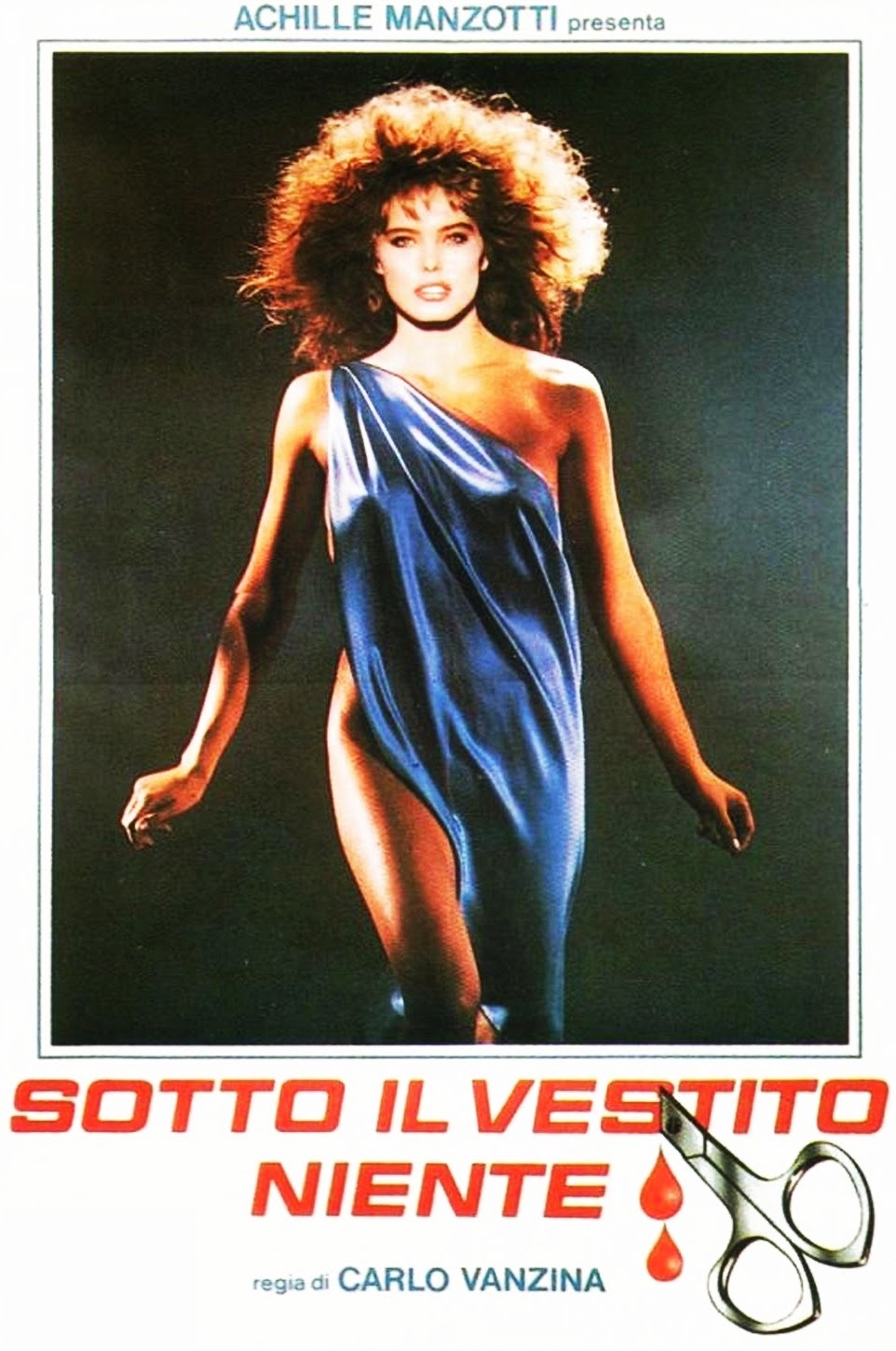
nothing underneath

Much like film noir, the Italian giallo is a genre without a clear-cut definition. There is a specific time period in which they flourished (the 1940s-1950s for noir and the late 1960s to the early 1980s for giallo) and certain stylistic certainties in which they operate, but there are so many outliers within each genre that pinning down an actual definition is nearly impossible. The later a film is made within their respective time periods the more fuzzy they tend to exist within the genres.

Nothing Underneath came out in the very late period of gialli, you might even call it post-giallo (although Dario Argento made Opera in 1987 and it is one of the very best gialli ever made, so go figure.) Even within the very fuzzy confines of giallo definitions, it remains a very fuzzy example of the genre.

It begins in the most unlikely of places for a giallo – Yellowstone National Park where we find our hero Bob (Tom Schanley) a ranger. He has a psychic connection to his sister, Jessica (Nicola Perring) who is a fashion model in London. While walking amongst the mountains and the trees he has a vision that Jessica is being murdered by a black-gloved killer with a pair of scissors.

Bob immediately flies to London and attempts to warn his sister of her impending doom but she’s gone missing. There is no evidence of murder, but nobody seems to know anything about where she might have gone. His investigations find that she was at a party hosted by fashion designer Giorgio Zanoni (Cyrus Elias) where he bribed several models (including Jessica) to play a game of Russian Roulette for a cache of diamonds.

Soon enough some of the women at that party start getting murdered with a pair of scissors just like in the vision. Bob teams up with Inspector Danesi (Donald Pleasence sporting a terrible Italian accent) to solve the case.

The black-gloved killer, the fashion models (providing ample excuses for casual nudity), and the killer’s point-of-view shots are all classic gialli tropes. It actually reminded me quite a bit of Brian DePalma’s work in the 1980s, but of course, he was highly influenced by the giallo genre. It lacks his formal command and the genre’s sense of style. It definitely feels like giallo-lite, or that it has outgrown the genre in some way. Or, more than likely, it just isn’t very well made.

If you are a fan of the genre and have seen all the classics then this one is worth watching. All others need not apply.

31 Days of Horror: Waxwork (1988)

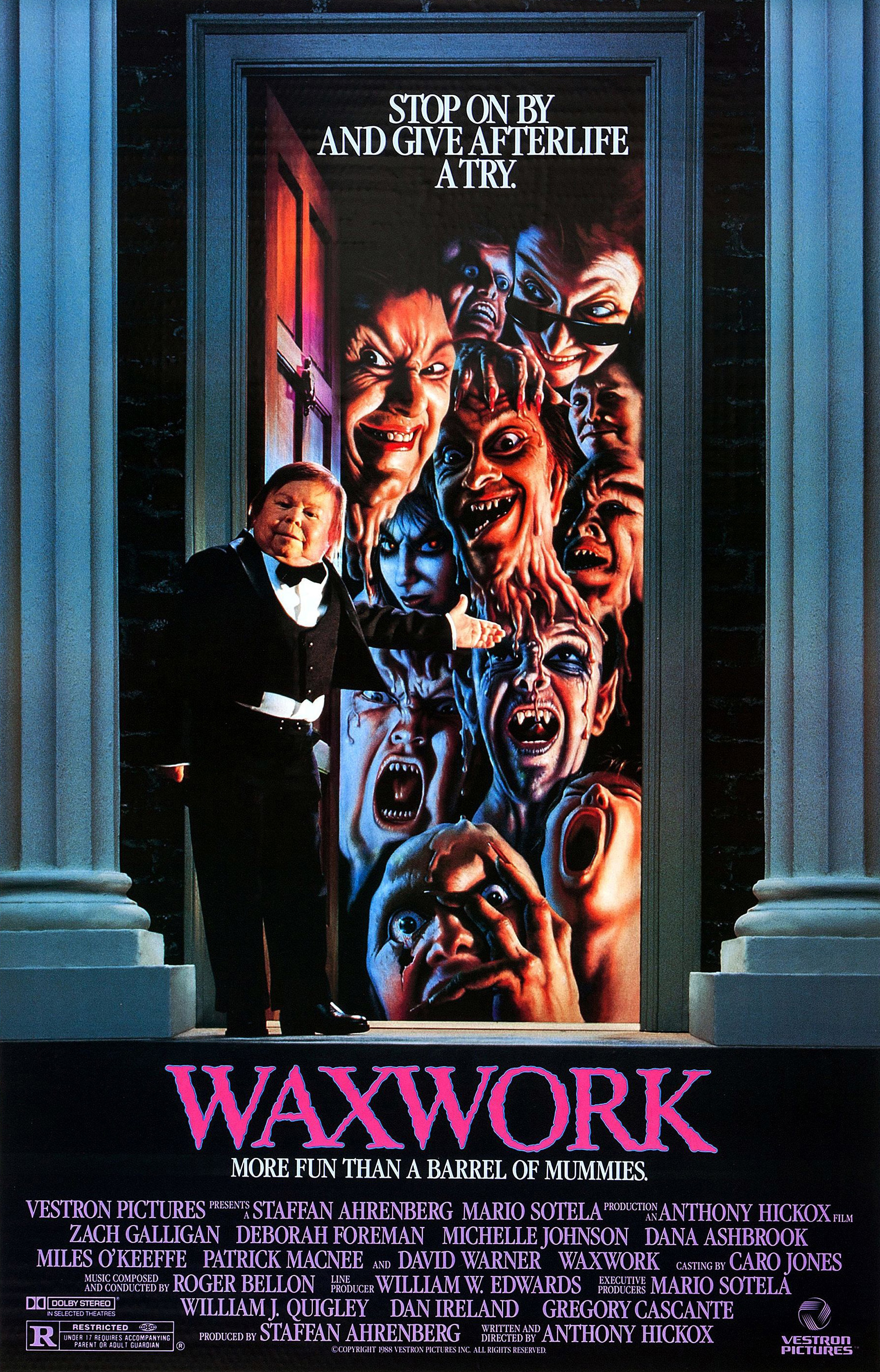
waxwork

I have a habit of following various cinematic rabbit holes when it suits me. Sometimes I’ll watch a bunch of movies with the same actor in it, or from the same director. Other times I’ll watch movies set in the same city, or that tell similar stories. Those are the most fun to watch. Sometimes that means I’m watching sequels or remakes, or whatever, but other times films will just tell similar stories that have actually nothing to do with one another.

The other night I watched Mystery of the Wax Museum (1933) and enjoyed it. This afternoon I was flipping through my unwatched horror queue and came across Waxwork. That’s a film I’ve known existed for some time in that I’d probably seen its cover art in some old video store back in the VHS days but had never been all that interested in watching it. But now that I was connecting it with Mystery of the Wax Museum I gave it a go. I’m glad I did.

Waxwork has nothing to do with that old film except that it is a horror film set in a wax museum. This one stars Zach Galligan as Mark a bored, rich kid. He and a few friends get invited to a secret opening of a waxworks by a creepy dude who appears out of nowhere (David Warner).

The waxwork has various displays of classic horror characters (Dracula, a werewolf, the Marquis De Sade, zombies, etc). The thing is if you step inside the display you are transported to a pocket dimension where you are a character in that particular display’s story.

One by one the kids get picked off except for Mark and his friend Sarah (Deborah Foremen). They escape and spend some time figuring out exactly what is going on. I won’t bore you with those details except to say they are pretty boring.

What makes the film worth watching is the adventures inside the displays. The film has a lot of fun playing inside the various horror subgenres and updating them to the 1980s. There are slices of Hammer Horror, Universal Horror, and George A. Romero Horror and they are a treat to watch.

I enjoyed Zach Galligan in the Gremlins films but here he can’t cut it as the leading man (it doesn’t help that he’s sporting an atrociously bad haircut) and the rest of the cast isn’t much better. Everything outside of the display scenes just isn’t that interesting.

But those display scenes really are worth the price of admission.

31 Days of Horror: Mystery of the Wax Museum (1933)

Mystery of the Wax Museum Poster

Ivan Igor (Lionel Atwill) is a sculptor of immaculate wax sculptures of historical figures, living in London. Apparently, immaculate sculptures of historical figures don’t draw a crowd. Hence, his investor decides that the only way to get his money back is to burn the gallery to the ground and collect on the insurance. When Igor balks, the investor lights the match with him inside it.

Flash forward 12 years and we’re in New York City. Intrepid reporter Florence Dempsey (Glenda Farrell) is about to be sacked from her job unless she can come up with a story, and that fast. Being that it is New Year’s Eve she hits up her cop friends to see if there are any interesting crimes to write about. Turns out George Winton (Gavin Gordon) a rich socialite is being held for questioning over the death of his girlfriend Joan. Her death was originally deemed a suicide, but new evidence indicates it may have been murder.

By the time she gets there the body of Joan, which was slated for an autopsy, has been stolen. She learns that other bodies have mysteriously disappeared as well.

About this time our old friend Igor shows up in New York preparing to open a new wax museum. It doesn’t take a genius to figure out how these two things connect.

After the success of Doctor X, director Michael Curtiz teamed up once again with stars Lionel Atwill and Fay Wray (she plays the girlfriend of someone who works at the wax museum – but she’s mostly there to scream).

Like Doctor X it also used a two-color Technicolor system (and was the last film to use that system from Warner Bros.) giving it an interesting green hue.

The plot is very silly. Though Lionel Atwill and Fay Wray get top billing it is Glenda Farrell that steals the show. Her reporter is a fast-talking, wise-cracking dame. The best scenes all involve her and her editor (Frank McHue) who toss one-liners at each other as if they were in a screwball comedy instead of a horror-mystery.

The set design is fantastic, especially the wax museum in New York. The showroom is beautifully balanced, but it is the basement areas where the work is done that come in looking like something out of Frankenstein’s castle. The wax sculptures themselves look wonderful, even if a great many of them are actually real-life actors standing still.

Once considered a lost film Mystery of the Wax Museum has been lovingly restored (with a generation donation from George Lucas) and it looks fantastic. It isn’t a great film by any means, but it is a fun one, and historically important.