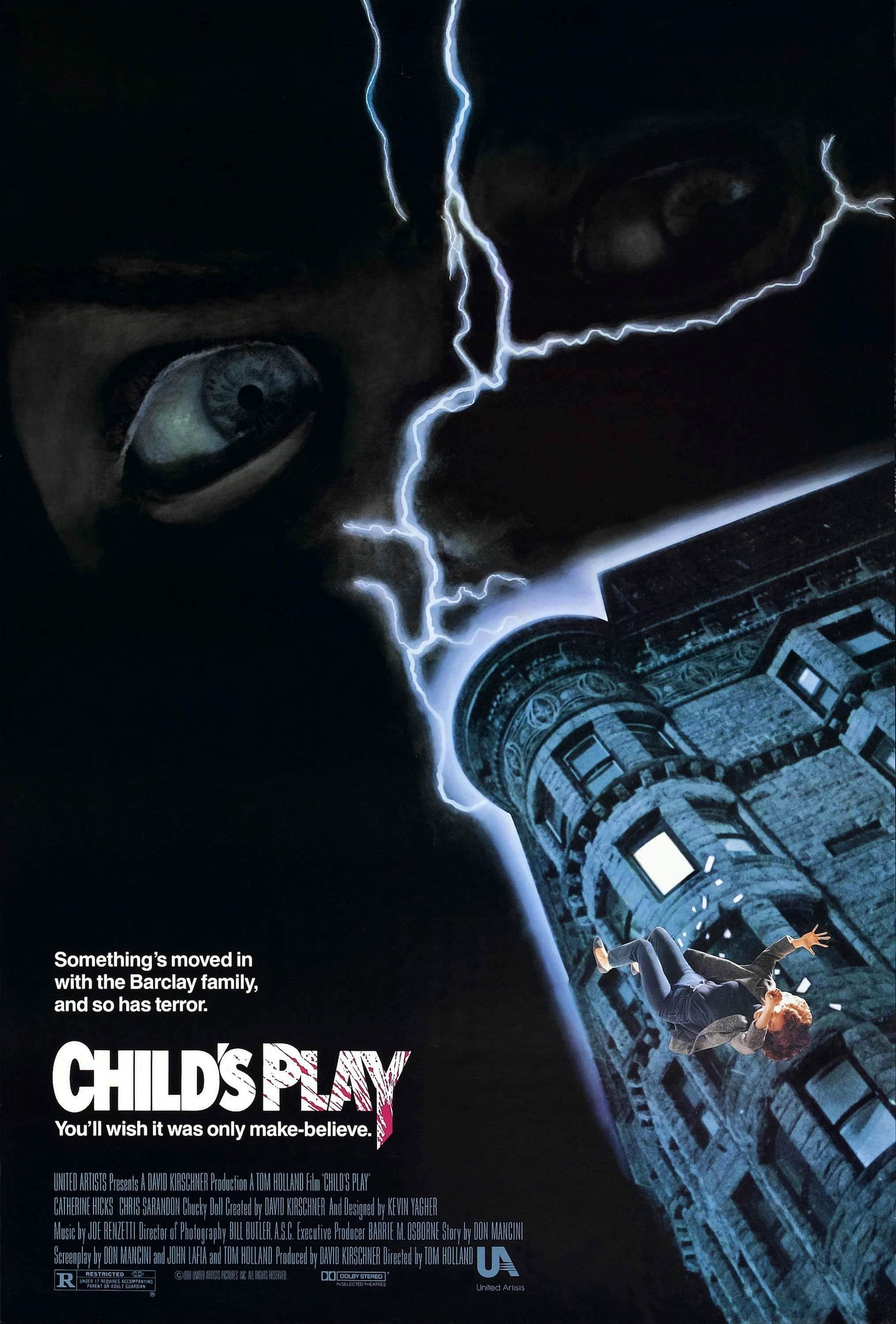
The Friday Night Horror Movie: Child’s Play (1988)

childs play

Out of all the classic 1980s horror icons – Jason, Freddy Kreuger, Michael Myers, Pinhead, etc – the only one I had never paid any attention to was Chucky. I don’t really know why. I was too young in 1988 to have seen the original in theaters, and it may have come too late in the cycle of ’80s horror films to have had the same cultural cache, or at least the same influence on me. Most of those other franchises had just about petered out by the time Child’s Play hit the screen. The exception would be the Hellraiser franchise which got its start in 1987, but I didn’t watch it until 2012.

Or maybe the Child’s Play films didn’t get the same late-night cable TV airplay as the others. Like I say, I don’t really know why I never got around to watching Child’s Play.

I rectified that tonight and while I’m glad I did, I can’t say that I’m all that upset it took me this long to get to it.

Chucky, the knife-wielding, homicidal doll (voiced by the always wonderful Brad Dourif) is an iconic character. I’m definitely familiar with him but that familiarity comes from seeing clips from all the movies and various commercials or specials or whatever.

The thing about the first film in a long-running franchise is that it is often more subdued than the subsequent films. Sequels have a tendency of ramping things up. So it is with Child’s Play. I was surprised at how long it takes for Chucky to really show himself.

First, there is a scene demonstrating how the crazed killer’s soul got into the doll. Then we have to introduce the family he’s going to terrorize. There’s the mom Karen (Catherine Hicks) and the little boy Andy (Alex Vincent). The boy precocious and smart. He’s introduced by fixing his mother breakfast in bed which consists of an overflowing (and over-sweetened) bowl of cereal and a huge blob of butter on burnt toast. He wants a Good Guy doll for his birthday but she can’t afford one. Later some homeless dude has one for sale for cheap.

At first the doll talks in its normal voice. Everything is normal about it. Then the babysitter gets pushed out the window of their high-rise apartment. Andy says Chucky scared her and she fell. Andy says Chucky speaks to him (and his language is pretty filthy).

No one believes Andy, including police detective Mike Norris (Chris Sarandon). We get a few POV shots from Chucky’s perspective and a glimpse of him moving around, but for a good chunk of the film we don’t really see him in action.

This isn’t to say the film would be improved if Chucky were to be seen early on wreaking murderous havoc. I suspect we’ll get more of that in the sequels. Rather I’m simply stating how surprising it was to me to find the story weaving a mystery for the characters about whether or not Andy was making Chucky up or not, even though as an audience we know the doll lives.

It makes sense from the perspective of the filmmakers. They didn’t know this was going to turn into an iconic franchise. They were just trying to make a scary movie about a killer doll. They needed an actual story, with plausible characters. Later it can have films with more murdering mayhem, but the first film in a franchise needs grounding.

Or something. That concept makes sense in my mind, but honestly, watching it was a little bit of a drag. I wanted more Chucky, not more story, more grounding. Once the doll does come out it is pretty cool. The animatronics are great, and while he’s not in full-on shite talking mode yet, he gets in a few good lines. And the ending is pretty great.

I’ll definitely be checking out those sequels.
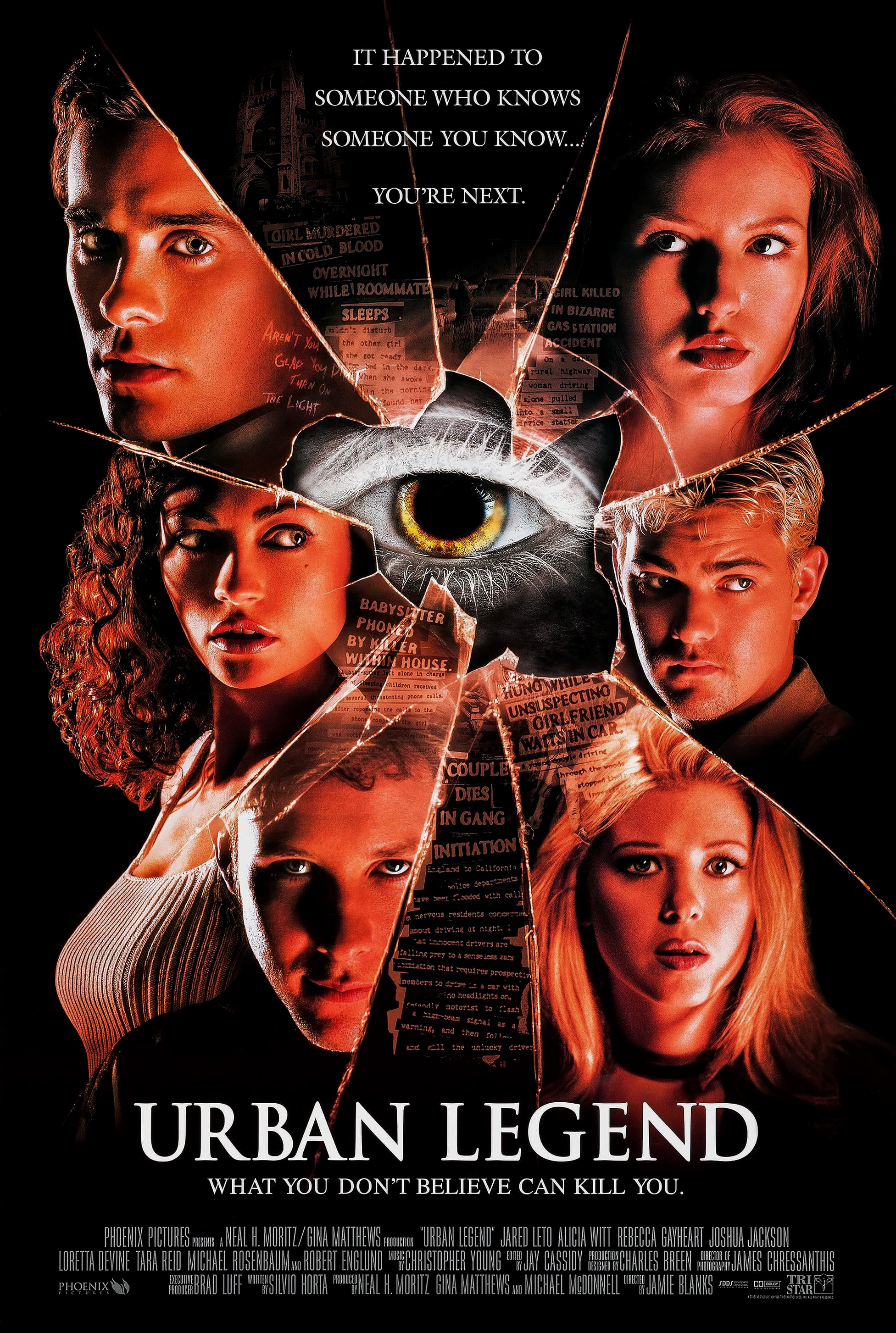
31 Days of Horror: Urban Legend (1998)

urban legend movie

By the early 1990s, the slasher was dead. Or at least bankrupt. There were no new ideas and fans had stopped watching them. Then came Scream. Wes Craven and screenwriter Kevin Williamson turned the slasher upside down and made it self-aware. I loved it. Lots of people loved it. It was a huge hit. Like a lot of huge hits, imitators followed.

Unfortunately, most of these films missed out on what made Scream so good. Mainly a self-aware, clever script, and genuine thrills. The imitators copied the up-and-coming cast from hip TV shows, a hip soundtrack featuring up-and-coming alternative rock bands, and lots of (not too gory) violence.

Urban Legend poses the idea of what would happen if a serial killer used actual urban legends as his/her inspiration? Which is both an utterly stupid and kind of amazing idea for a horror film.

I’m not by any means an expert on urban legends so take this thought with a grain of salt, but it does feel like the late 1990s were a real hotspot for urban legends. The Internet had just taken off in a very big way which allowed urban legends to flourish like never before, but we weren’t so internet savvy (or cynical) as to easily debunk them. So, the idea of using urban legends for your slasher movie makes sense.

The movie is bad though.

It is set at a fictional New England university that is populated by beautiful, hip, kids who get picked off one by one in not all that interesting ways.

Our hero is Natalie Simon (Alicia Witt) a sweet, sincere, student who is very upset over the news that a student was recently decapitated in her car (that’s the legend where a creepy dude (the always great Brad Dourif) freaks a girl out while trying to warn her that there is a killer in the backseat).

Jerod Leto is the school newspaper reporter who knows all about urban legends and is obsessed with scoops. Rebecca Gayheart is the best friend, Tara Reid is the party girl who hosts a sexy call-in radio show, and Loretta Devine in the sassy security guard.

Oh, and Robert Englund is the professor who specializes in urban legends because that’s a thing.

Some of the urban legends discussed and used to kill people include the don’t flash your lights at another car who doesn’t have their headlights on legend, the aren’t you glad you didn’t turn on the lights last night because I was secretly killing your roommate in the dark legend, and the don’t drink soda with a mouthful of Poprocks legend (one of these didn’t actually kill anybody).

The kills are all fairly tame. The reveal of the killer is downright awful. Everything in between isn’t all that bad, but neither is it particularly interesting.

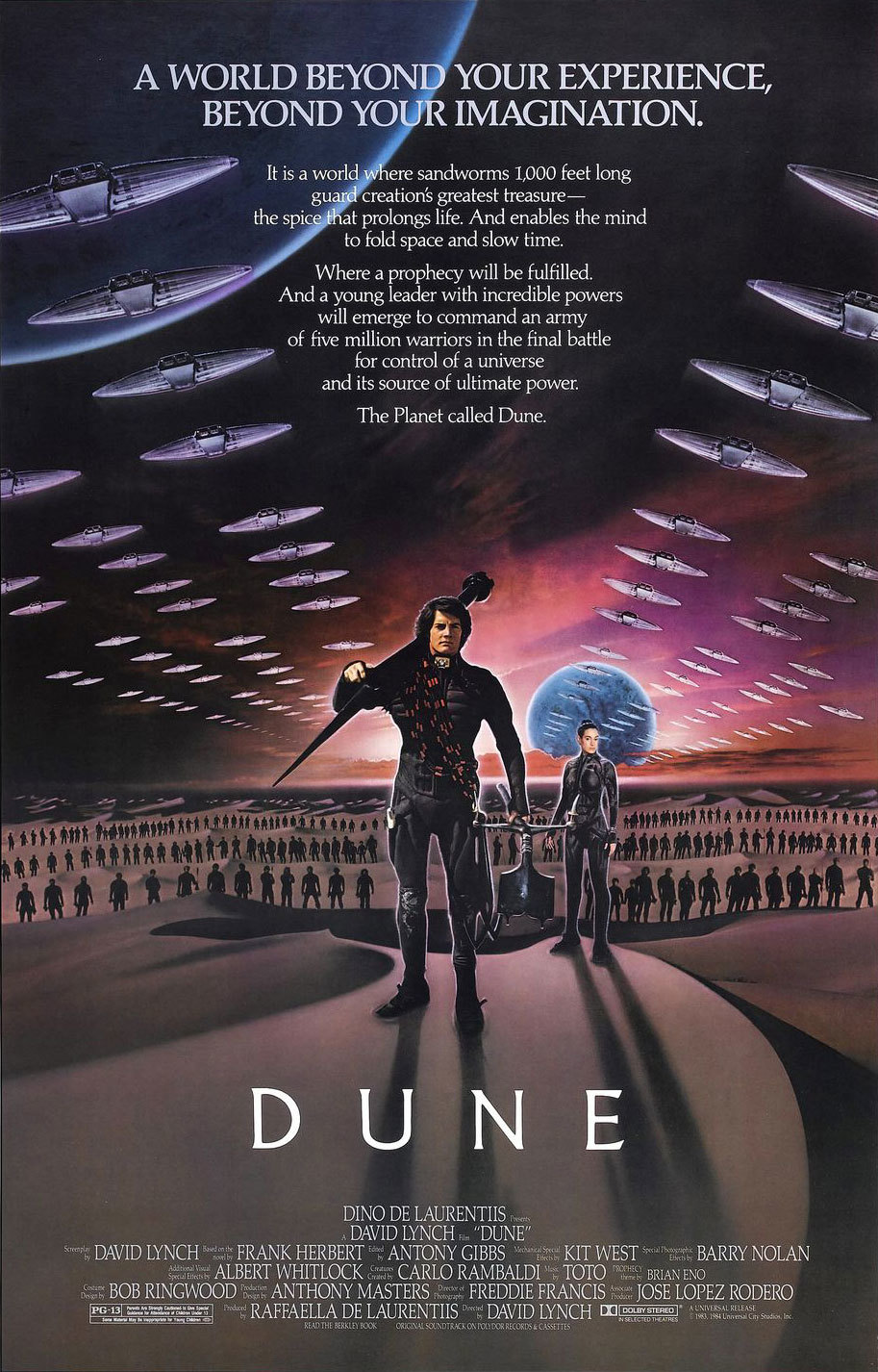
Awesome ’80s in April: Dune (1984)

duen movie poster

I’ve had a copy of Dune, the Frank Herbert novel, on my bookshelves for years. I’ve never managed to read it. I’ve tried a couple of times but I can’t get past the first few paragraphs. It is so dense, so full of new words that I feel immediately lost and that it isn’t worth my time to dig in.

I’ve had a DVD copy of Dune, the movie directed by David Lynch on my shelves for years as well. Until recently I had never managed to watch it. I tried once, many months ago, but didn’t get past the first few minutes. It was so full of exposition and new ideas that I was almost immediately lost and it didn’t feel worth my time to try and dig in.

Last year I did watch Dune, the movie directed by Denis Villeneuve and quite liked it. I’m a big fan of his films in general, and he somehow made this dense world full of numerous people and clans and ideas seem understandable and manageable. So, I figured now was the time to give Lynch’s adaptation another shot.

It was a notoriously expensive bomb. Lynch’s original cut ran about four hours and the studio made him cut it down to just over two. Critics hated it, audiences mostly stayed away, and Lynch has since disavowed it and refuses to speak of it in interviews.

It continues to be reevaluated by new audiences, and the general consensus of it is an ambitious failure.

It was David Lych’s third film. His first was Eraserhead (1977), a really weird, surrealistic body horror flick that became a cult hit. Mel Brooks of all people loved it and hired Lynch to direct his next film, The Elephant Man. That was a much more straightforward film, and it became a big hit and an award-winner. This is how Lynch came to direct Dune, a big-budget sci-fi epic.

I love it. With caveats. The plot is near incomprehensible even with multiple characters explaining what they are doing and with our ability to hear their thoughts.

Most of it takes place on a desert planet, the only place where the people of this universe can get something called spice. Which is a mind-altering drug, it can extend a person’s life and it allows people to bend space so they can travel across the universe in seconds. Or something. There are various warring clans who all are fighting over this planet. But it all seems to be covert. Outwardly the Emperor of the Universe has given control of the planet to one family. Their son is named Paul (Kyle MacLachlan) and he’s apparently some kind of messiah figure.

Everyone has weird hairstyles, one guy can float, and Sting spends a lot of the time practicing fighting with his shirt off. There are cool electronic shields of some kind, people have to wear these weird nose pieces on the spice planet and, oh yea, the planet is full of giant sandworms.

There is so much going on in this film that it is impossible to explain and even more impossible to understand. But it looks really cool. And it is populated by loads of great actors including Patrick Stewart, Brad Dourif, Linda Hunt, José Ferrer, Dean Stockwell, Max Von Sydow, and Sean Young.

The style and look of the film are completely Lynchian. So even while I wasn’t always sure as to what was happening on screen, I sure enjoyed watching it.