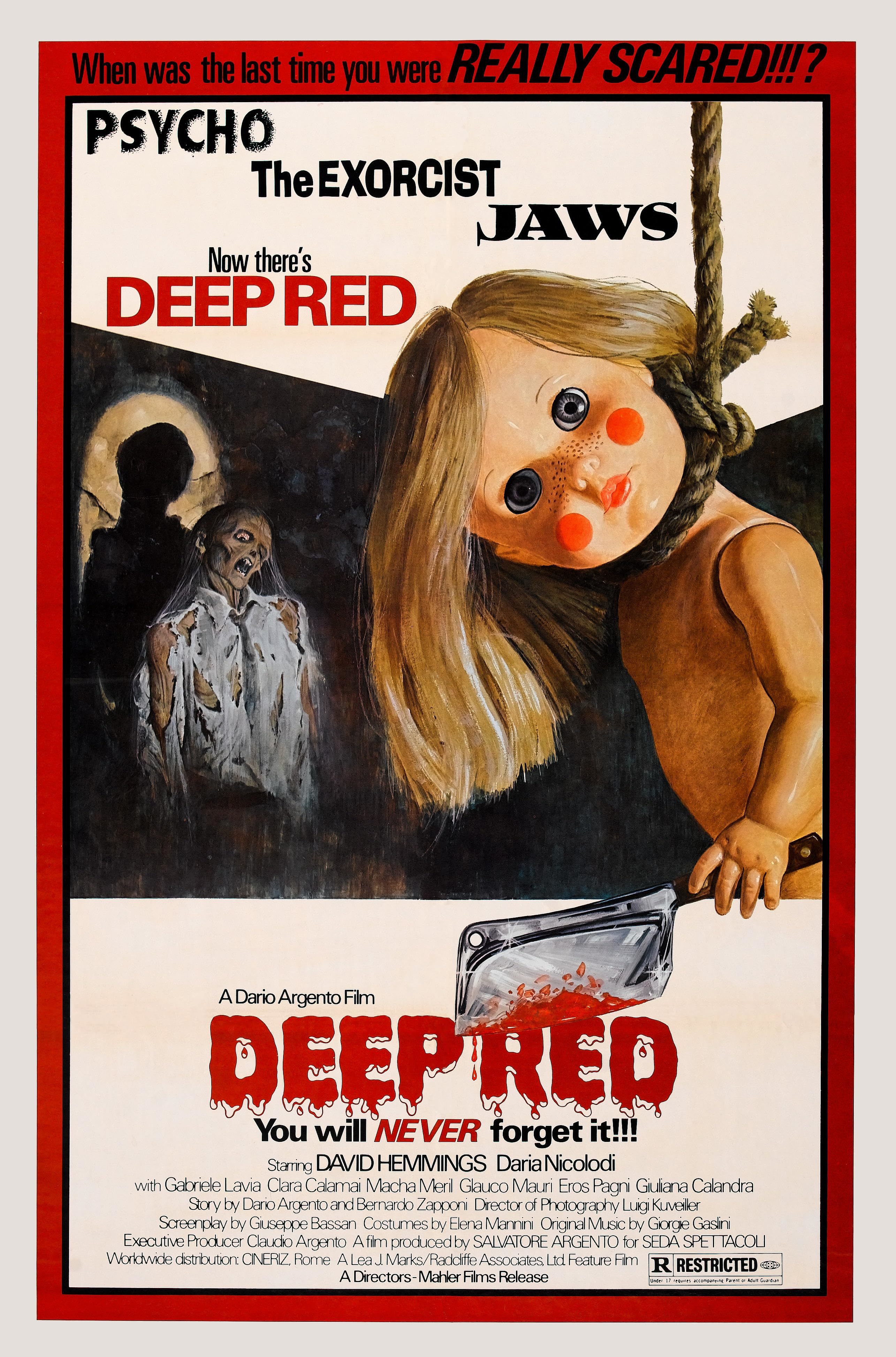
I’ve mentioned Dario Argento several times before on this blog. He’s one of my favorite directors – certainly my favorite horror director. He didn’t invent the Giallo, but he definitely popularized it and perfected it. Deep Red is one of, it not my actual favorite films of his and possibly the best Giallo ever made.
The plot is deceptively simple – it is a relatively straightforward murder mystery – and yet also a convoluted mess. David Hemmings stars as a jazz pianist who witnesses his downstairs neighbor get brutally murdered. He teams up with a journalist played by Daria Nicolodi and tries to figure out what happened.
I’ve seen this film at least five different times, and I’m still not sure I understand everything that happens in the film or the real motivation of the killer.
And I don’t care in the least that I don’t.
Argento was a master of style and it is on full display here. It is full of dark, bold colors (especially red) and disturbing imagery. The camera moves and slides across corridors, it is filled with extreme closeups and wondrously stylized violence.
There is a scene about halfway through the film in which a character sits in his office. The camera and the music let us know that something scary is about to happen. That the killer is there. The character knows it. We hear the killer whisper. Then something happens, I won’t spoil it here, but it is one of the most surprising and terrifying things I’ve ever witnessed at the cinema.
When my heart slows down I realize that this moment makes absolutely no logical sense, especially given who the killer turns out to be, but again I just don’t care.
The score by progressive rock band Goblin is kinetic, percussive, and heart-pounding. They wrote the scores for several other Argento films and they are all terrific. The director uses the music to great effect – stopping and starting it at crucial moments creating small, but effective adrenaline rushes.
If you are a horror fan I absolutely recommend Deep Red to you.
Like a lot of Italian productions at the time the film was shot without sync sound. All of the dialog was dubbed in post-production in both English and Italian. In previous watches I was always confused because periodically some characters would start speaking Italian without warning and then a moment later they would switch back to English. Bilingual people can, and often do this in real life, but there didn’t seem to be any rhyme or reason to it in this film.
Pulling out my Arrow Vidoe Blu-ray tonight I discovered why. They edited out several scenes (and snippets of scenes) for the exported cut of the film (which presumably means the copies sent to English-speaking countries) and thus they did not record English language tracks for those scenes. Or if they did the English tracks were lost at some point. Those scenes have since been added back into the English language version of the film but there are no English language audio for the new scenes. In some ways this adds to the already disjointedness of the film.


 themidnightcafe.org