
The Friday Night Horror Movie: Halloween (1978)

halloween poster

I don’t remember the first time I watched John Carpenter’s Halloween. I don’t think I saw it while in high school; it was probably college that found me first seeing it. Whenever it was, I’ve seen it many times since. It has become part of my DNA. I love it deep down in my bones. So I was surprised to realize that I’ve never actually written about it. I’ve written about several of the sequels and the remakes, but never the original. I’ve gotten into the habit over the last several years of watching one of the Halloween movies on Halloween, so I decided it was high time I watched the original on this, the spookiest of evenings, and then finally wrote something about it.

Reading some of my other Halloween reviews, I find that I’ve talked quite a lot about Carpenter’s film and its place in popular culture, so I don’t want to go too heavy in that direction here. Though it is often cited as the first slasher, you can actually go back as far as Psycho and Peeping Tom (both released in 1960) to find films that fit the mold. Italian giallos certainly had a lot of influence over the slasher genre and could even be considered slashers themselves. Technically Black Christmas, a very good slasher itself, was released a few years before Halloween. But it was Carpenter’s film that popularized the genre and solidified the tropes.

While this is true, I would argue that Friday the 13th (1980) truly solidified everything the slasher would become over the remaining decade. Sean S. Cunningham was clearly inspired by Halloween‘s success, and he distilled the Carpenter film down to its very essence. It has a group of sexy teens getting killed off one by one by a blade-wielding maniac. The final girl is virginal and thus pure in the film’s point of view. The killings all stem from something in the killers’ past. Etc. Even the title is taking the holiday premise from Carpenter. Friday the 13th takes the tropes established in Halloween and grinds them down, then exploits the hell out of them. The sex and nudity are more gratuitous, the violence more gore-filled. 

Carpenter is on record stating that the notion that Laurie Strode survives Halloween due to her “purity” was purely accidental. And it’s true, Laurie isn’t some paragon of virtue. We see her smoking in one scene, and she doesn’t seem opposed to drinking or the fact that her friends are screwing their boyfriends at the drop of a hat. Her virginity seems to be more of a product of her own shyness and lack of confidence than any sense of morality. She is a “good girl” in the sense that she tries hard at school and genuinely seems to care about the kids she’s sitting with (unlike one of her friends who constantly yells at her charge and dumps her off at Laurie’s as soon as possible.)

Friday the 13th doubles down on the tropes. Its success led to many more slashers in the ensuing years, and most of them kept the distilled versions of these ideas and codified them.

It is always surprising to me how much Halloween takes its time getting to the killing.  There is a murder in the opening flashback and then a long period of nothing. After a fantastic credit sequence (featuring a beautifully lit jack-o’-lantern and that iconic score), we open in 1963. A long POV shot shows us Michael Myers stabbing his sister to death (after she’s had some sexy fun times with her boyfriend). But the sex is off-screen, and the violence is fairly tame. Even the nudity feels not particularly gratuitous.

Then we move to the present day (1978) and find Dr. Loomis (Donald Pleasence) for some reason driving to the asylum where Michael Myers is kept with a nurse in the middle of the night. Michael has escaped, attacks the nurse, and gets away. Dr. Loomis tracks him to his hometown of Haddonfield, IL. Loomis is our expositional bank. He keeps finding people to talk to about how Michael Myers isn’t human, he’s evil incarnate, he’s an unstoppable killing machine. Intercut with his hunt for Michael, we find Laurie Strode (Jamie Lee Curtis) going to school and hanging out with her friends Annie (Nancy Loomis) and Lynda (PJ Soles.) They are typical teenagers. They smoke, they drive around town, and they talk about boys. Laurie gets teased because she cares about her grades and she’s shy around boys, but they genuinely seem to like each other.

In the background is Michael Myers. Standing tall, dressed in coveralls with that weird mask on, just stalking them. We’ll see him driving around, following Laurie. He’s standing outside her bedroom window or her classroom or down the road, but then he’ll quickly disappear. Because Loomis is constantly telling us about how evil Myers is, we feel that tension. Even when Laurie is doing something perfectly boring like making popcorn for the little boy she’s sitting, we know Michael is out there, just waiting to kill her. 

The sequels will give Michael Myers a connection to Laurie. This will give him a reason to constantly be coming after her, but in this first film that connection hasn’t been made. His obsession with her is random, and all the more terrifying for it.

When the killings do come, they are fairly tame. There is very little bloodletting or gore. Michael does stab one guy so hard the knife pins him to a wall, and there is another scene in which a body is staged on a bed, and others fall out of closets, but they’d pass a TV edit these days.

But they work because they are so well staged by Carpenter. The way he sets them up and films them, the way he has spent the first 45 minutes setting up Michael Myers as this merciless killer, makes them incredibly effective. Dean Cundey’s cinematography is evocative. A lot of the scenes happen in darkness, but he finds a way to let just enough light in to shine across Michael’s face, or his victims as they flee in terror.

It isn’t a perfect film. There are times when it’s a very small-budget show. You can see some of the seems, but I don’t care. I just love every loving minute of it. It doesn’t get better than Halloween in terms of slashers.

31 Days of Horror: Halloween (2007)

image host

John Carpenter’s original Halloween (1978) didn’t invent the slasher genre. It has its roots in the Italian Giallo and films like Black Christmas (1974) came out earlier and contain all the elements of the genre. But Halloween really set the template for what slavers would become, and its immense popularity meant that it would be copied over and over again throughout the next decade.

It remains the greatest slasher ever made and is a truly great horror film. Much of this comes down to Carpenter’s economic direction. In just over 90 minutes he tells a complete story without an ounce of fat. It isn’t that the film is nonstop thrills either. There is a lot of exposition, we spend a lot of time just hanging out with the characters. But Carpenter makes them count. He lets us get to know the characters, especially Laurie Strode (Jamie Lee Curtis in a career-defining role), which allows us to actually care for them when the horror comes.

As Doctor Loomis (a wonderful Donald Pleasence) constantly lets us know Michael Myers is evil personified. The film doesn’t provide a back story. We don’t learn anything about who he is or why he kills. We don’t need to know.

Rob Zombie’s 2007 remake of Halloween is a terrible film. It takes all that makes Carpenter’s film great and chucks it out the window, then stomps on it with its dirty boots.

A good half of the film is filling in Michael Myers’s back story (played by Daeg Faerch as a ten-year-old boy and Tyler Mane as an adult). His mom is a stripper, her boyfriend is an alcoholic, abusive cripple. He’s bullied at school. Etc., etc., and so forth. It is all basic, boilerplate reasons for becoming a psychopath.

Here he doesn’t just kill his older sister as a child, but his entire family (excluding his baby sister, of course). We then spend a bunch of time with him at the mental institution where Doctor Loomis (Malcolm McDowell) tries to cure him. Or at least show him some kindness. Or at least talk to him. His mom visits every week, but Michael shrinks back into himself. He stops talking but continues to make little paper masks to put over his face and hide his true self from the world.

None of this is very interesting and it is all superfluous. Again, we don’t need to know why Michael Myers is a killer. Trying to give him human reasons for being who he is takes away the horror of who he was in the original.

When we finally arrive at Halloween night in the present (where the original film spends most of its time) I’d stop being interested in what this film was trying to do. Unfortunately, I had to keep watching for another hour.

Scout Taylor-Compton plays Lauri Strode in this version and all apologies to the actress, but she is not good. Jamie Lee Curtis portrayed the character as kind and good (it literally began the trope that the Final Girl in these films would be virtuous and a virgin), but also tough, a fighter. She’s innocent, but not naive or weak. Taylor-Compton turns her into a mostly whiny brat. Her girlfriends are even more obnoxious.

In the original, the teens do a bit of drinking and sexing, but Carpenter’s camera never leers at them. Zombie’s camera is nothing but leers. It lingers on the sex scenes, is zooms in on the nudity. There is a rape scene early on in the asylum that is as gross as it is gratuitous. The violence is more visceral as well, and not in a good way. I love horror movies and I’ve seen more than my fair share of gore and gratuitous sex. Maybe I’m just getting older, but so much of this film just felt like way too much.

I first watched this film in 2008 while living in Shanghai, China. In those days you could buy bootleg DVDs super cheap. There were literally guys on the street corners with boxes full of them. As soon as a film came out in the States we would get flooded with copies (usually cam copies where folks literally filmed the movie inside the theater). Sometimes we’d get weird cuts of films. After watching Halloween over there I was looking up reviews and realized I had seen a different cut than everyone else.

Apparently, there are three different versions of the film. There is a theatrical cut, a director’s cut, and an original version that was sent to test audiences. That last version didn’t do very well so they added some scenes and cut some things out. At a guess, I’d say what I originally saw was that first version. But I really don’t remember.

I believe what I watched tonight was the Director’s Cut. Whatever I watched, it was bad. Really bad. Just terrible actually.

I only watched it because the only film in the entire franchise I’ve never seen is the sequel to this. I was hoping to watch it on Halloween night. I guess I still will, but now I’m not looking forward to it.

31 Days of Horror: Nothing Underneath (1985)

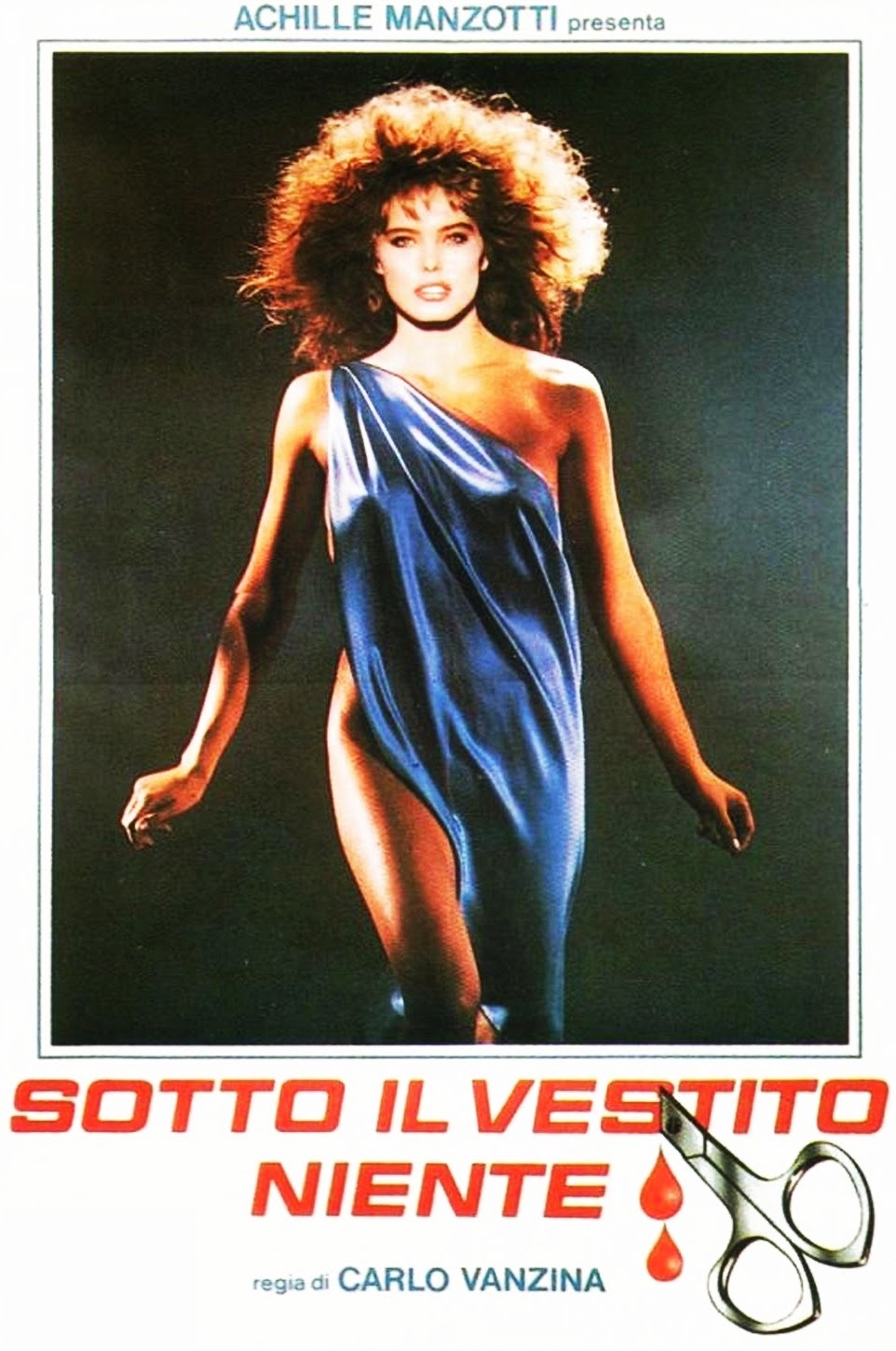
nothing underneath

Much like film noir, the Italian giallo is a genre without a clear-cut definition. There is a specific time period in which they flourished (the 1940s-1950s for noir and the late 1960s to the early 1980s for giallo) and certain stylistic certainties in which they operate, but there are so many outliers within each genre that pinning down an actual definition is nearly impossible. The later a film is made within their respective time periods the more fuzzy they tend to exist within the genres.

Nothing Underneath came out in the very late period of gialli, you might even call it post-giallo (although Dario Argento made Opera in 1987 and it is one of the very best gialli ever made, so go figure.) Even within the very fuzzy confines of giallo definitions, it remains a very fuzzy example of the genre.

It begins in the most unlikely of places for a giallo – Yellowstone National Park where we find our hero Bob (Tom Schanley) a ranger. He has a psychic connection to his sister, Jessica (Nicola Perring) who is a fashion model in London. While walking amongst the mountains and the trees he has a vision that Jessica is being murdered by a black-gloved killer with a pair of scissors.

Bob immediately flies to London and attempts to warn his sister of her impending doom but she’s gone missing. There is no evidence of murder, but nobody seems to know anything about where she might have gone. His investigations find that she was at a party hosted by fashion designer Giorgio Zanoni (Cyrus Elias) where he bribed several models (including Jessica) to play a game of Russian Roulette for a cache of diamonds.

Soon enough some of the women at that party start getting murdered with a pair of scissors just like in the vision. Bob teams up with Inspector Danesi (Donald Pleasence sporting a terrible Italian accent) to solve the case.

The black-gloved killer, the fashion models (providing ample excuses for casual nudity), and the killer’s point-of-view shots are all classic gialli tropes. It actually reminded me quite a bit of Brian DePalma’s work in the 1980s, but of course, he was highly influenced by the giallo genre. It lacks his formal command and the genre’s sense of style. It definitely feels like giallo-lite, or that it has outgrown the genre in some way. Or, more than likely, it just isn’t very well made.

If you are a fan of the genre and have seen all the classics then this one is worth watching. All others need not apply.