Mysteries in May: Lady In Cement (1968)

lady in cement movie poster

In my review of Tony Rome (1967), I noted that it wasn’t a bad film, but that it lacked a certain something, that it didn’t “pop.” The thing is, it was so close to being a very good film. With a few changes, it could have been brilliant. It was close enough that I decided to watch the sequel, Lady in Cement, in hopes that the filmmaker would make the proper corrections and turn the story into something wonderful.

Sometimes, even the smartest people are wrong. Lady in Cement does make some changes—all the wrong ones. In my opinion, Tony Rome needed a sharper script, some tighter one-liners, and an endlessly cool lead. What Lady in Cement does is lean into the more sexist and homophobic tropes, make the jokes much broader and, therefore, lame, and allow Frank Sinatra to be even less interesting and cool than before.

It starts out strong. Tony Rome is looking for some Spanish gold that was lost at sea in the 1500s and instead stumbles across a dead woman at the bottom of the ocean, her feet encased in concrete. (I do always wonder about these situations – did they force the woman to stand in wet concrete for hours until it dried, or did they kill her first and then someone stood her up until it dried?)

He reports the incident to our friendly neighborhood detective, Santini (Richard Conte), and carries on with his life. That doesn’t last long as a big old brute named Waldo Gronsky (Dan Blocker) hires Rome to find a lady named Sondra Lomax. Naturally, this case connects to the dead lady with cement shoes.

Raquel Welch makes an appearance as a lady who threw a party that Sondra Lomax attended. She’s connected to some gangster who gives our hero trouble. There’s a lot of shoe leather questioning at local hotspots and more than a lot of dumb gay jokes. The 1960s were a curious time in cinema as gay people were suddenly allowed to exist but they usually wind up just being stereotypes and the butt of dumb jokes.

None of the story is all that interesting, and the filmmaking doesn’t perk it up any. I’ve decided that Sinatra, who was in his 50s at the time, just doesn’t have that cool factor at that point to make his Tony Rome <ahem> sing. I love the guy, but he just doesn’t work for me in these films.

What we’re left with is a movie that could have been a lot of fun to watch but winds up being kind of a bore.

Mysteries in May: Tony Rome (1967)

tony rome movie poster

Tony Rome attempts to blend the cold calculations of classic film noir with the cool, hip 1960s thriller, but is unsuccessful at both. It isn’t a bad film, but it lacks a certain something. It doesn’t pop like it needs to.

The script (based on a novel by Marvin Albert and written by Richard L. Breen) is wonderfully twisty and convoluted, but it fails at creating the sort of witty, cynical dialogue Raymond Chandler was so good at writing and Humphrey Bogart was great at saying. Frank Sinatra was a great singer and a decent actor, and he was the epitome of cool, but he struggles to make Tony Rome interesting, and surprisingly fails at making him hip. He was in his fifties at the time, and this was the late sixties, so I suppose his hep factor had waned.

The film struggles with it as well. The opening titles find Tony Rome sailing about Miami Beach in his houseboat while Nancy Sinatra sings the title song. Sinatra looks goofy wearing a sailor’s hat. He docks, gets out, and notices a pretty woman wearing a bikini. The camera crash zooms in on her derriere, then immediately cuts to the bottom of a young male boxer.

It is an interesting cut, a fun nod to the casual sexism of these types of films. The camera all too quickly moves away from the boxer, which is either an even more interesting recognition of sexism (zooming in on a woman’s bottom is sexy, but staring at a man’s arse is gross and must be moved away from post haste) or I’m reading way too much into this very brief moment.

Tony Rome is a former cop turned struggling private investigator. He’s hired by his former partner, whom he hates, and is now working as a hotel detective, to take a drunken, passed-out woman currently sleeping it off in one of the hotel’s rooms, home.

The woman is Diana Pines (Sue Lyon), the daughter of a rich, powerful construction magnate, and it wouldn’t do the hotel any good to have her discovered in her condition on its premises.

Rome agrees, but when he arrives, he’s tasked by the father to find out where she has been and why she’s been acting so strangely lately. Before he can even walk out of the house, he’s hired by Diana’s step-mom to leave out some of the gory details when he reports to the dad.

When he gets to the houseboat, he finds two thugs tearing up the place. They are looking for a pin. When Tony informs them he doesn’t know what they are talking about, they courteously ask him whether he’d like to be knocked out with a gun whacked to the back of the head or via some chloroform.

When he awakens, he finds Diana looking over him. She also asks him about a pin, thinking he stole it before he took her home. The pin is a diamond-studded piece of jewelry, and it’s gone missing. Diana hires Rome to find it for her.

All of that happens in the first ten minutes. A whole lot more occurs over the next 90 minutes or so before the film concludes. I’d explain it to you, but I had a hard time following it all. He gets help from and romances Ann Archer (Jill St. John), and is antagonized by Lt. Santini (Richard Conte), while a surprisingly large number of bodies pile up. I enjoyed the mystery even though I’m not sure it made all that much sense.

It is an enjoyable enough film that I’m willing to check out its sequel, Lady in Cement. even while wishing it had been a little smarter, hipper, and tightly constructed.

Bootleg Country: Frank Sinatra – Oakland, CA (05/22/68)

With the advent of inexpensive, high-speed, broadband internet, actual tape trading has almost died out. There is no longer any need to look up tape lists, find good traders, and go through the hassle of mailing packages. Now all you have to do is point, click and wait while the internet brings you a new concert recording.

Bootleg collectors are a notoriously cranky bunch. They also have the ears of an audiophile. Back in my trading days I had to adhere to numerous rules to make the serious collector happy. Before CDR, all music had to be recorded on Maxwell XLII tapes, anything else was sub par in terms of quality. I had to write down source material and what generation of tape I had. Each recording from tape to tape reduced the quality of the actual sound.

Even in this new world of exact digital copies, and easy downloads; one still has to be precise as to where ones bootleg collection comes from. Serious collectors will collect several versions of a particularly fine concert to get the best possible source material.

The problem with downloading concerts is that they are often very large files. A Grateful Dead concert often went for three sets, lasting into the wee hours of the morning. Three or four compact disks worth of music can add up to several gigs for a download.

Though the rest of the digital community has converted entire music collections to the .mp3 format, bootleg collectors of stature, cannot stand the degradation in quality that comes from such a compression. Yet, .wav files are much, much too big for a conceivable download.

There are a couple of formats that are now used to compress sound files into something downloadable, without causing any compromise in the sound quality. Both SHN and FLAC are acceptable compression files.

Both types of files come with their own software to decode the compressions (or compress .wav files). Each also creates special signals that can be read by the software to ensure the compression still contains exact data. You can find SHN software at the immensely informative Etree site and flac software is available at their own website.

There are numerous websites out there in which to download new and old bootlegs. One of the most useful, and expansive is archive.org. The archive has thousands of concerts available in a myriad of compressed and uncompressed files.

One of the most popular formats in which to download bootleg concerts today is BitTorrent. This format has gotten a lot of flack lately in the media because it has also become the primary source of illegal downloads as well.

BitTorrent is kind of an evolution of the peer-to-peer download software as developed by Napster and Gnutella. BitTorrent’s ability to allow everyone to download small parts of the shared file from everyone allows for simple and fast downloads.

There are torrent sites out there for nearly every band that has ever played a concert. One of my favorites is bt.etree.org. It’s very jam band friendly, but well, so am I.

If Wilco is your band of choice then let me introduce you to Via Chicago Torrents.

Is bluegrass your thing? Then check out the Bluegrass Box.

If none of this suits your fancy, then drop on down to Pure Live Gigs, where they torrent everything from the Rolling Stones to Frank Zappa to Stevie Wonder. With a few searches, you can find just about anything you would ever want. It’s a big bootleg world out there, so come on in, the music’s just fine.

Frank Sinatra
05/22/68
Oakland, CA

One of the interesting things that have happened to my collection since going broadband is my ability to collect a myriad of bootlegs from a variety of genres. In my tape trading days, I generally stuck to the Grateful Dead and other jam bands. The trading scene consisted mostly of bands that actively allowed tapers into their midst and legally allowed their concerts to be traded, freely amongst fans. Where a lot of your big-name acts actively pursue punishment for concert recorders, most jam bands, following in the footsteps of the Grateful Dead, accept and encourage the sharing of their concerts.

However, as my horizons expanded with each available download, I found live concerts of nearly every type. While Frank Sinatra may not sing “Fly Me to the Moon” in 50 different ways, it is still interesting to hear how he sounded in a live setting. At under a quarter per blank disk, and only a few bucks a month for the internet connection, the price was completely right to find out.

This show is a lovely-sounding soundboard of Sinatra singing many of his standards and fan favorites. The backing band is swinging and his voice is in full form.

Apparently, there were some hecklers at this show, for a few times Sinatra cuts his singing off to take a crack right back at them. Just before he sings “Nancy (With the Laughing Face)” he jibes, “Oh the back the back…” obviously frustrated with the hecklers. Yet, through it all, he is the ultimate professional, never breaking the rhythm of the song.

Sinatra has such a fluid, real voice that many of the songs sound almost exactly like the studio versions. It is a voice so strong that it doesn’t need the digital clean-up of the studio to make the girls swoon.

More than once I’ve gotten a few queer looks from other drives as I buzz down the road singing at the top of my lungs with Frank on “Fly Me to the Moon.”

Sinatra seems to love all the songs he sings. To introduce them he announces this is one of the greatest songs ever written. Towards the end, he nearly runs out of adjectives to describe the songs (the greatest/sweetest/loveliest American/folk/contemporary songs ever written by a left-footed Bulgarian ballerina, etc.)

Personally, I could do without some of the slower ballads like “It Was a Very Good Year,” and the very rich, and very white Sinatra really can’t pull off the powerful slave song “Ol’ Man River,” even if it was written by two very white men.

But this is Sinatra, and to complain over a few song choices is trivial. The voice is there and that’s enough to win points with any lover, playing over a candlelit dinner.

A Hole in the Head (1959)

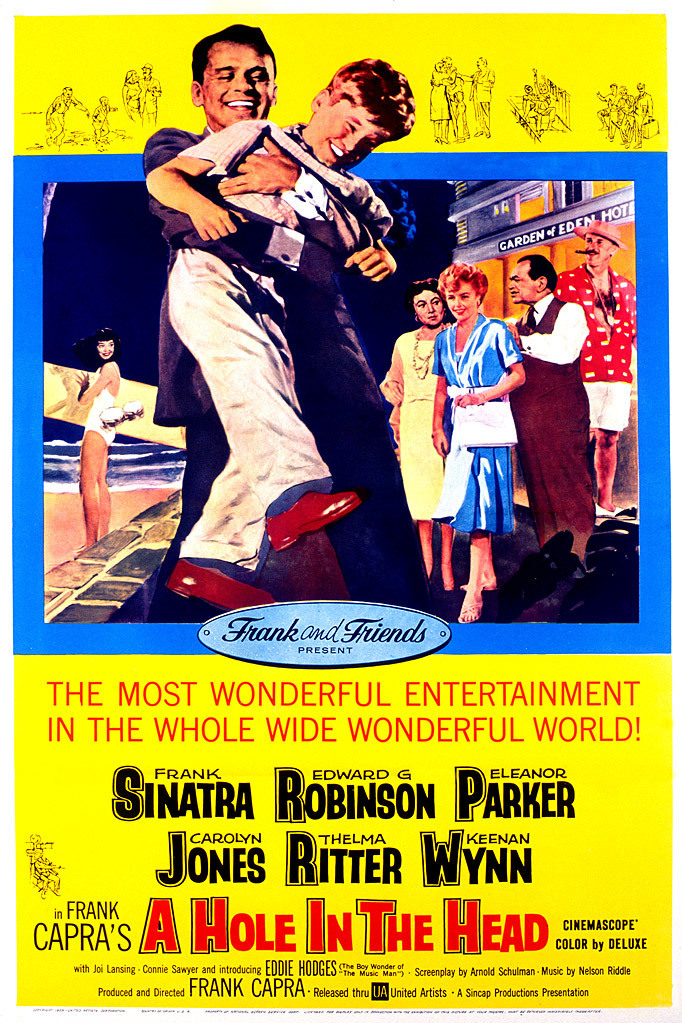
a hole in the head poster

I received A Hole in the Head for my birthday in a Frank Sinatra double pack with the original Manchurian Candidate. I had put off watching it because it did not seem like a movie I would particularly enjoy. But in my quest to watch and review all of my movies, I had no choice but to put it in the player. Of course, the fact that my wife wanted to watch it prompted me a little further even to the point of watching it out of alphabetical order.

Frank Capra is the great godfather of sentimental movies. Many of these are deservedly hailed by fans and critics. From Mr. Smith Goes to Washington to It’s a Wonderful Life and Arsenic and Old Lace Capra made movies about the little guys fighting the system and coming out on top. These movies are sentimental enough to be dubbed “Capracorn” by critics but are handled with masterful hands that rise above the schmaltz created by so many others. Besides little guys, he also flooded his movies with eccentric characters standing out in a world full of normal folk.  Sadly, A Hole in the Head tries to mix both of these Capra types and fails on both accounts.

The film is the second to last picture ever made by Capra and was the beginning of an attempted comeback, as he’d taken a break from making Hollywood pictures. But instead of a comeback, this film serves only to remind us of what Capra used to be. Frank Sinatra plays a down-on-his-luck big dreamer who is about to be evicted from his hotel business in Miami, Florida. He calls up his brother, Edward G Robinson, and sister-in-law Thelma Ritter for help pretending his son is sick. Robinson and his wife quickly head down from New York to see what’s going on. Hilarity and sentimentality ensue. Swinging Sinatra butts heads with button-down Robinson until a quick ending and easy solution is found.

The performances of the stars are fine. At this point in their careers, Sinatra and Robinson are essentially playing themselves. Although Sinatra is more up and coming to the declining Robinson. There are some good jokes and the simple story is fair enough as it is. Capra fills Sinatra’s hotel with an odd collection of eccentrics that seem to have no other purpose but to fill up some time and tell a few jokes. The ending of the movie seems tied on and creates changes to some characters without any real provocation. The cheese factor is high even for a Capra film and it’s not subdued by any superb performances. The drama is not elevated above the schlock you would see in a made-for-TV movie.

The stand out of the film is Sinatra and his son singing the classic “High Hopes”. Being a fan of Sinatra more as a singer than an actor this amusing break in the middle of the picture helped keep my hopes up for a decent picture. Those hopes were not shattered, nor were they completely fulfilled. For beginners of “Capracorn” you should pick out some of his earlier, superior films. But for a lonely night in need of some corny sentiment, this is some fluffy candy that just might fill.