The Friday Night Horror Movie: Opera (1987) & Tenebrae (1982)

image host

Apologies for my delay in getting The Friday Night Horror Movie out last night. For once I actually went to a movie theater and watched not one, but two horror movies. By the time I got back, it was late and I was too exhausted to write anything.

The Circle Cinema in Tulsa is one of my favorite places to see a movie. It opened in 1928 as a neighborhood movie house and ran as such until the late 1970s. By that time Tulsa had changed so much that the neighborhood wasn’t in much need of a neighborhood cinema and it closed its doors. Soon after it was purchased by another company and became a porno house.

In 1983 Francis Ford Coppola used it in his film The Outsiders. Then it closed its doors for a long time until reopening as an arthouse theater in the early 2000s. It has stayed as such ever since.

It does show some mainstream films, most likely to pay the bills, but its focus is on smaller-budget, foreign, and arthouse movies. It also does a lot of fun special screenings and events. I got to see James Ellroy give a talk before a screening of LA Confidential. They show Silent Movies on Saturdays with a live organ accompaniment. I’ve now seen four Dario Argento films there on a late-night showing.

I’ve always been a bit of a homebody. Covid has only intensified that aspect of my personality. I’ve come to realize I don’t go out nearly as much as I used to. I mean I was never one for clubbing or parties, but we did like to go to the park once and a while, or to fun local events. But over the last few years, we’ve mostly just stayed home and watched movies.

I’ve decided that 2025 is a year for change. I’m going to get out more. Do more fun things. Maybe meet some people. So when I learned that the Circle Cinema was doing a Dario Argento double feature last night I knew I needed to go.

They made it a fun event by calling it Splatter University. Before the films, they displayed a bunch of trivia about Argento, Giallo, and other horror films. The organizer gave a little talk before each film and at the end, they gave us a goofy little diploma.

Though I nearly fell asleep in the second feature (it didn’t start until after 10) I had a great time. They do these types of events pretty regularly and I hope to make it a habit.

The films, of course, are great. Opera is Dario Argento’s last great film. He’s made some decent films since then, but none of come close to the heights he reached at his peak. It is about a young opera singer (Christina Marsillach) who gets a chance to star in a production of Verdi’s Macbeth when the original lead singer gets into a terrible accident.

She is a great success, but soon enough a madman starts killing everyone she knows, often tying her up and making her watch in the process. In one of Argento’s great uses of violence, the killer tapes needles to her eyes forcing her to watch for if she blinks she’ll cut herself.

Made five years earlier Tenebrae stars Anthony Franciosa as an American writer of violent mysteries visiting Rome on a book tour. Soon enough someone starts killing people as a sick tribute to his latest novel, also called Tenebrae. (You can read my full review here.)

Argento is known for films with complicated, sometimes ridiculous plots and these two are no exceptions. I’ve seen them both several times before but it was fun watching them with a crowd, laughing at some of the sillier moments. But what the director lacks in plot cohesiveness he more than makes up for in style. Seeing these films on the big screen was enormously satisfying.

I’d previously watched Argento’s Suspiria and Deep Red at the Circle Cinema and I hope they’ll continue showing his films in the years to come.

Bring Out the Perverts: The Girl Who Knew Too Much (1963)

the girl who knew too much poster

The general consensus is that Mario Bava’s 1963 film The Girl Who Knew Too Much (also known as The Evil Eye) was the very first Giallo. This is strange because it doesn’t actually seem like a Giallo at all.

It was filmed in black and white and Gialli is known for its bold use of color. The killer is neither black-masked nor black-gloved. There is little to no gore and the killer’s motivations don’t stem from some psycho-sexual need. The camera does linger on the main actress’s bikini-clad body in one scene. In another, she’s wearing a short nighty and the photograph of an old man (played by Bava himself) ogles her. But it has none of the sleaze later Gilli would contain.

It is a murder mystery and Bava does deploy some imaginative camera setups and interesting visuals, but it seems more like an inventive thriller than anything you’d dub a Giallo.

Truth be told I don’t know where that idea that it is the first Giallo comes from. Wikipedia says it’s true so maybe it is, but most of the other online articles I’ve read both note that it is the first Giallo and then in the same breath note that it doesn’t really feel like one. So who knows.

To make all this even more strange is the fact that Bava directed Blood and Black Lace just one year later and it has all the hallmarks of a Giallo.

Whether or not The Girl Who Knew Too Much deserves that Giallo recognition or not it is a fine film and deserves to be seen.

Letícia Román stars as Nora, an American tourist visiting her aunt in Rome. The aunt is very sick and dies that first night. When Nora leaves to find help she is immediately attacked by a robber. When she awakes she sees a woman run out of a house with a knife sticking out of her back. A man approaches the corpse and grabs the knife. She then faints. When she wakes up the street is clean and no one will believe her story.

Later she’ll read some old newspaper clippings about a woman who was murdered in the exact spot ten years prior. And then there were other murders, meaning a serial killer might be on the loose.

She’s aided by Dr. Marcello Bassi (John Saxon) who both believes her story and rather fancies her. They will investigate. I suppose that is another way in which this film meets the Giallo standard – non-police investigating the crime.

They’ll run into lots of interesting people and there will be a few more corpses. It is all pretty standard murder mystery stuff. But Bava infuses it with some remarkable images. It doesn’t hurt that it is set in Rome and Bava apparently had free reign of many of its incredible landmarks. Norah winds up staying in a house located right on the Spanish Steps and the film makes great use of that location.

I don’t know that I would really consider it a Giallo but it is an interesting starting point for the genre, call it proto-Giallo. Or don’t, but I recommend it anyway because it is well worth watching whatever genre you want to put it in.

The Friday Night Horror Movie: All the Colors of the Dark (1972)

all the colors of the dark poster

A while back I started a little feature I called Bring Out the Perverts: Giallo on the Criterion Channel. That streaming service featured 13 Italian genre films and that seemed like a fun thing to review. I like the idea of having a pre-selected set of films to watch and review. I thought I’d do a bunch of them.

When I say “a while back” I mean I started this feature last September. Four months have gone by and I still haven’t finished watching 13 films. I did well through October, but the Noirvember happened and I completely forgot about this idea.

This is the second to last one and hopefully, I’ll finish it out soon after that. I still like the idea, and I’ve got some things brewing in a similar vein for this coming year. So consider this a Friday Night Horror Movie and a Bring Out the Perverts.

All the Colors of the Dark is a mixture of classic Giallo with some early 1970s psychedelia with a touch of satanism thrown in for good measure.

Edwige Fenech stars as Jane Harrison a woman whose recent car accident caused her to miscarry and lose her baby. This has sent her spiraling into mental breakdown. She begins losing her grip on reality, unable to tell her dream world full of nightmarish images and a man with a knife out to kill her, and real life.

She’s seeing a psychiatrist, but her boyfriend Richard (George Hilton) is against it. But he’s mostly annoyed that every time they start to have sex she starts envisioning that dude with the knife and has a panic attack. We’ll skip the analysis about knives and sex, stabbings, and penetration for now.

She meets a friend who suggests attending a Black Mass. There she is, well I don’t want to say raped because that feels slightly too strong a word so let’s just say strongly persuaded to drink the blood of a sacrificed dog and then engage in a lot of sex. Afterward, she’s totally into sexing up her boyfriend again. I wouldn’t touch that analysis with a ten-foot pole.

That dude with the knife keeps showing up in odd places stalking her. Sometimes she envisions him attacking her but every time that seems to just be a hallucination. At another Black Mass, she might have been forced to kill her friend who introduced her to it. Or maybe that was just a dream too. The lines between reality and hallucination become quite blurred.

It all wraps up a little too neatly for my tastes with all the solutions coming fast and clean.

Fenech is quite good. She’s the Scream Queen of Gialli and while I’m a fan, I’d never call it a fantastic actress. But she does well as this damaged woman in distress.

Director Sergio Martino leans heavily into the psychedelia of the era. He does that thing that was common at this time where the images turn into a kaleidoscope. He uses a lot of quick cuts, and he’ll repeat images over and over. I find it all very dated and rather annoying.

When he’s not giving you a visual trip he does create some rather striking images.

I’ve never been a fan of this type of psychedelic cinema and I find it especially obnoxious in horror. Looking at my Letterboxd friend list most of them seem to really like this one. So your mileage may vary.

Bring Out the Perverts: Strip Nude For Your Killer (1975)

strip nude for your killer poster

Horror films have always been at least a little transgressive and salacious. They are trying to evoke strong emotions after all. Starting in the 1960s and moving strongly in the 1970s and 1980s they began to rely heavily on sex and violence. Horror tends to be watched by younger people and younger people buy tickets when that’s what you’re selling.

Giallo always trodded on those tropes. This makes sense since Giallo is at heart a genre about violence against women. The best films in the genre examine those tropes, they ponder the male gaze (while often at the same time offering up examples of it) and probe the links between sex and violence. The worst ones simply give the audience plenty of naked flesh and blood-letting without much thought behind it beyond making a few dollars.

Strip Nude For Your Killer is one of the sleaziest horror films I’ve ever seen. Hardly a scene goes by without someone (usually any number of beautiful women) taking off their clothes. Actually, it is always the women. This is a film that has no problem showing full-frontal nudity from a woman but always pans up just as the men are taking off their pants.

It begins with a woman lying naked on her back, her feet in stirrups. She’s getting a back-alley abortion. The doctor’s head is strategically placed so that we can see pubic hair, but not her actual genitals. That’s about as sophisticated as the film gets.

I won’t get too far into the plot, as you can read more about that in my review of the Blu-ray over at Cinema Sentries. There isn’t much plot to be found if I’m being honest. It is basically someone killing a bunch of people connected to a modeling agency.

The kills aren’t particularly interesting, and the filmmaking is rather plain. There is a groovy soundtrack and the killer does wear a pretty rad-looking leather biker suit (someday I’m gonna make a list of all the films that have a killer wearing a similar suit – there are a lot of them, and they always seem to keep their helmets on!)

It also stars Edwige Fenech and I’ll never complain about that. However, she’s not given much to do (other than strip off her clothes at every opportunity) even as she is the main character and the one who is investigating the murders.

It isn’t a terrible film, it just isn’t particularly exciting which is quite a thing to say considering how much nudity and murder it has in it.

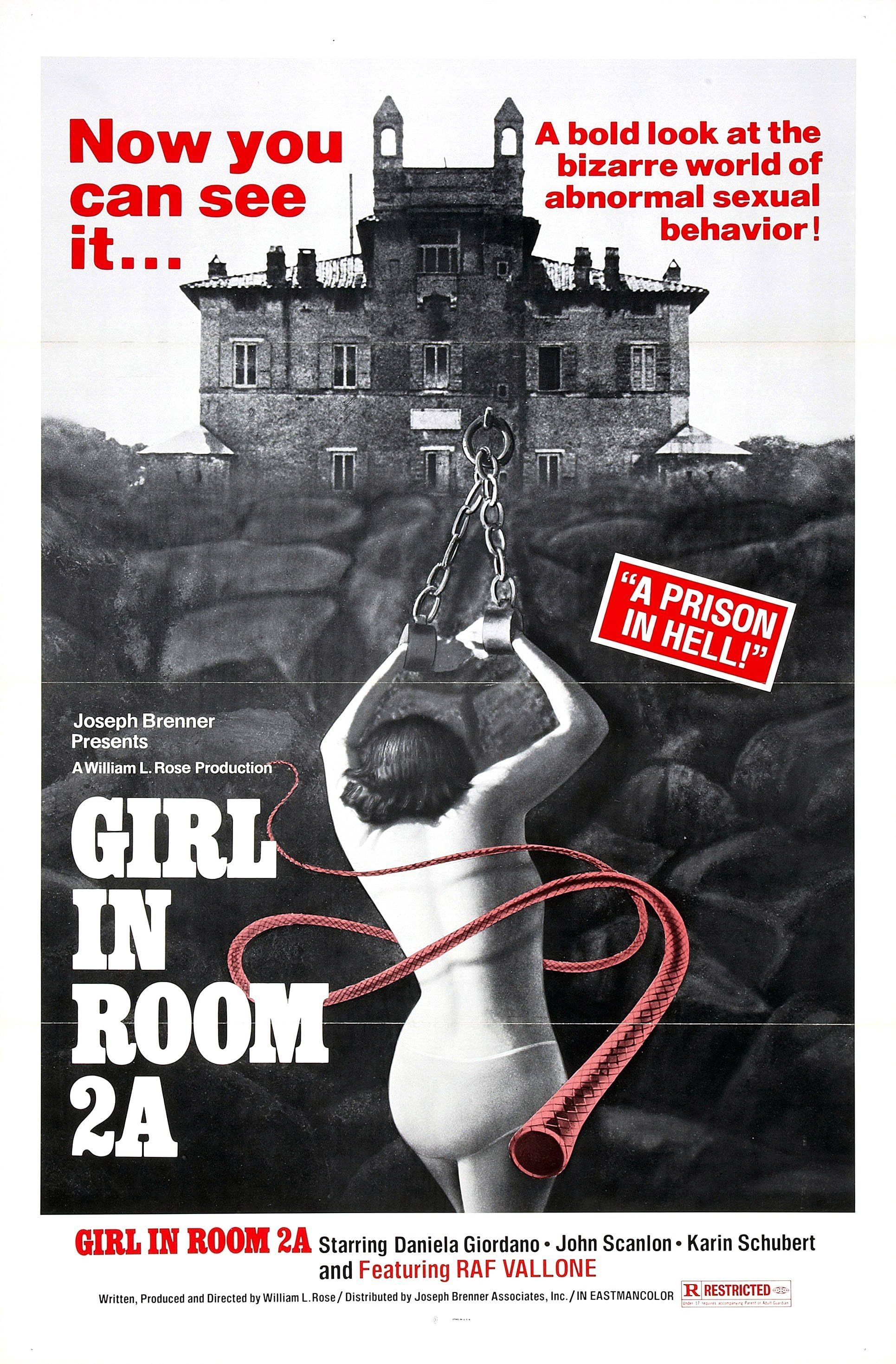
The Friday Night Horror Movie: The Girl In Room 2A (1974)

the girl in 2A poster

I watched The Girl in Room 2A via my Forgotten Gialli Blu-ray collection from Severin Films. “Forgotten” makes them sound like some overlooked classics or some incredible bits of cinema that were lost to time. But in reality, they were forgotten for a reason. That reason being they are mostly rubbish.

That’s not entirely fair to The Girl in Room 2A. It isn’t complete rubbish, it has a few moments that make it sort-of interesting. Or at least worth a watch if you are digging into the deep well of Giallo.

It starts out with a bang. A woman is kidnapped as she leaves a building. She’s grabbed, tossed into the back of a car, and taken to some dungeon. There she is stripped and punctured with these spikey metal rods. Then she’s driven to a cliff and dumped overboard. And all of that occurs during the opening credits.

Then we meet our heroine Margaret Bradley (Daniela Giordano). She’s just been released from prison and she sets herself up in the titular Room 2A in a sort-of halfway house.

The owner of the house is nice, but a bit nosey. The room is comfortable but there is a strange red spot on the floor. She’ll clean it up, but later it will reappear. At night she hears strange noises and she keeps having strange dreams about queer-looking people dressed in red robes doing…things to her.

I quite liked this part of the film. I love a good haunted house mystery. But then the film decides to show us what’s going on. In detail. They don’t just let us see the killers but it explains who they are and what their purpose is. In detail. I won’t bother with it, but all the explanations bog the film down. The mystery is lost and it becomes rather dull.

There is also a love interest which is dull in its own way, but at least that makes sense. I can accept a love interest in this sort of film, but there is no reason to spend so much time with the death cult explaining their motivations.

There is a final action sequence that’s pretty great, but it isn’t enough to make the film interesting.

Bring Out the Perverts: What Have They Done To Your Daughters? (1974)

what have they done to your daughters poster

Italian Cinema was dominated by two genres in the 1970s – the Poliziotteschi and the Giallo. The Poliziotteschi was a particular type of crime drama that is noted for its gritty, down-and-dirty take on police work featuring loads of violence and action sequences, highlighted by corruption at the highest levels. Gialli were murder mysteries featuring graphic violence, hyper-stylization, overt sexuality, and wild soundtracks.

What Have They Done To Your Daughters? is an interesting blending of both genres. Plotwise it is very Poliziotteschi as it follows the police as they try to catch a killer and are then pulled into a child prostitution ring with ties to the upper echelon of the city’s political sphere. Stylistically it is mostly gritty like a Poliziotteschi, and it features a couple of terrific chase sequences, but it also has a few stylish Giallo-esque moments.

There is also a black-gloved, motorcycle helmet-wearing, hatched-yielding psycho going around hacking people to death, and a few moments of sleaze where the camera lingers on naked female bodies (one of which is supposed to be a 15-year-old girl – the actress is of age – which makes it particularly gross).

I cover the basic details of the plot in my old review of the Arrow Video Blu-ray release (which you can read at Cinema Sentries) so I’ll skip them in this write-up.

I mostly really dug the film this go-around. I think I enjoyed the Poliziotteschi elements more than the Giallo. The story is good, the investigative elements are interesting, and the action sequences are top-notch. It is not unusual for this type of crime drama to dive into underage sex rings, but it still grosses me out, especially now that I have a young daughter. And this film gets a bit skeevy in that area.

I did dig the hatched-wielding killer, but like, why is he running around in a motorcycle helmet (other than the film keeping us from seeing his face I mean)? It is especially weird since the cops figure out who he is fairly early in the film (it is the guys who hired him that remain a mystery).

Overall, a very enjoyable cinematic experience.

Bring Out the Perverts: Torso (1973)

torso movie poster

I’m not sure how the Criterion Channel decided to organize their list of Giallos. It certainly isn’t chronological, and I can’t see any sort of thematic relevance. But we have definitely entered into the sleazy section of the list. By their very nature – black-gloved, knife-wielding maniac stalks and murders beautiful, young women – all Gialli are at least somewhat sleazy. But some definitely lean into that aspect of the genre.

Torso is not the sleaziest Giallo I’ve ever seen (that award goes to Strip Nude For Your Killer which is on the list and will be reviewed soon) but it certainly has plenty of gratuitous sex, nudity, and violence.

In the Italian city of Perugia, someone is strangling and then mutilating women from the local university. Terrified, four students take off for the weekend to an isolated villa that sits on top of a tall cliff overlooking a small village. Naturally, the killer follows them there and now they have nowhere to run.

But first, the two lesbians have to do a little sexing, and everybody must lounge around in skimpy lingerie. The violence ratchets up until our Final Girl is stuck inside the villa watching the killer literally make torsos out of his victims.

But Sergio Martino is too good a director to let this slip completely into sleaze. The mystery is well done (even if I did guess who the killer was early on). There are lots of red herrings and the kills are gruesome, but interesting and effective.

It is definitely not the first film I’d recommend to people looking to dive into the genre, but it is definitely not one I’d say you should avoid.

Bring Out the Perverts: Who Saw Her Die? (1972)

image host

I’ve seen all but one of the Giallos on the Criterion Channel. That is to say almost all of the films that will make up this series. I own quite a few of them on Blu-ray and reviewed most of them for Cinema Sentries. I’ve enjoyed rewatching these films thus far and writing new reviews. It is fun to read the old reviews and think about how my opinions have changed.

The thing with Who Saw Her Die? is that my opinion has stayed pretty much the same. Reading over my review from 2019 I find myself nodding along, pretty much completely agreeing with my thoughts from back then.

So what do I have to say about it now? Not much, really.

Like a lot of Italian films from this period, the actors all spoke whatever language came naturally while they were on the stage and then their voices were dubbed in post-production. They created two soundtracks for the film – one in English, one in Italian. In the English dub star George Lazenby used his own voice. In the Italian version, some Italian actor spoke his lines.

The Arrow Video Blu-ray has both soundtracks. I previously watched the English track. Criterion only has the Italian one. Lazenby once played James Bond. It was weird watching him act but hearing someone else’s voice come out of his mouth.

That really affected my view of his performance. In my review, I praised his acting, this time around I was less impressed.

The plot is pretty standard-issue Giallo. The visuals aren’t all that stylish, and the kills are pretty tame. But it does look lovely. It uses the Venice setting wonderfully and has that warm feel that only an excellent film and a good cinematographer can provide.

I’m making it sound worse than it is. It’s really fine. The mystery is interesting, and it has a good collection of weird characters. There are perhaps a few too many of them, and the plot gets a little too complicated, but it is still enjoyable to watch.

And that Ennio Morricone score is wild.

Bring Out the Perverts: In The Folds of the Flesh (1970)

in the folds of the flesh poster

This is the only film in the collection which I had not previously watched. It also happens to be the worst of the bunch, and I’d hardly call it a Giallo at all.

I’ve talked before about how most Gialli don’t make all that much logical sense. They often have plot inconsistencies and characters will behave in a nonsensical manner. But In the Folds of the Flesh is on a whole new level of nonsense. Honestly, I’m not sure I could describe everything that goes on in this film, or how any of it fits into the plot.

But I’ll try.

A convict escapes from a mental hospital. He comes across a woman who has just killed her husband and is burying him in her yard. But before he can do anything he is captured by the police. Many years later a long-lost cousin shows up to the house and is promptly murdered. Then an old friend comes to the house and he gets his head sliced off. Then the convict finds his way back to the house, tries to blackmail the family, and finds himself in an acid bath.

I think there is a police investigation and there are definitely flashbacks to a Nazi concentration camp, and probably a bunch of other stuff too. I really can’t remember. It all happens so haphazardly it was difficult to keep up. Or to care.

It is shot with psychedelic glee. There are a lot of flash zooms and kaleidoscope-y split screens. The kills (which feature quite a few decapitations) are pretty fun. And goofy.

It is overwrought and trashy. And a little bit of fun. But not enough to make me recommend it.

Bring Out the Perverts: Tenebrae (1982)


cover

While Mario Bava may have invented the Giallo, it was Dario Argento who popularized it in 1970 with The Bird With the Crystal Plumage. Without that film, we wouldn’t be talking about Giallo at all. Then in 1975, he perfected the genre with Deep Red.

While the genre was a very popular one, it had its critics. Many criticized its overt sexualization of violence and its graphic violence towards women. In 1982, just over a decade after making The Bird With the Crystal Plumage and thus creating the Giallo craze, Argento made Tenebrae, a film that can be viewed as the director’s direct response to the criticism of his films. While the genre would continue to be popular throughout the 1980s and Argento would make several more, Tenebrae can also be looked at as a final statement about the genre from the director.

While The Bird With the Crystal Plumage opens with the killer typing something on a typewriter – he is the creator of the art, Tenebrae opens with the killer reading an already-published novel – he is an audience to the art. That novel, also titled Tenebrae, was written by our protagonist Peter Neal (Anthony Franciosa) and it could rightly be considered a Giallo. It is about a killer who attacks women he considers to be perversions to society.

The real killer acts like a copycat to the killer inside the book (inside this film). We see him murder a woman who offers herself up sexually in order to get out of a shoplifting charge, and then later a lesbian couple with an open relationship. Like Travis Bickle in Taxi Driver, the killer believes he has been sent to rid the streets of so-called scum.

Peter Neal is in Rome for a book tour celebrating Tenebrae. His agent Bullmer (John Saxon) keeps booking him interviews in which Peter is constantly being asked about what effects the violence in his book may create in society. That’s Argento getting meta, as he was often asked similar questions about his movies.

When one of the murder victims has pages of his book inserted into her mouth the police begin asking Peter questions. Later the killer will slide quotes from Tenebrae under his door. Peter and his assistant Anne (Daria Nicolodi) start their own investigation.

The film is filled with scenes exactly what you’ve come to expect from an Argento-directed Giallo. There are sly camera angles, extreme close-ups, surprising jump-scares, blood-soaked violence, and a righteous score from Goblin (well, three of the members at least).

While the film does present lots of questions about violence and art – does it create violence in society or is it simply a depiction of the existing violence in society? Argento doesn’t give us any concrete answers. His on-screen surrogate, Peter Neal bats the questions away with pat answers, but the movie seems to indulge the idea both ways. Perhaps his films are a reflection of the real-life violence Argento was surrounded by, or perhaps his films influenced others to violence in society. Maybe a little bit of both occurred. It is clear Argento loved depicting violence in his films. I suspect he was never ever to truly untangle the reasons why. I love his films and abhor real-life violence so I have no pat answers either.

What we are left with is a pretty darn good little film filled with stylish violence and an interesting mystery. That is more than enough for me.