Bring Out the Perverts: Don’t Torture a Duckling (1972)

poster

Lucio Fulci is sometimes called the Godfather of Gore. As one might assume from that name his films were often filled with gratuitous violence and loads of blood and guts. Honestly, his films are sometimes not much more than blood and guts. Some of his films feel like he thought up some crazy violent scenes that would be cool to film and then tried to piece a story around it. Even at his best, his stories aren’t all that well done.

He wasn’t a particularly good stylist either. His films rarely look great. There is often a kind of DIY approach to the way he shoots his films.

I’m making it sound like I don’t like his film, but mostly I do. I think The Beyond (1981) is quite good and Zombi 2 (1979) is fantastic. But I wouldn’t say that Fulci is a great filmmaker. There is a bluntness to his films that reaches right into your guts and pulls them straight out. That violence and gore created some truly memorable effects work and he could certainly create a scene that will stick in your memory banks.

But yeah, he’s not really known for his thought-provoking scripts.

Don’t Torture A Duckling then is a bit of an oddity in Fulci’s filmography. The gore is toned down a great deal, and there is a concentration on telling a real story. One with a social conscience even.

The story revolves around the murder of three young boys in a small Italian village. It shocks the citizens and creates a sort of moral panic. They must find the killer, even if it’s a scapegoat. The community must go back to normal.

The first pick on a simple-minded man, then when it’s clear he could not be the culprit they go after a wandering witch. Then they decide it could be Patrizia (Barbara Bouchet) a rich, classy woman from the city spending some time in the country. She talks funny and dresses in tight shirts and short skirts. Surely she has loose morals and could be a killer. Rumors and superstition lead the investigation, at least where the townsfolk are concerned. The police are relatively competent but it hardly matters.

This is a Lucio Fulci message picture. Rural Italy is run on superstition and religion, science and procedure take second place. Not even the Catholic Church is given a break.

I appreciate that he’s trying to do something more than his usual shocking violence and gore. I also appreciate that he spends more time than usual creating beautiful images. Most of the film was shot on location and there are some truly beautiful landscapes that he lovingly captures. But if I’m being honest it isn’t all that interesting to me.

I’m not entirely sure why this qualifies as a Giallo. Outside of it being a murder mystery, it has very few of the hallmarks of the genre. But whatever, it is worth watching just to enjoy Fulci paying attention to the story for once.

I previously reviewed Arrow Video’s Blu-ray release of Don’t Torture a Duckling for Cinema Sentries.

Bring Out the Perverts: Deep Red (1975)

poster

I wrote about Deep Red for my Friday Night Horror movie a little over a year ago. I don’t know that I have a whole lot more to say about it. It is my favorite Giallo. I think it perfectly encapsulates everything I love about the genre.

Dario Argento is a master of creating fascinating visual images. Working with cinematographer Luigi Kuveiller they created a film that is stunningly beautiful, thrilling, and often quite terrifying.

I’ve seen it at least half a dozen times and it has never lost its allure for me. I’m always captivated.

I still do get it confused with The Bird with the Crystal Plumage. They have similar plots starting with a protagonist who witnesses a murder inside a building while he is on the streets of Rome. There is some detail he saw but can’t quite put his finger on.

But it doesn’t matter. Plots really don’t matter in these things, especially in Deep Red. I still couldn’t tell you all the details of what happens in this film, or at least what they mean. There are moments and entire scenes that don’t make any sort of logical sense, but they completely work for me. They are frightening, alluring, or at the very least visually interesting.

The score from the progressive rock band Goblin is an all-timer for me. It is sometimes a bit over the top but it somehow works perfectly within this film.

Everything works perfectly within this film. I love it so much.

Bring Out the Perverts: Death Walks at Midnight (1972)

cover

By 1972 the Giallo was already well established and quite popular. Mario Bava had created its template and Dario Argento had perfected it, but by this stage, many others had begun to play in that particular sandbox.

Quite a few of the directors now making Giallo weren’t necessarily interested in the genre, but they made whatever types of films they could get financed. These workman-like filmmakers went where the money was. As such the films aren’t always the best, sometimes they are pretty awful, to be honest, but a good filmmaker can make something interesting out of genres he’s not necessarily interested in.

There were quite a few directors during this period who would make a couple of westerns, a couple of Gialli, and then maybe a couple of action-packed crime thrillers.

Luciano Ercoli was that kind of director. He made some comedies, a couple of drams, some gritty crime thrillers, and three pretty good Gialli.

Death Walks at Midnight was his last foray into the genre, and arguably it is his best. It still has that workman-like sensibility to it, but it has style. And one of the best weapons in all of Giallo.

Fashion model Valentina (Susan Scott) agrees to drop a bit of LSD while her boyfriend and journalist Gio Baldi (Simón Andreu) photographs her and documents her experience. The agreement is he will not use her name and she’ll wear a mask so her identity will not be known. But as soon as the drug takes effect all bets are off, Gio removes the mask and ultimately uses her name to sell more newspapers.

While in the midst of her trip, she witnesses a gruesome murder in the flat across the street. A man dressed in black and donning a metal spiked gauntlet on his hand, smashes in the face of a beautiful, young woman.

Nobody else sees the murder and because she’s high as a kite on hallucinogens no one believes her. Later she learns a woman was murdered by a similar weapon in that very flat several months prior. But they caught the killer for that incident. He was found next to the body and confessed to the crime.

Perhaps Valentina witnessed that crime at the time, but it was so brutal, so awful, she repressed the memory. And then the drug resurfaced it. Or maybe the drugs unlocked some psychic ability and she was able to see into the past.

But then why does the killer from her vision look nothing like the man who confessed? And why does a man who looks just like the killer in her vision keep following her around town? And who is that other guy who keeps showing up to tell her she’s in danger?

Naturally, she begins her own investigation which leads her down all sorts of twists and turns. For the most part, Ercoli is pretty straightforward in his direction. The mystery is front and center. Except, it isn’t really a mystery as the film shows us who the killer is from the start. There is no mask in this one. He’s not hidden in shadows, and we don’t see things from his point of view. We know what he looks like, but we don’t know who he is. Or why he killed in such an awful way.

It is a fine story, told well. Periodically Ercoli infuses it with real style. The murder is especially well-shot. We see part of it reflected in his sunglasses. In another moment the screen splashes red with blood. But mostly, and I’m sorry to keep using this word, the direction is workmanlike. It is good. It is well done. But it isn’t all that memorable.

Except for that crazy gauntlet. That thing is cool.

I previously reviewed this movie and another Ercoli Giallo, Death Walks on High Heels for Cinema Sentries.

Bring Out the Perverts: Blood and Black Lace (1964)

poster

Mario Bava’s 1963 film The Girl Who Knew Too Much is generally considered the first Giallo ever made. While it does contain many of the hallmarks of that genre, it is missing one important ingredient: color. It was filmed totally in black and white.

As if correcting his own mistake Bava’s next turn into the genre would be absolutely exploding with color. Blood and Black Lace is one of the most colorful films I’ve ever seen. The genre forevermore would make great use of bold color schemes.

Bava was an artist and cinematographer before he became a director and it certainly shows with this film. Every scene is a painting. Every shot is beautiful. Even the violent ones.

He constantly uses different colored spotlights (red, blue, green, etc.) and will shine them on a specific object in his scene so that in any given shot, multiple things will shine bright in specific colors. One set is filled with mannequins, all of which have their own colored lights, and billowing curtains, again with different colored lights shining on them. It gives the entire thing this beautiful, yet eerie look.

His use of shadow and light is entrancing. Everything truly is astonishing-looking.

It is the story that lets me down. A black-gloved, masked killer is murdering beautiful women at a modeling agency. A police detective tries to solve the case. Everyone is a suspect. Everyone has an opinion on who the real killer is. A secret diary, red herrings galore, and all sorts of backstabbings and skeletons are in the closet. That sounds good, but something about its execution just doesn’t do it for me.

I think the lack of a real protagonist, or at least someone to root for causes my interest to lag. We wander from character to character, learning their dark secrets and thus their potential to be the murderer without ever really caring for them.

But Giallo has never been a genre that was all that concerned with telling a good story. It is about style, and Blood and Black Lace has that in spades.

What’s amazing is how this film, the second-ever Giallo, has pretty much every hallmark of the genre. This is the gold standard by which every other Gialli came into existence.

The killer has a black trenchcoat, a black hat, and black gloves. Here he wears a faceless mask that obscures everything about him, even his gender. He prefers blades over guns. The motives are psychosexual (presumably), and the victims are beautiful women. The camera is all gaze, objectifying the women as they become victims. Implicating us as it thrills us. And as I say it has style for days.

If you are interested in Giallo this is where you begin.

I previously wrote a review of Blood and Black Lace for Cinema Sentries, you can read it here.

Bring Out the Perverts: The Bird With the Crystal Plumage (1970)

cover

Dario Argento’s debut film was not the first Giallo ever made (Mario Bava’s 1963 film The Girl Who Knew Too Much usually gets that honor, followed by another Bava film Blood and Black Lace from 1964 – both of which I’ll be writing about later). Nor did it create any of the hallmarks usually associated with the genre (black-gloved killers, bold use of color and camera angles, psycho-sexual motives, etc). I wouldn’t even say he perfected it (at least not with this film). Still, The Bird With the Crystal Plumage was exceedingly successful, helping to popularize the genre and influencing a decade’s worth of Italian horror films.

It is a bit like how John Carpenter’s Halloween didn’t invent the slasher (a genre greatly influenced by the Giallo) but it popularized it to the degree that without it 1980s horror would look extraordinarily different.

The thing to remember about Giallo is that they are all essentially murder mysteries. Someone is killed (usually female, usually graphically), and someone else (usually not a cop) tries to solve the crime. They fall into the horror category because the violence is often stylized, brutal, and blood-soaked, and the killer often pops out of nowhere leading to jump scares. But at their heart, they are no different from other crime stories.

The genre in general, and Argento in specific never seem to care that much about the details of the crime or its solution. If, upon examination, some part of the story doesn’t make logical sense, that’s okay. What matters is the style and the execution (of the story, not the victims, although the kills are an important part of the genre.)

So it is with The Bird With the Crystal Plumage. Some of the plot points are a little goofy and the final solution is a bit ham-fisted, but I never care no matter how many times I watch it.

Sam Dalmas (Tony Musante) is an American writer vacationing in Rome. While walking home one evening he sees what appears to be a woman attacked by a man wearing a black trench coat, black gloves, and a black fedora. The woman is stabbed and the man runs away through a back door.

Sam tries to help but finds himself stuck between two sliding doors. He stands there helpless, watching this woman bleed out. Eventually, he manages to flag down a passerby who calls the police. The woman lives.

The police think the assailant has also killed three other women in the city within the last few weeks. Sam is haunted by what he saw. He thinks about that scene over and over again. He can’t even make love to his girlfriend without thinking about it. He’s convinced he missed some vital detail. Perhaps he saw the man’s face and can’t remember it. Or maybe there is some other clue he’s not seeing.

The film keeps flashing back to that moment as well. We see the attack from slightly different angles. In slow motion. It zooms in. As an audience, we examine the scene, looking for some vital clue. All cinema is voyeurism, but Argento makes it explicit. We are a part of this movie.

In another scene, the killer will look at his potential victim. He’ll snap photographs of her. The movie camera will look through the photographer’s lens. Voyeurism upon voyeurism.

The film opens with the killer in his black coat, donning his black gloves typing at a typewriter. Anecdotally I know that it was Dario Argento himself wearing those gloves, being seen creating words on a typewriter. In this moment the creator of the film portrays the killer creating something. Creation is art and art is violence.

Sam begins his own investigation into the crime. He visits an antique shop where one of the victims worked. The last thing she sold was a strange painting of a girl getting stabbed in the snow. More art. More violence. He visits the artist and finds that his painting is based on a real incident that happened several years before.

Meanwhile, the killer makes a few attempts on Sam’s life. In one stunning scene, he’ll attack his girlfriend in her apartment. The killer makes threatening phone calls. All the while Sam and the police get closer to him.

The ending is a bit of a letdown. It reminded me a little of Pscyho which is also a fantastic film right up until the end.

The Bird With the Crystal Plumage isn’t my favorite Giallo, it isn’t even my favorite Argento film but it is a stunning debut and helped crystalize what the genre was about, and certainly influenced nearly every Giallo that came after.

I previously reviewed this film for Cinema Sentries.

Bring Out The Perverts: Giallo On The Criterion Channel

cover

Criterion was one of the first boutique physical media companies. They started making Laserdiscs as far back as 1984 and then eventually moved to DVDs, Blu-rays, and most recently 4K UHD. They specialize in arthouse, foreign, and independent movies. Basically, they are the film snobs’ religion.

But that isn’t really fair. While they do release films by non-American, art-house directors like Akira Kurosawa, Francois Truffaut, Andrei Tarkovsky, and Federico Fellini and independent film darlings like Noah Baumbach and Wes Anderson, they also have boxed sets starring Bruce Lee and Godzilla.

The Criterion Channel does an even better job at this. Sure, you can watch the entire filmography of Rainer Werner Fassbinder, but they also regularly add in all sorts of obscure, goofy, and cult films like The Atomic Submarine, Atragon (about a giant sea snake that decides humans have become technologically advanced and attacks), Baba Yaga (based on a series of S&M friendly comics), and The Canyons (starring Lindsay Lohan and porn star James Deen).

Right now they are featuring thirteen Giallos. Fans of this site know I’m a huge fan of that stylish Italian horror genre so this is like catnip to me.

Even though I’ve previously watched all of the films, own most of them on DVD, and have even reviewed quite a few of them before, I thought it would be fun to watch them on the Criterion Channel and do a little write-up on each one.

Now that the music has moved to a separate site, I keep wanting to find ways to add value to this site. Something like this seems exactly perfect.

The name of this series, by the way, comes from Dario Argento’s debut film The Bird With the Crystal Plumage. A cop in that film has put together a lineup of crooks who might be the murderers of several beautiful women. He yells this when bringing them out. I thought it was a fun title for this series.

The films are as follows:

The Bird with the Crystal Plumage (1970)
Blood and Black Lace (1964)
Death Walks at Midnight (1972)
Deep Red (1975)
Don’t Torture a Duckling (1972)
Tenebrae (1982)
In the Folds of the Flesh (1970)
Who Saw Her Die? (1972)
Torso (1973)
What Have They Done To Your Daughters (1974)
Strip Nude For Your Killer (1975)
All the Colors of the Dark (1972)
The Evil Eye (1963)

Usually, Criterion presents their collections in chronological order, but lately, they’ve used some other criteria. I presume someone has ordered them in a way that makes for interesting viewing. I’ve decided to follow their order.

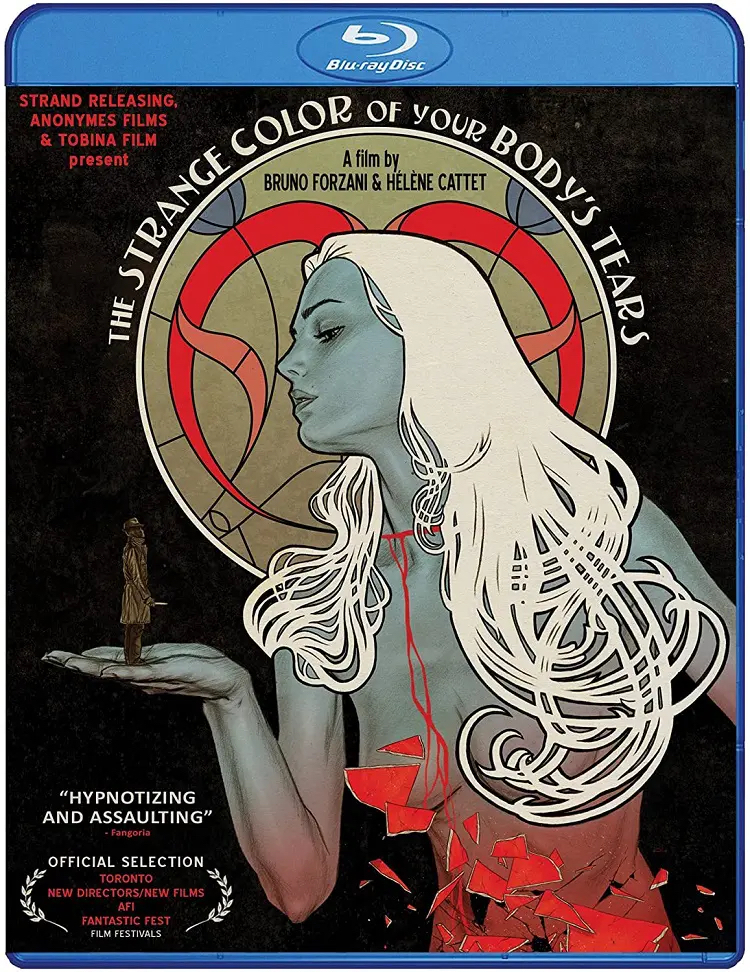
The Strange Color of Your Body’s Tears (2014)

cover

In my review of The Strange Color of Your Body’s Tears I noted that while I liked the film I was not likely to ever watch it again. And yet my review of the film makes me want to do just that.

It is a strange, almost incomprehensible film – one filled with beautiful, dark, blood-soaked images. I barely remember it. I need to rewatch it.

My full review is here.

Murder Mysteries In May: Arabella: Black Angel (1989)

image host

I’ve been trying real hard to review every murder mystery I watch this month. It is a struggle (but fun) because I have a…well, I started to say I have a life, but anyone who has an actual life doesn’t watch 7-10 movies a week. But I do have a job and a family, and other things that need my attention besides writing about movies (I mean I have to watch them too!). But also it’s a struggle because sometimes the movies are bad. Sometimes it is fun to write about a bad movie, sometimes it is a struggle.

But here we go again…

Arabella: Black Angel stars Tinin Cansino as Deborah Veronesi a woman with an insatiable sexual appetite who has the misfortune of being married to a man paralyzed from the waist down. Every night she slips away and finds some stranger to get sexy with.

One night she attends a wild warehouse sex party. It gets raided by the cops and one officer mistakes her for a prostitute and forces her to have sex with him. A paparazzi-esque blackmailer takes photographs of this.

Before he can do much blackmailing he’s stabbed with some scissors. Before you know it everyone Tinin sleeps with gets themselves scissored.

Meanwhile, the husband learns of her sexual escapades and is turned on by it. He wants to know more and he turns that more into his next book.

All of this could be a pretty good movie. But the film is more interested in gratuitous sex and nudity than it is in telling a good story.

It has a few decent Giallo visuals, and the killings are staged fairly well, but that’s about it. You all know I’m no prude when it comes to gratuitous sex but god golly I need more than that. For Giallo completist only

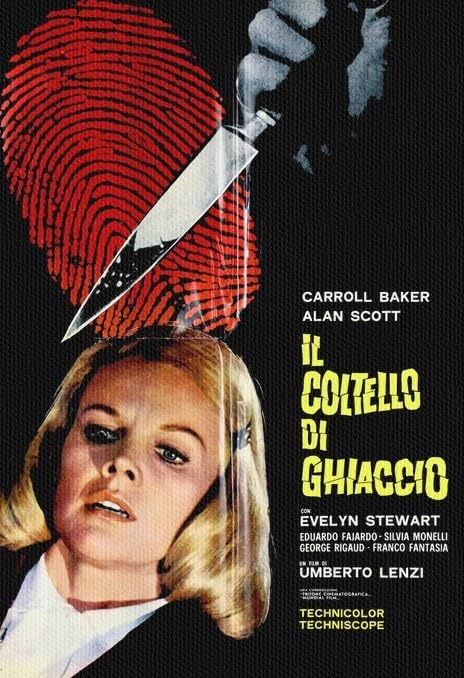
The Friday Night Horror Movie: Knife of Ice (1972)

poster

I knew that I was going to watch a Giallo some Friday this month when I dedicated it to murder mysteries. The name Giallo comes from the yellow coloring of the cheap paperback mysteries that were for sale in Rome at the time. Filmmakers started adapting them in lurid, violent ways, which turned them into horror films, but at their heart, they are murder mysteries.

I had not meant this Giallo to have been directed by Umberto Lenzi, the Italian genre director who now leads the director field in my stats for the year with me having now seen four of his films in 2024. I never would have guessed he’d be leading the pack in the middle of May. But life, and my film watching, is just full of surprises.

This one stars Carroll Baker (who made three other films with Lenzi) as Martha a woman who witnessed her parents die in a horrible accident when she was but a child, rendering her mute.

Now in her twenties, she lives with her uncle in a beautiful estate in the Spanish countryside. One day her cousin Jenny (Evelyn Stewart), who is a famous singer shows up. Then she gets herself murdered by a knife-wielding maniac.

The police note that another woman was found dead in a ditch not far away. It must be the work of a sex maniac. Later they’ll find remnants of a black mass and decide the murders aren’t that of a sex maniac, but of a satan worshipper.

More murders pile up and it appears as if Martha may be the next victim. The police inspector put three officers around her house for protection. It is the worst protection I’ve ever seen in a film. One guy takes shelter in an underground crypt (her house is next to a cemetery). Another one tells her that his replacement is running late so he just takes off without waiting. The last guy gets a call stating there is an accident nearby so he takes off, leaving her alone.

There are lots of twists and turns and the killer’s reveal is a big (and rather dumb) twist that will likely surprise everyone. Lenzi is a good enough director to keep you from getting bored, but just. There are some cool images (one involving some fog-covered streets is particularly nice) and some well-directed kills, but the story is mostly dull. There’s nothing particularly special about it.

The Friday Night Horror Movie: Spasmo (1974)

spasmo

I’ve come to realize the line between the horror genre and the crime genre is often a thin one. Sometimes horror films involve monsters or space aliens or the supernatural, but sometimes the villains are more pedestrian. Many horror films involve human killers – often of the psychopathic and serial variety – but human all the same. Many of these films follow a police detective private detective or some other normal citizen as they investigate the murders. This is, of course, what countless crime dramas do.

In these cases, it isn’t entirely clear as to what differentiates a horror movie from a crime one. Sometimes it might be a matter of the violence and gore, but I’ve seen plenty of detective movies/series that revel in the gruesome details. Maybe horror movies have more jump scares. Or maybe sometimes the genres rather blend together and you get to decide which one you are watching.

The Italian Giallo was pretty much always crime stories with a (usually leather-gloved, knife-wielding) killer on the loose and someone out to discover who he (or she) is. But they did so with a particular brand of style and a pension for graphic, sexualized violence.

Spasmo is a Giallo that works more like a standard crime mystery with a bit of (not very graphic at all) sexual psychology thrown in for good measure.

Christian (Robert Hoffman) and his girl go frolicking on some beach. They come across a woman face down in the sand. At first, they think she’s dead, but upon further inspection, they find she has just passed out. When she awakens she says her name is Barbara (Suzy Kendall) but she gets pretty cagey when asked any other questions. As soon as Christian’s back is turned she runs for her car and jets away.

But she leaves behind a bottle with the name “Tucania” written on it. Somehow they figure out the name is also the name of a boat and they jump aboard and attend a party going on there. As it happens Barbara is also aboard and before you know it Christian has dumped his girlfriend and run off with Barbara.

Strangely, Barbara is all about a little hanky panky but she forces Christian to shave his beard first. While he’s in the bathroom getting a face trim some dude busts in the window brandishing a gun and threatening to kill him. A Tussel ensues and Christian accidentally shoots the man dead (or is he?).

Barbara is weirdly chill about this fact, doesn’t even bother to look at the guy but does suggest that the two of them (her and this man she’s just met) go on the run together. But before they can leave Barbara’s boyfriend shows up and forces her to go with him. Christian takes off separately, then realizes he left a necklace at the house and returns to the scene. There he finds the dead man has vanished.

He regroups with Barbara at a chateau on the sea where they meet a couple of oddballs who tell them a story about a weird crime they just came across. Turns out someone is planting very lifelike dummies, dressed in lingerie and with knives sticking out of them all around the countryside. The film is littered with people discovering these strange creations.

Someone else attacks Christian and nearly kills him. His brother is somehow involved. Barbara seems to come and go. Christian begins to think he’s going crazy. At its heart this is a murder mystery, but also a psychological horror. We’re never quite sure what is real and what is being imagined by Christian.

The ending ties it all together with a twist that I won’t spoil, but it’s one of those things where once you see the conclusion the rest of the film makes more sense. I found myself thinking about the beginning and what was confusing got tied together. But that didn’t really make watching it the first time all that satisfying, and I’m not sure this film really merits a second viewing.

ScreeningNotes over at Letterboxd has a really interesting essay on the film. He ties it into the larger Italian cinema from the time frame. I’m not sure I buy into everything he’s spouting, but it is an interesting read anyway.

For my money, if you are a fan of the genre then this is worth watching, but you’ve really got to be a fan.