Scars of Dracula (1970)

scars of dracula

Regular readers will know I’m a big fan of Hammer Studios horror films. The truth is I don’t necessarily think all their films are all that good, but there is something about them that I love anyway. They are like Classic Doctor Who in that manner.

Scars of Dracula isn’t a great film by any real measurement, but I thoroughly enjoyed myself with it anyway. I truly can’t get enough of Christophe Lee enjoying himself as Dracula.

You can read my review of this film in all of its 4K UHD glory right here.

The Friday Night Horror Movie: The Revenge of Frankenstein (1958)

image host

As I mentioned the other day, I’ve been slowly working my way through the classic monster series from Hammer Studios. This is the second film in the Frankenstein series. The first film, The Curse of Frankenstein (1957) very loosely adapted the novel from Mary Shelley. Apparently Universal Studios was all too ready to sue them if they adapted it too closely, or if they copied any of their designs for the castles or the monster so it is a very loose adaptation, but a good one.

At the end of that film, Victor Frankenstein (Peter Cushing) is set to face the guillotine for his crimes. At the beginning of this film, we learn that with the help of a hunchback named Karl (Oscar Quitak) a priest was executed in his place and he escaped. Three years later we find him living in Carlsbrück, Germany as a successful doctor named Victor Stein.

He’s become very popular amongst the rich (much to the chagrin of the medical council (as he refuses to join their club), but he also runs a clinic for the poor. Naturally, he’s also continuing his experiments into creating life (and probably hacking off a few body parts from the poor for that purpose.)

He teams up with Doctor Hans Kleve (Francis Matthews) a man who recognises him from his past and is excited about the work he did with reanimation.  They will successfully remove Karl’s brain and implant it into a much healthier body. Things go pretty well, until of course they don’t. It wouldn’t be a Frankenstein film if he didn’t wind up going at least a little bit crazy.

The thing I’ve learned about Hammer Horror, especially their early entries, is that they are all about setting a mood. They have these wonderful sets and costumes that look both real and artificial. They create scenes that feel like they take place hundreds of years ago, yet there is an artificiality to it as well. Like you know you are watching a movie, but are still transported anyway.

The plots are often convoluted, and if I’m being honest, a little dull. And it often takes a while for the action and horror to take place, if it even comes at all. This film is like that. There is very little action or violence. It takes an incredibly long time for the monster to do anything.  Instead, we spend time with Dr. Stein and Kleve talking about what they are going to do. Stein shows off his lab, which had a rudimentary experiment in it (there is a severed hand in one box of water, and a floating pair of eyes in the other, and they respond to one another). 

There is a potential love interest, and some complaining by the board. Etc. It is more like a drama that just happens to have a reanimated corpse in it rather than a straight up horror film, but I still completely dig it.

I find I have to be in a certain mood for these films. You have to let them wash over you and enjoy what they are doing instead of what you might expect. But when you can’t, they are a lot of fun.

31 Days of Horror: The Mummy (1959)

the mummy

I’ve talked about Hammer Horror numerous times in these pages. Their most famous, and arguably their best, films were when they essentially remade the classic Universal Monster Movies (Dracula, Frankenstein, and The Mummy). Hammer updated the filmmaking to 1950-1970s standards, giving them lots more violence and sex appeal, while still keeping the stories interesting and familiar. They made a lot of sequels to the three main monsters, and I’ve seen most of them, but never in order. A few weeks ago I thought it would be fun to actually watch them in order. Unfortunately, I watched the first two (Dracula, The Revenge of Frankenstein) before I decided to start writing again, and it has been too long for me to reasonably be able to talk about them now. So we’ll just begin here.

The Mummy (1932) is my least favorite of the classic Universal Monster Movies (at least of the originals; some of the later sequels are pretty bad.) And so it is with Hammer’s attempt at making a Mummy movie (the only truly good Mummy film is that one with Brendan Fraser from the 1990s).

This one has its moments, but it gets bogged down in a rather dull backstory that completely destroys any momentum the film had going for it. The plot steals most of its details from several of the sequels to the Universal Mummy movie. A couple of archaeologists are searching for the tomb of Egyptian Ananka in 1885. The father finds it and accidentally awakens Kharis (Christopher Lee) the mummified guardian of Ananka. This sends the father into a catatonic state.

He awakens three years later and tells his tale to his son, John Banning (Peter Cushing.) The Mummy will now attack all those who desecrated Ananka’s tomb. But first, an overly long backstory. The film flashes back to tell us about Kharis and his secret relationship with Ananka. Honestly, it isn’t interesting enough to delve into, but the film seems to love it.

Actually, I feel like the costume and set designers worked really hard on this section (and probably spent a lot of money on it), so the filmmakers felt they needed to make all that time and money fill the screen for a while. There is literally a parade where extras in extravagant costumes, carrying ornate props, walk across the screen for several minutes. It completely kills the momentum of the film.

Eventually, we get back to the film proper and get some good Mummy action, and it is there that the film excels. Christopher Lee’s mummy costume looks great. He mostly just moans and walks awkwardly across the screen, so I can’t say much about his acting (he is unmummified in the flashbacks, which might be why that scene is so long – Lee wanted more time on screen unwrapped). Whenever the Mummy gets shot, holes blow right through him. The effect is pretty chilling (though sadly there is no scene like you see on the poster where a light shines straight through.

Peter Cushing is great as always and the scenes where he’s battling it out with the Mummy are the best parts of the movie. The rest of it is rather dull, I’m afraid.

Still, it is definitely worth watching if you are interested in Hammer Horror. But I’d recommend the Dracula films first.

31 Days of Horror: The Phantom of the Opera (1962)

phantom of the opera hammer horror poster

Hammer Studios became well known for their horror output. This is mostly due to the way they remade all the classic Universal Monster movies – Dracula, Frankenstein, The Mummy, etc., though they did make a great deal of other films, some of which were not horror-related at all.

In 1962 they adapted another famous horror story, The Phantom of the Opera, with mixed results. The Gaston Leroux book has been adapted numerous times and, of course, was turned into a Broadway Musical. I loved the book, and have seen at least a couple of those cinematic adaptations (though I’ve never seen any version of the musical, much to my wife’s surprise.)

Directed by Hammer stalwart Terrence Fischer the action is moved from Paris to London. Quite a few other things have been changed as well, but my memory is too faulty to lock those down for you.

The basics are the same. A pretty opera singer named Christine (Heather Sears) gets a chance to sing the lead in a brand-new opera. Producer Harry Hunter (Edward de Souza) takes a liking to her. Meanwhile, the Phantom (Herbert Lom) keeps causing problems.

There is a different backstory for the Phantom and Harry takes a much more active role and is more of a hero here. The Phantom spends a great deal of time training Christine to be a better singer than she already is. The real villain in this story is Lord Ambrose D’Arcy (a wonderful Michael Gough) who stole the opera from the Phantom (which we see in a flashback). And most of the really horrible things the Phantom usually does is given to a henchman to do.

All of this is fine, if a bit staid and clunky. The story never has any real oomph to it, and the ending is a dud. Lom is good and the sets have that usual Hammer charm to them. There are definitely better adaptations of the story than this one, but if you are a Hammer aficionado then you’ll probably like this just fine.

The Friday Night Horror Movie: Frankenstein Created Woman (1967)

cover

Hammer Studios made a name for themselves in the 1960s and 1970s by remaking and updating the classic Universal Horror Monster Movies. They were stylish and full of wonderful sets. They were more violent and sexy than those classic films, though they come out looking fairly tame by today’s standards.

They made numerous Dracula, Frankenstein, and Mummy films (I don’t believe they ever made an Invisible Man or Creature from the Black Lagoon film), most of which starred Christopher Lee and/or Peter Cushing. I’ve talked about a few of them in these pages. I have a great fondness for them all.

Frankenstein Created Woman was the fourth film in Hammer’s Frankenstein series (there would be seven in total.) It is a bit of a strange one in that it doesn’t seem to have much of a connection to the other films other than Peter Cushing playing Victor Frankenstein, and him continuing to be a mad scientist.

Here he isn’t so much reanimating freshly dead corpses, but capturing the souls of the recently deceased and placing them in fresh bodies. It is also strangely, almost accidentally progressive.

It opens with Frankenstein lying dead in a sort of deep-freeze coffin. He’s been dead for exactly one hour and at that precise moment, his assistant Dr. Hertz (Thorley Walters) resuscitates (or resurrects?) him. This proves to Frankenstein that a person’s soul does not immediately leave the body at death. Something he surely must experiment with.

Meanwhile, his other assistant, Hans (Robert Morris) is having a love affair with Christina Kleve (Susan Denberg) a woman who is disfigured and whose body is partially paralyzed.

Soon enough he’ll find himself being guillotined for a crime he didn’t commit and she’ll commit suicide shortly thereafter.

Naturally, Frankenstein takes this as an opportunity to capture the soul of Hans and put it into Christina’s body. This is where the film gets accidentally progressive. It apparently doesn’t occur to our friend Baron Victor Frankenstein that putting a male soul inside a female body might be considered strange (I mean stranger than reuniting a dead person). He doesn’t seem to consider it at all. For a brief moment, Hertz raises the question but it shuts down with a singular word from Frankenstein.

The film doesn’t really do anything with the concept after that either. There aren’t any moments where Hans’ soul is questioned about what it is like inhabiting a woman’s body or anything of the sort. No one ever mentions the fact that he could have simply resurrected Christina without Hans’ soul and his experiment would have still been a success.

Frankenstein also fixes all of Christina’s ailments (well, technically Hertz does the actual surgeries as Frankenstein’s hands no longer work – something I think that happened when he was frozen). She can now walk properly and her face is beautiful. No one questions why he didn’t do this while she was properly alive. That would have actually been something the entire community could get behind.

Anyway…

The two souls seem to exist simultaneously. Christina is more or less in control, but she hears Hans talking to her – he mostly screams at her to kill the people who committed the crime that got him executed.

It is a strange entry into the Frankenstein universe. There isn’t really a monster, just a nice girl who gets her dead lover’s soul implanted inside her body. Even after she (or they) start a murder spree the film is on their side. It seems to justify their crimes since the people getting killed were jerks in the first place.

So she’s not really a monster. There aren’t any townspeople with pitchforks, and Frankenstein isn’t all that involved in his own movie. We spend more time with others, developing relationships than with Frankenstein in his lab.

But it kind of worked for me. I am a great fan of these Hammer Horror films. They are often rather slow and meandering, but there is something I just love about them. This is no exception.

You can stream the film for free on the Internet Archive.

The Friday Night Horror Movie: The Devil Rides Out (1968)

poster

I am 100% a fan of Hammer Horror. I love the production designs, the sets and costumes, and the way their films looked. I love their stable of great British actors including Peter Cushing and Christopher Lee. I’ve watched something like 28 of the 70 or so films the studio made in the horror genre. So again I say I am a fan.

But I have to admit, that while I love a great many things about these films, I often find them rather dull. The films look gorgeous, and there is often a wonderful amount of sex and violence for a 1960s production, but the plots often have this staidness to them. There is a lot of boring talking and exposition that takes place that just causes me to nod off.

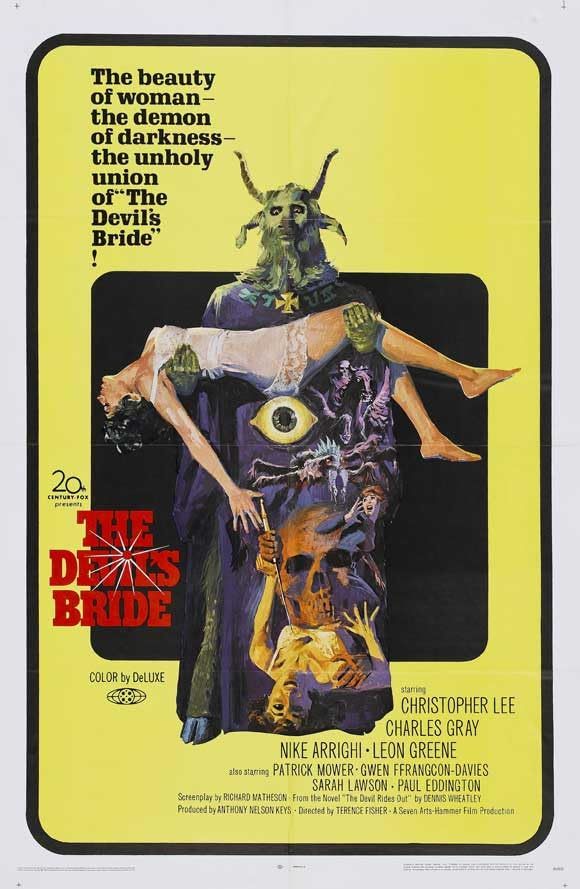
The Devil Rides Out (or The Devil’s Bride if you prefer) kept me completely enthralled from start to finish. It is quite wonderful throughout.

Christopher Lee stars as Nicholas, Duc de Richleau (who was apparently a recurring character in a popular series of novels from 1933 to 1970) a nobleman with a sturdy education and who is well-versed in the occult.

When his friend Rex Van Ryn (Leon Greene) returns home from a long voyage they decide to stop at their mutual friend Simon Aron’s (Patrick Mower) house. There they are met by a strange group of people Simon calls his Astronomy Club, but whom Richleau quickly deduces is a satanic cult.

They manage to rescue him from the house but almost immediately lose him again. They rescue him a second time, this time from a Satanic Orgy/Baptismal ceremony where a goat-headed Satan has been summoned. They also rescue Tanith Carlisle (Niké Arrighi) who was also supposed to be Satanically baptized that night.

Simon and Tanith are both somewhat under the spell of the head Satanist Mocata (Charles Gray). He can sometimes mind-control them into doing things for him (and sometimes he can’t depending on the needs of the script).

It is all a bit silly, but it won me over by the power of the performances (especially Christopher Lee who is always great, but especially wonderful here). Unlike a lot of Hammer films which tend to lean into their silliness, The Devil Rides Out is completely serious in its presentation and it is all the better for it.

There is a scene in the back half of the film in which Richleau creates a circle of protection that he and his cohorts must stand in to resist the power of Mocata. It begins with most of his friends being skeptical. It is a bit silly to think a chalk circle with some Latin written in it will protect them from anything. But then there is a loud knocking on the door and the sound of Simon yelling to be let in. Then a giant spider attacks, followed by Death riding a horse. The effects are cheap and goofy, but somehow effective. By the end, everyone is terrified, including me.

It is a scene that shouldn’t work. In the hands of less competent people, it wouldn’t work. And yet it is one of my favorite scenes in all of Hammer Horror. The entire film is like that. It shouldn’t be as good as it is, but somehow it is all pulled off magnificently.

The Friday Night Horror Movie: Countess Dracula (1971)

countess dracula

I don’t remember the first time I became aware of Hammer Horror. They seem to be a part of my forever memory, but I suspect I actually came to know them rather late. Presumably, I heard some chatter about Hammer Horror after I became a fan of the Univeral Monster Movies, which would put it sometime after college. But it was years later that I actually watched any of their films. Letterboxd notes the first Hammer film I ever watched was Dracula (1958) in February of 2014. I watched The Curse of Frankenstein (1957) not long after that, but it wasn’t until 2020 that I watched a third film and from there I started watching Hammer Horror with some regularity.

What I’ve come to realize is that I tend to find Hammer films to be rather dull. Their stories often have a staid quality about them. Oh, eventually there is some bloodletting, some murders, maybe a monster or two, and a bit of horror. But they often (not always) take their time getting there. They tend to be very British in their melodrama. There are a lot of costumes, and talking, and ideas of decorum before the horror begins, and even then it always comes back to the drama.

But the thing is, I still kind of love these films. They are gorgeous to look at. The set designs – mostly creaky old castles, and magnificent gothic mansions – are impeccable. Their cinematographers are genius, filling each scene with color and shadows, fog and light. And those costumes, my goodness those costumes are simply fabulous. So, while I am sometimes a little bored with the stories, I never grow tired of just watching these films.

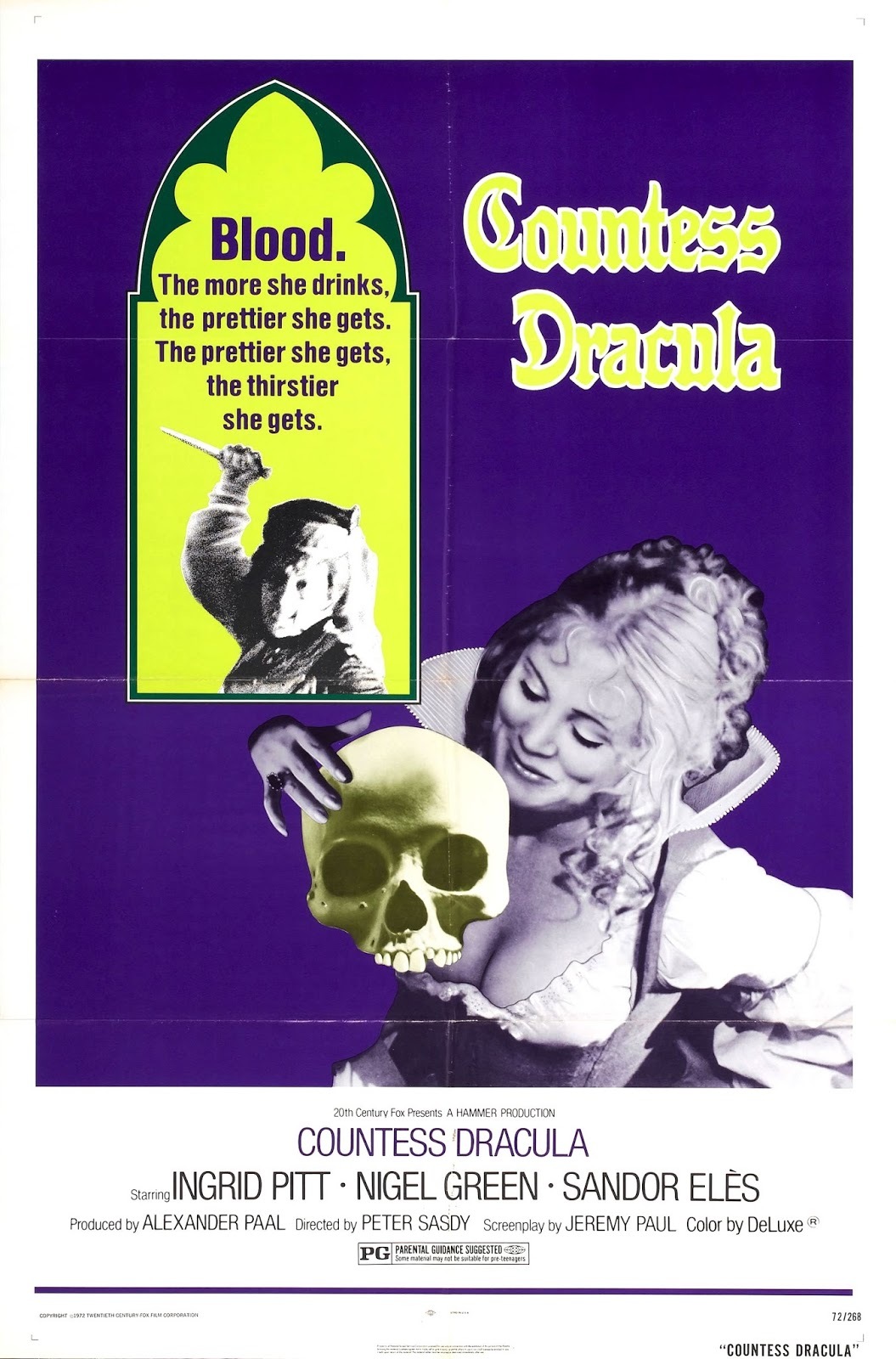
Despite its title, Countess Dracula has nothing to do with the Dracula legend, (and Christopher Lee and Peter Cushing are nowhere to be found) but is a loose retelling of the Countess Báthory story. She was a real person who lived in the late 1500s, was accused of killing hundreds of young women (and of bathing in their blood). Her story influenced a great many of the Dracula stories over the years so in that way you can consider this film a Dracula movie.

Anyway, in this story Countess Elisabeth Nádasdy (Ingrid Pitt, sadly dubbed for some dumb reason) discovers that drinking the blood of young women will restore her to youth and beauty. She does so and then must pretend to be her own daughter so as not to cause a stir in the village.

The real daughter, Ilona (Leslie-Anne Dow) was sent away when she was very young. When she returns to the castle, Elisabeth has her kidnapped and held captive so as to not be found out.

Meanwhile, Elisabeth seduces a young Lieutenant (Sandor Elès) all the while continuing to murder young maidens from the village (after killing a prostitute and bathing in her blood she realizes for the magic to work they must be virgins). In case you are wondering, all of the main servants in the household seem perfectly okay with their mistress regularly murdering people.

Eventually, things come to a head, but it takes its time to get there. I think I’ve made the plot sound much more exciting than it actually is. There is a lot more romancing than I’ve let on, and palace intrigue. There are a lot of scenes of people sitting around talking, and far too little bathing in blood.

But again, I still kind of loved it. I’m a big fan of Ingrid Pitt. She’s a marvelous horror icon and despite the painful voice dubbing she does some good work here. The sets are fantastic and the lighting is superb. There is a scene where Elisabeth is despairing over once again turning into an old hag. She wanders around her fabulously large, and perfectly lit bedroom in a flowing white gown and it’s like a dream.

The Friday Night Horror Movie: The Brides of Dracula (1960)

brides of drcula

Some of the best Hammer Horror films are the ones where they essentially remake the classic Universal Horror movies. Remake isn’t really the right word for the Hammer versions of the classic Universal Monsters (Frankenstein, Dracula, The Mummy, and the Wolfman) often differ greatly from their Universal origins. The Hammer films were much more violent and sexual than the original films, and just as stylish. They all appear a bit tame by today’s standards, but realizing that many of them were made in the late 1950s and early 1960s it is fairly astounding that they got away with so much.

The Brides of Dracula is the first sequel to Horror of Dracula (1958) (they made several more). Christopher Lee was great in that one as Dracula, but he died at the end so they couldn’t put him in this sequel (he is very much missed here and so he shows up again, despite being dead, in the next movie). Peter Cushing does return as Dr. Van Helsing.

A French school teacher, Marianne (Yvonne Monlaur) takes a position at an all-girls school in Transylvania. She takes the usual rickety coach through the usual creepy woods in the usual middle of the night. When they stop off at a little village for a bite to eat, the coach driver gets spooked and abandons her.

The innkeepers fret about, warning Marianne that she can’t possibly stay the night in their village alone. Just about that time in walks Baroness Meinster (Martita Hunt). She’s old and creepy but kindly offers to put Marianne up for the night in her castle. Despite the innkeeper’s warnings, she agrees.

There she finds a strange servant and the Baroness’s son Baron Meinster (David Peel) locked in his room and chained to the wall. The Baroness warns that he is ill and maybe a bit crazy, but he’s nice to Marianne, and handsome so she unlocks him.

Of course, he’s a vampire. Of course, he pretty quickly starts turning the pretty ladies of the village into his brides and has his eyes on Marianne.

This is where Van Helsing comes in. He does his usual thing which eventually leads to a showdown with the vampire. I won’t spoil it but it has one of the best vampire kills in all of vampire moviedom.

The thing is I generally find Hammer Horror films to be slightly tedious in terms of plot and pacing. The Brides of Dracula is no different. The plot just kind of plods along. It takes ages for a vampire to show up and ages still for Van Helsing to come along. Even then the action is often broken up by too much talking.

But the real thing is that I don’t ever really mind. I love Hammer Horror movies. They always build these incredible sets and costumes. They light it spectacularly with all of these lovely reds, blues, and greens. Their films always look amazing. The men are always dressed in these fabulous suits and the women are draped in the most marvelous flouncy gowns.

I love Peter Cushing (he is so much more than Grand Moff Tarkin in Star Wars. He’s surprisingly athletic in this film, running and jumping all over the place. I love Christopher Lee, too and he is greatly missed in this movie (try as he might but David Peel is the palest of imitations).

So, yeah, plotwise The Brides of Dracula isn’t great, but it is so much fun to look at and watch I don’t really mind.

The Friday Night Horror Movie: Taste of Fear (1961)

taste of fear

On Friday nights me and the family usually go upstairs to my room and watch Doctor Who. Afterward, the wife and daughter remain in our room to watch Youtube videos, while I go downstairs and watch a horror movie. Tonight, the daughter is staying over at a friend’s house. Which leaves me and the wife here alone.

Friends, I have to admit I didn’t know what to do with myself. We were too tired and poor to really go out for a date night. It is too hot outside to go to the park or anything. So, we had a little dinner and watched a movie. Two movies, actually.

Because I am a creature of habit I could only watch a horror movie tonight. That’s just what I do on Friday nights. Also, I write this article and I couldn’t let you all down, could I? I know every single one of my readers waits for me to tell them what horror movie I watch on Friday nights. 🙂

But my wife doesn’t like horror movies. So, I had to find something she could enjoy as well. Enter Hammer Studios. They made a whole lot of horror movies in the 1960s and 1970s that are not too scary, or gore-filled but are also a lot of fun. My wife can enjoy that sort of thing, and actually quite likes Hammer Horror as a genre.

The first film we watched was Dracula: Prince of Darkness (1966) which is the third film in Hammer’s Dracula series and the second to star Christopher Lee as the vampire (the second film The Brides of Dracula (1960) doesn’t actually have Dracula in it at all). It wasn’t great and since we decided to watch another film after that one, and it is actually quite good, I’ve decided to talk about it instead.

Taste of Fear (sometimes called Scream of Fear) is a wonderful bit of gothic psychological horror. It stars Susan Strasberg as Penny Appleby a wheelchair-bound heiress who has been away from home for ten years. When her father summons her she returns to his estate on the French Riviera. Strangely, when she arrives she finds that her father has just left on business. Stranger still, that night she sees a light on in the no longer used summer cottage attached to the estate. Upon investigating she finds the corpse of her father sitting in a chair.

Fleeing, she accidentally falls into the pool and knocks herself unconscious. When she awakes she is assured by everyone that it was all just a hallucination caused by fatigue and too much wine. As an avid moviegoer, I know at this point she’s being gaslit, but the reasons why are unclear.

The film has a lot of fun (very slowly) unveiling those reasons. Penny continues to see and hear things that make her believe her father is at the house, but no one will believe her. Well, almost no one. The chauffeur (Ronald Lewis) eventually does and becomes the love interest. The film gives us so many twists and turns that it is hard to know what is real and what isn’t. Just when I thought I knew what was happening the film mixed things up and I was completely surprised.

It is a bit of a slow burn, it takes its time to get interesting, but it is beautifully shot in black and white and is filled to the brim with atmosphere and mood. Once things do take off it becomes really quite wonderful.