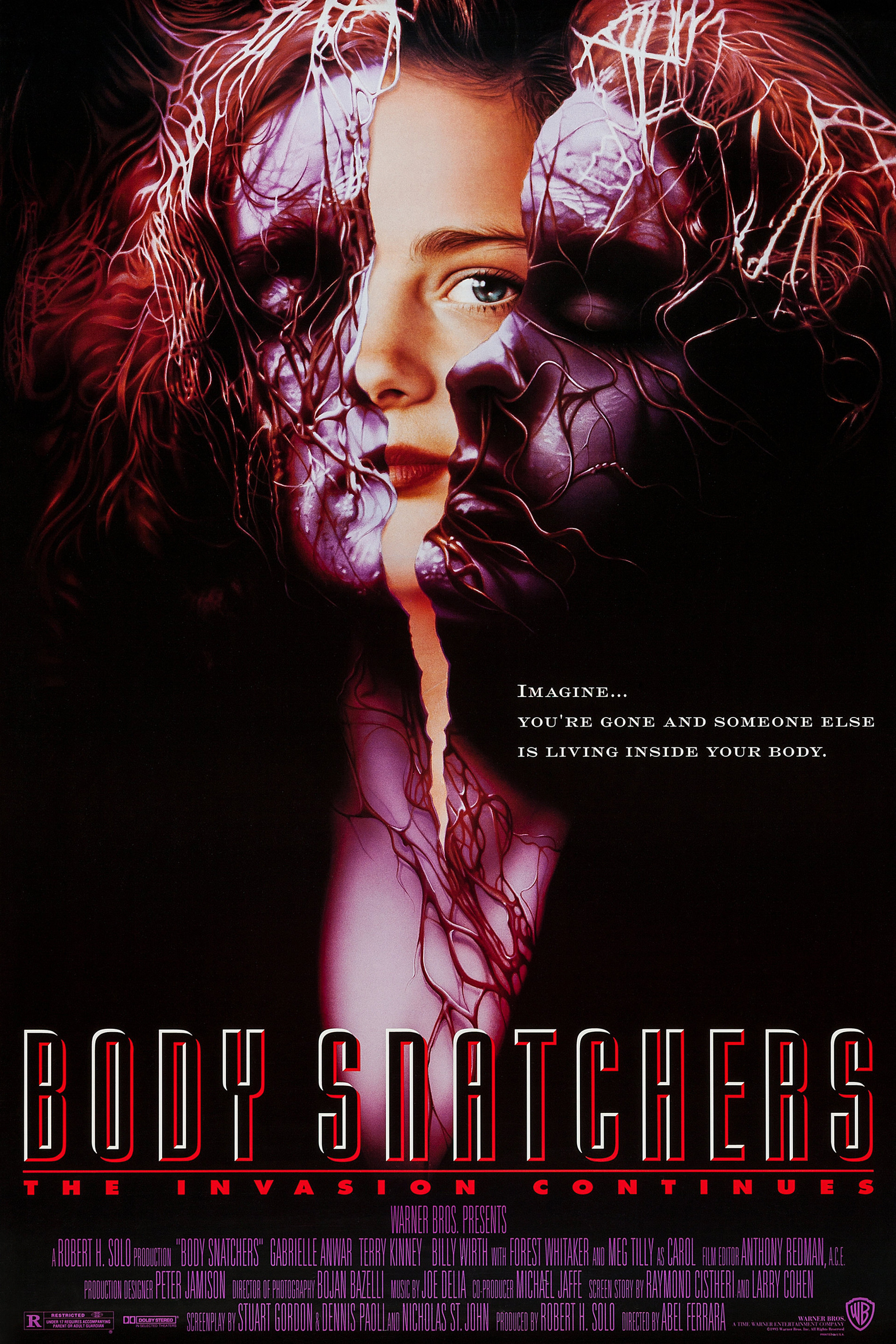
31 Days of Horror: Body Snatchers (1993)

body snatchers

In 1954 Jack Finney published a book entitled The Body Snatchers about a small town in California being invaded by alien seeds that transform into pods that then perfectly duplicate humans while they are sleeping. They duplicate everything down to the memories, but they have no emotions. The real people, meanwhile, turn to dust.

The book was turned into a low-budget B-noir in 1956 called Invasion of the Body Snatchers. It keeps the small-town setting and emphasizes how it is nearly impossible to know who has been turned and who hasn’t. Phillip Kaufman remade it in 1978. He kept the new name moved the setting to San Francisco and turned it into a terrific paranoid thriller.

Abel Ferrara remade it in 1993. He changed the name back to Body Snatchers and moved the setting to a military base.

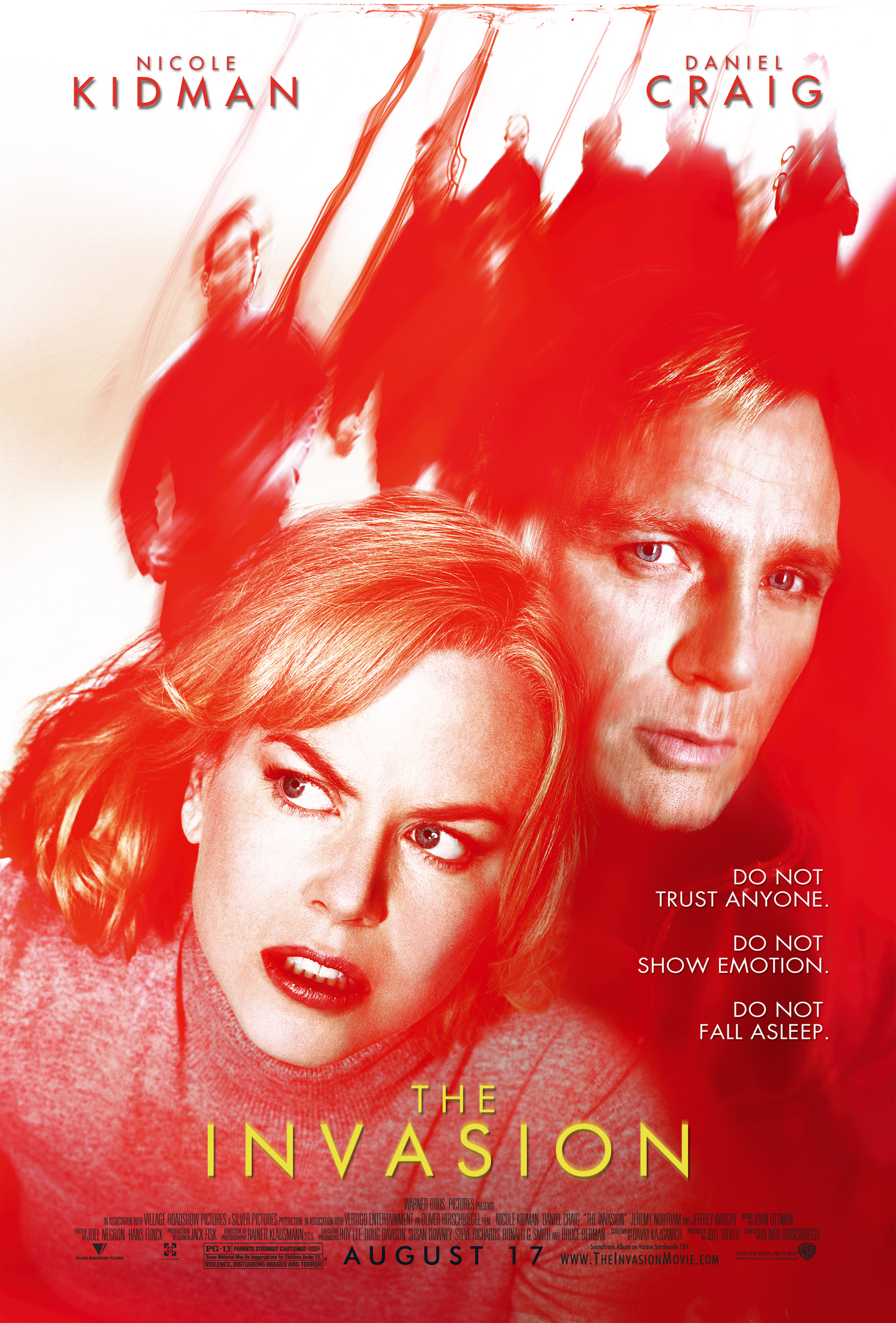
I don’t know what it is about this story that’s made it be adapted so often (they remade it again in 2007, I’ll probably be talking about that one in a few days) except that the idea of being turned into an emotionless pod people somehow continue to resonate. Doctor Who does something similar with their Cybermen.

In this version, an EPA agent Steve Malone (Terry Kinney) is sent to a military base for some routine tests on the effects of the base on the local environment. He takes with him his wife Carol (Meg Tilley) and teenaged daughter Marti (Gabrielle Anwar).

The plot is basically the same as the other films. The family starts to notice a strangeness in some of the people, and then they realize aliens are taking over and attempt to escape with their lives.

What’s interesting at this point is what’s different between the films. Setting this one at a military base sets up some interesting ideas about conformity since soldiers are supposed to obey orders without question and the pod people interact with each other as one unit. But the film never does a lot with the idea.

This film mostly follows Marti while the other two follow adult men which gives it a different perspective. This film mostly tosses out the paranoia of the other two films brought on by the characters not being able to tell who has been turned and who hasn’t. Instead, it makes the entire thing much more action-packed. This really loses what makes the earlier films so great.

There are some gnarly effects in this one. When the humans sleep the pods sling out this gross looking tentacles that slip into their orificaces and presumably extract what they need. Meg Tilley’s role as the mother is a small one but she’s quite good in it. She’s the first in the family to be turned and she’s wonderfully effective playing the emotionless alien.

But in the end, there is no real reason for this film to exist. The previous films are quite good. They are also different enough from one another to make an interesting double feature. This one doesn’t have enough to say to make its existence necessary.

31 Days of Horror: Talk To Me (2022)

talk to me poster

A group of teenagers come across an embalmed hand. When you hold the hand and say “Talk to Me” you will see a spirit. If you then utter “I Let You In” you will be possessed by same spirit. The teenagers use this magic to make viral TikTok videos.

Mia (Sophie Wilde), a 17-year-old who is still grieving over her mother’s death two years prior. She died after taking too many sleeping pills and it is unclear as to whether this was accidental or suicide. Her relationship with her father has become strained so she spends most of her time at her friend Jade’s (Alexandra Jensen) house.

Mia is considered a bit weird by the popular girls and this is starting to strain her relationship with Jade. This is perhaps why Mia eagerly volunteers to use the hand at a party they attend.

There are rules regarding the hand. There are always rules with these things. You cannot be possessed for more than 90 seconds or the spirits they will remain in this world. Naturally, the rule gets broken and things get bad.

Talk to Me was directed by Danny and Michael Phillipou better known as the YouTube channel RackaRacka which is known for its horror/comedy videos. This was their first feature-length film. I haven’t watched any of those YouTube videos but you can see the influence of those types of videos on the film. The camera often moves in big swoops, the editing is quick, and when we peak into the supernatural the look is stylish.

It is a very entertaining film with some good scares and a lot of style. Sophie Wilde is terrific and I hope she has a long, storied career. I’m just not sure there is much to the film beyond its entertainment value. Mia is clearly still deeply wounded by her mother’s death, but the film doesn’t seem to know what to do with that, other than periodically have her mom appear to her as a vision. It has some fun with the idea that these kids are dabbling in the supernatural, taking huge risks with evil all for social media clicks, but again it doesn’t really know what it wants to say about all of that.

Plotwise it is a mix of Flatliners and a Monkey’s Paw story, which is fine in and of itself, I just wish there was something more to it than surface horror.

31 Days of Horror: Doctor X (1932)

doctor x poster


So, I watched and reviewed a movie entitled The Return of Doctor X the other day. As far as I can tell it is not in any way a sequel to this film entitled Doctor X. It seems to be one of those things where one movie was popular and so they decided to make a new film and give it a similar title as a type of cash-in. Or at least the hope of a cash-in, whereupon people who enjoyed the first film might see the second film based on the title alone.

No one involved in the first film was involved in the second one. And while the plots are in the same ball field as one another, there isn’t any lap over in terms of characters or anything else other than a bunch of murders being solved, in part, by a news reporter.

A series of brutal murders have been committed in New York City over the last several months. They always occur during the full moon, and the bodies have been cannibalized.

Ace reporter Lee Taylor (Lee Tracy) is on the case. The police have learned that each victim has been killed by a highly specialized scalpel. One that only exists in one place in the city – Doctor Xavier’s (Lionel Atwill) institution. They figure one of Xavier’s scientists must be responsible.

The scientists are all mad and perfectly suited for these murders – one of them is fascinated by cannibalism, another by how the moon affects our psyches, another fetishized voyeurism, and the other is a grouchy paralytic (and thus could not have possibly committed the crimes…or could he?)

The good Doctor X is worried that if the police rush in and start questioning everybody it will ruin the institute’s reputation. He asks to be able to run his own investigation and surprisingly they agree. He does an early version of a lie detector test, hooking everybody up to some gadgets that monitor their heart rate and then he stages the murder scene. The first test finds no answers but does cause a blackout inside of which someone else is murdered.

Doctor X has a daughter, Joanne (Fay Wray) who mainly exists to give exposition and to be the love interest for Lee Taylor. He mainly exists for comic relief. He mostly plays it too big and too broad to be funny, but there are a couple of good bits including one in which he’s locked inside a closet with a skeleton.

The whole film is goofy, and a lot of fun. The sets are amazing, especially the testing arena. Michael Curtiz directed and he keeps things moving at a clip and makes it all visually interesting. It was shot in a two-tone color format which gives the whole thing an other-wordly feel. Made in 1932 it is a Pre-Code film and while not particularly scandalous when viewed with today’s eyes at the time a film dealing with murder and cannibalism (it also includes a brothel and talk of rape) was quite a thing.

The comedy often takes you out of the horror/mystery elements and none of it gels very well, but mostly it is a fairly forgettable, but rather enjoyable little film.

31 Days of Horror: The Secret of the Blue Room (1933)

blue room

The Criterion Channel is hosting several horror films made before the Production Code was rigidly enforced starting in 1934 – calling it Pre-Code Horror.

Pre-Code films are fascinating in part because it sounds so tantalizing. Films made before the Code got away with a lot and they can be shocking to someone who watches a lot of films made under the scrutiny of the Code. But it isn’t like these films were employing hard-core nudity and extreme violence. They were still under the preview of the cultural morals of the time.

The Secret of the Blue Room is not particularly scandalous at all. The most worrisome moment in the entire film is when a young lady kisses her father and three suitors full on the mouth, but that seems more like an old-fashioned cultural moment than anything actually scandalous.

The woman, Irene von Helldorf (Gloria Stuart) is celebrating her twenty-first birthday with her father, Robert (Lionel Atwill), her suitor Thomas (William Janney), and two other dudes who’d like to get with her, Walter (Paul Lucas) and Frank (Onslow Stevens). For some reason, they celebrate the birthday at the stroke of midnight and then tell the story of the blue room.

It is a locked-up room inside the Helldorf’s mansion. Years ago three people on separate occasions died inside the room at exactly 1 in the AM. Men being men they all decide that they will each successively sleep in the room to prove their manliness to Irine and probably win her heart.

The first one disappears without a trace, the second is shot dead and Irene is attacked in the room one morning by a mysterious man. Somehow, through all of this, none of them think to do something logical like call the police. Or search the house for the strange man. Or systematically go through the room looking for secret entrances, or try to understand the mystery.

Eventually, they do report things to the police and an investigation of sorts does occur. None of it is particularly interesting, but it isn’t grown-worthy either. I find a lot of really old films have this effect on me. It is like watching a television series from my youth. I recognize that it’s not really all that good, but it is a pleasant enough way to spend an hour of your time (The Secret of the Blue Room clocks in at 66 minutes.)

It is a remake of a German film from 1932 and it was remade two additional times, once in 1938 and again in 1944. Which just goes to show that Hollywood was cannibalizing itself long before its current trend of only making films with existing IP.

31 Days of Horror: The Return of Dr. X (1939)

the return of dr x

One of the things I enjoy about watching old movies is being able to chart the rise (and sometimes fall) of some of my favorite stars. You can, of course, do that with modern stars, but you never know where they will wind up. With classic movie stars, you get the entire picture.

Humphrey Bogart is my all-time favorite actor. He stars in my all-time favorite movie, Casablanca, and a slew of other great films including The Big Sleep, The Maltese Falcon, Key Largo, The African Queen, and many more. For much of his career, he was one of the biggest stars in Hollywood.

But of course, he wasn’t always a star. While he became famous for playing roles in which he was something of a reluctant hero, in his early films he often played the heavy – gangsters and bad men. He was good at it too. I sometimes wonder where his career would have taken him if he’d never become the big star.

The Return of Doctor X was made towards the end of his gangster period and just two years before becoming a huge star with The Maltese Falcon in 1941.

Reportedly Bogart hated the film and refused to talk about it in interviews. I can kind of see why. It isn’t a good film. It is the only horror movie he ever made and it is decidedly different from anything else in his filmography.

But, it isn’t that bad. It is kind of fun, actually. And Bogart is terrific.

It is supposedly a sequel to Doctor X, a film we’ll talk about in a few days, but really it has nothing to do with that earlier movie.

Several people have recently been murdered and completely drained of their Type One blood. Ace reporter Walter Garrett (Wayne Morris) is on the case. His investigation leads him to Dr. Flegg (John Litel) who, as it turns out, has created a synthetic blood that he has used to bring life back to the dead.

For his first patient, he grabs a recently executed man, Dr. Maurice Xavier (Bogart, naturally), fake buries him, and brings him back to life. Then forces him to act as his assistant. Trouble is the synthetic blood doesn’t replicate itself and so Xavier must murder (and presumably drink, or inject) the victim’s blood in order to stay alive.

Bogart, sporting slicked-back black hair with a shock of white in it, is utterly creepy as Dr. X. His skin is made to look pale and his eyes are sunk in as to make him the living dead and he plays it like a man half-dead.

The story is very silly, and it plays up the comedy angle, with the reporter being a bit of a ham. It isn’t at all scary, nor actually very good, but there is a goofiness to it that I found enjoyable and Bogart really is quite good. So, not the film I’d point anyone toward to discover why Bogart is my favorite actor, but certainly one worth watching if you are a fan.

31 Days of Horror: Messiah of Evil (1974)

messiah of evil poster

The 1970s were a fascinating time for horror movies. The studio system was dead, and independent cinema was on the rise. The production code was out and the ratings system was in. Sex, nudity, pervasive language, and violence were suddenly not only permissible but encouraged. The real-life horrors of the Vietnam War were all around. Also, Watergate, Nixon, and racial tension pervaded the minds of America. If horror is a reflection of what a culture is going through at any given time, in the 1970s we were going through a lot.

There were tons of great horror movies released in the 1970s – The Exorcist, Halloween, Suspiria, Dawn of the Dead, The Texas Chainsaw Massacre, etc., etc., etc. It was a great decade for horror.

Something I’ve noticed about a lot of horror films from the era is that they often have this gritty, impending sense of dread. Horror movies can be entertaining. Some of them are even fun. But horror in the 1970s was often dreary, filled with a sense of hopelessness and doom. I suppose that is a sign of the times, of all those things I just mentioned – war, politics, struggling for basic rights.

That can make for a great horror film. The Texas Chainsaw Massacre is incredibly bleak, but it is also one of the greatest horror films ever made. But when not done well, that sense of dread can be a real bummer.

Messiah of Evil isn’t a bummer, but it isn’t a lot of fun either. The basic plot – a woman travels to a small seaside town looking for her father only to discover it has been overtaken by cultish cannibals – isn’t particularly clever or all that fleshed out, really. There are long sections that I found to be rather dull.

But there are a couple of terrific set pieces. One in which a woman wanders into a grocery store only to find the customers are all munching on raw meat and then eye her for the next course. Another whereby another woman goes into a deserted theater to watch a film only to have it slowly filled with those crazy cannibals in a manner that eerily resembles a similar scene in The Birds.

There is also some wonderful set work. The father’s house is painted with incredibly detailed, and quite uncanny murals.

But so much of the rest of the film seems to just meander about. The woman, Arletty (Marianne Hill) comes to town looking for her father. She asks about and everybody says they’ve never heard of him, but they all seem to be hiding something. Eventually, she finds some people in a hotel who may know something. But first, they interview an old drunk (Eisha Cook, Jr.). He tells some old stories about weird happenings in the town a hundred years ago. The man (Michael Greer) says he’s interested in old stories, folklore, and the like.

But none of this really goes anywhere. We hear some more about the town and those strange events from 100 years ago. They seem to be happening again, but the film doesn’t explain any of it. I’m okay with a film not explaining every detail about what is happening, but this one only muddies the water in unsatisfying ways.

Thom and his two female companions loaf about in Arletty’s father’s house. The girls becomes jealous of her while he tries to seduce her. Etc. and so forth. It all feels like a lot of padding for those two (admittedly incredibly) set pieces.

It is definitely worth watching for those two scenes, but otherwise it is a bit of a drag.

The Friday Night Horror Movie: Infinity Pool (2022)

infinity pool poster

David Cronenberg is one of the most interesting directors of the last few decades. He began by making low-budget body horror flicks (a genre that he essentially invented) and grew into one of the more intellectually stimulating horror directors ever with occasional stints into science fiction, crime, and straight dramas.

His son, Brandon has recently started directing films and so far he hasn’t strayed far from his father’s roots.

Possessor from 2020 was a film about an assassin who is able to take control of people’s bodies with some kind of brain implant technology. I quite liked it.

Infinity Pool is weirder and far less interesting.

James (Alexander Skarsgård), a failed writer looking for inspiration, and Em (Cleopatra Coleman) the rich daughter of a book publishing mogul take a holiday at a resort in a vaguely Asian, and apparently backward and rather hostile country.

They are not supposed to leave the gated resort, but when they meet Gabi (Mia Goth) and Alban (Jalil Lespert) they are talked into sneaking off to a beach for a bit of fun and drinking.

I don’t know how to talk about this film without spoiling some of its central concepts so be warned.

On their way back James, driving a bit drunk, hits a local man killing him instantly. The next morning he is arrested and told this country has very strict punishments, but a rather unique way out of it. For the killing, he is to be executed, but if he can pay a large fee they will clone him and it is the clone that will be killed.

He does just this and is forced to watch the son of the man he killed take a knife and stab his clone to death.

That night Gabi and Alban introduce James to a group of people who have all been through the same ordeal. But rather than be devastated over this, they have found it freeing. Here is a country that will literally let them get away with murder, as long as they can pay the fine. Having to watch their clones get executed afterward is just a bizarre perk.

The film has a lot to say about nepotism (which is really interesting since Brandon is a nepo baby) and how the rich can get away with anything. Both Goth and Skarsgård give really good performances. But it all left me wanting for more, or at least something different. It is an unsettling film, I felt very uncomfortable while watching it, but I couldn’t exactly pinpoint why.

Some films give you a feeling of dread – they make you feel like something terrible is going to happen to their characters and you dread the moment it comes. This had that same feeling, but all of the characters in Infinity Pool are terrible people, I was kind of hoping the bottom would fall out.

Cronenberg disorients us on several occasions. It begins with idyllic scenes of the resort with his camera turning upside down, making you feel a little seasick. There are several drug-induced hallucinations where he quickly cuts a lot of different images, many of which are flooded with psychedelic lighting that did nothing to help the film but did make me dizzy.

In the end, it felt like a film with some interesting ideas, some good performances, but the messy filmmaking dropped it all on the floor.

The Friday Night Horror Movie: Countess Dracula (1971)

countess dracula

I don’t remember the first time I became aware of Hammer Horror. They seem to be a part of my forever memory, but I suspect I actually came to know them rather late. Presumably, I heard some chatter about Hammer Horror after I became a fan of the Univeral Monster Movies, which would put it sometime after college. But it was years later that I actually watched any of their films. Letterboxd notes the first Hammer film I ever watched was Dracula (1958) in February of 2014. I watched The Curse of Frankenstein (1957) not long after that, but it wasn’t until 2020 that I watched a third film and from there I started watching Hammer Horror with some regularity.

What I’ve come to realize is that I tend to find Hammer films to be rather dull. Their stories often have a staid quality about them. Oh, eventually there is some bloodletting, some murders, maybe a monster or two, and a bit of horror. But they often (not always) take their time getting there. They tend to be very British in their melodrama. There are a lot of costumes, and talking, and ideas of decorum before the horror begins, and even then it always comes back to the drama.

But the thing is, I still kind of love these films. They are gorgeous to look at. The set designs – mostly creaky old castles, and magnificent gothic mansions – are impeccable. Their cinematographers are genius, filling each scene with color and shadows, fog and light. And those costumes, my goodness those costumes are simply fabulous. So, while I am sometimes a little bored with the stories, I never grow tired of just watching these films.

Despite its title, Countess Dracula has nothing to do with the Dracula legend, (and Christopher Lee and Peter Cushing are nowhere to be found) but is a loose retelling of the Countess Báthory story. She was a real person who lived in the late 1500s, was accused of killing hundreds of young women (and of bathing in their blood). Her story influenced a great many of the Dracula stories over the years so in that way you can consider this film a Dracula movie.

Anyway, in this story Countess Elisabeth Nádasdy (Ingrid Pitt, sadly dubbed for some dumb reason) discovers that drinking the blood of young women will restore her to youth and beauty. She does so and then must pretend to be her own daughter so as not to cause a stir in the village.

The real daughter, Ilona (Leslie-Anne Dow) was sent away when she was very young. When she returns to the castle, Elisabeth has her kidnapped and held captive so as to not be found out.

Meanwhile, Elisabeth seduces a young Lieutenant (Sandor Elès) all the while continuing to murder young maidens from the village (after killing a prostitute and bathing in her blood she realizes for the magic to work they must be virgins). In case you are wondering, all of the main servants in the household seem perfectly okay with their mistress regularly murdering people.

Eventually, things come to a head, but it takes its time to get there. I think I’ve made the plot sound much more exciting than it actually is. There is a lot more romancing than I’ve let on, and palace intrigue. There are a lot of scenes of people sitting around talking, and far too little bathing in blood.

But again, I still kind of loved it. I’m a big fan of Ingrid Pitt. She’s a marvelous horror icon and despite the painful voice dubbing she does some good work here. The sets are fantastic and the lighting is superb. There is a scene where Elisabeth is despairing over once again turning into an old hag. She wanders around her fabulously large, and perfectly lit bedroom in a flowing white gown and it’s like a dream.

The Friday Night Horror Movies: The Purge: Anarchy (2014) & The Purge: Election Year (2016)

the purge

I’ve watched several old British films for my Friday Night Horror the last few weeks so I wanted to watch something more modern and the first two Purge sequels fit the bill.

So, The Purge Franchise is set in a dystopian future. At some point in the past America was overrun with crime and violence. To curb this violence it was decided that one night a year, for a 12-hour period all crime, including murder, will be made legal. The thought is that this will allow everyone to get it out of their system, and for the rest of the year everyone will be chill.

Though the films lean on the idea that we aren’t all that far off from something like that actually happening, the concept is actually completely ridiculous. For real life I mean. For a movie, it’s really pretty cool.

The first film, simply titled The Purge (2013) focused on one (rich, white) family trying to survive the night. Things get complicated when they allow a stranger into their home and give him protection and a group of crazies come to say he is the very person they want to Purge. It isn’t a bad little thriller but it tends to lose focus on its conceptual idea and winds up focusing on the more generic base under siege aspects of the story.

I had minor hopes the sequels would spend more time on the bigger ideas. They sort-of do. While The Purge focused on one family inside their house The Purge: Anarchy and The Purge: Election Year expand the stories to larger groups of people and allow us to see more of the outside world.

The problem with all three of these films is that they all have a vague political message that boils down to The Purge is run by rich white people who benefit from the violence, while poor people of color suffer the most. A relevant message, but not one they hit on very hard, nor make very specific.

A concept like The Purge could make for a really great science fiction film with all sorts of allegories, but these films want to be money-making franchise machines in the horror genre and they don’t seem to have the stomach for more direct political messaging.

Yet they rarely nail the thriller/horror aspects either. If you are going to make a horror film about a period of time in which all crime is legal, then you should really go all in. Give us some Tobe Hooper-style insanity.

There is one really great scene during The Purge: Election Year that nails what I’m talking about. A car decked out in Christmas lights pulls up to a locked-up and barricaded convenience store. A group of women dressed in sexy Halloween costumes and carrying swords, saws, and machine guns get out and demand they be let inside, for the leader of the gang wants a candy bar. The subsequent battle is just as nuts. It is a well-staged sequence and it totally worked for me because it leans into the absolute insanity of the concept. The rest of the film doesn’t work nearly as well.

Thus far, the films have only had one character carry over from one film to the other. In The Purge: Anarchy we find Leo Barnes (Frank Grillo) on a mission to seek out some revenge on Purge Night. Along the way, he stumbles on several people who are clearly out of their depth and need help. By the film’s end, he’s become a reluctant hero.

In The Purge: Election Year he’s become head of security for Senator Charlie Roan (Elizabeth Mitchell) who is running for President on a ticket that promises to outlaw The Purge. Honestly, he’s kind of a generic action hero which is kind of my problem with the whole franchise thus far. My problem with most of the Blumhouse films I’ve seen, to be honest. They lack a specificity that can turn a high concept like this one into something great. Movies need a particular point of view, they need to find interesting ways to tell their stories. Otherwise, they wind up feeling generic, and just like a million other films.

These three The Purge films lack that specificity, that point of view. They take an interesting idea and turn it into something just average. That doesn’t make them bad films. I mostly enjoyed watching them. But it keeps them from being truly great or interesting.

The Friday Night Horror Movie: Island of Terror (1966)

island of terror

On a remote island off the coast of Ireland, a man is found dead with his bones missing. He’s all squishy flesh. The film’s budget doesn’t allow us to see much of that but what we get – a rubbery, flabby face – is pretty great. Constable John (Sam Kydd) calls the island’s physician Dr. Reginald Landers (Eddie Byrne) but his skills are limited and after an autopsy doesn’t pull up much in terms of answers he scurries to London to discuss the matter with imminent pathologist Dr. Brian Stanley (Peter Cushing), who in turn calls on bone specialist Dr. David West (Edward Judd). He’s busy with his lady friend Toni Merrill (Carole Gray) who as luck would have it happens to have access to a helicopter that can take them to the island straight away (although it must return to London immediately after thus stranding them on the island for a few days.

After learning that a cancer specialist had set up shop on the island they go to visit him hoping to gain his help as well, but find him dead and boneless like the other guy. His lab assistants are all squishy as well. But the dude had a really nice lab which allows our heroes to do some nice science-y stuff. They do some autopsies and look at things under a microscope and say a lot of words that don’t make much sense even if you have a medical degree.

Eventually, they find the monsters. They look like slimy Jell-O molds with tentacles. They are impossible to kill and use the tentacle to inject their victims with bone-dissolving liquid. Our guys chop them with an axe, shoot them with rifles, torch them with Molotov cocktails, and even throw dynamite at them, but like I say those creatures are indestructible.

To keep the rest of the islanders safe they lock them all into one room which only causes mass panic when the lights go out. Meanwhile, these brilliant scientists finally decide that they should inject some cows with some radioactive fluid (I told you that the cancer guy had a well-stocked lab) figuring that the monster will eat the cows and then die of radioactive poisoning.

All of this is taken absolutely seriously by our actors and filmmakers. I love these old British horror films from the 1960s. They are so full of absolute silliness with ridiculous plots and poorly built monsters, but the actors perform like they are doing Shakespeare (and no doubt many of them are trained Shakespearean actors). It is wonderful. Just wonderful.