The Friday Night Horror Movie: Halloween (1978)

halloween poster

I don’t remember the first time I watched John Carpenter’s Halloween. I don’t think I saw it while in high school; it was probably college that found me first seeing it. Whenever it was, I’ve seen it many times since. It has become part of my DNA. I love it deep down in my bones. So I was surprised to realize that I’ve never actually written about it. I’ve written about several of the sequels and the remakes, but never the original. I’ve gotten into the habit over the last several years of watching one of the Halloween movies on Halloween, so I decided it was high time I watched the original on this, the spookiest of evenings, and then finally wrote something about it.

Reading some of my other Halloween reviews, I find that I’ve talked quite a lot about Carpenter’s film and its place in popular culture, so I don’t want to go too heavy in that direction here. Though it is often cited as the first slasher, you can actually go back as far as Psycho and Peeping Tom (both released in 1960) to find films that fit the mold. Italian giallos certainly had a lot of influence over the slasher genre and could even be considered slashers themselves. Technically Black Christmas, a very good slasher itself, was released a few years before Halloween. But it was Carpenter’s film that popularized the genre and solidified the tropes.

While this is true, I would argue that Friday the 13th (1980) truly solidified everything the slasher would become over the remaining decade. Sean S. Cunningham was clearly inspired by Halloween‘s success, and he distilled the Carpenter film down to its very essence. It has a group of sexy teens getting killed off one by one by a blade-wielding maniac. The final girl is virginal and thus pure in the film’s point of view. The killings all stem from something in the killers’ past. Etc. Even the title is taking the holiday premise from Carpenter. Friday the 13th takes the tropes established in Halloween and grinds them down, then exploits the hell out of them. The sex and nudity are more gratuitous, the violence more gore-filled. 

Carpenter is on record stating that the notion that Laurie Strode survives Halloween due to her “purity” was purely accidental. And it’s true, Laurie isn’t some paragon of virtue. We see her smoking in one scene, and she doesn’t seem opposed to drinking or the fact that her friends are screwing their boyfriends at the drop of a hat. Her virginity seems to be more of a product of her own shyness and lack of confidence than any sense of morality. She is a “good girl” in the sense that she tries hard at school and genuinely seems to care about the kids she’s sitting with (unlike one of her friends who constantly yells at her charge and dumps her off at Laurie’s as soon as possible.)

Friday the 13th doubles down on the tropes. Its success led to many more slashers in the ensuing years, and most of them kept the distilled versions of these ideas and codified them.

It is always surprising to me how much Halloween takes its time getting to the killing.  There is a murder in the opening flashback and then a long period of nothing. After a fantastic credit sequence (featuring a beautifully lit jack-o’-lantern and that iconic score), we open in 1963. A long POV shot shows us Michael Myers stabbing his sister to death (after she’s had some sexy fun times with her boyfriend). But the sex is off-screen, and the violence is fairly tame. Even the nudity feels not particularly gratuitous.

Then we move to the present day (1978) and find Dr. Loomis (Donald Pleasence) for some reason driving to the asylum where Michael Myers is kept with a nurse in the middle of the night. Michael has escaped, attacks the nurse, and gets away. Dr. Loomis tracks him to his hometown of Haddonfield, IL. Loomis is our expositional bank. He keeps finding people to talk to about how Michael Myers isn’t human, he’s evil incarnate, he’s an unstoppable killing machine. Intercut with his hunt for Michael, we find Laurie Strode (Jamie Lee Curtis) going to school and hanging out with her friends Annie (Nancy Loomis) and Lynda (PJ Soles.) They are typical teenagers. They smoke, they drive around town, and they talk about boys. Laurie gets teased because she cares about her grades and she’s shy around boys, but they genuinely seem to like each other.

In the background is Michael Myers. Standing tall, dressed in coveralls with that weird mask on, just stalking them. We’ll see him driving around, following Laurie. He’s standing outside her bedroom window or her classroom or down the road, but then he’ll quickly disappear. Because Loomis is constantly telling us about how evil Myers is, we feel that tension. Even when Laurie is doing something perfectly boring like making popcorn for the little boy she’s sitting, we know Michael is out there, just waiting to kill her. 

The sequels will give Michael Myers a connection to Laurie. This will give him a reason to constantly be coming after her, but in this first film that connection hasn’t been made. His obsession with her is random, and all the more terrifying for it.

When the killings do come, they are fairly tame. There is very little bloodletting or gore. Michael does stab one guy so hard the knife pins him to a wall, and there is another scene in which a body is staged on a bed, and others fall out of closets, but they’d pass a TV edit these days.

But they work because they are so well staged by Carpenter. The way he sets them up and films them, the way he has spent the first 45 minutes setting up Michael Myers as this merciless killer, makes them incredibly effective. Dean Cundey’s cinematography is evocative. A lot of the scenes happen in darkness, but he finds a way to let just enough light in to shine across Michael’s face, or his victims as they flee in terror.

It isn’t a perfect film. There are times when it’s a very small-budget show. You can see some of the seems, but I don’t care. I just love every loving minute of it. It doesn’t get better than Halloween in terms of slashers.

31 Days of Horror: The Thing From Another World (1951)

image host

Friday night I realized my wife had never seen John Carpenter’s The Thing (1982). She’s not really a horror fan, and I was afraid it might be too much for her, so I decided to give her an appetizer to help warm her up to the idea. That appetizer being the original film, The Thing From Another World. Officially Carpenter’s film is an adaptation of the novella “Who Goes There?” and not a sequel to the 1951 film, but Carpenter is clearly a fan of that film (it is the movie playing on the television in Carpenter’s Halloween (1978)).

Anyway, there is some dispute about who directed The Thing From Another World. Officially Christian Nyby gets the credit, but it is sometimes claimed that Howard Hawks took over most of the directorial duties as the film progressed. Hawks was a producer on the film, and he was clearly a guiding hand, but it is unclear if he did any actual directing or was just there to give Nyby a hand. It certainly does have Hawks’ stamp all over it.

This film and Carpenter’s share some basic plot elements, but they differ quite a bit as well. Some of this would be due to the Production Code at the time not allowing for certain elements, but a lot of it had to do with the limited budget of this production.

An unusual aircraft crashes in the North Pole. Captain Patrick Hendry (Kenneth Tobey) is sent to investigate. Journalist Ned Scott (Douglas Spencer) tags along. At Polar Expedition Six, he meets a group of soldiers and scientists. They head out to the crash site and find a UFO buried beneath the ice. They use thermite to try and melt the ice, but it completely destroys the ship. Nearby they find a body frozen in ice. They chip it out but leave it inside a large block of ice.

Back at the base, Hendry denies Scott the opportunity to send out a story and lead scientist Dr. Carrington (Robert Cornthwaite) the ability to study the creature. He sends a message to base, awaiting further orders. The men are ordered to guard it, but one of them gets scared of staring at the thing and covers it with an electric blanket. The ice melts, the alien comes to life, and it attacks everybody.

In the book and in the Carpenter film, the alien is a shape-shifter, but in this film they couldn’t afford that effect, and so the alien is just a tall dude with some prosthetics on his head and hands, or, as my wife stated, a “Frankenstein reject.”  Whereas in the Carpenter film the main tension comes from never knowing who the alien has turned into, here the argument is over whether or not science should be able to study the creature, or the military should completely destroy it.

The film makes great use of its claustrophobic sets. It mostly takes place in cramped bunkers and long hallways filled with supplies. It is fascinating to compare it with Carpenter’s film, and I’m glad I finally watched them back to back. Both films are very much products of their time. Made in 1982, Carpenter’s film is filled with 1970s paranoia where nobody can be trusted. I love that his characters have clearly let the isolation of the Arctic setting get to them. They are haggard and worn out. Nobody seems to care. They smoke pot and get drunk, and it doesn’t feel like anyone is doing any actual work. 

But this film is full of hardworking people doing their jobs the best that they can. The tension is between a scientist who sees a major discovery and a soldier who is willing to follow orders above all else. But there is also a bit of postwar paranoia. They’ve seen the horrors of World War II, and now live in the atomic age. Anything seems possible, and that’s terrifying.

Carpenter’s film is nothing but dudes, but this film gets a leading lady (Margaret Sheridan even gets top billing.) She plays Nikki Nicholson, who is the love interest, but she’s also a scientist, smart, and more than willing to get things done.

This film also spends a lot of time discussing what the alien is. The scientists do get some time to study the creature, or at least some pods it leaves behind, and we’re subjected to a lot of science-y nonsense. Whereas Carpenter’s film is more or less happy to just let the alien exist on its own accord.

I could go on, but I’ll stop here. The Thing is the superior film. Carpenter had a real budget, and it looks fantastic. It is incredibly tense, and filled with wonderful effects. The Thing From Another World had a tiny budget made at a time when films were only allowed to show so much, and all of that shows. But despite all of that, it is still a thoroughly enjoyable film. Highly recommended.

The Friday Night Horror Movie: Prince of Darkness (1987)

image host

A priest dies. With him is a cylinder that contains a key and diary. Another priest (Donald Pleasence) is called in. he discovers the key and opens the door to a basement inside an old, abandoned church. Inside he finds a large cylinder filled with swirling liquid. The priest calls his friend Professor Howard Birack (Victor Wong), a quantum physicist to investigate. He calls in a bunch of graduate students.

They discover the cylinder is ancient. The diary is coded, written in multiple languages, and full of equations. Decoded it says that the cylinder literally contains Satan and that Jesus Christ was an alien who came to Earth to warn humans about the cylinder. Jesus was killed by humans who thought he was insane.

The priest questions his faith. In some ways, Prince of Darkness is yet another inquiry into the age-old question of science versus faith. But told by horror maestro John Carpenter by way of B-movie genre cinema. It totally works for me.

Outside the church, a group of people (including a dude played by Alice Cooper) gather. They simply stand there and stare. Later one of the students will try to escape and he’ll be righteously killed by those people (and then somehow reanimated by bugs). Some of the canister goo will pour into another student’s mouth turning her into a Satan zombie. Or something. She’ll spit in other people’s mouths turning them into zombies as well.

Meanwhile, the priest, the professor, and the remaining students try to figure out how to keep the Satan goo from taking over the world.

As you can tell the plot of Prince of Darkness is pure schlock. It is goofy and weird, silly, and quite a bit dumb. But it looks great. Cinematographer Gary B. Kibbe lights the film to perfection, filling the screen with lots of beautiful candle-lit shots. And Carpenter is a master of this stuff.

It is a little disappointing that a film that promises Satan and the Apocalypse never gives us much more than goo in a jar and some silly zombies, but it doesn’t really matter. This is John Carpenter, genre master, having lots of fun. I did too.

The Friday Night Horror Movie(s) – Someone’s Watching Me (1978) & The Ward (2010)

image host

John Carpenter is one of my favorite genre filmmakers. He’s one of the few guys making genre films that has no pretensions as to being any other kind of filmmaker. He wasn’t making horror films as a means to fund his arthouse projects, he was making them because he loves horror movies.

When he was good there were few better, when he was bad…well I started to say I don’t want to talk about when he was bad, but I have to talk about The Ward.

After I watched The Ward but before I sat down to write anything I decided to put on another movie. Browsing through the Criterion Channel I discovered another John Carpenter movie Someone’s Watching Me, and I decided to make it a double feature.

Made in 2010 The Ward remains the last film Carpenter ever directed. Considering that was 14 years ago, that he’s now in his mid-70s, and has expressed no desire to ever make a film again, I think it is safe to say it will be his last film.

Made in 1978 Someone’s Watching Me was the third film he’d ever directed, coming just after the experimental student film Dark Star and the low-budget, independent (but still great) Assault on Precinct 13.

The Ward was made by an elder statesman with nothing left to prove. A man who had grown tired of making films. It was his first film after a ten-year break from feature films. A man who admitted he was burned out, and fallen out of love with filmmaking.

Someone’s Watching Me was made by a young artist, hungry. He not only directed his previous two films but wrote their scripts and scored them. Warner Brothers asked him to write the script for Someone’s Watching Me based on a true story that happened in Chicago. When they decided to turn it into a made-for-TV movie they offered him the director’s chair. Carpenter jumped at the chance.

It would mean a bigger budget (even 1970s made-for-TV money was more than he was used to working with) and access to better equipment and good crews. It even gave him his Director’s Guild union card.

It isn’t that The Ward is a bad film, it’s just generic. Were it made by any other filmmaker it would be largely forgotten. But because it was made by Carpenter and it was his “comeback” film after 10 years away it is nothing but disappointing. His films weren’t always great but they were never generic, they were always made by a filmmaker with a vision.

There are generic aspects of Someone’s Watching Me’s plot, it is your basic woman being stalked by an unknown stranger story that has been told many times. But Carpenter infuses it with style and does his very best to keep it interesting. It is full of camera movement and shots that clearly took time to set up and were well thought out.

The Ward feels dull in comparison. It is a story that has been told many times before as well. A young woman finds herself in a psychiatric ward where something is stalking her and her fellow patients. But is it real or is it all inside her head?

But Carpenter does nothing with the material. Unlike most of his films, he didn’t have a hand in writing The Ward and he didn’t score it either. It was more or less a director-for-hire type film and he phoned it in.

It was fun watching these two films from both sides of his long, storied career. His best material lies between the two (he almost immediately started making Halloween just after he wrapped on Someone’s Watching Me and he says he learned many of the techniques he’d use on that horror masterpiece there). But is always interesting to see a filmmaker at the beginning of his career and then at the end.

For the pedantic film nerds among you, I am aware that Carpenter directed two episodes of the Masters of Horror series after that ten-year hiatus, and he recently filmed an episode of John Carpenter’s Suburban Screams, but those weren’t feature-length films so I made an editorial decision and left them out of the discussion.

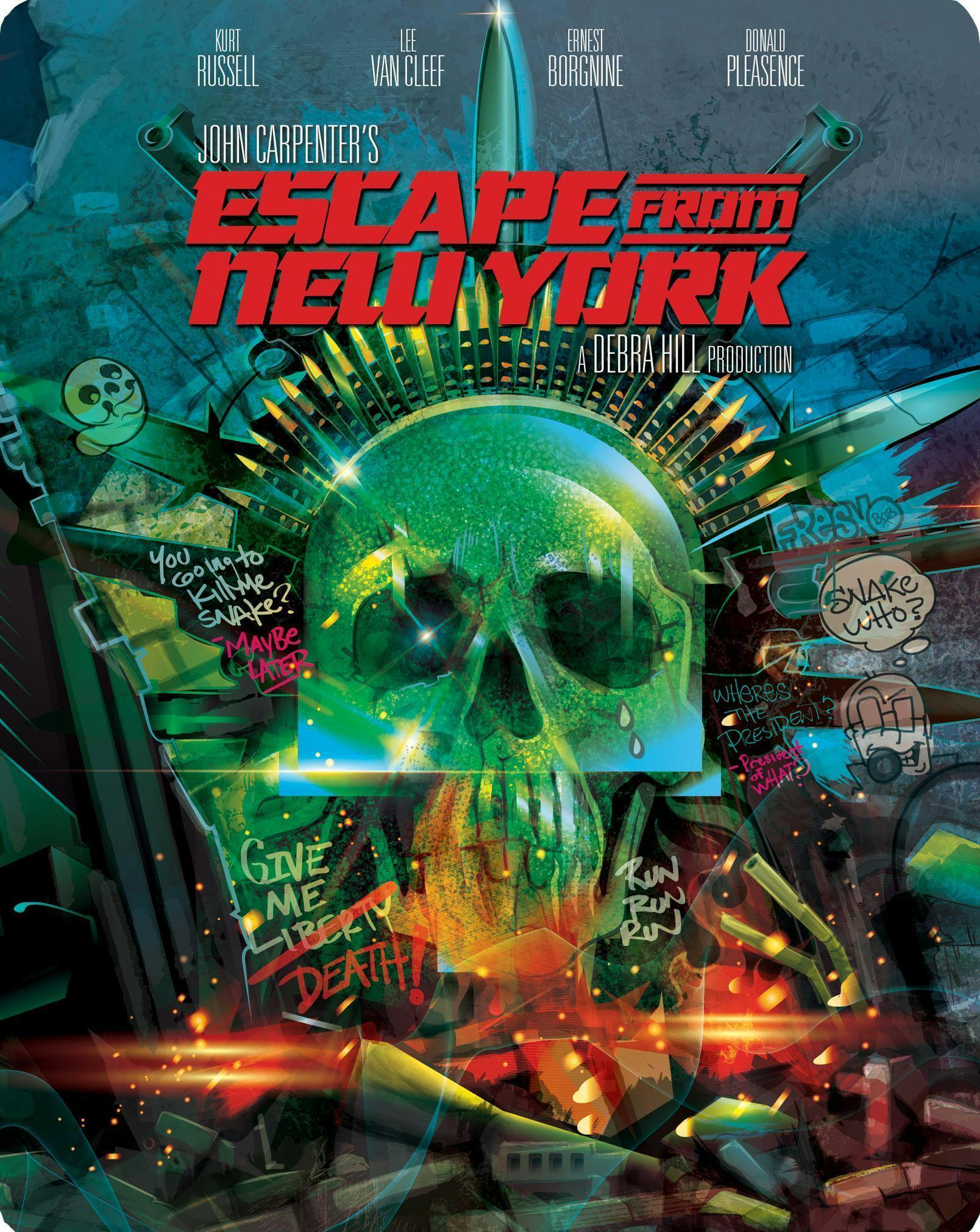
Escape From New York Is the New Blu-ray Pick of the Week

escape from new york 4k

I love a good genre movie. Whether it is a western, a horror flick, a film noir, a sci-fi film, or something else, genres give us a set of rules to follow. There is something comforting in knowing the basic elements of a film before it even begins. And yet, of course, the best genre films upend the rules and do something different.

John Carpenter is one of the greatest genre filmmakers ever. He remains one of the great masters. His best films – The Thing, Halloween, The Fog – I’ve seen dozens of times. They are endlessly entertaining.

Strangely, I’ve only seen Escape From New York once, and that was years ago. I remember loving it, but for reasons I now can’t fathom, I’ve never returned to it. I think with this new 4K UHD release from Shout Factory that will be rectified soon.

Also out this week that looks interesting:

Godzilla 4K UHD: Criterion has released this film a few times, once as a Blu-ray with their usual set of extras, then again as part of their big Godzilla boxed set (I own both of those) and now again in 4K (I won’t be purchasing this one).

White Christmas 4K UHD: My wife absolutely adores this musical starring Bing Crosby, Danny Kaye, and Rosemary Clooney. I could live without it.

The Crow: This remake of the cult classic has gotten terrible reviews from both fans and critics.

Trap 4K UHD: A pretty fun, if ultimately quite goofy little thriller from M. Night Shyamalan. You can read my review here.

I Love Lucy: The Complete Series: I’m sure I’ve seen many episodes of this classic sitcom, but I can’t remember any of them. It just wasn’t a series I paid much attention to when I was a kid (when they endlessly reran it, I’m not old enough to have seen it when it originally aired.)

The Wizard of Oz 4K UHD: An undeniable classic gets yet another repackaging. I can’t count the number of times this has been released in a variety of formats.

Orphan Black: Echoes. The original series was utterly original and interesting and fantastic until it wasn’t. My wife and I watched the first few seasons and then it started getting bogged down inside its own endless conspiracy theories and we tuned out. I’m interested in this sequel series if only because it stars Krysten Ritter whom I love.

31 Days of Horror: The Fog (1980)

the fog poster

John Carpenter’s The Fog begins with a cheesy old campfire tale told by an old man that essentially gives us the backstory to the movie we’re about to see. Both the backstory and the actual story are pretty silly. The monsters are goofy, and the ending somewhat anti-climatic. Yet I love the film through and through.

Carpenter is the master of creating a mood and The Fog finds him at his moodiest. Since time immemorial (or at least the time in which films have existed) movies have used fog to create a spooky, eerie mood. Fog was made for cinema. It is both opaque and translucent. It obfuscates your vision and yet seem to reveal. It crawls in and moves with the wind. And it looks great when lit up.

One hundred years ago, on a dark foggy night the founders of Antonio Bay, a small coastal town in Northern California murdered a group of lepers for their gold. Now as the town celebrates its centennial anniversary the fog is back, as are the lepers and they are looking for revenge.

Our heroes are Stevie Wayne (Adrienne Barbeau) who owns and DJs the coolest looking lo-fi radio station inside a lighthouse, fisherman Nick Castle (Tom Atkins), and Elizabeth Solley (Jamie Lee Curtis) the hitchhiker Nick picked up one foggy night.

Stevie spends most of her time in the lighthouse talking to her listeners (and us) whilst playing light jazz records. She acts almost like a narrator, feeding her listeners (and us) information. Nick and Elizabeth run around trying to figure out what is happening.

The monsters apparently only appear between the hours of 12 midnight and 1 AM. They show up the first night mostly messing with electronic equipment and freaking everybody out, and then on the second night, the night of the actual anniversary they start killing people.

Whatever, the story takes second chair to the general creepiness Carpenter is creating. As usual, Carpenter wrote his own score and it is terrific. The film looks terrific and there is an enormous amount of creepy fog drifting into town across the bay, floating across streets and into rooms. The film lights it up giving it a hypnotic look.

It isn’t particularly scary and there are just a few scenes of genuine violence (although none of it is bloody) but the general vibe is excellent.

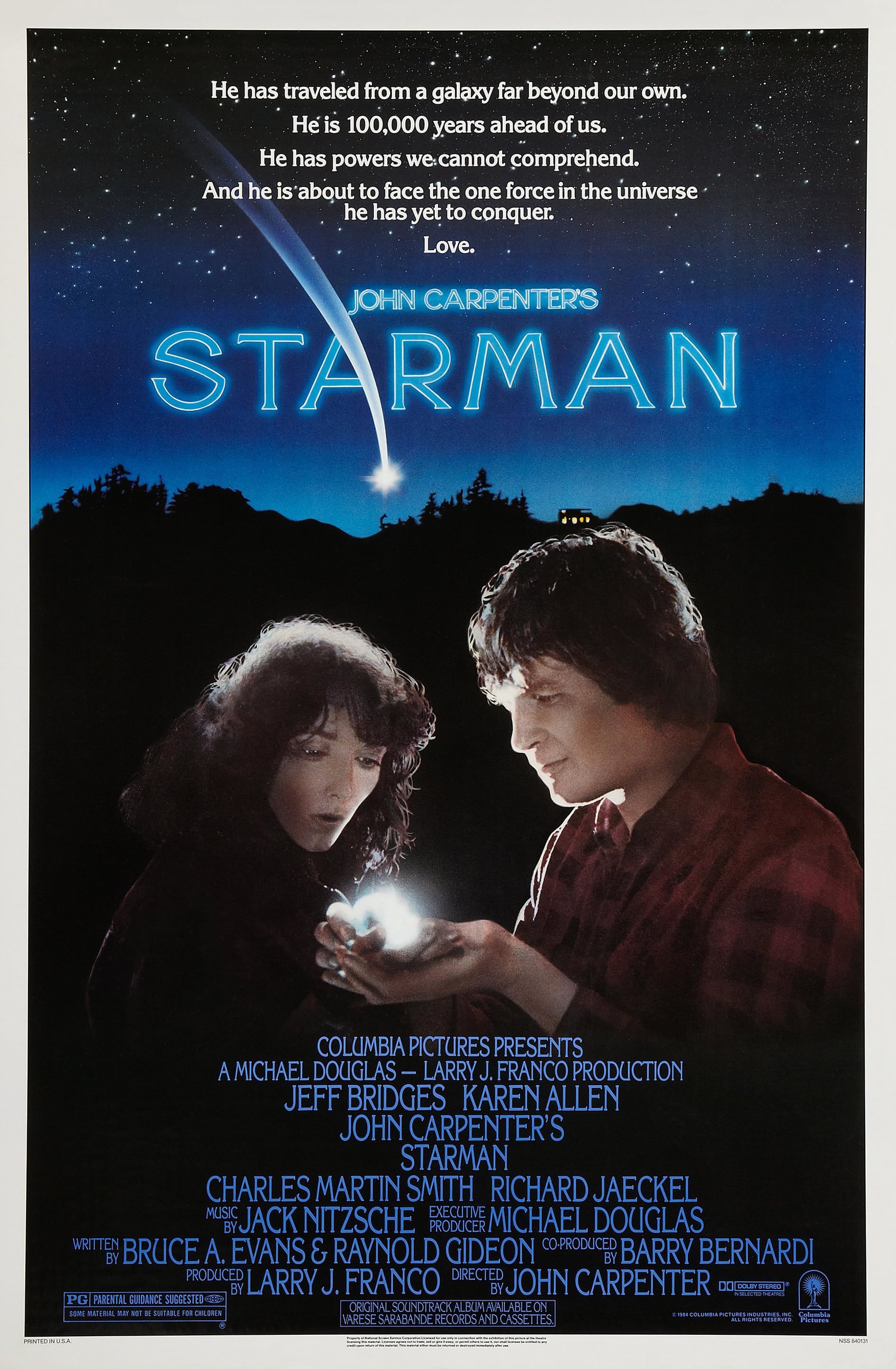
Awesome ’80s in April: Starman (1984)

poster

I have this very vague memory of watching Starman as a kid. This would have been the mid to late 80s, I was in my early teens, definitely pubescent. I think Mom rented it. I wouldn’t have known who John Carpenter was at that point, but I’d definitely known Karen Allen from Raiders of the Lost Ark, and I’d probably seen Tron by that point and known Jeff Bridges from it.

Starman seems like a very mature movie for me to have watched at the time, so I’m guessing Mom got it for her and since I knew those actors and I liked alien movies I gave it a watch. I definitely remember not liking it, finding it rather boring.

I know I was pubescent because Karen Allen has an early scene in her underwear and that image has stuck in my brain all these years later.

I’ve since become a very big John Carpenter fan, but have put off watching this since that early viewing for having that memory of it being dull.

But it is the Awesome 80s in April and I’ve been watching a lot of early Jeff Bridges movies so I decided to give it another shot.

I still found it to be kind of dull.

Boring means something different to me now, and Starman definitely has its merits, but there is still something flat about it that didn’t appeal to me.

Karen Allen plays Jenny Hayden, a woman living on her own in an isolated lakeside cabin in Wisconsin. She’s a widow, having recently lost her husband in an accident. She spends her nights watching old home movies of him and feeling sad.

The Voyager 2 space probe makes contact with a distant alien race. They send Jeff Bridges (or rather an alien form that eventually takes the shape of Jeff Bridges – or rather Jenny’s late husband who is played by Jeff Bridges).

He immediately decides the planet is hostile and takes Jenny hostage on a road trip to that big crater in Arizona. They eventually become friends, and fall in love. Meanwhile, they are being chased by the Military led by Mark Shermin (Martin Cruz Smith) who is really a scientist interested in aliens, and unlike the rest of the Army men, doesn’t want to hurt the alien.

Basically, it is a road movie with the two leads getting romantic while Bridges is a fish out of water.

Allen and Bridges are great (Bridges was nominated for an Oscar). He gives his alien a lot of physical quirks and ticks. Carpenter and cinematographer Donald M. Morgan created some lovely images. Some of the effects are a little dated, but there’s nothing cringe-worthy.

It is a fine little film, but there’s just not much to it. Carpenter says he was inspired by The 39 Steps and It Happened One Night both of which are much better films. He also says he was trying to get away from the thriller/horror films he’d become famous for. But it should be noted he made Big Trouble In Little China after this.

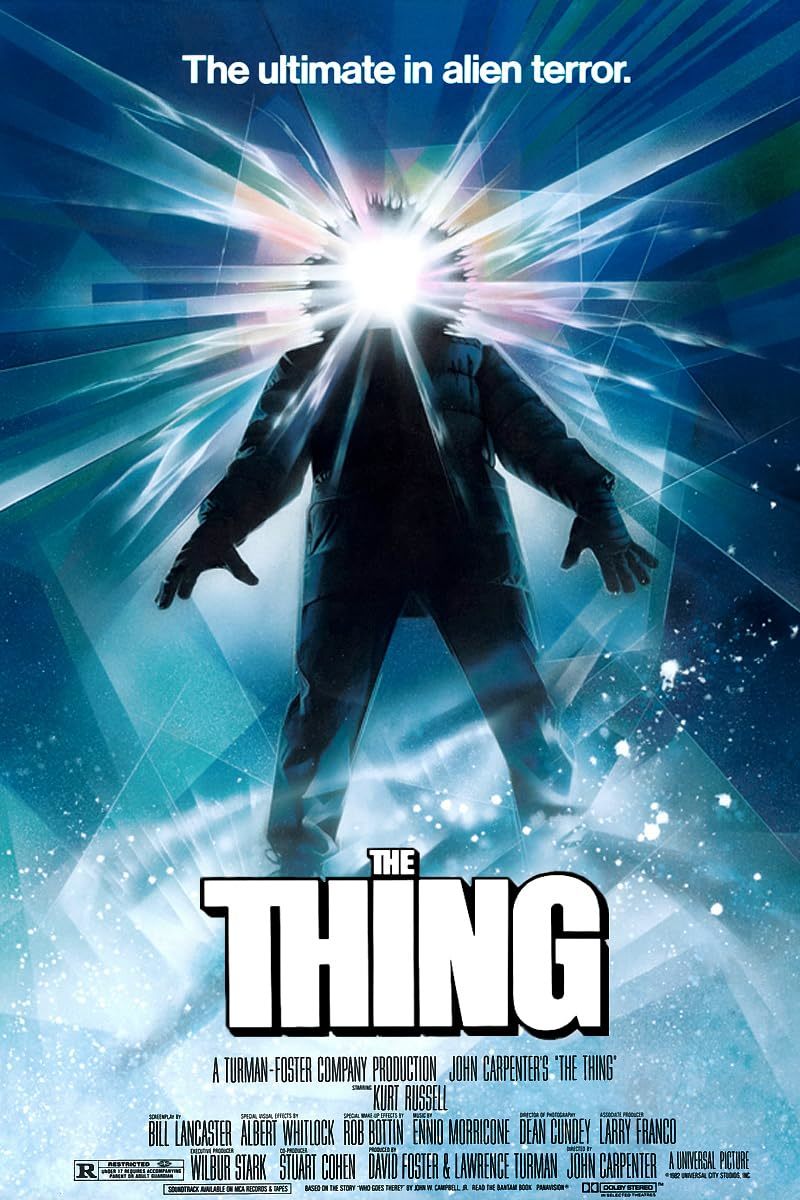
The Friday Night Horror Movie: The Thing (1982)

the thing movie poster

When I was first thinking about this month’s theme – Frozen in January – it was John Carpenter’s The Thing that came to mind. It is the perfect encapsulation of what I was going for. Its characters are trapped in an isolated place covered in snow and ice. An external force causes an already tense situation into turmoil. The weather and the cold, frozen setting aren’t just window dressing, they help inform the story. I actually didn’t love the movie the first time I watched it, but with each subsequent viewing, I like it more and more. Now I think it is just about perfect.

The Thing is based upon a novella by John W. Campbell entitled Who Goes There?. It was previously adapted into the pretty great film in 1951, The Thing From Another World. 

Set in an American research station in Antarctica The Thing stars Kurt Russell (and Wilford Brimley, and Keith David, and T.K. Carter and others, it really is a great cast) as a group of men who are already pushed beyond their limits. The isolation and the freezing weather are getting to them.

This is why, when a helicopter from the Norwegian station flies in shooting at some dog, and then at our heroes, they don’t initially think something is really wrong. They just chalk it up to those guys going stir-crazy.

I’ve seen this movie several times and I always forget how long it takes to get to the scenes I remember. The scenes in which the shape-shifting alien starts wiping everybody out. But before that, there are long, tension-building scenes, in which they try to figure out what’s going on at the Norwegian base. You’d think I’d remember them finding an alien spacecraft but I never do.

I think that is a testament to just how incredible the back half of this movie is. One of the many things I love about The Thing is that, unlike most of the films I’ve watched in this series, it really uses the freezing, isolated setting to help build the tension. As things ratchet up with the alien, we fully understand how there is no escape. Nowhere to go. No one will come to their rescue.

The alien is a shape-shifter so it can look like any one of them. No one knows who is human or something else. Carpenter makes us feel every moment of that horror.

The practical effects do look a bit unreal. I think that’s a big part of what I didn’t like about it on my first watch. They aren’t natural or realistic looking and that can take you out of the moment. Now I find that part of the film’s charm. The alien isn’t supposed to look real, not when it’s shifting into a chest cavity that can chop your hands off. It is supposed to look, well, alien. And cool. They look so cool. I’d love to see a behind-the-scenes look at how they made them.

John Carpenter really was a master of horror for so many years. The more I watch his classic films (and I’ve seen most of them several times) the more I think he’s one of the best who ever did it.

31 Days of Horror: Halloween (2007)

image host

John Carpenter’s original Halloween (1978) didn’t invent the slasher genre. It has its roots in the Italian Giallo and films like Black Christmas (1974) came out earlier and contain all the elements of the genre. But Halloween really set the template for what slavers would become, and its immense popularity meant that it would be copied over and over again throughout the next decade.

It remains the greatest slasher ever made and is a truly great horror film. Much of this comes down to Carpenter’s economic direction. In just over 90 minutes he tells a complete story without an ounce of fat. It isn’t that the film is nonstop thrills either. There is a lot of exposition, we spend a lot of time just hanging out with the characters. But Carpenter makes them count. He lets us get to know the characters, especially Laurie Strode (Jamie Lee Curtis in a career-defining role), which allows us to actually care for them when the horror comes.

As Doctor Loomis (a wonderful Donald Pleasence) constantly lets us know Michael Myers is evil personified. The film doesn’t provide a back story. We don’t learn anything about who he is or why he kills. We don’t need to know.

Rob Zombie’s 2007 remake of Halloween is a terrible film. It takes all that makes Carpenter’s film great and chucks it out the window, then stomps on it with its dirty boots.

A good half of the film is filling in Michael Myers’s back story (played by Daeg Faerch as a ten-year-old boy and Tyler Mane as an adult). His mom is a stripper, her boyfriend is an alcoholic, abusive cripple. He’s bullied at school. Etc., etc., and so forth. It is all basic, boilerplate reasons for becoming a psychopath.

Here he doesn’t just kill his older sister as a child, but his entire family (excluding his baby sister, of course). We then spend a bunch of time with him at the mental institution where Doctor Loomis (Malcolm McDowell) tries to cure him. Or at least show him some kindness. Or at least talk to him. His mom visits every week, but Michael shrinks back into himself. He stops talking but continues to make little paper masks to put over his face and hide his true self from the world.

None of this is very interesting and it is all superfluous. Again, we don’t need to know why Michael Myers is a killer. Trying to give him human reasons for being who he is takes away the horror of who he was in the original.

When we finally arrive at Halloween night in the present (where the original film spends most of its time) I’d stop being interested in what this film was trying to do. Unfortunately, I had to keep watching for another hour.

Scout Taylor-Compton plays Lauri Strode in this version and all apologies to the actress, but she is not good. Jamie Lee Curtis portrayed the character as kind and good (it literally began the trope that the Final Girl in these films would be virtuous and a virgin), but also tough, a fighter. She’s innocent, but not naive or weak. Taylor-Compton turns her into a mostly whiny brat. Her girlfriends are even more obnoxious.

In the original, the teens do a bit of drinking and sexing, but Carpenter’s camera never leers at them. Zombie’s camera is nothing but leers. It lingers on the sex scenes, is zooms in on the nudity. There is a rape scene early on in the asylum that is as gross as it is gratuitous. The violence is more visceral as well, and not in a good way. I love horror movies and I’ve seen more than my fair share of gore and gratuitous sex. Maybe I’m just getting older, but so much of this film just felt like way too much.

I first watched this film in 2008 while living in Shanghai, China. In those days you could buy bootleg DVDs super cheap. There were literally guys on the street corners with boxes full of them. As soon as a film came out in the States we would get flooded with copies (usually cam copies where folks literally filmed the movie inside the theater). Sometimes we’d get weird cuts of films. After watching Halloween over there I was looking up reviews and realized I had seen a different cut than everyone else.

Apparently, there are three different versions of the film. There is a theatrical cut, a director’s cut, and an original version that was sent to test audiences. That last version didn’t do very well so they added some scenes and cut some things out. At a guess, I’d say what I originally saw was that first version. But I really don’t remember.

I believe what I watched tonight was the Director’s Cut. Whatever I watched, it was bad. Really bad. Just terrible actually.

I only watched it because the only film in the entire franchise I’ve never seen is the sequel to this. I was hoping to watch it on Halloween night. I guess I still will, but now I’m not looking forward to it.

They Live (1988)

they live

There is a company called Fathom Events that bring classic (and not so classic) films as well as live theater and other special events to movie theaters across the country.

I used to go to their events fairly often, but then COVID hit and other things happened and I stopped going to the theater all together. I’m hoping to get back to it a little more often and was thrilled when I saw Fathom was doing some John Carpenter movies.

I got to saw They Live and wrote a little thing about it for Cinema Sentries.