
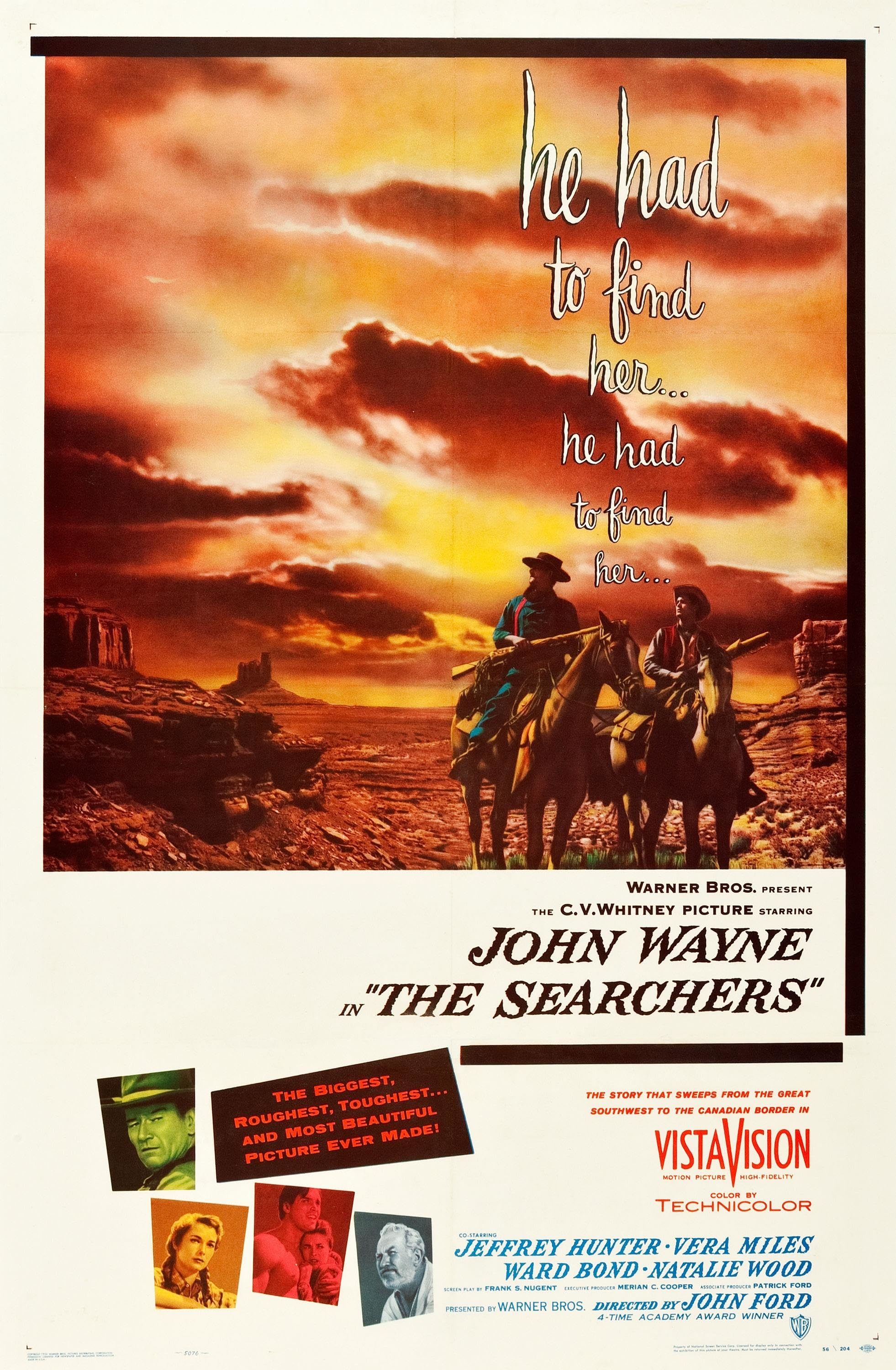
Westerns in March: The Searchers (1956)

the searchers

When we went to visit Monument Valley I knew I’d be watching a John Ford western soon after, I just wasn’t sure which one it was going to be. Ford made some half a dozen films there and it was really those movies that made the location famous. There is even a spot in the Valley called John Ford Point.

He shot at least a couple of scenes on that point, but I couldn’t remember which ones so I decided to watch my favorite Ford Western, The Searchers.

In some ways, The Searchers was John Ford and John Wayne’s response to many of the previous Westerns they made together. Like a lot of Westerns at the time their previous films depicted American Indians as deplorable enemies – faceless, nameless, and utterly brutal. In The Searchers the Native Americans aren’t exactly kind and generous, but the white folks are just as brutal.

Wayne plays Ethan Edwards an independent loner. The film begins with one of cinema’s most striking images. Matha Edwards (Dorothy Jordan) stands in her doorway. The camera sits inside her house which is dark and small, it looks outside into the wild, expanse of the West. In the distance rides Ethan, small and alone. This image will be bookended at the end of the film with Ethan standing just outside the door, always on his own.

He fought in the Civil War on the side of the Confederates. He still wears the uniform and takes pride in having never surrendered. It’s been three years since the war ended, but he’s just now returning home. He’s got gold in his pocket and it is hinted that he got it by ill-gotten means. The way he looks at Martha, his brother’s wife, indicates he’s in love with her.

When a neighbor’s cattle are stolen by someone – probably Indians – Ethan rides off to help. When he realizes that the cattle were a diversion, that the Indians were really a “murder party” he heads home but too late. His brother, wife and one of their children are dead. The older daughter Lucy and the youngest Debbie (played by Natalie Wood later in the film) have been abducted.

Ethan and Lucy’s fiancee Martin (Jeffrey Hunter) spend the next many years pursuing the tribe. Soon they find Lucy murdered (and by implication, raped) but Debbie remains with the tribe, taken in as one of their own.

We soon realize that Ethan isn’t tracking her as a rescue mission, but aims to kill the girl, as living as an Indian is worse than being dead in his warped mind. Martin stays with him, acting as something of a moral compass, but mostly there to keep Ethan from doing what he’s set out to do.

It’s fascinating to see Wayne in this mode. He’s so often played the hero. Here his actions are often very similar to what he’s done in previous movies – killing Native Americans with a vengeance – but The Searchers allows the audience to view those actions in a different light. We see the black heart of racism deep inside his character and it’s chilling. It’s also one of Wayne’s finest performances.

Ford shoots it beautifully. The western landscapes, especially those of Monument Valley are uncanny and utterly beautiful. This is the West of the movies, and it has never looked better.

I’ve seen The Searchers three times now and I’ve liked it more with each viewing. On the surface level it is a terrifically told Western adventure, but a closer look finds Ford really digging deep into the mythos of the Old West and what it meant for Native Americans and the Europeans who conquered it.

A terrific movie all around.
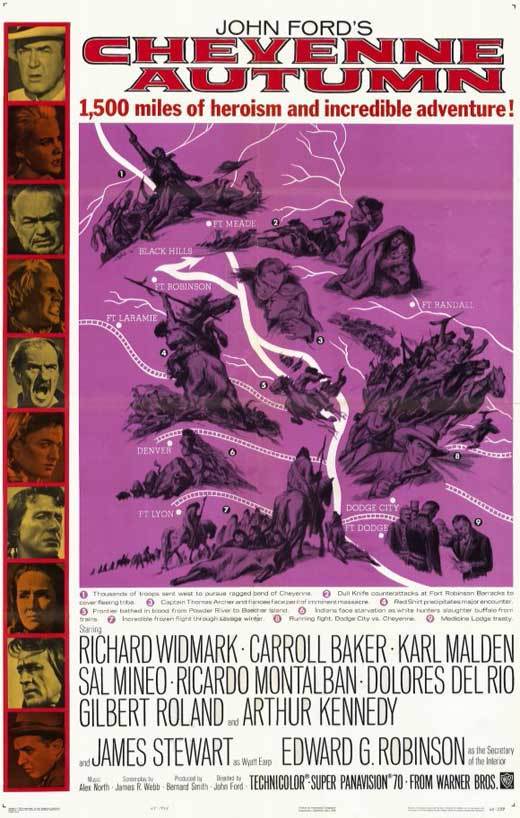
Westerns In March: Cheyenne Autumn (1964)

cheyenne autumn poster

John Ford made some of the greatest westerns ever made. From Stagecoach (1939) to My Darling Clementine (1946), The Man Who Shot Liberty Valence (1962) to The Searchers (1956) Ford proved over and over again to be a master of his craft, and of telling stories about the wild west and the men (and women) who tamed it.

Unfortunately, like so many western filmmakers at the time his films were not always kind to the Indians. All too often the Native Americans in western movies were faceless savages bent on raping and killing the white man. They were rarely made into full characters and very little attention was paid to the fact that the white man was invading the Indian’s territory and homeland.

In later years Ford seemed to have recognized his flaws in this area and at least in some ways he tried to make amends. In The Searchers John Wayne plays a pretty repugnant racist and his quest to rescue his niece, who has been captured by some Comanche Indians, allows the film to raise questions about the inherent racism of Manifest Destiny and America’s unrelenting quest to capture the entire country.

With Cheyenne Autumn, Ford’s last western and his penultimate film as a director, he depicts the historical event of the Northern Cheyenne Exodus in 1877 where a group of Indians decided to move from Oklahoma Territory back to their homeland in Wyoming. His depiction of the Indians is sympathetic and demonstrates just how awful the American government treated them.

Unfortunately, the film is overlong, rather dull, and still a bit racist. The two main Indian characters, Red Shirt and Little Wolf are played by Sal Mineo and Ricardo Montalban respectively – two very much not Indian actors (Mineo was of Italian descent and Montalban was Mexican born). The film’s focus likewise is on the white characters with the Indian characters playing second fiddle in their own story.

I could be more forgiving of most of this if the film was actually any good. Instead, it is slow, plodding, and contains one of the most unnecessary side stories I’ve ever witnessed.

The film begins with the Cheyenne on a reservation in Oklahoma. The land is arid and infertile. The people are sick and starving. Some delegates from Washington are supposed to meet them and discuss what can be done. But they don’t show and the Cheyenne decide to go home.

The trip is long and arduous. They must travel in desolate areas so as to not be seen by one of the many Army Forts along the way. Starving, some of them decide to turn themselves in at one of those forts. Though the Captain is sympathetic to their needs he has orders to turn them right around and send them home. Sickness, starvation and the brutal winter weather be damned.

There is some business about the press drumming up hysteria by printing falsehoods about the number of Cheyenne on the march and their ill intentions. Many of the soldiers on the ground (led by Richard Widmark) tend to be sympathetic to the plight of the Cheyenne but have their hands tied by forces in Washington.

Etc. and so on. Ford shot some of it in and around Monument Valley and Arches National Park and he gives the scenery his usual widescreen glory. But the story just never congeals into something interesting.

At one point, out of nowhere comes a scene with James Stewart playing Wyatt Earp and Arthur Kenney as Doc Holiday. It has absolutely nothing to do with the rest of the film and is completely comic in tone (the rest of the film is utterly dramatic) and then it just ends and we never see them again.

Somewhere buried in there is a film that could have been great. The story of the Cheyenne’s exodus is a fascinating one and could make an excellent film. This is not that film and what we’re left with is the thought that Ford’s legacy left a whole lot of other films that are far greater than this one.