Mysteries in May: Night Has a Thousand Eyes (1948)

image host

There is this thing that certain movies do where a character will have a vision or be foretold the future in some way. The future is usually bad for them; they’ll die or someone close to them will be murdered. The visions will include several very specific, yet strange details. The characters will spend the rest of the movie trying to stop the inevitable. At first, they will probably not believe in the visions, but as those specific, yet strange details all come true, there will be a mad rush to stop the horrific thing from becoming reality.

I don’t know if Night Has a Thousand Eyes was the first film to do this thing, probably it wasn’t. But I believe it is the earliest version of it that I’ve seen (or maybe not, I’m sure I’ll remember an earlier one once I hit Post.

Truth be told, I’m not a huge fan of this trope, probably because it is a trope. Whenever this sort of thing happens, you know the prophecy (or whatever) will come true. A prophecy that doesn’t come true in a movie (or is narrowly averted) would be boring.

John Triton (Edward G. Robinson) used to be a charlatan. He had an act where he pretended he was psychic. He was good at it, too. Then one day, he discovered he really could see the future. But the things he could see were always terrible events, mostly people getting killed. The thing he pretended to do for money has now become a curse.

The film begins with Jean Courtland (Gail Russell), an heiress, attempting to kill herself by jumping in front of a train. Her boyfriend, Elliott Carson (John Lund), saves her in the nick of time. When she asks him how he knew where she was, he takes her to a bar where Triton is waiting for them.

Lund is skeptical of Triton’s psychic abilities, but Jean is a firm believer. Triton then tells the whole sordid deal of how he came to know Jean and how she found herself about to commit suicide. We see this in flashbacks.

Basically, Triton had a vision that Jean’s father was going to die in a plane crash. He tries to warn her, but is unsuccessful in saving him. They begin to talk, and Triton has another vision, foreseeing Jean’s death under the stars, in a few days.

Jean can’t take the pressure and decides it isn’t worth living, knowing she’ll be dead soon anyway. But after Lund rescues her, she decides to try for life. Lund calls the cops, and a whole bunch of people try to make sure the prophecy doesn’t come true. The prophesy has some of those pesky details I was telling you about and as they come true everybody is freaking out.

I won’t spoil it all for you, but you can probably guess most of it. I will say it does something at the end that’s pretty interesting, but most of it is rather pat.

Edward G. Robinson is great, though. He’s always great, and he plays the tormented psychic pretty well.

Mysteries in May: Lady In Cement (1968)

lady in cement movie poster

In my review of Tony Rome (1967), I noted that it wasn’t a bad film, but that it lacked a certain something, that it didn’t “pop.” The thing is, it was so close to being a very good film. With a few changes, it could have been brilliant. It was close enough that I decided to watch the sequel, Lady in Cement, in hopes that the filmmaker would make the proper corrections and turn the story into something wonderful.

Sometimes, even the smartest people are wrong. Lady in Cement does make some changes—all the wrong ones. In my opinion, Tony Rome needed a sharper script, some tighter one-liners, and an endlessly cool lead. What Lady in Cement does is lean into the more sexist and homophobic tropes, make the jokes much broader and, therefore, lame, and allow Frank Sinatra to be even less interesting and cool than before.

It starts out strong. Tony Rome is looking for some Spanish gold that was lost at sea in the 1500s and instead stumbles across a dead woman at the bottom of the ocean, her feet encased in concrete. (I do always wonder about these situations – did they force the woman to stand in wet concrete for hours until it dried, or did they kill her first and then someone stood her up until it dried?)

He reports the incident to our friendly neighborhood detective, Santini (Richard Conte), and carries on with his life. That doesn’t last long as a big old brute named Waldo Gronsky (Dan Blocker) hires Rome to find a lady named Sondra Lomax. Naturally, this case connects to the dead lady with cement shoes.

Raquel Welch makes an appearance as a lady who threw a party that Sondra Lomax attended. She’s connected to some gangster who gives our hero trouble. There’s a lot of shoe leather questioning at local hotspots and more than a lot of dumb gay jokes. The 1960s were a curious time in cinema as gay people were suddenly allowed to exist but they usually wind up just being stereotypes and the butt of dumb jokes.

None of the story is all that interesting, and the filmmaking doesn’t perk it up any. I’ve decided that Sinatra, who was in his 50s at the time, just doesn’t have that cool factor at that point to make his Tony Rome <ahem> sing. I love the guy, but he just doesn’t work for me in these films.

What we’re left with is a movie that could have been a lot of fun to watch but winds up being kind of a bore.

Mysteries In May: Twin Peaks – Fire Walk With Me (1992)

image host

I never watched Twin Peaks when it originally aired. As I noted in my Five Cool Things column, I do remember seeing some magazine spread that talked about the show, detailed what we knew (at that time) about the central mystery, and gave some details on the various characters inside the fictional town of Twin Peaks, Washington.

The series was massively popular at the time, and the question of Who Killed Laura Palmer? was a cultural phenomenon. But then the popularity waned, and it was cancelled after two seasons.

My assumption was that they did not solve the mystery in those two seasons, which is why they made a movie, Twin Peaks: Fire Walk With Me.

Many years after the original airing, my wife and I borrowed the series on VHS tape from the local library. They only lent it out one tape at a time. I think we watched the first two tapes, but it could have been three or even four. We definitely did not finish the first season. But then the next tape was not available, and we got distracted and never returned. I thought about it often, but Twin Peaks is the sort of series you really want to watch straight through, and eventually, enough time had passed that we knew we needed to start it all over again.

Weirdly, my wife at some point watched Fire Walk With Me. Again, my assumption was that the movie solved the murder mystery, and since I hadn’t finished the series, I did not partake.

Recently, we finished the original series, and I finally caught up with the movie.

For those of you who know nothing about Twin Peaks, I think I can say, without really spoiling anything, that they do solve the murder of Laura Palmer somewhere in the middle of Season Two.

For those of you who know even less about the series, Twin Peaks is a television series created by David Lynch and Mark Frost, which ran on ABC for two seasons in 1990-1991.

The fictional town of Twin Peaks is an idyllic small American town with picturesque views of the Rocky Mountains. As the series begins, Laura Palmer, the beautiful Homecoming Queen and apparent darling of the town, is found brutally murdered, lying naked in the river.

FBI Agent Dale Cooper (Kyle MacLachlan) is sent to investigate. While the town is seemingly as American as Apple Pie and as idyllic as those snow-covered mountains, Agent Cooper will soon discover a dark underbelly to Twin Peaks. And Laura Palmer likewise is found to harbor dark secrets, including drug use and promiscuity.

The series is relatively light-hearted, treating most of the characters as quirky and mysterious rather than lecherous monsters. It is very much an entertaining small-town murder mystery, albeit one with periodic turns into surreal horror.

The series doesn’t judge Laura Palmer’s darker side; it doesn’t blame her murder on her various indiscretions. But it doesn’t absolve her of them either. It seems very much a part of Lynch’s obsession with revealing the darkness behind bucolic settings (see Blue Velvet for more).

And now, we finally arrive at Fire Walk With Me. If Twin Peaks: The Original Series was all about answering the question “Who Killed Laura Palmer?”, then Twin Peaks: Fire Walk With Me attempted to answer “Who Was Laura Palmer?” Which makes it not really a mystery, but as it does answer some of the lingering questions of the series (though not nearly all of them) I’m allowing into my Mysteries in May series.

Since she is dead before the original series begins, we only know her through the memories of others and the clues Agent Cooper finds. Her friends and family members remember her fondly, with rose colored glasses. She was the homecoming queen, a good girl, a saint. But then her drug use and promiscuity are revealed. She’s shown to have worked at a cat house and sold cocaine. The assumption is that she was just a stereotypical “bad” girl, rebelling against her white picket fence home life.

Fire Walk With Me plunges us into who she really was.

But first, there is some business about another murder. The film begins with two FBI agents (portrayed by Keifer Sutherland and Chris Isaak) investigating a murder very similar to that of Laura Palmer, which occurred sometime before Laura’s death. But just as we’re starting to get invested in that case, one of the agents disappears.

Back at FBI headquarters, several agents (including Agent Cooper) are discussing the matter when Agent Jeffries (David Bowie), who had been missing for many years, suddenly enters and tells them a wild tale involving spirits and a Red Lodge (something that would feature prominently in the original series). And then he disappears.

We then move on to the last days of Laura Palmer, and that initial mystery is just left hanging. Apparently, David Lynch shot a lot more footage dealing with that first mystery, plus hours of footage around Laura Palmer, but cut it for the final movie. He has since gone back and compiled many of the cut pieces into something of its own, semi-coherent movie entitled Twin Peaks: The Missing Pieces. I have yet to watch that, but it is on my Criterion Collection Blu-ray.

In the original series, Laura Palmer was a mystery to be solved. We learn about her, but she’s never anything more than a murdered corpse. Fire Walk With Me lets us know her as a living, breathing person.

In the series, she was a “bad girl” who pretended to be good. But in the film, she’s a tragic figure. We learn that she endured years of abuse and trauma. The drugs, the sex weren’t a good girl acting out, but a young woman who has systematically been abused trying to cope.

Obviously, we know Laura Palmer is going to be murdered, but the character seems to know she’s living out her final day as well. It is a staggering, heartbreaking performance by Sheryl Lee.

It is a difficult movie. Lynch infuses it with his surrealistic, nightmarish horror. Add to that the very real trauma Laura is experiencing, and it is a tough watch at times. But also beautiful, powerful, and brilliant.

I highly recommend it, but only after you’ve seen the original series and are braced for this to be something completely different.

Mysteries in May: So Evil My Love (1948)

image host

I watched this movie five days ago, and I have to admit I had to read the entire Wikipedia synopsis to remember what had happened. My mind was completely blank on the plot details. You would think that would mean I didn’t like it, but the opposite is true – I liked it a lot. I guess I’ve just slept since then.

So Evil My Love is a twisty film noir set in Liverpool during the Victorian era (Wikipedia says this subgenre of Victorian noirs is called Gaslight Noirs, and I just love that). Ray Milland stars as Mark Bellis, and Ann Todd plays Olivia Harwood. They meet on a boat returning from the West Indies. He is a rapscallion and a thief; she’s the widow of a missionary.

He’s sick on the boat with malaria, and she nurses him back to health. When they land in Liverpool, he charms her into letting him stay at her boarding house. A romance ensues.

He learns she’s got a rich friend and talks her into asking the rich lady for money. Then she becomes the rich lady’s paid companion. Meanwhile, Bellis is attempting burglary and stepping out with another woman. He pushes Olivia into blackmailing her friend.

It is less of a mystery and more of a naive woman being beguiled by a lecherous older man. The stuff between Bellis and Olivia is golden. The first act is a real treat. But when the plot turns to her rich friend and all those shenanigans, it becomes a bit of a bore. Thankfully, it turns a corner towards the end and creates a completely satisfying closing.

Well worth checking out.

Mysteries in May: The Uninvited (1944)

image host

The Uninvited was not the first ghost story to ever make it on film, but it was one of the first movies to take them seriously. Prior to this, ghosts were used for comic relief, or there were natural or psychological reasons for them to “exist.” They were explained away in some fashion. In The Uninvited, they are quite real and quite terrifying.

Roderick Fitzgerald (Ray Milland) and his sister Pamela (Ruth Hussey) are holidaying on the coast of Cornwall. They fall in love with an abandoned seaside manor. When they inquire into whether or not it is for sale, they are at first told by Stella Meredith (Gail Russell) that it is off the market, but her grandfather, Commander Beech (Donald Crisp), immediately agrees to sell it for a low price.

Later, they’ll learn that Stella is quite attached to the house as it was her mother’s house, and where she died under mysterious circumstances when Stella was quite young. Roderick and Stella form an instant bond and the beginnings of a romance, but Commander Beech forbids it and for Stella to even set foot inside the house.

There are rumors around the village that the house is haunted, and sure enough, our heroes begin experiencing strange occurrences. Their pets refuse to go up the stairs. They periodically smell mimosa wafting from somewhere, though there isn’t any on the premises. And in the wee hours of the morning, they sometimes hear a woman sobbing.

At first, Roderick is skeptical, but Pamela wants to believe, and Stella is a firm believer and is fascinated. She believes her mother haunts the place. At times, she seems possessed by her.

One lonely evening, she runs out of the house in a trance and nearly falls off a cliff next to where her mother did that very thing. They hold a fake seance (to try and convince Stella to stay away from the house) and see a real ghost.

The film isn’t really scary. Not by the gore-filled, jump scare standards of today. But it is full of a wonderfully creepy atmosphere. It isn’t quite gothic, but it was certainly influenced by the genre with the big, creepy house and the various mysterious characters.

The main cast is all terrific, and while the story didn’t quite enthrall me, it did keep me fully interested and entertained. It is a perfect Saturday night movie to watch in the wee hours of the night during a thunderstorm.

Mysteries in May: Tony Rome (1967)

tony rome movie poster

Tony Rome attempts to blend the cold calculations of classic film noir with the cool, hip 1960s thriller, but is unsuccessful at both. It isn’t a bad film, but it lacks a certain something. It doesn’t pop like it needs to.

The script (based on a novel by Marvin Albert and written by Richard L. Breen) is wonderfully twisty and convoluted, but it fails at creating the sort of witty, cynical dialogue Raymond Chandler was so good at writing and Humphrey Bogart was great at saying. Frank Sinatra was a great singer and a decent actor, and he was the epitome of cool, but he struggles to make Tony Rome interesting, and surprisingly fails at making him hip. He was in his fifties at the time, and this was the late sixties, so I suppose his hep factor had waned.

The film struggles with it as well. The opening titles find Tony Rome sailing about Miami Beach in his houseboat while Nancy Sinatra sings the title song. Sinatra looks goofy wearing a sailor’s hat. He docks, gets out, and notices a pretty woman wearing a bikini. The camera crash zooms in on her derriere, then immediately cuts to the bottom of a young male boxer.

It is an interesting cut, a fun nod to the casual sexism of these types of films. The camera all too quickly moves away from the boxer, which is either an even more interesting recognition of sexism (zooming in on a woman’s bottom is sexy, but staring at a man’s arse is gross and must be moved away from post haste) or I’m reading way too much into this very brief moment.

Tony Rome is a former cop turned struggling private investigator. He’s hired by his former partner, whom he hates, and is now working as a hotel detective, to take a drunken, passed-out woman currently sleeping it off in one of the hotel’s rooms, home.

The woman is Diana Pines (Sue Lyon), the daughter of a rich, powerful construction magnate, and it wouldn’t do the hotel any good to have her discovered in her condition on its premises.

Rome agrees, but when he arrives, he’s tasked by the father to find out where she has been and why she’s been acting so strangely lately. Before he can even walk out of the house, he’s hired by Diana’s step-mom to leave out some of the gory details when he reports to the dad.

When he gets to the houseboat, he finds two thugs tearing up the place. They are looking for a pin. When Tony informs them he doesn’t know what they are talking about, they courteously ask him whether he’d like to be knocked out with a gun whacked to the back of the head or via some chloroform.

When he awakens, he finds Diana looking over him. She also asks him about a pin, thinking he stole it before he took her home. The pin is a diamond-studded piece of jewelry, and it’s gone missing. Diana hires Rome to find it for her.

All of that happens in the first ten minutes. A whole lot more occurs over the next 90 minutes or so before the film concludes. I’d explain it to you, but I had a hard time following it all. He gets help from and romances Ann Archer (Jill St. John), and is antagonized by Lt. Santini (Richard Conte), while a surprisingly large number of bodies pile up. I enjoyed the mystery even though I’m not sure it made all that much sense.

It is an enjoyable enough film that I’m willing to check out its sequel, Lady in Cement. even while wishing it had been a little smarter, hipper, and tightly constructed.

The Friday Night Horror Movie: Crooked House (2008)

image host

We have now moved from our beloved Awesome ’80s in April to Mysteries in May. When I started this theme last year, I entitled it Murder Mysteries in May. I think I liked the aliteration more than anything, but I also seem to have known I would probably move from Murder Mysteries to just Mysteries, as when I created the category for it, I did not include “Murder.”

The thing, of course, is that you can have a mystery without there being a murder. I imagine that the majority of mysteries involve solving some sort of crime, often a murder, and Lord knows I love a good Murder Mystery, but I think I like broadening it up to other types of mysteries as well. So here we are. I’ll likely write more about that tomorrow in my normal opening salvo for the month’s theme, so I’ll move on.

It is easy to find a mystery that is also a horror film. Lots of murder mysteries have horror elements mixed in, and a good haunted house story is also mysterious. Tonight I wanted to watch something with my wife, and as she doesn’t like the hard horror stuff, I went looking for a nice mystery with just a touch of horror. It took forever, and when I finally found something, our internet went bad, so I had to find something else.

I landed on a movie called Crooked House from 2017. It is based on an Agatha Christie story, it was scripted by Julian Fellowes, and stars Glenn Close, Terrence Stamp, Julian Sands, Gillian Anderson, and Christina Hendricks. The trailer looked fun, and my Fire Stick indicated it was available on Prime.

I pressed play, and an opening scene had Marc Gatiss in it. That was a nice surprise, and I was pleased to have yet another actor I enjoy in this thing. Then the opening credits rolled, and none of the other names were familiar to me. None of those stars I just rattled off appeared either.

This was the wrong film. I backed out and looked at it again. The title card indicated the movie I wanted, and the trailer too. But pressing “play” again yielded the same results. I then searched for “Crooked House” on my Fire Stick, and now Amazon indicated that the film I wanted was not available to me.

Figuring the Mark Gatiss film was just an older adaptation of the same story, I decided to go ahead and watch.

It is not the same story. It isn’t even a movie. This Crooked House was a television series created by Mark Gatiss, who also wrote it. It ran for three episodes in 2008. Presumably, someone put the episodes together and made them into a movie. It works like an anthology series, which fits the premise well.

Gatiss conceived it as a homage to both the stories of M.R. James and the films of Amicus Productions. I’ve not read anything by James, but I am quite familiar with Amicus, which made a bunch of low-budget horror films in the 1970s that feel like low-rent Hammer Horror knock-offs.

A high school history teacher, Ben Morris (Lee Ingleby), brings an ancient door knocker he’s recently discovered to the local museum, where he presents it to the curator (Mark Gatiss). He says it must be from the old Geap Manor and proceeds to tell him two ghost stories about the place.

The first story finds an old miser restoring the Manor after he got rich on an investment that ruined the other speculators. Soon enough, he’s hearing loud knocks coming from the walls, which seem to turn to blood in the wee hours of the night.

The second story takes place in the Roaring Twenties, with a wild party going on in the manor. The new owner announces his engagement to the daughter of a tradesman, much to the chagrin of his ex-girlfriend and grandmother. The ex is jealous, but the grandmother tells a story of a terrible suicide that happened to her sister on her wedding day. And the curse the woman put upon all new brides in that house.

Our final story involves Ben Morris as he takes the knocker home and puts it on his own door, only to begin hearing creepy knocking at 3 every morning and finding his house transformed into the old manor.

None of the stories is particularly good, but they do have a certain creepy charm to them, and there are a couple of good scares to be found. The fact that it was initially a television series somehow makes it better. I can totally see myself enjoying it that way. And I do dig that Amicus vibe.

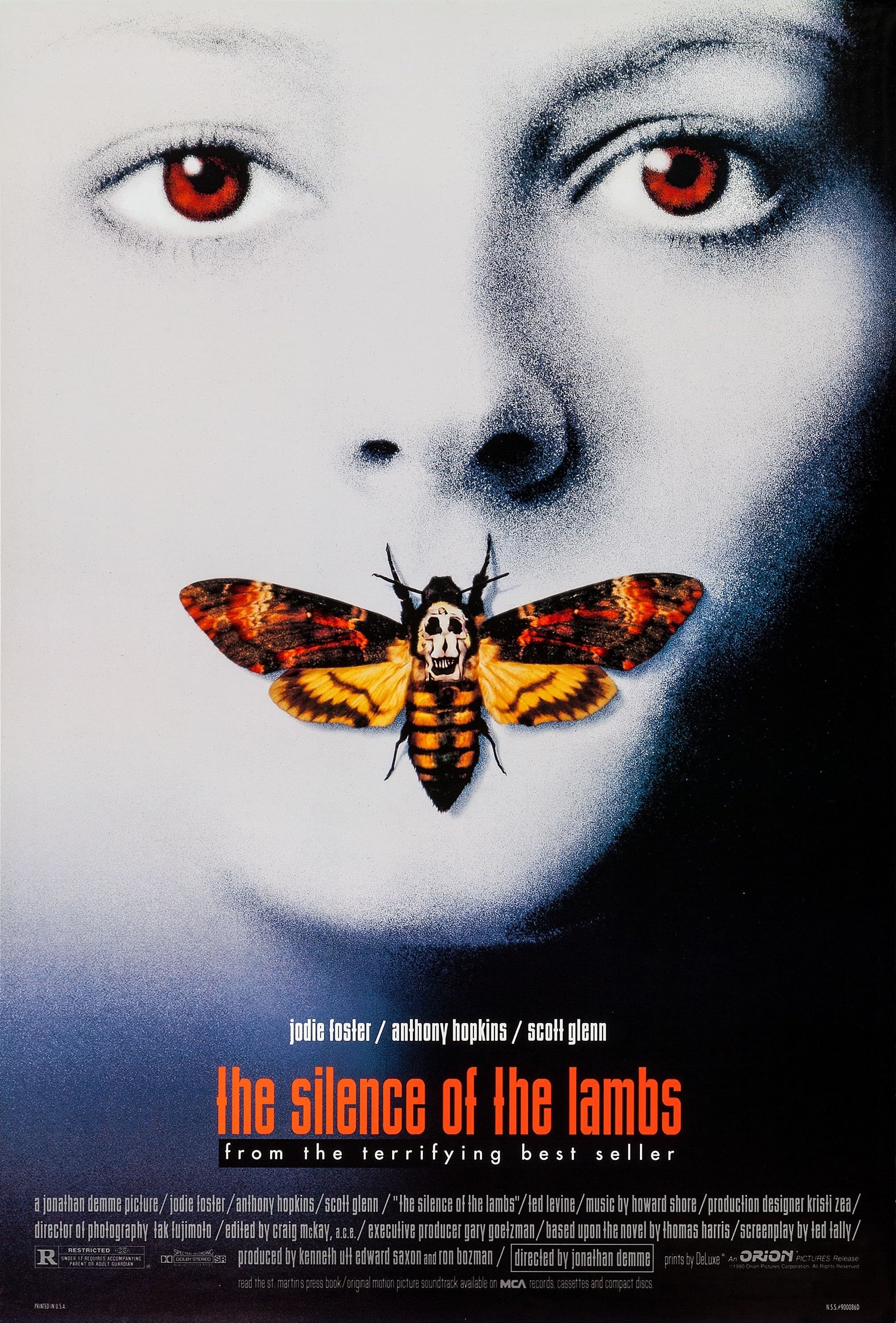
The Friday Night Horror Movie: The Silence of the Lambs (1991)

poster

Music has the ability of searing into your brain as memories. We all have songs that immediately take us to a particular place and time whenever we hear them. Movies can do that but to a lesser extent. I remember movies for their plots, or their direction, or some other thing, but rarely do they bring me back to the time in which I watched them.

I don’t actually remember watching The Silence of the Lambs for the first time in the theater, but I remember why I watched it. My brother is four years older than me. He was dating a girl named Jennifer at the time. He had just graduated high school but she was still a junior. Unsurprisingly, I was not a popular kid in school, but she was. She liked me. Her popularity rubbed off on me a little bit, by proxy. I wanted to impress her.

They watched The Silence of the Lambs on a date and came back raving about it. Somehow, I talked my mother into letting me see it. I was 15 at the time, and usually not allowed to watch rated R movies.

I did like the movie, but I didn’t love it. But wanting to make Jennifer think I was cool I pretended like it was my new favorite. I faked it so well that my mother bought me the novel by Thomas Harris for Christmas.

I wasn’t much of a reader at the time, but I devoured that book. I read it three times over the Christmas break. The novel is more of a procedural than the movie. It digs pretty heavily into the behavioral science and forensics of catching a serial killer. I loved that stuff. I’ve always been fascinated by serial killers and the book was like catnip to me.

I watched the movie again when it came out on home video and for the first time, I realized how a book can enhance a film. So many little details were filled in by the book that the movie somehow seemed better by knowing them.

It has remained a favorite of mine. The DVD was the first one I’d ever purchased that was put out by the Criterion Collection.

Every time I watch it my appreciation deepens.

I’m not the only one who thinks it is a masterpiece. It made Anthony Hopkins a star. It swept the Oscars that year winning Best Picture, Best Actor and Actress, Screenplay, and Director.

Hopkins’s performance is a thing of legend. He’s only in it for a small amount of the film’s runtime, but he made Hannibal Lecter an icon of the horror genre. He’s terrifying. He’s also immensely quotable. I found myself saying his dialog along with him in every scene.

Real quick, the plot, for the few of you who may not know it. Jodie Foster plays Clarice Starling, an FBI trainee. She’s tasked by Behavioral Science director Jack Crawford (Scott Glenn) to interview Hannibal Lecter, a notorious serial killer and cannibal, currently behind bars at a hospital for the criminally insane. He calls it an interesting errand, but really he’s hoping Lecter might shed some light on catching Buffalo Bill a man who is currently killing women and skinning them.

Clarice and Hannibal form a kinship of sorts – she tells him personal stories about her life and he gives her some insight into Buffalo Bill. Then Clarice investigates and eventually captures the killer.

It was hugely influential, nearly every serial killer movie and TV show that follows owes a debt. But what I love is that director Jonathan Demme isn’t all that interested in the genre. He’s telling a much more human story. The film often uses character POV shots to let us see what others (mostly Clarice) are looking at. It gets you inside their skin. Jason Bailey over at Flavorwire has an excellent essay on the use of POV in the movie.

Multiple times Demme shows how men ogle Clarice when she passes by. There is a famous scene at the beginning of the movie where she gets on an elevator surrounded by taller men who stare down at her. Or another one where a group of men jog past her and then turn around to look at her ass.

At a funeral home, about to perform an autopsy on one of Buffalo Bill’s victims, Crawford says something to a cop about not wanting to discuss such a heinous crime around…then he glances over at Clarice. It is a tactic meant to allow the two men to move away from the crowd of cops, but the camera lingers on Clarice’s face showing her disappointment and anger. Later she calls Crawford out on it, noting that while he may not be sexist himself, moments like that indicate to the men present that sexist behavior is okay.

Over and over Demme shows us how difficult it is for a woman to get any respect at the F.B.I. And how Clarice has to be tough and smart just to stay afloat. Call it a feminist serial killer movie.

But it is also thrilling. The scenes with Buffalo Bill are terrifying. He’s wild and camp while Lecter is subdued and intellectual. Both are nightmares come alive.

I could go on and on. I love this movie fully. It is so smart and entertaining, thrilling and scary – bolstered by terrific performances, a great script and subtle direction. One of my absolute favorites.

Murder Mysteries In May: Arabella: Black Angel (1989)

image host

I’ve been trying real hard to review every murder mystery I watch this month. It is a struggle (but fun) because I have a…well, I started to say I have a life, but anyone who has an actual life doesn’t watch 7-10 movies a week. But I do have a job and a family, and other things that need my attention besides writing about movies (I mean I have to watch them too!). But also it’s a struggle because sometimes the movies are bad. Sometimes it is fun to write about a bad movie, sometimes it is a struggle.

But here we go again…

Arabella: Black Angel stars Tinin Cansino as Deborah Veronesi a woman with an insatiable sexual appetite who has the misfortune of being married to a man paralyzed from the waist down. Every night she slips away and finds some stranger to get sexy with.

One night she attends a wild warehouse sex party. It gets raided by the cops and one officer mistakes her for a prostitute and forces her to have sex with him. A paparazzi-esque blackmailer takes photographs of this.

Before he can do much blackmailing he’s stabbed with some scissors. Before you know it everyone Tinin sleeps with gets themselves scissored.

Meanwhile, the husband learns of her sexual escapades and is turned on by it. He wants to know more and he turns that more into his next book.

All of this could be a pretty good movie. But the film is more interested in gratuitous sex and nudity than it is in telling a good story.

It has a few decent Giallo visuals, and the killings are staged fairly well, but that’s about it. You all know I’m no prude when it comes to gratuitous sex but god golly I need more than that. For Giallo completist only

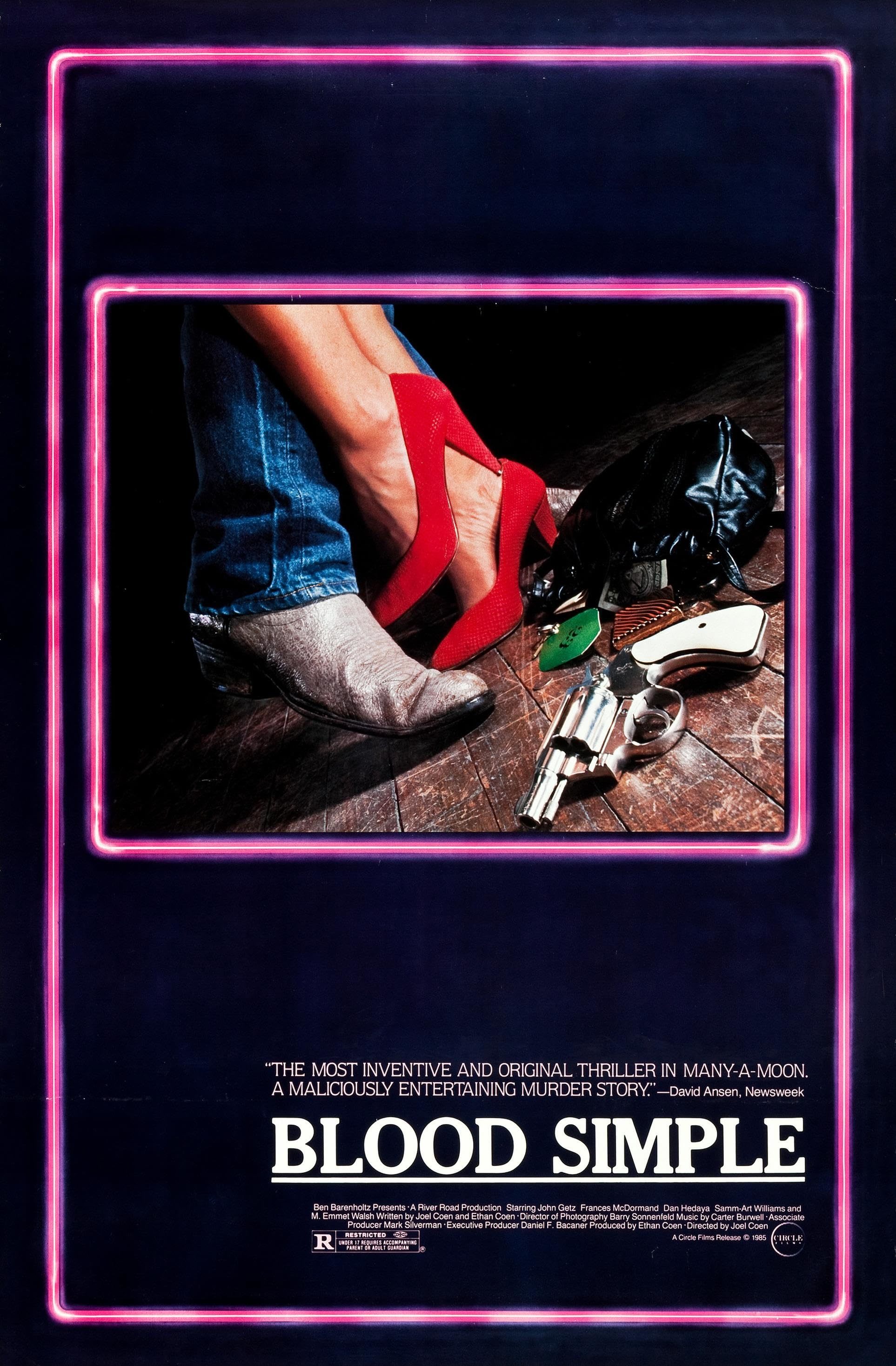
Murder Mysteries In May: Blood Simple (1984)

poster

Rare has a debut film been so self-assured, so completely full of what would become the filmmaker’s regular themes and style than the Coen Brothers’ Blood Simple. It isn’t their best film, but it is a great one, and it is absolutely through and through a Coen Brothers movie.

The title comes from a line in Dashiell Hammett’s novel Red Harvest in which a character starts getting a little punchy after being involved in a series of murders. The plot is original, but it was clearly influenced by another hard-boiled crime writer – James M. Cain, with bits of Jim Thompson thrown in for good measure.

The Coens would return to the hard-boiled film noir well many times in their careers. Their third film, Miller’s Crossing stole plot points from two Hammett novels – Red Harvest and The Glass Key. The Big Lebowski is a modern, stoner retelling of Raymond Chandler’s The Big Sleep. Neither Fargo, No Country For Old Men, nor The Man Who Wasn’t There seem directly influenced by any hard-boiled novel that I know of, but they fit right into that milieu.

But let’s get back to Blood Simple. The plot finds a sleazy bar owner named Julien (Dan Hedaya) hiring Loren Visser (M. Emmett Walsh) an even sleazier private detective to kill his wife Abby (Frances McDormand in her first film role) who is cheating on him with his barkeep Ray (John Getz).

One of the many joys of the film is following its labyrinth plot so I don’t want to spoil anything, but I will say things do not go as planned. Like so many noirs none of the characters are particularly bright, and rarely do they actually understand what’s going on. I don’t think either Abby or Ray ever realized that Loren even exists.

All of the Coen’s style is here, even if it is in a slightly rougher form. There are a couple of bravura shots that feel like first-time directors trying to show off what they can do, but they are pretty impressive all the same.

The entire cast is fantastic. Frances McDormand immediately shows herself to be one of the greatest actors of a generation. But the movie belongs to M. Emmett Walsh. He’s great in everything, but he’s particularly slimy here (and wonderful).

It is a terrific film, one that keeps getting better everytime I watch it and an absolutely smashing debut for some of my favorite directors.