
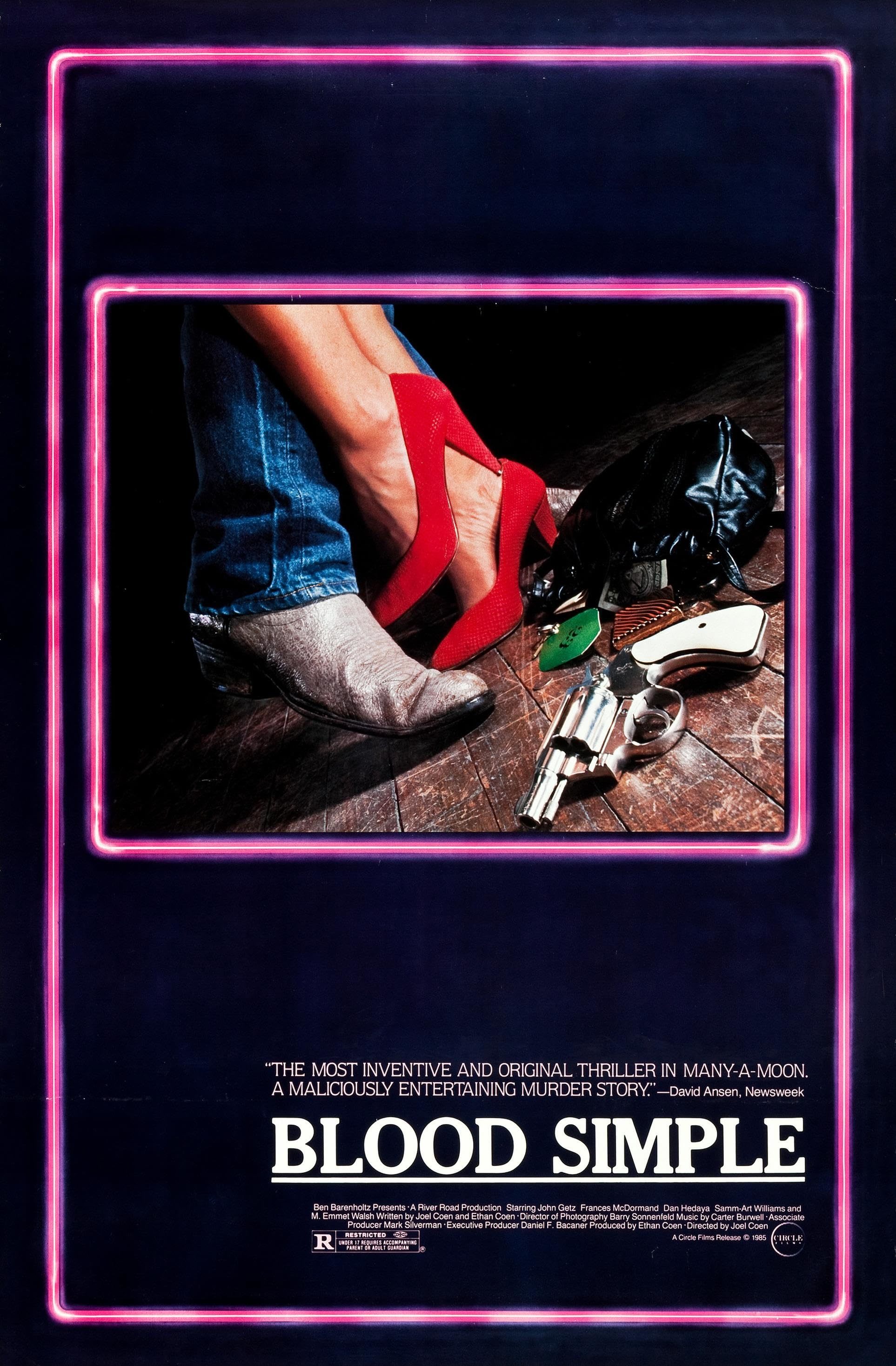
Murder Mysteries In May: Blood Simple (1984)

poster

Rare has a debut film been so self-assured, so completely full of what would become the filmmaker’s regular themes and style than the Coen Brothers’ Blood Simple. It isn’t their best film, but it is a great one, and it is absolutely through and through a Coen Brothers movie.

The title comes from a line in Dashiell Hammett’s novel Red Harvest in which a character starts getting a little punchy after being involved in a series of murders. The plot is original, but it was clearly influenced by another hard-boiled crime writer – James M. Cain, with bits of Jim Thompson thrown in for good measure.

The Coens would return to the hard-boiled film noir well many times in their careers. Their third film, Miller’s Crossing stole plot points from two Hammett novels – Red Harvest and The Glass Key. The Big Lebowski is a modern, stoner retelling of Raymond Chandler’s The Big Sleep. Neither Fargo, No Country For Old Men, nor The Man Who Wasn’t There seem directly influenced by any hard-boiled novel that I know of, but they fit right into that milieu.

But let’s get back to Blood Simple. The plot finds a sleazy bar owner named Julien (Dan Hedaya) hiring Loren Visser (M. Emmett Walsh) an even sleazier private detective to kill his wife Abby (Frances McDormand in her first film role) who is cheating on him with his barkeep Ray (John Getz).

One of the many joys of the film is following its labyrinth plot so I don’t want to spoil anything, but I will say things do not go as planned. Like so many noirs none of the characters are particularly bright, and rarely do they actually understand what’s going on. I don’t think either Abby or Ray ever realized that Loren even exists.

All of the Coen’s style is here, even if it is in a slightly rougher form. There are a couple of bravura shots that feel like first-time directors trying to show off what they can do, but they are pretty impressive all the same.

The entire cast is fantastic. Frances McDormand immediately shows herself to be one of the greatest actors of a generation. But the movie belongs to M. Emmett Walsh. He’s great in everything, but he’s particularly slimy here (and wonderful).

It is a terrific film, one that keeps getting better everytime I watch it and an absolutely smashing debut for some of my favorite directors.

Awesome ’80s in April: The Bedroom Window (1987)

the bedroom window poster

After a work party, Terry (Steve Guttenberg) talks Sylvia (Isabelle Hubbert), his boss’ wife, into going back to his apartment and to bed with him. After the lovemaking, Terry goes to the bathroom. Sylvia hears a noise outside. She sees a man attacking a woman. She struggles with opening the window and the noise startles the man, and he runs away.

She thinks about calling the cops to tell them what she’s seen, but she fears this will lead to her husband finding out about the affair. The next day they learn a different woman was raped and murdered not far from the apartment, just 30 minutes after the attack Sylvia witnessed.

Still fearing retribution from the husband, but now believing the man Sylvia saw was likely the man who murdered the other woman, Terry decides to call the police and pretend he was the witness. Sylvia gives him the details of the attacker and at first, the conversation with the police goes well.

Naturally, there are complications.

In order to arrest the killer they need more information from Terry, but he can’t give that information because he really didn’t witness anything. More murders occur and Terry’s desire to tell the real truth increases, but Sylvia remains unwilling to come forward. Terry does some investigating on his own and meets Denise (Elizabeth McGovern) the girl who was attacked outside his apartment.

The Bedroom Window follows some standard Noir tropes but with interesting modifications. Steve Guttenberg is either a brilliant choice for the lead actor, or an awful one. I know him from the Police Academy movies and Three Men and a Baby. He has such a goofy, gentle presence it is difficult to believe he could seduce someone like Isabelle Hubbert. Though it is quite easy to believe he could be the typical noir patsy.

But that’s just it, Sylvia isn’t the typical femme fatale. She isn’t involved in the murders. She doesn’t set Terry up. She simply witnessed one assault. She does become a cold fish the more Terry tries to convince her to come forward as a witness, but before that, she seems like a lady in a loveless marriage looking for some fun.

Denise is an interesting monkey wrench in the proceedings as well. She becomes a secondary love interest to Terry, but she’s also deep into the mix of trying to figure out who the killer is. She seems more out of a detective story – the plucky kid who helps the detective – than a film noir. She’s also the only actor who even attempts a Baltimore accent which is kind of distracting.

Terry makes idiotic decision after idiotic decision which digs him deeper into trouble. The film never quite makes me believe he’s as dumb as his actions make him out to be which caused me to yell at the TV more than once.

Director Curtis Hanson, who would later make LA Confidential one of the all-time great neo-noirs, keeps things moving briskly and with great style. The Bedroom Window isn’t great, but it is well worth watching if you dig neo-noirs with a slice of erotic thrillers thrown in.