
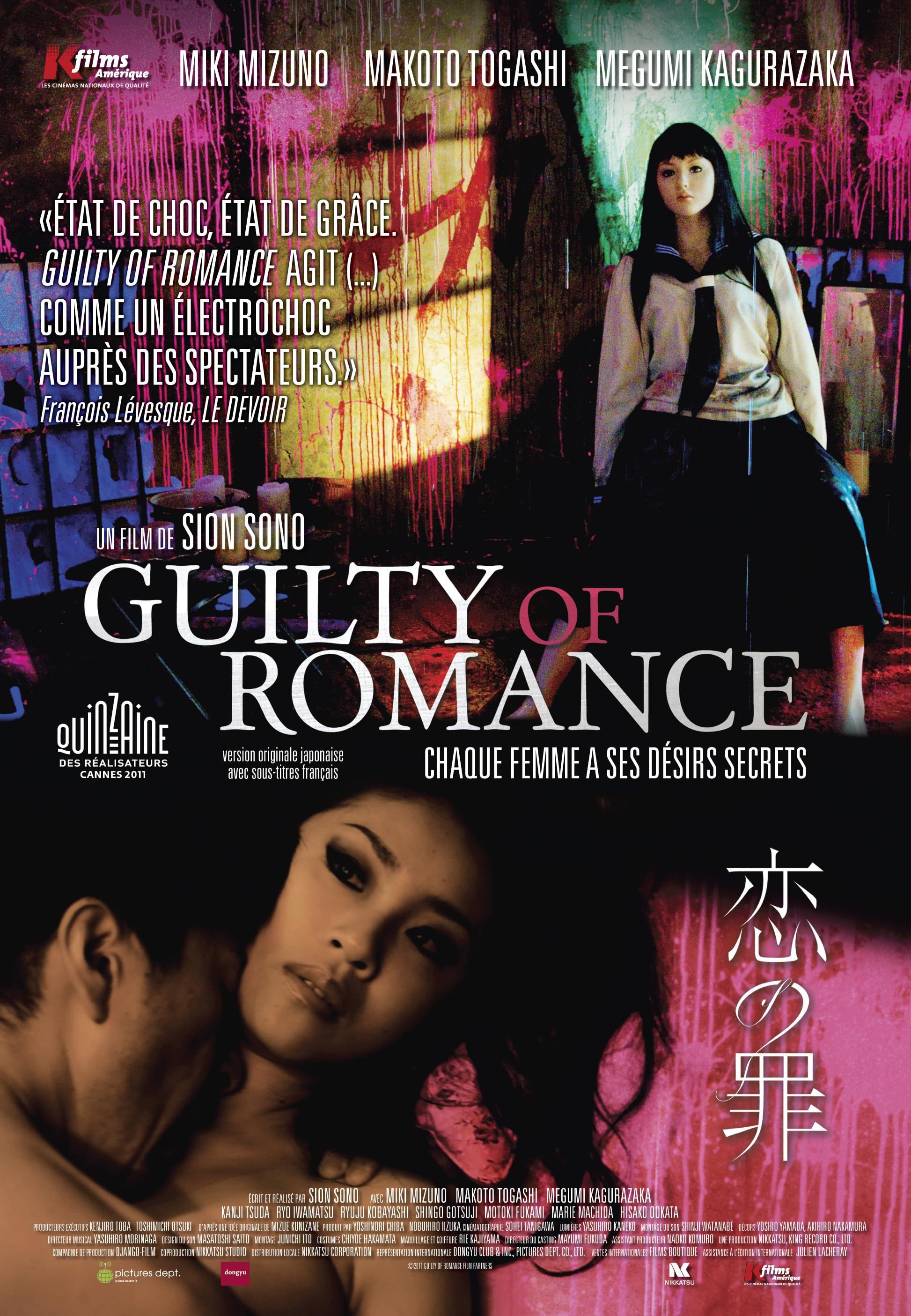
The Friday Night Horror Movie: Guilty of Romance (2011)

poster

When you watch as many movies as I do you are sometimes going to venture into the strange. You’re gonna watch a few films that make you say “What the Hell did I just watch?” I’m not entirely sure I liked Guilty of Romance. I’m definitely sure I didn’t quite understand it. But I’ll never say I was bored watching it.

It begins with a grizzly murder. A young woman has been dismembered inside a rundown flat in the Love Hotel district of Tokyo. Parts of her body are wearing a pretty red dress with the missing parts being replaced by mannequin pieces. Other sections of the corpse are fitted out in the same manner but in a schoolgirl uniform. The head and sex parts are missing.

Police detective Kazuko Yoshida (Miki Mizuno) is on the case. The story intercuts the investigation with that of bored housewife Izumi Kikuchi (Megumi Kagurazaka). She’s married to a famous novelist. He’s an exacting husband. He leaves at the same time every morning and returns promptly in the evening. When he arrives he expects his slippers to be waiting for him in the entryway and to be placed in a precise manner. He complements her tea-making skills in a way that lets us know he’s chastised her about it before. When she places some Japanese soap (not the French stuff he likes) in the bath, he berates her.

Their marriage seems to be without romance, love, or satisfying sexual encounters. She’s approached by a woman in a shop who claims to be a talent agent. Izumi is pretty enough to be a model she says. The photos turn out to be softcore in nature. Later she meets Mitsuko Ozama (Makoto Togashi) a sex worker who convinces Izumi to join her in that work.

In some ways, the film is about this repressed woman, living a very traditional lifestyle, diving deeper and deeper into sexual liberation.

Kazuko is more modern and liberated. She’s a police detective, a working woman in a field dominated by men. She’s also married, to a man who seems perfectly nice. But she’s had affairs as well. Currently, she’s involved with a man who likes to play domination games.

There is a lot more to the story but to delve any deeper would be to spoil it. The murder mystery takes second shelf to all of the sexual shenanigans. Director Sion Sono is interested in the ways women must navigate their own sexuality, and society’s demands upon it.

It is a deeply weird, subversive film. At times I was quite uncomfortable watching it. Especially early on when Izumi is being pushed into sexual acts she’s clearly not ready for. But the film wants us to be uncomfortable. This isn’t sex for titillation, there is always a reason behind it. I’m not always sure I understand those reasons or can get behind them fully, but I’m glad I watched it.

Recommended, but not for the faint of heart.
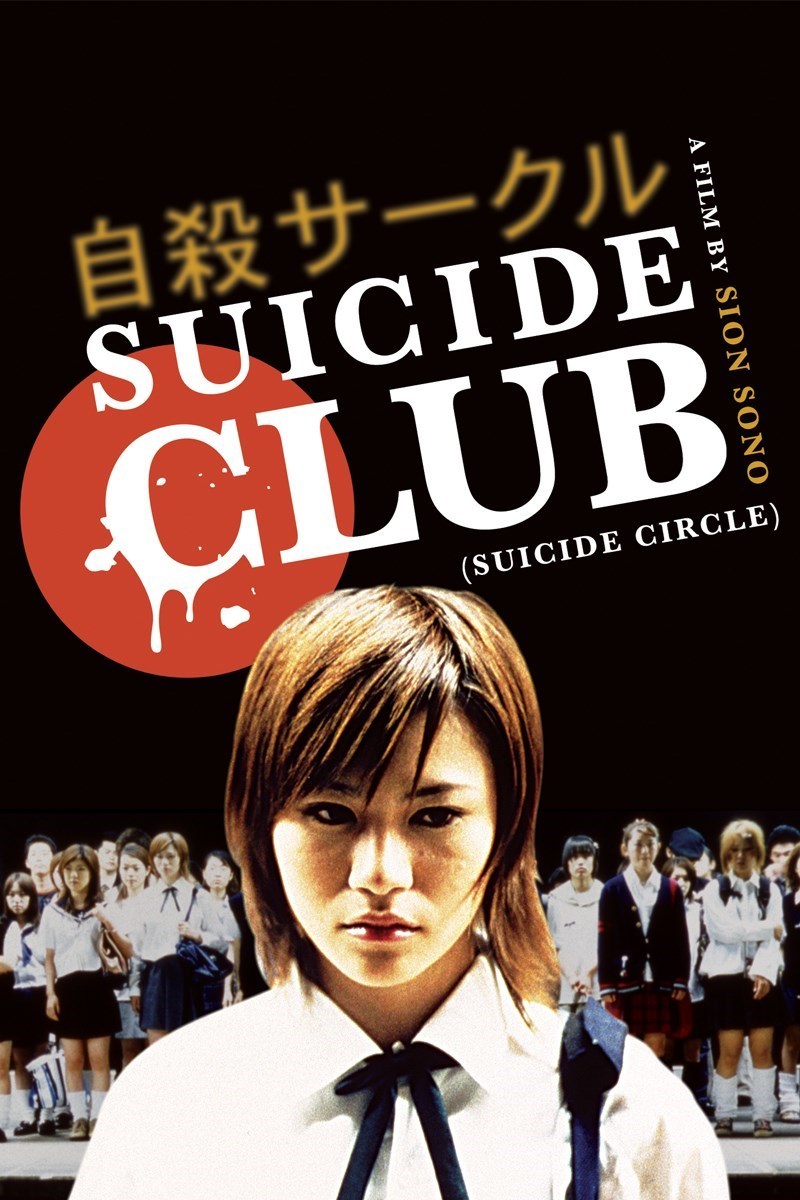
Suicide Club (2001)

suicide club poster

Fifty-four Japanese schoolgirls stand on a train platform, holding hands, singing, and laughing. As the train approaches they clasp their hands tighter, and in sing-song fashion start to count. As the train arrives, the counting stops, and all 54 of them jump in front of the train. Buckets of blood and guts spray the train, the passengers, and the people passing by.

Later, another group of teenagers sits on the roof of a school building during their lunch break. They are eating and laughing and looking like happy schoolchildren. Conversations turn to the 54 and how cool it would be to form their own suicide circle. Amongst much joking and a good time having, a crew decides to end their lives then and there. Standing on the edge of the rooftop they hold hands and plunge their way to the bottom. Buckets of blood and guts spray all over the school grounds, teachers and students.

Amongst the bloodletting are some scenes about a pop group whose Britney Spearesesque pop wailings are irresistible to every teen. Adults everywhere do their best to quash any talk about the deaths being a part of a suicide club movement.  A theme develops about society’s herd mentality.

Call it Japanese horror with a message.

The cops have to rule all of these deaths as accidents for there seems to be no foul play involved. That is until a bag filled with little rectangles of skin sewn together shows up. Then the suicides become a matter of detective work.

The detectives begin getting calls from a cyber-savvy woman who seems to know more than she lets on, calling herself the Bat. She leads the detectives to an internet site keeping a count of the suicides before they actually happen. One of the detective’s kids finds another site with some peculiar type clues.

Call it a Japanese horror, detective thriller with a message.

Through all this shocking, blood-splattering suicidal carnage continues to occur.

The detectives find a suspect who acts like a cross between Ziggy Stardust and Graham Norton. He’s definitely a bad fellow, what with the squishing of animals, kidnapping, and the random sexing with girls wrapped in pillowcases lying in a bowling alley. But he may not be behind all the suicides.

Call it a Japanese horror, detective thriller by way of Asian MTV, with a message.

In the end, we’re left with nary an explanation of the suicides, but that’s not really the point anyway. There is lots of gory violence if you like that kind of thing. And let’s be honest if you are taking the time to search out a copy of a relatively obscure Japanese horror film called Suicide Club, you probably do. There are gobs of creepy, moody suspense, with some very dark humor thrown in. All mixed in with some pretty in-your-face, and spot-on social commentary.

What’s not to love?