The Friday Night Horror Movie: Memoir of a Murderer (2017)

memoir of a murderer

My father has Alzheimer’s. It is early stages yet, so things are mostly okay. He sometimes forgets things that he’s just done, or other little details, but he always knows where he is and who I am. His father had it as well, and I watched Grandpa go through its entire course. It was awful. He often didn’t know who his wife or his children were. He’d forget where he was and what he was doing. He started hoarding money. It is an awful, awful disease.

As it turns out, it can also be a pretty good twist in a South Korean thriller. 

Byeong-soo (Sul Kyung-gu) killed his father when he was a teenager. The father was a horrible man who often beat Byeong-soo and his sister. When the cops never came to get him, Byeong-soo began to believe the murder was justified. And then he began thinking maybe other murders would be justified. He became an avenging angel, murdering anyone he felt deserved it.

The years rolled by, and the bodies piled up. But then he had an accident, and it did something to him. Dementia came next, and a diagnosis of Alzheimer’s. He often has blackouts, and his memory is not so good. He stopsed killing and becomes a model citizen and loving father.

His daughter, Eun-hee (Kim Seol-hyun), knows nothing of his past. She cares for him and gives him a little microrecorder that he can use to record everything he does in a day. This, she thinks, will help his memory.

One day he gets into a fender bender with a man named Min Tae-joo (Kim Nam-gil). This causes Min Tae-joo’s trunk to pop open. There is something wrapped in plastic inside, and blood is dripping to the road. Min Tae-joo says it is a deer he hit earlier, but Byeong-soo recognizes human blood when he sees it and the cold look in Min Tae-joo’s eyes. This man, he knows, is a killer.  More than that, he knows he must be the man who has been killing young women in his province. Three bodies have already shown up.

Ah, but Min Tae-joo also recognizes a killer when he sees one and decides to play a game. He discovers Byeong-soo has a daughter and begins to woo her. He sneaks into his house and reads his journal. Suddenly it is serial killer versus serial killer, except one of them can’t remember who he is half the time.

The film never really manages to rise above that pulp plot. The dementia angle adds some interesting twists. It creates a sort of unreliable narrator. The film is told through Byeong-soo’s point of view, so sometimes we’ll see something happen, and then he’ll question whether or not it was real, thus making us wonder the same thing. But it is also used a few too many times as a plot device. Beyong-soo will come close to killing Min Tae-joo, but then his eye will twitch (the film’s indication that he’s having an episode), and he’ll get away. 

It mostly plays his Alzheimer’s as a plot device, as something to add an edge to the proceedings. We get a feel for how it affects Eun-hee, and there is a cop friend of Byeong-soo who reacts with astonishment whenever he either cannot remember him or he actually does. I can’t really complain that the film doesn’t spend a lot of time with the emotionality of dealing with that disease, as I’m not sure if I’d be able to take it. And it isn’t that it’s handled poorly here, but this is definitely not a feel about that disease and its effects on both those who have it and those that must take care of them.

Min Tae-joo is a fairly generic villain. He’s your typical basic cable serial killer. He is a cop in this one, so that’s interesting, except the film doesn’t really delve very deeply into that angle. Sul Kyung-gu is excellent as our anti-hero, and the film remains quite entertaining and thrilling. The final fight scene is well staged, and I mostly dug the entire film. But it’s never anything more than you expect.

The Friday Night Horror Movie: Midnight (2021)

image host

I have to admit that the Friday Night Horror Movie is often, in reality, the Friday Afternoon Horror Movie. I tend to knock off work a little early on Friday afternoons, about the time my wife is picking up our daughter from school. With no one home, I go upstairs and put on a horror movie. Often I’ll put on another one immediately after, and sometimes I’ll even watch a third one before the night is over.

But lately, I find myself watching something with my wife in the evening. I like her and she doesn’t like horror so we’ll catch a mystery or something silly. Thus the horror movie I watched in the daylight hours becomes the thing I write about.

This afternoon I watched Severance (2006) about a group of weapons salespeople who get attacked by some crazy killers whilst out on a work retreat. It was terrible and I didn’t feel like writing about another terrible movie so I let my wife watch something with the kid and I settled down into Midnight.

I’m glad I did because it is terrific. And it was nice to watch something truly terrifying in the dark recesses of the night.

Midnight takes a couple of pretty standard thriller tropes (serial killer, deaf woman being stalked) and doesn’t necessarily do anything original with them, and some of its plot choices are baffling, but its execution is excellent.

Kim Kyung-mi (Jin Ki-joo) is a deaf woman working as a sign language customer service agent. On her way home one evening she stumbles onto a murder scene. A woman has been attacked and left for dead in an alleyway. When the injured woman throws her shoe into the street Kim investigates. Her attacker, Do-shik (Wi Ha-joon) watches from his van and then attacks Kim with a knife. He’ll wind up chasing her through the streets of the city for the rest of the movie.

Along the way, she’ll pick up her also deaf mother (Gil Hae-yeon) and the alley woman’s brother Jong-tak (Park Hoon). Together and separately they will make one terrible decision after another. The movie regularly stretches credibility in order to keep the thrills rolling.

But it makes smart use of sound, often cutting out at important moments to indicate how our two female protagonists live in a world without sound. There is a wonderful moment in which Kim is trying to escape by opening a metal gate, unable to hear the grating sound it is making, alerting the killer to her whereabouts. Another finds the killer inside the house making all sorts of noise while Kim thinks she is safe.

Kim and her mother are not just victims in this film, they fight back using every available weapon in their arsenal. The film also delves a little into the casual misogyny and overt ableism they face on a regular basis.

Most of the movie takes place on the apparently deserted streets of the city, leaving our heroes to fight the killer on their own. But even when they enter the crowded downtown area their inability to speak leaves their pleas for help falling on deaf ears.

Many of the plot choices may leave some of you smirking in your seats, but if you are able to overlook them this is one thriller packed with chills.

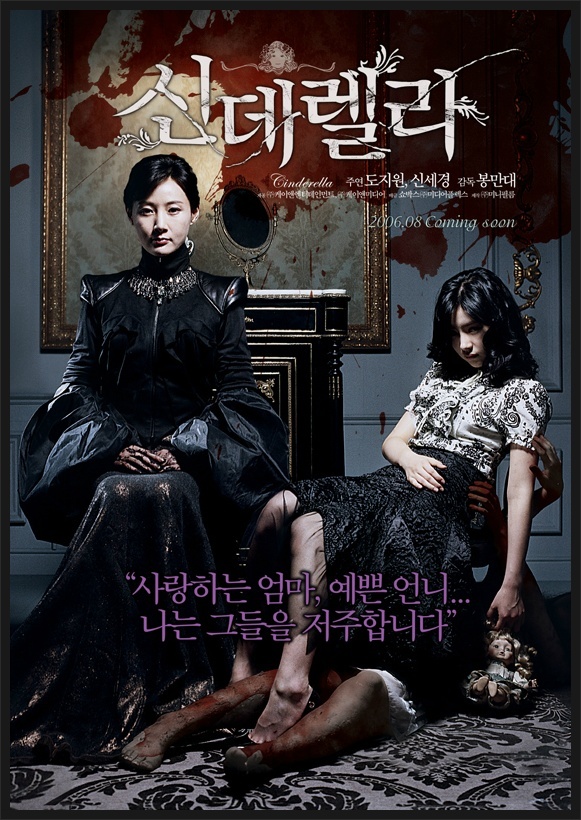
Cinderella (2006)

cinderella poster

For as far back as I can remember I have loved horror movies. Growing up in the 80s I can remember begging my mother to let me see the slasher films of Freddie Kreuger, Jason, and Michael Myers. Mostly she said no, but I still managed to catch them on late-night cable TV. Later the voyeuristic, sick pleasures of real death films like Faces of Death became something of an underground scene at my school. In the decades since that time, I have continued in my love for horror and gore.

The slasher film seemed to go out of style sometime in the early 90s but came back in vogue a few years later with Scream and its winking, ironic sensibilities. Now we’ve got Asian horror and its significant lack of naked breasts but with plenty of extreme violence. This brings us to Cinderella.

I’m not exactly sure why this film is called Cinderella as there is nary a Prince Charming, a mouse, nor a pumpkin carriage to be found, but there is enough dark moodiness to have Cinderella and her stepsisters screaming for mercy.

The story revolves around Hyun-soo (Shin Se-Kyung) and her mother, Yoon-hee (Do Ji-Won), a plastic surgeon. Dear old Dr. Mom performs facelifts for all of Hyun-soo’s friends who are obsessed with ul-jjang (the ideal beauty), but before long things start going horribly wrong. The face-lifted friends begin having weird visions of their faces being clawed off, which leads them to do some pretty nasty stuff to themselves.

Hyun-soo also begins having visions that her face is a horrible wreck, and she hears voices claiming her own face is someone else’s.

The film is loaded with mood. Shadows abound, and unknown dark faces linger just out of focus in the background. Voices whisper strange and haunting things throughout. As an audience, we’re never quite sure what is going on at any time, but we can be pretty sure it’s eerie.

There are a few Asian horror movie clichés, and to be sure you see more than a few long black-haired girls creeping along. In the end, it feels more like a Romantic era melodrama than a horror film, but for what it lacks in originality and gore it makes up for in mood and social commentary.

Yeah, that’s right, I said social commentary. The film has a great deal to say about our perception of beauty and the extremes we will go through to achieve them. Hyun-soo and her friends, who have all undergone some form of cosmetic surgery, are young students. They haven’t really formed concrete personalities but are more than willing to change their appearance surgically to gain some warped sense of beauty.

In one chilling scene, two girls begin slicing their faces open with sculpting knives all the while whispering “I’ll make you pretty.” This mantra is repeated throughout the film. All anyone seems to care about is his or her physical beauty, and they are willing to do just about anything to achieve it. Take a quick look at our own magazines and television commercials it’s not hard to see how such a warped perception could easily be believed.

Unfortunately in its attempts to be a horror film, a melodrama, and a social commentary, the film falls a little short in all categories. It is stretched just a little too thin to be completely satisfying as any of them, yet it provides enough of each to make it well worth watching.

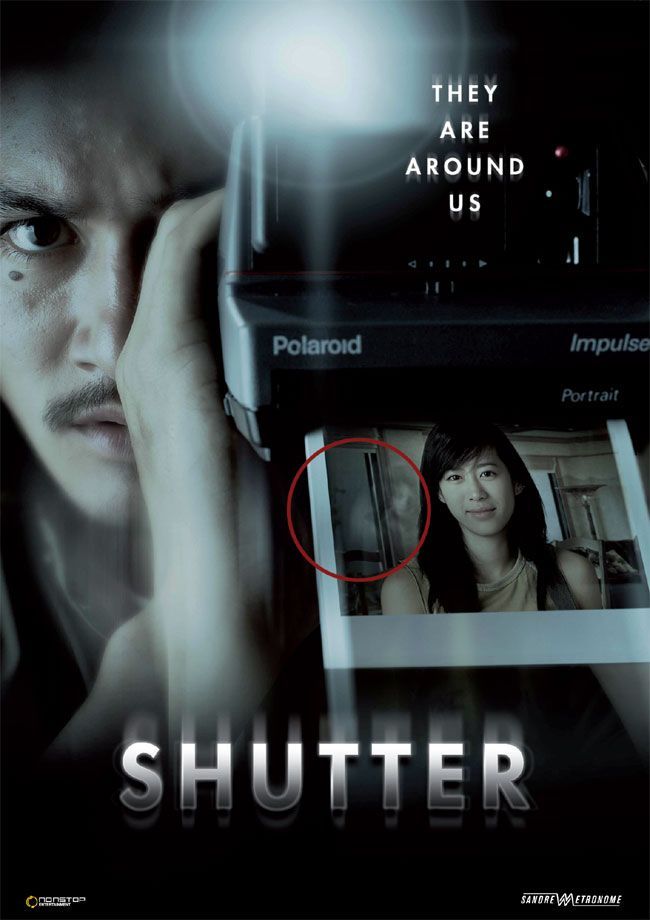
Shutter (2004)

shutter movie poster

A young couple races down a dark, deserted stretch of road. Out of nowhere, someone appears on the road and the young couple tears into her. Shook up, the couple heatedly discuss what to do, with a corpse on the road, and quickly decide to leave it lying there.

Sound familiar? The Shutter starts with an I Know What You Did Last Summer twist, and continues through its 95 minutes stealing from, er paying homage to, all sorts of horror films. There’s a creepy, long, black-haired Asian girl slinking out of regular household objects a la Ringu, and strange effects keep happening to photographs as in Ju-On (The Grudge). In some ways, it is very much a pastiche of other horror films.

Don’t let that discourage you from seeing this film, for though it doesn’t come out all that original, it still manages to be effectively horrifying. The tension builds quite nicely, and there were more than a few moments where I was squirming in my seat.

Post running over the poor girl, the couple – Tun (Ananda Everingham) and Jane (Natthaweeranuch Thongmee) – begin experiencing some strange, even supernatural, events. A young girl begins haunting their dreams and even appearing in the shadows, the bathroom sink, and their photographs. Tun is a photographer by trade, and he begins finding strange white streaks in his most recent photographs, followed by shadowy glimpses of a girl. Could it be the girl they ran over?

They follow the photographs to people who collect pictures of the dead, of ghosts, and discover a few old mysteries along the way. As they attempt to find out why they are being haunted, and losing a few friends via suicide, they discover more about this mystery girl and each other.

As an audience, we are treated to a handful of really effective films that amp up the tension and give us more than a little fright.

There are a few scenes in which the camera rolls over a series of “real” photographs borrowed from actual true believers outside the confines of the film. I had seen some of these pictures on ghost websites, and though I am completely skeptical, those scenes creeped the crap out of me.

The score is amazingly well done, being filled with clatters and screams and freaky noises even in the non “scary” scenes adding a surreal mood for the entire film.

On a purely critical level, there are several things to dislike. Many of its effects are taken directly from other films, and there are a few giant holes in the plot upon which to frown. But ultimately, it is very effective at what it attempts to do. That is to create a creepy hour and a half in which to scare the bejeesus out of its audience.

Spider Forest (2004)

spider forest poster

This was originally written and posted on October 4, 2006.

A Neo-noir mystery wrapped in a detective story pretending to be a horror film, Spider Forest is a little bit of everything but not enough of anything to be as excellent as I had hoped. It starts out incredibly strong but meanders in the middle trying to be as confusing as possible before coming to an interesting if not entirely satisfying ending.

The film begins with Kang Min (Woo-seong Kam) stumbling across a grisly murder in a small cabin in the middle of the woods. A man is gruesomely lying on the floor having been hacked to death, and we see every bloody detail. Unlike most cop shows where dead men have small blood stains on their shirt, but otherwise look perfectly fine, the camera here shows that murder is a disgusting, dirty thing, expulsing blood and guts in a nasty mess.

As Kang Min walks further into the home he sees his girlfriend lying on the bed, beaten and battered. She can only say something about spiders and that she is scared before finally succumbing to death. But what’s this? The killer is still in the house and Kang Min chases him outside into the forest. Unfortunately, the killer is too quick for him and backtracks to beat Kang Min with a club.

Left for dead Kang Min stumbles up and wanders for help on a lone stretch of highway. A car, not seeing him, hits him straight on, and again he is left for dead. He is eventually found and taken to the hospital.

In a wonderful opening scene for Detective Choi (Jang Hyeon-seong) we see him and several other cops staging a raid on a gang resting inside an apartment. As the men give a three count before busting in, Choi’s cellular phone rings and ruins the surprise. With nothing to do but break down the door, the cops charge in and beat the villains to a bloody pulp. Then, while sitting on top of one bad guy, Choi answers his still-ringing phone.

It is a lovely, sadistic, and hilarious bit of filmmaking.

The caller was someone from the hospital informing Choi of Kang Min’s accident and Choi rushes over to meet him.

It is here that the film verges off into the land of confusion. Several times it jumps and cuts through time without much warning. I was often confused as to where I was in the timeline and just who I was seeing on the screen. We see Kang Min meeting his wife, meeting his girlfriend after his wife has died in multiple flashbacks we see the killing in the cabin as King Min begins to remember exactly what did happen.

Some of these scenes are incredibly interesting and kept me begging for more clues, while others tended to drag and not move the plot forward in any distinct way. I suppose this was to add to the mystery of it all and keep the audience guessing, but ultimately it felt like sloppy editing.

I won’t give away the ending, but it is the sort of film that even after everything is wrapped up you may not fully understand. I had to give it considerable thought and consult some online forums to decipher it fully. Which, depending on your personality is either an annoying way to tie things up or a brilliant way to finish.

In the end, it contained a number of wonderful moments but was marred by a lack of consistency in development. What’s brilliant is well worth watching and there is enough to chew on after the credits roll, but the promise of the first twenty minutes is never lived up to in the end.

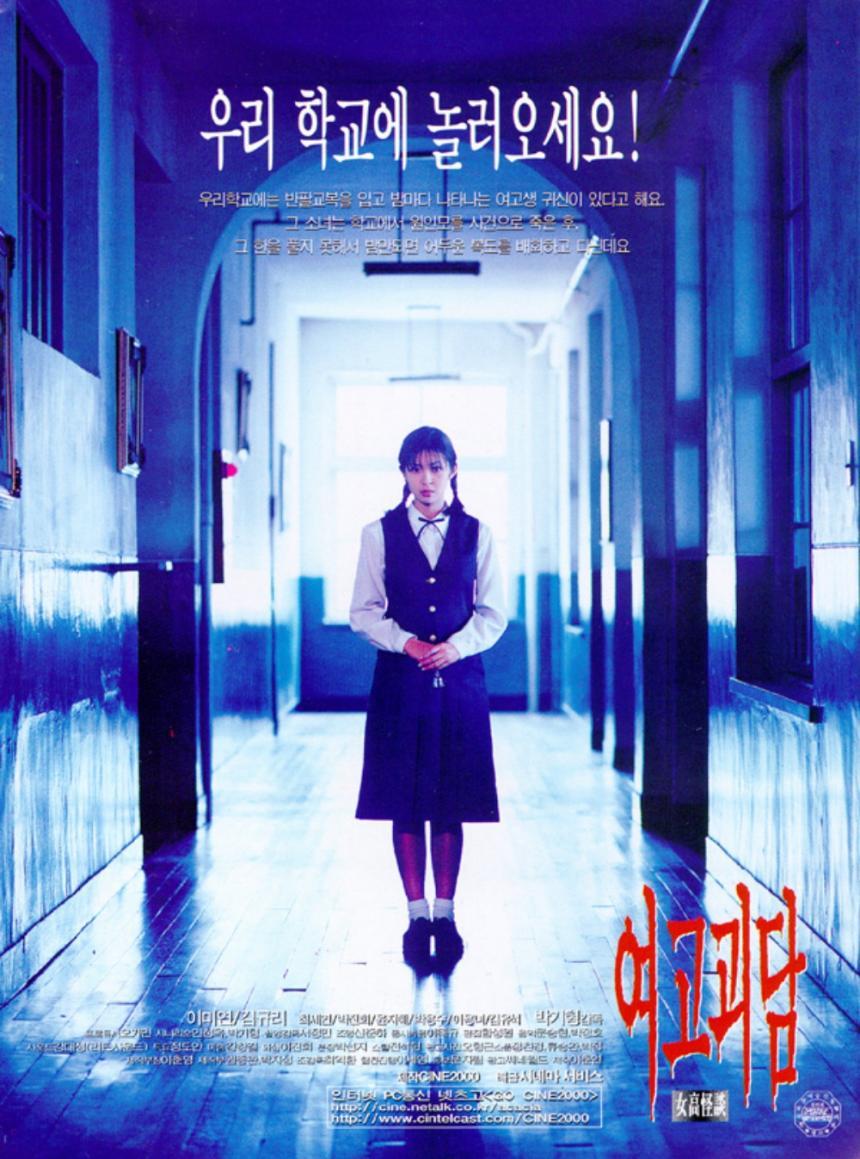
Whispering Corridors (1998)

whispering corridors

Poor Hur Eun-young (Mi-yeon Lee) has been having difficulties ever since she started teaching at her old school. The students don’t respect her as an authority figure, the teachers still look at her as a student, and unlike all of her fellow peers, she actually has some sympathy for what it is like to feel the pressures of being a young girl in South Korea. Oh, and people keep dropping like bloody flies around her.

The film begins with Mrs. Park, a teacher at the all-girl school, finding something disturbing in a yearbook. She then runs frantically through the hallways, scared out of her wits, before she calls Eun-young and mysteriously tells her that Jin-ju is still around, still attending the school. She then drops the phone and is strangled to death by an unseen person wearing the school uniform.

This mysterious killer takes Mrs. Park’s body and moves it outside to make it look like a suicide hanging. Early the next morning two completely different students, the pretty, outgoing art student Ji-oh (Gyu-ri Kim) and the less pretty, shy Jae-yi (Kang-hie Choi) arrive at school early for they have been chosen this week as class clerks, which means they have to arrive early and clean the room. Upon entering the classroom they discover Kim Jung-sook (Ji-hye Yun) is already there. The three form something of a friendship that will grow and change as the film progresses. Ji-oh, upon walking outside discovers Mrs. Park’s body hanging outside.

All of the girls are rounded up and made to promise they will not talk about the incident, and specifically not spread any rumors about it.

Of course, the girls do talk about it and begin to speculate that it was not suicide but murder. Mrs. Park was a notoriously mean and hateful teacher who seemed to take great pleasure in punishing her students. Perhaps a particularly hated student went off the edge and murdered Park in retribution. Those rumors turn to speculation that it could have been Jung-sook as she was a particular favorite for punishment by Park, was not a particularly good student, has few friends, and was at the school earlier than anyone else.

Eun-young befriends our three protagonists and begins sniffing out foul play herself, as she is continually reminded of the death of her high school friend, Jin-ju a few years earlier on those very school grounds.

The mystery deepens, the bodies pile up and the plot gets confusing.

I’ll be honest here, I had a very hard time following just exactly what the heck was happening. This is not particularly uncommon for me, especially in mysteries where knowing who did what to whom is almost always vitally important. I don’t mind it so much because I’m almost always clueless as to who-dunnit until the movie tells me during the final scene.

The thing is I’m really lousy at remembering character names, and unless the actor is someone well known to me faces and actions get mixed up in my head. A film like Whispering Corridors only compounds this confusion. The unfamiliar Korean names render them impossible for me to remember. And the unknown actors have a hard time standing out in my head (and when it is an all-girl cast all with the same long, black hair clothed in the same school-girl outfits you can forget it.)

The confusion is compounded by the plot of the film which is full of flashbacks, useless clues, and of red herrings. Like many mysteries, the film is designed to confuse the viewer a little so that it can surprise us in the last scene.

Visually the film takes quite a few cues from US slasher films circa the 1980s. There are lots of stop-motion cuts, weird fade-outs, and shots of the killer from angles that obscure his/her face. It has also taken a few pages out of the Dario Argento film book, especially with its use of sound for disturbing effects.

In reality, it isn’t particularly scary. The deaths mostly look cheesy and belong to a different era. Though director Ki-Hyung Park tries his best to create a creepy mood, he can only manage a few good moments of eeriness with broad shots of the super long hallways linking all of the classrooms together. It works best, not as a horror film, but as social commentary. I don’t know a thing about Korean school systems, but if they are anything like those depicted in this film, then they need some serious reorganization.

All of the teachers take sadistic pleasure in abusing and harassing the students. Several times we see teachers not only verbally abusing their students but even hitting them, hard, in the face and kicking at them. One teacher in particular, nicknamed Mad Dog, unleashes upon his students in nearly every scene. When he is not pitting them against each other academically (going as far as to say they are enemies in the war for the best grades) he is physically abusing them and coming onto them sexually.

What is particularly revolting about these scenes is that none of the students seem surprised by the actions, and the administration turns a blind eye. Even Eun-young who is a good-hearted woman and wants to make social change in the system, jokes at the Mad Dogs advances saying his nickname instead should be “pervert.”

Behind the death toll and mystery lies a cry for help from the students. It is an interesting juxtaposition between this and American movies that deal with the high school experience. Where American films generally deal with the effects of social standing and the fight to become “popular” Whispering Corridors shows how in a world where only good grades count the actions are also less than exemplary.

Whispering Corridors generally fails as an excellent horror/mystery film, but it does manage to raise important questions about the educational system, friendship, and how we treat our fellow beings.

Lady Vengeance (2005)

lady vengeance poster

Forget Kill Bill.

Screw Quentin Tarantino.

There is one filmatic revenge series to obsess over and it doesn’t come from the mighty shores of California. Chan-wook Park’s final installment to his vengeance trilogy, Lady Vengeance, has just been released on US DVD and it is an awesome way to end the series, indeed.

Where Tarantino gave us two films full of exquisite style and very little substance, Park finds time to explore the meaning between the bloodletting.

Where Tarantino created an amazing genre-bending exploitation masterpiece, Park has made a violent, stylish trilogy that is more than just eye candy.

That’s all the Kill Bill references I’ll make, I promise.

Lady Vengeance (which was forever named Sympathy for Lady Vengeance, until the good people at Tartan decided it needed a little spiffing) is a tad slower, and less action-oriented than the other two in the trilogy, but it is the final in the series and like Kill Bill Vol. 2 (darn it, ok I swear that was the last one, for real this time) the series needs a little grounding.

Lee Geum-Ja (Yeong-ae Lee) is sent to prison at the age of 19 for the abduction and murder of a small child. Truth in fact she did not murder or abduct the boy (she merely helped keep him) but takes the blame for her accomplice, Mr. Baek (Min-sik Choi) because he threatens her own child with violent harm if she does not.

She spends 13 years in prison for those crimes and while there she makes good with everybody. She is the perfect inmate – she finds religion, helps out, cares for an elderly inmate, and even donates an organ – all the while she meticulously plots her revenge.

Upon release, she uses her former cellmates to help get her revenge and extols it in true Chan-wook Park fashion.

Although served deathly cold, the revenge is not so sweet. In fact it is quite bitter and does not relieve Geum-Ja of guilt like she thought it would. Like all of the films in the trilogy, Lady Vengeance delves deep into the consequence of being wronged and how finding vengeance reaps more than it sows.

The film is astonishingly beautiful. Bathed in gorgeous color and light that makes even the most blood-soaked scenes look as delectable as the desirous confections Geum-Ja is so good at making.

With only four films under his belt, Park has proven he is an artist of the finest measure.

As mentioned, the film is slightly more subdued than the others. There are no liver donations as performed by hoodlums, no ironic circle jerks, and certainly no massive fist-fights as performed in small hallways, but what it lacks in extremism it finds in emotional gravitas.

Yeong-ae Lee is to Chan-wook Park as Uma Thruman is to Quentin Tarantino (oh forget it, you can’t review Lady Vengeance without referencing Kill Bill, at least not in this house.) Gawd just looking in her eyes would make a cold stone weep. She plays the role of Geum-ja with an intensity of a thousand suns, yet manages to keep an eternal sadness just below the surface. It is a performance worthy of honor.

For once Park has ended a vengeance film with something resembling a happy ending. No, the vengeance isn’t really vindicated, nor is Geum-ja satisfied, but unlike the preceding films, the violence, and vengeance seem to stop here. And that seems to be enough.

It may not be as gut-wrenchingly satisfying an ending as we get in Sympathy For Mr. Vengeance or Oldboy, but it is one that rings the finality to the trilogy, one that serves as an answer to the questions brought up by all three films.