The Awesome ’80s In April: Innerspace (1987)

image host

Innerspace was the very first movie I ever saw in Letterboxd.

Quickly, for the few of you who may not know, letterbox is when they put those black bars on the tops and the bottom of the screen. They do that because movies are generally shot in a rectangular aspect ratio that fits the movie theater screen but does not fit the old square TV screens. To make it fit the square TV screen they had to cut off parts of the movie which is called Pan & Scan (pan is the cutting off of the sides, scanning is moving what you see within that cut image). Letterboxing added the black bars to make the image rectangular again thus allowing you to see everything the filmmakers wanted you to see.

I have a vivid memory of renting Innerspace and getting a little pre-movie title explaining what Letterboxing was. I did not understand it at all. I immediately noticed the black bars though. Me and mom complained about it heavily. But also, it did seem to make the movie look better somehow, more cinematic. Sometime later I watched The Empire Strikes Back in letterbox and I was hooked. I became a lifelong champion of the format. Nowadays pretty much everything is Letterboxd, even are TVs are formatted that way.

Anyway, when we plugged in Innerspace this past weekend that’s what I thought about.

Also, it is a pretty fun movie. It is some basic 1980s science fiction cheese but it has a good performance from Dennis Quaid and a hilarious one from Martin Short. And the special effects still hold up quite well.

Quaid plays Lt. Tuck Pendleton a great pilot whose also a bit of a hotshot and alcoholic. He volunteers for a special mission in which he’ll be shrunk down to the size of a pin head and injected into a rabbit. For science you understand.

Short plays Jack Putter a hypochondriac grocery store clerk. For *reasons* Tuck is injected into Putter’s body instead of the rabbit. Our heroes have to find a way of getting him out before his air runs out. Also, some bad guys want the machine Tuck uses to fly around inside Putter’s body.

The film is basically one long excuse to show off some cool effects of this little machine zooming around the inside of a body. Like I said they do hold up. I’m a sucker for classic practical effects. It also allows Short to show off his physical comedy. With the little ship zooming through is bloodstream and the like he has to make all kinds of animated reactions and he’s a master at that stuff.

The rest of the film is just silly 1980s action stuff and isn’t worth mentioning. Meg Ryan is always worth mentioning. She’s Tuck’s girlfriend but isn’t given much more to do than that.

I’ll always remember Innerspace for turning me onto the Letterbox format, but it is worth checking out all on its own.

31 Days of Horror: Gremlins (1984)

gremlins poster

I was eight years old in 1984 when Gremlins came out. I saw it at least once in the theater, but I suspect I saw it more than that. Certainly, I remember talking to my friends about it at school and on the playground. We all loved it. Famously it was one of the movies that created the PG-13 rating (the other was Indiana Jones and the Temple of Doom). There is quite a bit of violence in the film including scenes in which Gremlins are pureed in a food processor and blown up in a microwave. Some audience members were disturbed by this, having taken their young children to the movie due to its PG rating. Steven Spielberg who produced this movie and directed Temple of Doom used his clout to suggest a rating between PG and R and thus the PG-13 rating was born.

As kids, of course, it was those very scenes that we loved and were talking about on the playground.

If you haven’t seen it, Gremlins is about how a father buys a cute little furry creature from a mystical old Chinese man (we’re gonna overlook the terrible caricature that trope has always been, but do note I am completely aware of it). for his son Billy (Zach Galligan). Well, technically he buys it from the man’s grandson, but that detail isn’t that important. The creature called a Mogwai and named Gizmo by Billy comes with three rules.

He doesn’t like bright lights, and sunlight will kill him.
Never get him wet.
Never, ever, feed him after midnight.

As a side note, I once bought the woman who would become my wife a stuffed Gizmo but made her recite the rules to me before I would give it to her. She still has it, and pulled him out while watching the movie.

Naturally, all three of these rules will be broken in the course of the movie.

When water is accidentally spilled onto Gizmo he spawns a bunch of other Mogwai. Unlike Gizmo these spawns are more mischievous and malevolent. They trick Billy into feeding them after midnight which metamorphosizes them into larger, nastier creatures with evil intent.

Mayhem and quite a bit of pretty bloody violence ensue.

Director Joe Dante directs Gremlins from a script by Chris Columbus with a wonderful mix of humor and gore. As a kid I loved it. As an adult I still do.

It takes place on Christmas Eve so technically you could call it a Christmas movie rather than a Halloween one, but I’m still counting it for my 31 Days of Horror scoreboard.

The Goonies (1985)

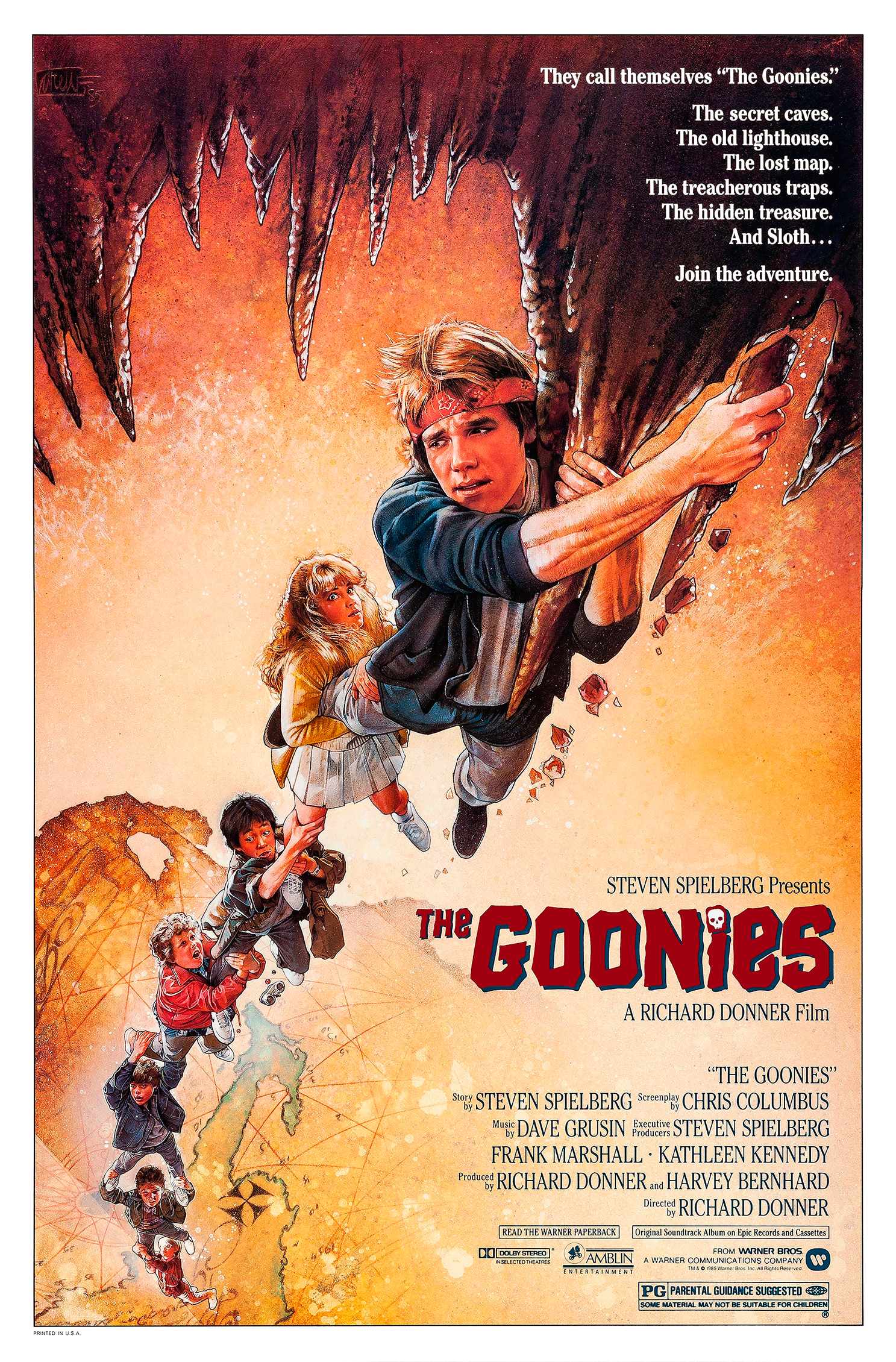
the goonies movie poster

Editors Note: I apparently wrote a review of this movie, then immediately went back and wrote a second one.  Posted both of them.  My guess is that the second part was unintentional – that I wrote the first one, but didn’t like the draft yet accidentally posted it. Then the next day went to rewrite it, probably couldn’t find it in my drafts and wrote a new one from scratch.  Or something like that.  Yesterday I reposted the old one without realizing this one existed.  I guess I make bonehead moves over and over again.  I think it is fascinating to compare the two as I used some of the same language, but also changed quite a bit. 

Come back with me to a time of innocence and fun. Let’s all go back to my childhood when movies were watched for entertainment. When I didn’t have to dissect hidden meanings and write about the symbolism or depth of a film. When I wasn’t a critic, but an audience member. Jump into my DeLorean and set the date for the 1980s.

It is a time when you could count on jokes about getting kicked in the nads, plot lines weren’t important, and you could always count on a good action figure to play with after the end credits. There was always a musical montage, you knew not to feed the mysterious animals after midnight, and a red Ferrari was your ride when you cut class.

Simple tasks such as fixing breakfast, or opening a gate became immensely difficult by using everyday items as complex machinery. If you were good, you could incorporate a ball (preferably bowling). It was a time when a small boy named Jonathan Ke Quan ruled the world.

I suppose I must admit that there were some very serious films made in the 1980s, but I was a child then and I didn’t see any of those films until much later. For me, it was a time of action, adventure, and plenty of buttered popcorn.

One of my favorite movies from the time is The Goonies. It’s a perfect movie of the 80s, what with the high adventure, the pirate gold, a steaming heap full of Jonathan Ke Quan, and bloody mother f’ing Sloth. Nothing beats Sloth.

Watching it again I am amused by the fact that the Goonies aren’t explained in any way. There is no background to how the club was formed or what even a Goony (or is the singular Goonie?) is exactly. And they don’t have to. As a kid I didn’t need a back story, they were the Goonies and that’s all I needed to know. I wanted to be a Goony, and I had many a pretend adventure going after the rich stuff.

The plot – O’ the glories of the plot – concerns an entire neighborhood that is about to be turned into a golf course. It seems the golf course people have managed to evict every single person in the neighborhood at the same time due to a lack of funds. For if only one family could come up with the extra funds then they could tell the golfers to buzz off.

Never mind that the neighborhood seems to be made up of middle-class suburbanites or that none of them can manage to pay this mysterious amount of money (mortgage?). How a pile of jewels manages to take care of everything isn’t exactly explained either.

But that’s getting caught up in the plot, and that’s never the point with a good 80’s flick. The Goonies – a group of misfit teens (and I mean that in the totally 80’s kind of way, and not the post-Columbine psychotic meaning of the term) – find a treasure map leading to pirate booty. They have many an adventure finding the treasure and are followed by the Fratelli crime family. Of course, the Goonies find the treasure and save the neighborhood, but like so many things in life, it’s the journey that really counts.

Along the way, we are treated to glorious action, romance, comedy, and of course, a moral involving teamwork and acceptance – even acceptance of a grotesque-looking monster man dubbed Sloth.

Sloth – the greatest of all 80’s characters – is a deformed giant and a member of the Fratelli family. The chubby Goony – kindly named in 80s cinematic glory as Chunk – is captured and thrown in with Sloth. We are all petrified as to what this hideous creature is going to do, only to find a moral in the monster with a heart of gold.

Critics will scoff at the The Goonies plot holes, cheesy effects, and overall silliness. But if you’ll step back a moment in time with me you might find a wonderful slice of nostalgia, and a little bit of fun in a movie meant to do nothing more than entertain.

The Goonies (1985)

the goonies poster This was originally written on July 15, 2006.

Ah the 80’s. When making movies was simple and easy. When all you needed was some cheesy dialogue, a few nut sack jokes, long montages set to cheesier music, and the go-to nerdy Asian kid actor Jonathan Ke Quan. If you could make simple actions like opening a gate door incredibly complicated and involve some type of ball (preferably bowling) then you were almost guaranteed a hit.

Ok, there were serious, art movies made in the 80’s, it’s just that I didn’t see any of them at the time. Hey, don’t blame me, I was just a kid. If you have to lay blame, go find my mother.

For me, the 1980s was full of the Goonies, Gremlins, The Lost Boys, ET, Indiana Jones, and freaking Return of the Jedi. T’was a glorious time filled with mayhem, action, silly comedy, and all the stereotypes you could shake a stick at.

Reliving my nostalgic memories is sometimes surprisingly good, and often quite frightening. The Lost Boys is embarrassing, while a film like The Goonies holds up amazingly well. Sure, it won’t go on any of my top 5 lists, but it is still an enjoyable, entertaining romp.

To gather up some plot points, the Goonies are a group of adolescent boys all living in a neighborhood that’s about to be turned into a golf course. If only they could come up with the money to keep their parents mortgage then all would be saved. Through some shenanigans, it turns out that two of the boy’s dad is a curator for a museum that just happens to have an attic full of pirate lore.

They find a treasure map and set out to find the pirate gold and save their neighborhood. Along the way, they run into some nefarious gangsters who become quite interested in the pirate booty.

Bountiful misadventures occur as both the Goonies and the gangsters run amok underground the city escaping all sorts of mad booby traps. The gold of course is found, and lost, and found again, well enough to save the day. The gangsters are caught and everything is hunky dory.

Did I mention Sloth? No! How could I forget Sloth? He is this giant disfigured character the gangster bad guys keep locked up because he’s family and a menace, or weird. Or something. Of course, he is really a Goonie at heart and once again a movie of the 80s shows us the way to acceptance and world harmony.

Close Encounters of the Third Kind (1977)

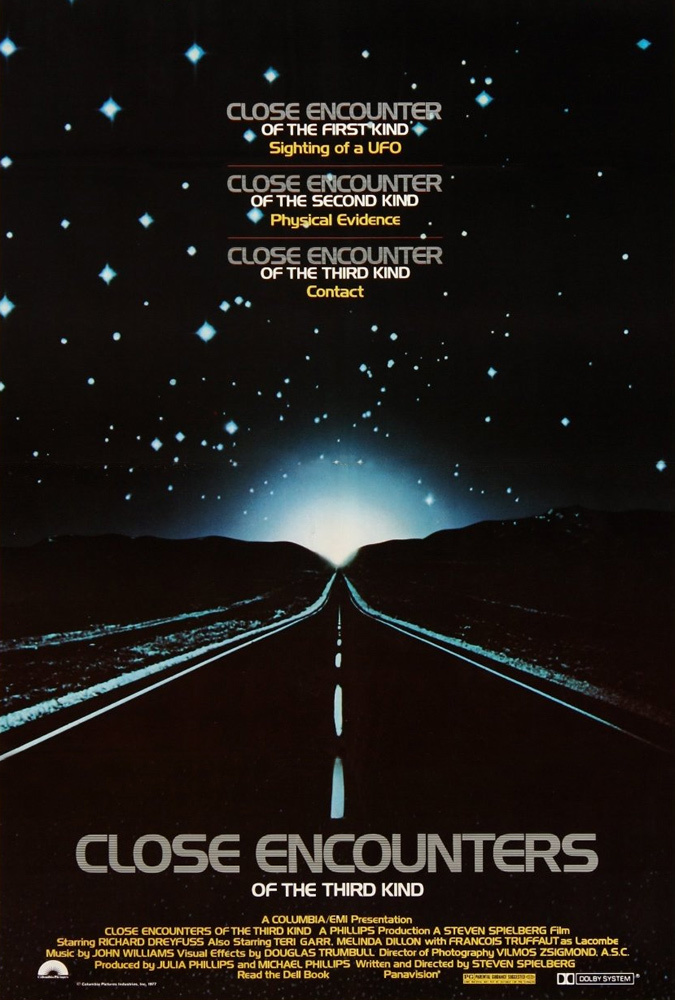
close encounters of the third kind poster

Editor’s Note:  This is one of the earliest reviews I ever wrote. It is interesting (at least to me) to see how I’m trying to find my voice, trying to figure out exactly how to review a film.

This movie is pure joy to me. This makes it rather difficult for me to actually review the movie and not just give it praise. Since I have seen it numerous times, and there are then no surprises for me, so I must warn the reader that there will probably be **spoilers** in this review. So if you have not seen it and do not want any details of the film, stop reading now.

There were a few differences with this viewing than in previous viewings. First I have actually been to the Devil’s Tower in Wyoming. Having actually seen this natural monument takes a little mystery out of it in the film. For years it seemed more like something out of the filmmaker’s imagination, something of the dreams of Hollywood, than something real. Something made of rocks and dirt. The mysterious glow that surrounded the rock in the film, and especially the first actual appearance in the film on television, has been dimmed a little. Likewise, as Richard Dreyfuss sculpts the mount in the beginning I wanted to shout at him to flatten the top.

Secondly, I am now quite familiar with a number of Francois Truffaut’s films. He plays the mysterious French scientist in the film, but is in reality, a gifted director and pioneer in the French New Wave. Being familiar with who the actor is, gave the character more depth and mystery. I wonder how Spielberg talked him into becoming an actor in his film. If he had any influence on the direction of the film.

Having learned a little French myself, and having a very good translator beside me also shed some light on what was actually being said in the French conversations. There are several moments in the film when Truffaut speaks in French and Spielberg uses no subtitles. I always felt this was intentional to give the film a little more mystery, to add the international, interwordly feel to the film. So it was interesting now to actually understand what was being said.

I have also, for the past few years, lived in Indiana. Much of the movie takes place in Muncie, Indiana and I found the same joy that I always find when a movie, book, or song takes place somewhere I know or have been to. As if it becomes more real simply because I know the places it occurs.

To me, the film is less about aliens and more about a sense of wonderment. In a famous scene, a small boy stands in front of an open door that is ablaze in a fiery glow. You cannot see what is outside, but you have spent the previous minutes watching the boy’s mother become very frightened as the aliens attempt to enter the house. Yet the boy standing close to these unseen and unknown creatures stands unafraid, even curious. There are many beautiful shots of a night sky with billions of brilliant stars sparkling. Throughout the film, Spielberg seems to be using space and aliens as a means to express wonder and amazement at the unknown.

Richard Dreyfuss’ character loses interest in his family and outside life except for the mystery of the things he saw in the night sky and the recurrent thought of the mysterious mountain. Several times as he builds the mountain out of clay, dirt, and mashed potatoes he proclaims that it must mean something, but isn’t sure of what. Even in the last scene when he boards the alien craft there is no final meaning given. It’s as if Speilberg is saying that it is the search for meaning in the universe, it is in looking with wonder at the great mysteries of the world that we in fact find some purpose, some meaning.

I was reading a review of Steven Spielberg as a director and one of the things it discussed was the director’s tendency of not moving his camera. That he tends to allow action to come to the camera’s view instead of following the action with the camera. So as I watched this film I kept a keen eye out for camera movement. I did find this to be true. That’s not to say the camera was only in one place. In fact, it often was placed in different parts of a room for a scene, but in any given shot, there was little movement. No sweeping shots, no long-tracking scenes. The biggest movement I saw was when Richard Dreyfuss and Melinda Dillon arrive at the Devil’s Tower. The camera then sweeps over the car and follows the characters up a hill to reveal, finally, the giant rock in a real shot. I’m not sure what to make of this but found it interesting.

As in many Spielberg’s films there is marital strife in this movie. Richard Dreyfuss and Terri Garr’s marriage literally falls apart as Dreyfuss becomes more and more obsessed with his visions. There is one scene in particular where Dreyfuss is locked in a shower crying and Terri Garr begins to scream at him and scream at the children to go to their rooms. Speilberg uses several close-up shots of the children to show how this fighting disturbs them. Spielberg has been on record saying that his own parent’s divorce disturbed him deeply. Many of his films either show the distress of an unhealthy marriage or the products of divorce.

In this film, the problems of the marriage are Richard Dreyfuss’ character’s obsession.  He is also the hero of the film and is whisked away in the wonderful alien ship. I view this not as a detraction from the film but as an artistic endeavor. Spielberg takes time out of his alien picture to show the hurt and pain Dreyfuss causes. Dreyfuss’s character also shows remorse over his actions yet cannot turn away from his obsession. As he begins to tear down his scrapbooks of alien abductions he tears the pointy top of his clay Devil’s Tower and becomes obsessed all over again. Though in reality, I would see such a person’s actions in disgust and contempt in the context of the film I see it as a broader artistic action toward the overall goal of seeking deeper meaning and wonderment. Just as I can cheer for the violent destruction of the bad guy in an action movie when the reality which is abhorrent and gruesome.

And that’s my review. I am reluctant to give any kind of official 5-star rating or whatever because that seems so arbitrary. And as happens when I begin rating anything I find trouble in giving Evil Dead II the same rating as To Kill a Mockingbird because one is a much better piece of cinema but the other is also a wonderful flick.