
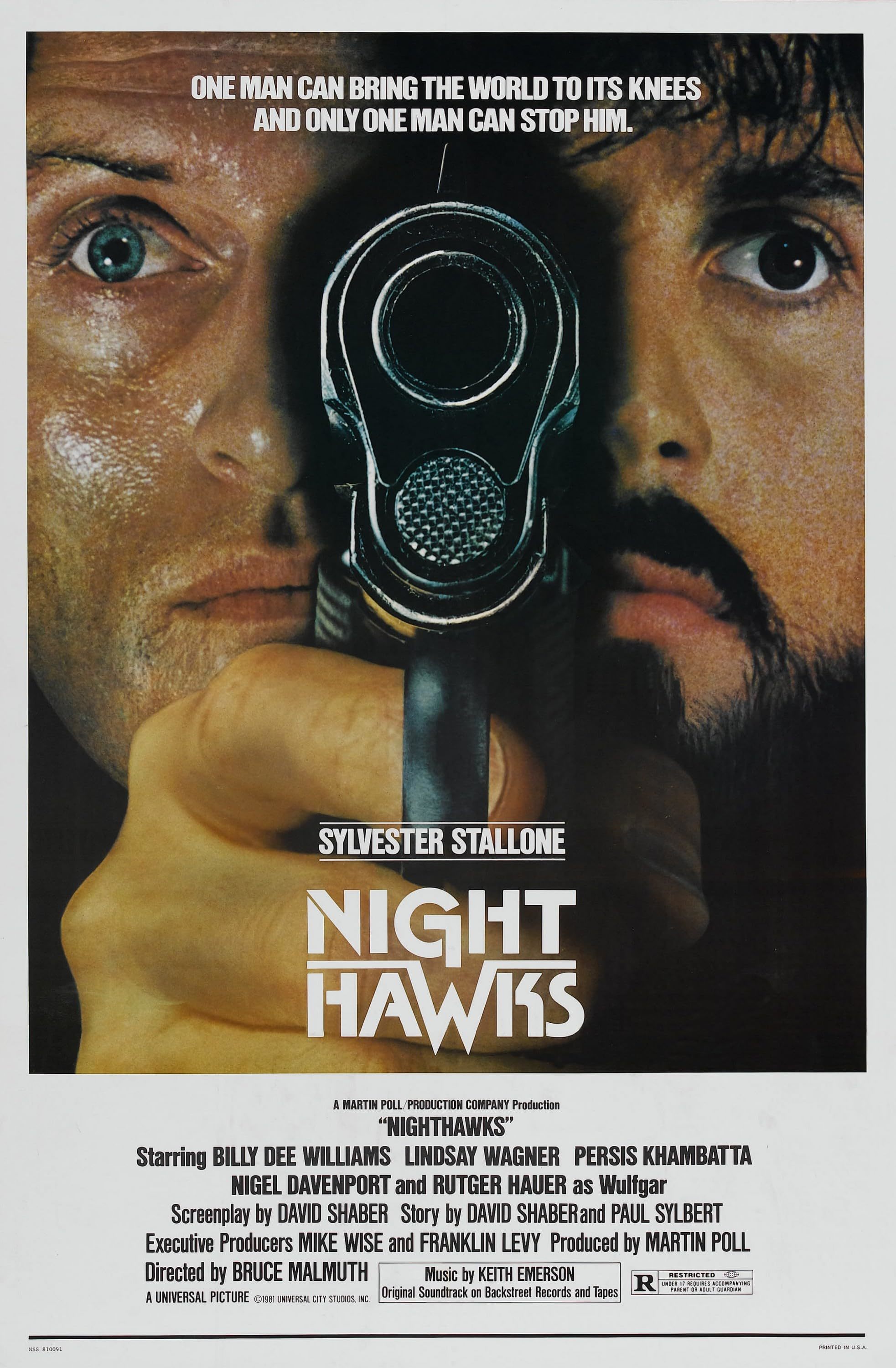
Awesome ’80s in April: Nighthawks (1981)

nightahwks

I was born in the late 1970s and so while I did grow up in the 1980s I didn’t really come of age until the early 1990s. So, the films that I watched during the 1980s were mostly kid stuff. In the years since I’ve watched most of the more popular and critically acclaimed films from that decade, but there are still tons of films I’ve missed.

I’ve said it many times before but one of the things I love about doing these little monthly movie themes is that I always discover films I’d never heard of before. Nighthawks did okay when it was first released but it seems to have been mostly forgotten, which is too bad because it’s pretty good.

I didn’t intend to watch so many Sylvester Stallone movies when I began the Awesome ’80s in April, but here I am four films deep and looking at some more to watch. Nighthawks was made fairly early in his career. Or I should say fairly soon after he found success with Rocky in 1976 (for he had been playing bit parts since 1969). He’s still clearly hungry and still trying to figure out just what kind of star he’s going to be.

It has some interesting behind-the-scenes production stories. Originally the film was written as the second sequel to The French Connection and it was going to be a buddy cop film with someone like Richard Pryor playing off of Gene Hackman’s Popeye Doyle character. But when Hackman declared he was done with the character they turned it into a stand-alone film.

The original director, Gary Nelson, was fired before he even really got started – just one week into production. When the next director, Bruce Malmoth was delayed for a day, Stallone took on the director’s duties so as to not lose a day of shooting. That caused trouble with the guild and he was fined for it. Later both the studio and Stallone made substantial edits to the film when it did poorly at early screenings. Supposedly Stallone cut out several scenes that focused on Rutger Hauer’s character.

None of this really matters of course, what we wound up with is what we’ve got, and what we’ve got is pretty good.

Stallone stars as Sergeant Deke DaSilva of the New York Police Department. He, and his partner, Sergeant Matthew Fox (Billy Dee Williams) work undercover (the film begins with a wonderful scene in which Stallone dawns a dress and a plastic face mask posing as a little old lady trying to catch some purse snatchers). They are quickly pulled into a new, elite squad designed to catch an international terrorist known only as Wulfgar (Rutger Hauer in his first American role).

Wulfgar has just come to New York City. He’s on the run from his European financiers due to running afoul to their good graces. One of his bombs killed some kids and he shot one of their men whom he believed had led the police to his doorstep.

He’s trailed by English Police Inspector Hartman (Nigel Davenport) who recruits DaSilva and Fox into his elite squad. A long chunk in the middle of the film is all about Hartman training the cops on how to catch Wulfgar which basically amounts to them throwing out all their police training and being willing to break the rules and kill the man if they can. This section is rather tedious.

Eventually, it becomes a cat-and-mouse game between DaSilva and Wulfgar and that’s when the film is at its best. There is a good scene set inside a subway line, and a terrific one on a tramway car high above the ocean, headed towards Roosevelt Island.

It looks gorgeous too with some wonderful cinematography by James A. Cotner. Stallone and Hauer play their parts well. Overall it is a good little 1980s thriller and one worth seeking out. But there is a reason why it slipped into obscurity as it doesn’t do anything particularly special with pretty standard material.
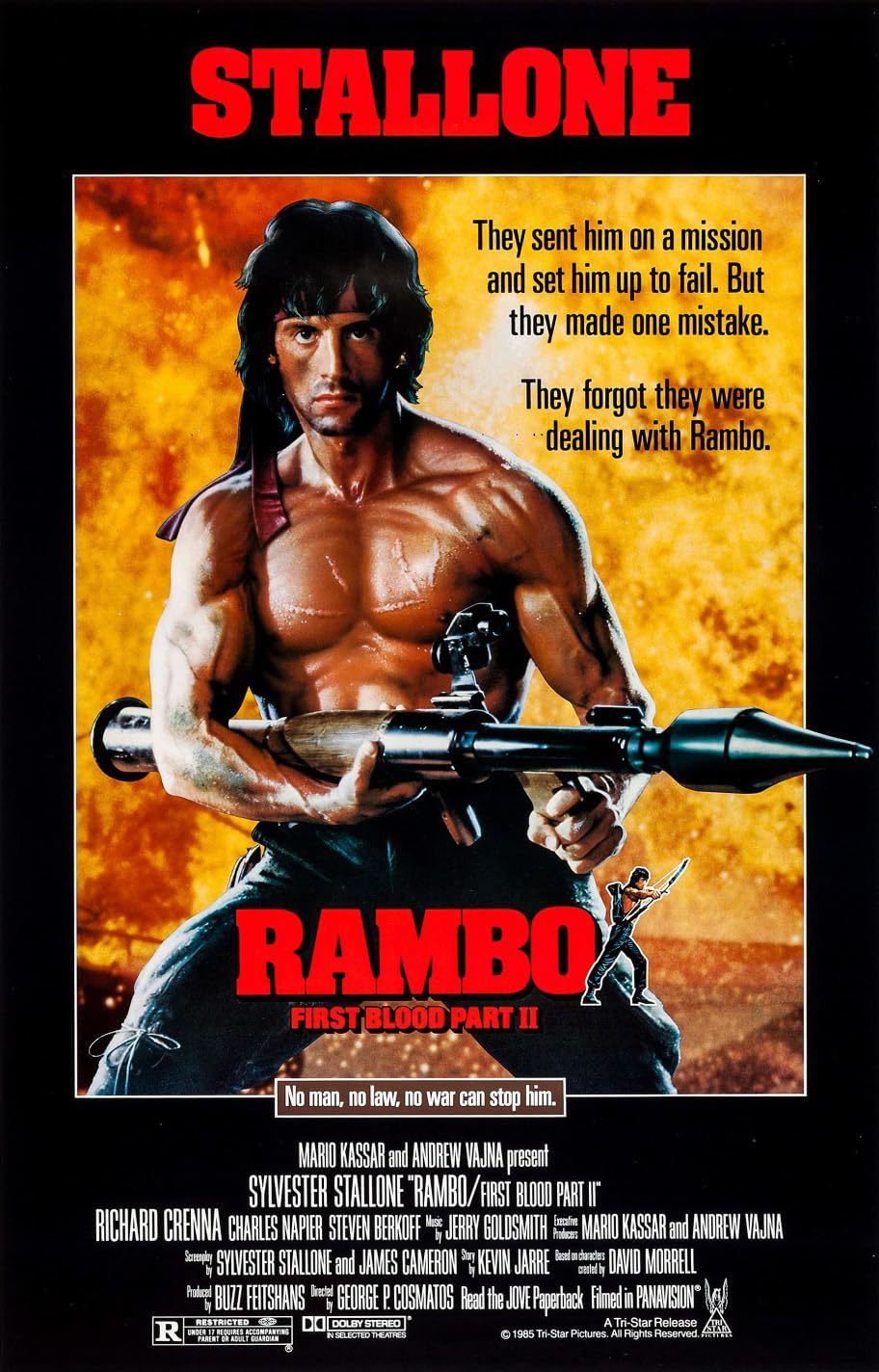
Awesome ’80s in April: The Rambo Trilogy

rambo ii

After years of getting bit parts and going nowhere, Sylvester Stallone sold his script to Rocky and somehow talked the right people into letting him star. It became a huge success and launched his career. In 1982 he starred in First Blood, the first Rambo movie. That film launched him into superstardom and made him one of the biggest actors of the 1980s.

What I didn’t realize until just now is that in the time between when he made Rocky in 1976 and First Blood in 1982 he made six other films including two Rocky sequels. Other than the Rocky sequels, most of them were only moderately successful. He is credited as a writer or co-writer on most of them. He also directed the first two Rocky sequels, Paradise Alley in 1978 and Staying Alive, the Saturday Night Fever sequel. It is interesting to look at his career at this stage and realize he seemed to think of himself as something of a Renaissance man.

But this isn’t about Sylvester Stallone, it is about John Rambo, the quintessential 1980s action hero. The Rambo films became something of a template for action films in the 1980s. You are probably picturing Stallone right now as Rambo, muscles bulging, a bandana wrapped around his long hair, sweat dripping down his brow as he fires a massive machine gun at countless bad guys.

Truth is the subsequent films became exactly that, but that first film, First Blood, actually attempts some real drama and a social message. It is more of a character study than an explosive shoot-em-up. For the first two acts anyway.

John Rambo is a Vietnam vet. He returns home to find his country not only isn’t proud of his service but angry at it. His fellow soldiers are spat upon when they return. He heads to the mountains to find his old friend. But when he gets there he finds his friend has died. It was cancer they wrote on his death certificate but his wife thinks it was Agent Orange from the war that really got him.

Disheartened he walks into town looking for a bit to eat before he moves on. He’s immediately picked up by Sheriff Will Teasle (Brian Dennehy). The Sheriff basically tells Rambo they don’t want his kind – dirty drifters who need a shower and a haircut – in his town and drops him off past the bridge. Rambo is having none of that and turns right back around.

He’s arrested then and essentially tortured by the local cops. Rambo, flashing back to his time in ‘Nam, when he was captured by the Vietcong and tortured, flips out and escapes. The chase is on and once again the police go too far, shooting at Rambo when he’s done nothing to deserve being killed. At this point, the film turns into an action film. Rambo’s former CO (Richard Crenna) shows up and lets the local yocals know they are facing the best damn Green Beret he’s ever seen and it’s best to give up.

The action is tight and well-composed all the way up until about the last fifteen minutes at which point it gets ratcheted up to ridiculous levels.

It is those levels that will serve as the inspiration for the following two sequels. In Rambo: First Blood Part II he’s offered a pardon from prison (for he did get sent to prison for killing all those cops in the first film) if he’ll go back to Vietnam. The mission is to infiltrate an old prison camp and see if there are still any POWs there. Naturally, there are and once again Rambo gets to kill a lot of people.

First Blood made a big deal about how the authorities were the villains. The cops hassled and tortured him just for existing, the military more or less turned their backs on him. That’s an interesting point of view for a 1980s action flick. Rambo II contains a little of that, with Rambo basically being used as an expendable pawn who is sent to Vietnam to basically prove that there aren’t any POWs left and everybody can be happy now that the war is over. But mostly it is a chance to let Rambo fight in the jungle.

With Rambo III our hero gets to fight in Afghanistan. His old CO is captured there and Rambo has to get him out. This time any pretext of a real plot of subtext is thrown out of the window in order to allow for more shooting, more explosions, and more dumb fun. Let’s just say there is a scene in which Rambo jumps inside a tank and fights off an attack helicopter and leave it at that.

There have been two subsequent Rambo sequels made – one in 2008 and another in 2019. I haven’t seen them. Those first three feel like enough.