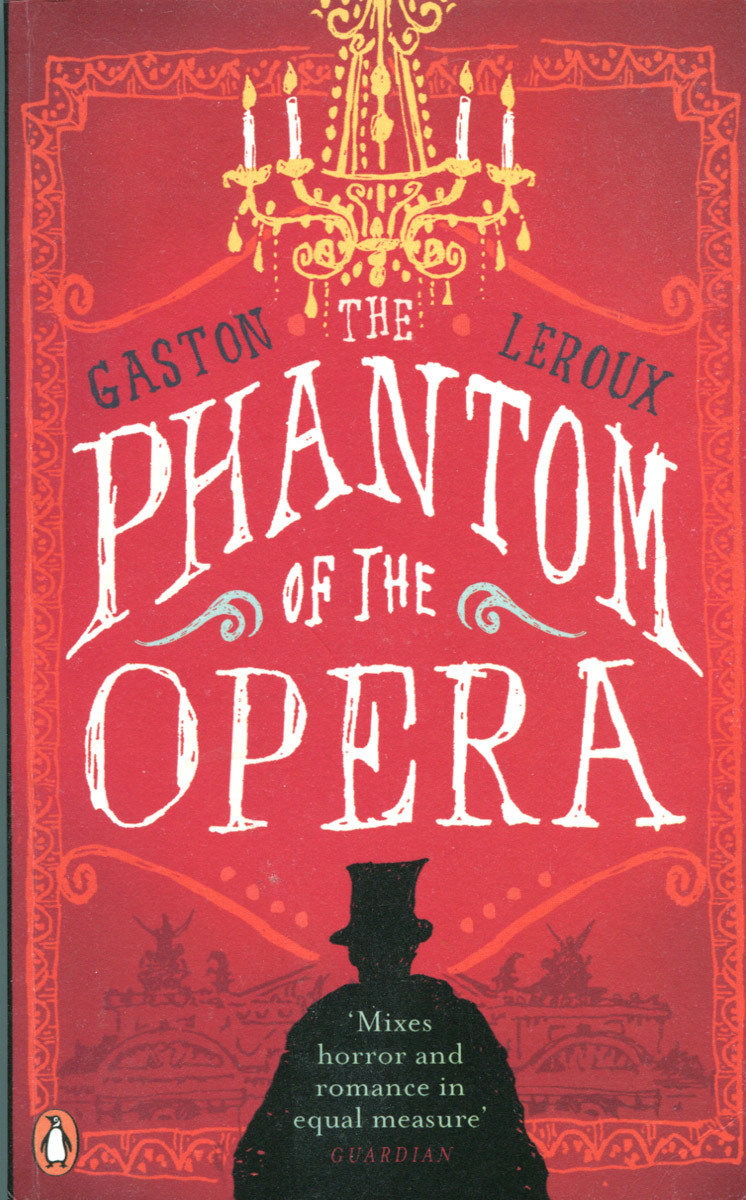
I’ve never seen a movie version of Phantom (not the classic, silent Lon Chaney version, and certainly not the new Joel “I should repent of my cinematic sins” Schumacher version). Nor have I seen any stage version of Andrew Lloyd Webber’s musical, or listened to music from that particular show. What I knew about the material is what everyone knows, what pop culture understands from the spoofs and the chattering fans in the back. I’ve never really been that interested either. What made me pick up the book then? I’m not really sure. Maybe it was the heavy amount of publicity it was getting from the new movie. Maybe it was my wife’s love of the musical, and a faint remembrance of her sending me a homemade card with a lyric from it. Or maybe it was the only halfway interesting book in English the library had.
Either way, I’m glad I picked it up. In a peculiar way, it is a continuation of my fascination with detective fiction. No, this is not Phillip Marlowe or Hercule Poirot chasing down some notorious killer. Gaston Leroux has created a mystery involving a ghost and murderer without the help of private detectives or Scotland Yard. Much of the words included in the book are determined to unmask this phantom, through a series of clues and hints. It is here we find kinship with the likes of Agatha Christie.
I’ll not explain much of the plot, for everyone knows it for the most part (and if you don’t just who are you?) It is a story set in the Paris Opera, a gigantic, intricate building with layer upon layer of subterranean levels masked in noirish, dark shadows. It involves a ghost, or phantom if you will, that lives in the bowels of the opera and makes frequent, and peculiar requests (such as a monthly salary and nightly tickets to the Opera in one of the best seats)to the new management. The old management, it seems, was all too happy to give in to the requests, but the new management is not so sure. Thus begins a series of punishments. There is also a love triangle involving the ghost, an accomplished singer of the opera, Christine Daae, and her childhood friend, Raoul.
Though I am learning the French language, my skill level is nowhere near the point where I have tried to tackle reading a novel in that language. So it is an English translation that I read. What I am learning in my French courses, though, is that translation is often a very difficult thing to do. Though many words literally translate well, often subtler meanings behind the words do not come through in a translation. Also, often words have no exact translation so approximations must be made. The story may come out the same, but the poetry is left behind. Maybe someday I’ll be able to read The Phantom of the Opera in its original language, but for now, I must be satisfied with this translation.
The first half of the novel acts exclusively like a mystery. There are rumors floating around the Opera of a ghost that haunts the lower levels of the building. Random notes appear to the new managers, threatening horror if the ghost’s demands are not met. There are ones who claim to have seen the ghost, others who claim to know him well, or as well as one can know a ghost. It is written from an outsider’s perspective. Our point of view is that of an investigator, someone interested in finding the truth about the ghost and events that happened during this time period. Leroux does a marvelous job making this piece of fiction look like history. After reading I even spent some time researching the events described to see if there was any truth to the story.
It is in the second half of the story that things change. We are introduced properly to the ghost and his madness. From this point, the story shifts from a mystery to a thriller. We know who the phantom is, but we are unsure of what he is going to do. Raoul and Christine are mad to leave the opera and be wed, but the ghost intercedes to create a great deal of suspense. As separate halves I found them both to be exhilarating, and a great read. But considered as a whole they leave a lot of questions. As with any good mystery, Phantom of the Opera begins with a lot of questions. The narrative spends a great deal of time trying to determine what the ghost is, whether it is flesh and blood or a spirit. Whether the events happening are caused by the supernatural, or are just tricks and games. As mentioned, the ghost makes many requests for service, it acts in peculiar ways to add to the mystery. Yet, when the nature of the ghost is revealed, these things go unanswered. The great mystery is revealed, but much of what was mysterious is never explained. This is a small quibble because the story moves along with such gusto it leaves little time to be perplexed.
Overall, Phantom of the Opera is a fast, entertaining read. There is much to enjoy and think over. It is a well-written, well-plotted, and well-done piece of fiction. It is not a great piece of literature, but this should not keep any fan of the written word from picking up and enjoying this novel.


 themidnightcafe.org