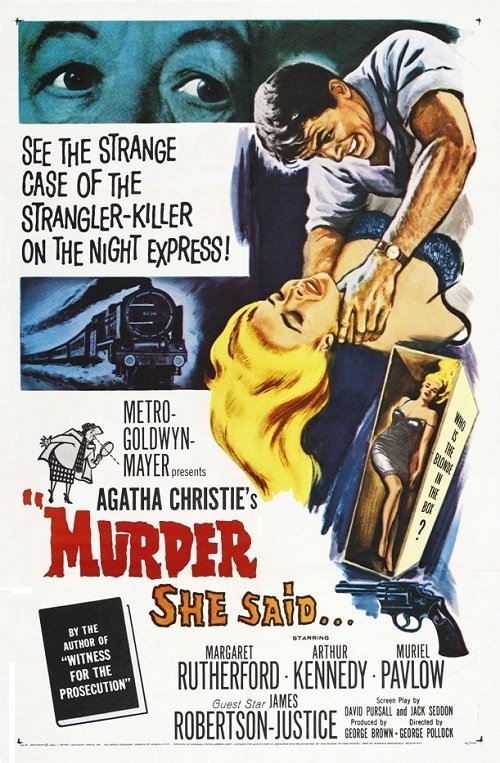
Great British Cinema: Murder She Said (1961)

murder she said

I love me a good detective story. Though I write a lot about horror movies the genre I find myself watching more than others is crime stories. There is something pleasurable about watching someone solve a murder.

Officially, I am on the side of Raymond Chandler and the school of the hard-boiled detectives. I like my crime dark and dirty, violent and real. Bloodless murders happening in the parlor rooms of rich and genteel classes are a little bit too silly for my liking. Especially when they conclude with a rounding up of all our suspects into one room while the detective susses out the culprit.

But sometimes, that’s exactly the sort of thing I need.

I’ve only read a few Agatha Christie novels, all of them Poirot, but I’ve seen quite a few cinematic and television adaptations of her stories (most of them Poirot) and I consider myself a fan.

Murder, She Said was the first screen adaptation of a Miss Marple story, and it is delightful.

It begins with Miss Marple (Margaret Rutherford) on a train. Another train crosses on a parallel track. Miss Marple watches the other passengers on the other train – an elderly man embarrassed that she sees him, a young girl who sticks out her tongue, and a woman getting strangled to death.

Miss Marple immediately informs the conductor who, when he spies the mystery novel she’s reading, believes she’s made it up. She makes him notify the police anyway, but they find nothing. They stop the train at the next station and can find no corpse. No body equals no murder and so they drop the matter.

Miss Marple, naturally, investigates.

She grabs a friend, Jim Stringer – a local bookseller and mystery enjoyed – and they walk the tracks around the area where she witnessed the murder. When they see some tracks made by what could be a dead body being dragged across the ground and trace them to Ackenthorpe Hall, Miss Marple finds a job there as a maid.

What follows is your standard Agatha Christie-type investigation. The Ackenthorpes are an odd bunch. She must do her duties as a maid, while still asking discreet questions and wandering around the grounds. There is a cute, clever boy who helps her, and lots of clues to be found.

It is handled very lightly, and often very humorously. Margaret Wutherford is just wonderful. She reminded me a lot of Angela Lansbury in Murder She Wrote. And considering how close that series title is to this film, I expect that is no coincidence. Wutherford is bold and clever, strong but vulnerable.

It works as both a good mystery and a comedy of manners. I loved it.
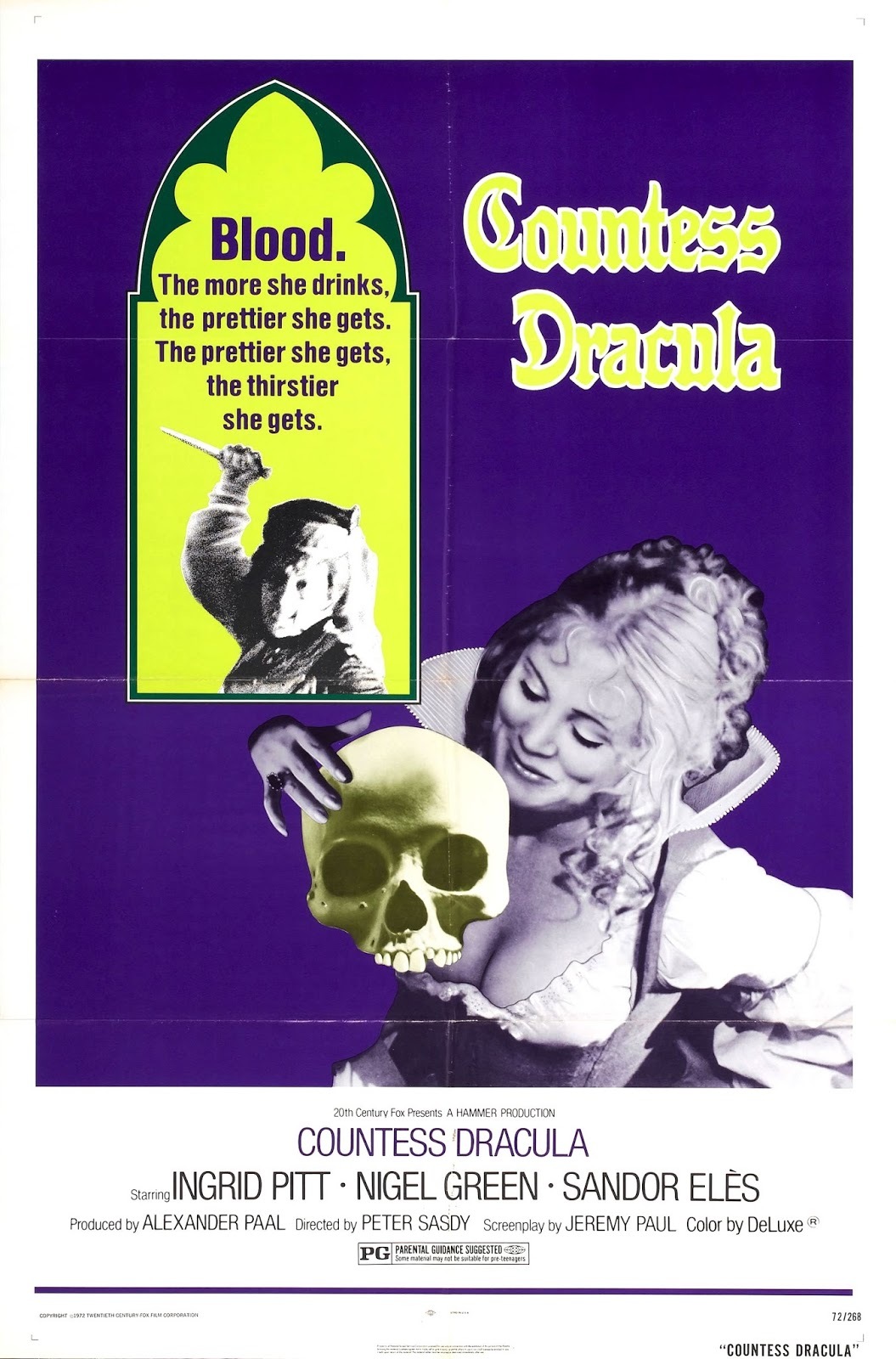
The Friday Night Horror Movie: Countess Dracula (1971)

countess dracula

I don’t remember the first time I became aware of Hammer Horror. They seem to be a part of my forever memory, but I suspect I actually came to know them rather late. Presumably, I heard some chatter about Hammer Horror after I became a fan of the Univeral Monster Movies, which would put it sometime after college. But it was years later that I actually watched any of their films. Letterboxd notes the first Hammer film I ever watched was Dracula (1958) in February of 2014. I watched The Curse of Frankenstein (1957) not long after that, but it wasn’t until 2020 that I watched a third film and from there I started watching Hammer Horror with some regularity.

What I’ve come to realize is that I tend to find Hammer films to be rather dull. Their stories often have a staid quality about them. Oh, eventually there is some bloodletting, some murders, maybe a monster or two, and a bit of horror. But they often (not always) take their time getting there. They tend to be very British in their melodrama. There are a lot of costumes, and talking, and ideas of decorum before the horror begins, and even then it always comes back to the drama.

But the thing is, I still kind of love these films. They are gorgeous to look at. The set designs – mostly creaky old castles, and magnificent gothic mansions – are impeccable. Their cinematographers are genius, filling each scene with color and shadows, fog and light. And those costumes, my goodness those costumes are simply fabulous. So, while I am sometimes a little bored with the stories, I never grow tired of just watching these films.

Despite its title, Countess Dracula has nothing to do with the Dracula legend, (and Christopher Lee and Peter Cushing are nowhere to be found) but is a loose retelling of the Countess Báthory story. She was a real person who lived in the late 1500s, was accused of killing hundreds of young women (and of bathing in their blood). Her story influenced a great many of the Dracula stories over the years so in that way you can consider this film a Dracula movie.

Anyway, in this story Countess Elisabeth Nádasdy (Ingrid Pitt, sadly dubbed for some dumb reason) discovers that drinking the blood of young women will restore her to youth and beauty. She does so and then must pretend to be her own daughter so as not to cause a stir in the village.

The real daughter, Ilona (Leslie-Anne Dow) was sent away when she was very young. When she returns to the castle, Elisabeth has her kidnapped and held captive so as to not be found out.

Meanwhile, Elisabeth seduces a young Lieutenant (Sandor Elès) all the while continuing to murder young maidens from the village (after killing a prostitute and bathing in her blood she realizes for the magic to work they must be virgins). In case you are wondering, all of the main servants in the household seem perfectly okay with their mistress regularly murdering people.

Eventually, things come to a head, but it takes its time to get there. I think I’ve made the plot sound much more exciting than it actually is. There is a lot more romancing than I’ve let on, and palace intrigue. There are a lot of scenes of people sitting around talking, and far too little bathing in blood.

But again, I still kind of loved it. I’m a big fan of Ingrid Pitt. She’s a marvelous horror icon and despite the painful voice dubbing she does some good work here. The sets are fantastic and the lighting is superb. There is a scene where Elisabeth is despairing over once again turning into an old hag. She wanders around her fabulously large, and perfectly lit bedroom in a flowing white gown and it’s like a dream.

Great British Cinema: The League of Gentlemen (1960)

the league of gentlemen

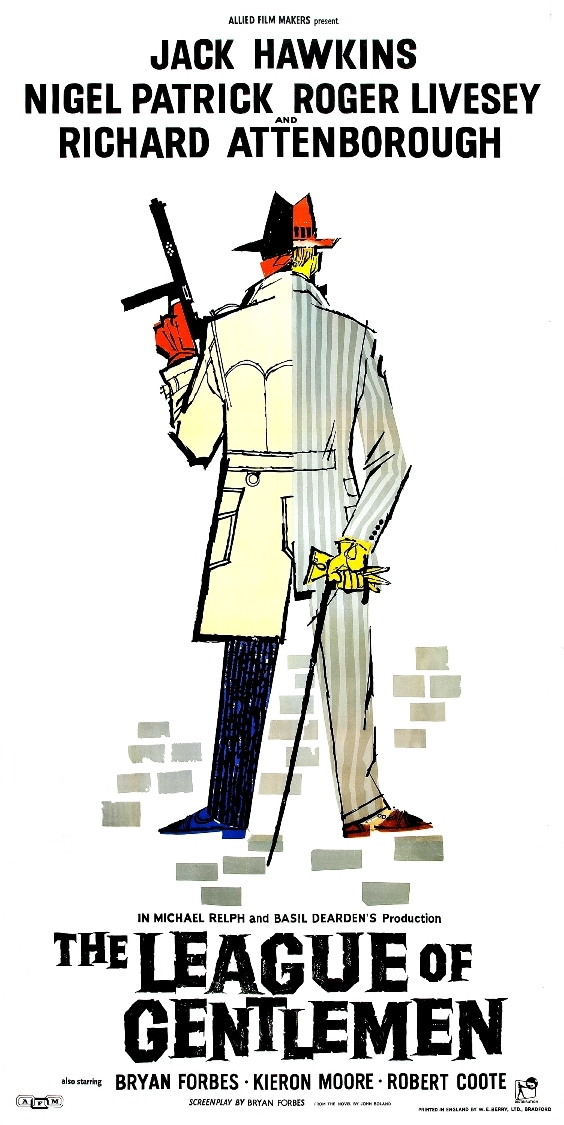
The League of Gentlemen is a British heist film that doesn’t do anything particularly original, nor does it set any high water marks, but it does what it does really well.

Jack Hawkins plays Lieutenant-Colonel Norman Hyde who has recently been forced into retirement from the military due to redundancies. Angry at this he decides to enact his vengeance upon the government by robbing a bank.

He essentially blackmails a group of former military officers who have since fallen on hard times, and either found themselves in embarrassing circumstances, or criminal ones. But there is really no need for blackmail as each man is more than willing to help with the caper and come away with a large wad of cash for their troubles.

Like the great French film Rififi, The League of Gentlemen spends a lot of time on the details. They discuss the heist, they train for the heist, they obtain weapons and supplies for the heist. Then they actually do the heist.

All of this is detailed in a very matter-of-fact manner. It never quite obtains the tension that Rififi accomplishes and there aren’t any scenes like the working the alarm scene or the actual heist in Rififi. In fact, I should stop comparing it to Rififi altogether because few films get anywhere near the greatness of that one.

But The League of Gentlemen is very well crafted and a joy to watch. The heist scene is also beautifully staged. At one point they ignite a bunch of smoke bombs in the streets of London creating this fabulously atmospheric fog.

I quite loved the whole thing.

Great British Cinema: Modesty Blaise (1966)

modesty blaise poster

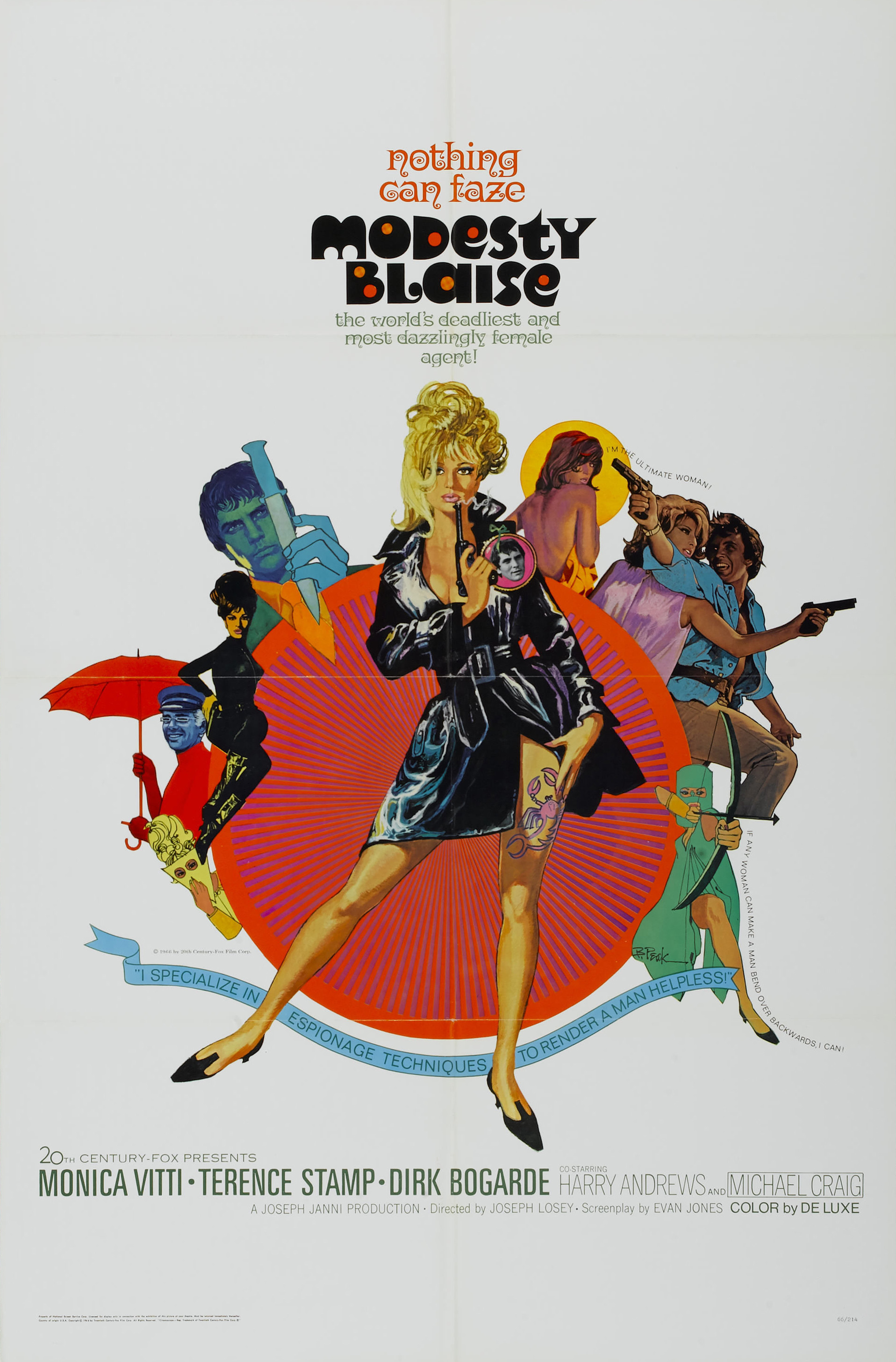
After watching a number of British films from the 1940s all filmed in a more classical style and mostly shot in black and white I wanted something more stylish, more colorful, more ’60s! Modesty Blaise scores highly on all of those charts. Unfortunately, it is also a rather big mess.

Loosely based on a series of comics and clearly trying to cash in on the James Bond craze, Modesty Blaise stars Monica Vitti as Modesty Blaise a criminal mastermind who is nevertheless hired by the British Secret Service to protect a shipment of diamonds headed to the Middle East.

Terence Stamp is her sexy cohort, Willie Garvin and Dirk Bogarde is camp personified as Gabrielle the super-villain.

This is another one of those movies where even though I watched it only a couple of weeks ago I’ve completely forgotten the vast majority of the plot.

It is decked out in those bright, candy-flavored colors certain movies of the 1960s loved. The costumes are amazing and Modesty seems to change clothes every few minutes, even if she’s right in the middle of a scene. The film has a lot of fun with that, actually, allowing her to find a new costume and change in a millisecond even though there is no conceivable way in which this could actually happen.

The music is wild and the plot (what I remember of it) has that early James Bond silliness to it. Part of the reason why I can’t remember the plot is that most of it makes very little sense. It feels very much like they just threw a bunch of stuff together, hoping it would come out really fun in the end. Wikipedia notes that some of this was intentional as they were trying to create a more avant-garde-style film. Whatever the case, it comes out more confusing and obnoxious than interesting and fun.

It is very bright, and camp, and the music is a real treat. I just wish it was a little more coherent. But I’d say it is worth watching if you are a fan of 1960s cinema in the style of James Bond or Rowan and Martin’s Laugh In.

Great British Cinema: The Wicked Lady (1945)

the wicked lady

The Wicked Lady was an enormous hit at the time. It broke box-office records in Britain. Hilariously, before it could be shown in the United States several scenes had to be reshot because the American censors couldn’t handle the bountiful bosoms heaving out of the (period-appropriate) dresses.

It is easy to see why it was such a success in 1945. The story is about a proper lady who steps out of her boring life and becomes a highwayman. Women at the time could have seen it as a story of independence, of throwing off the shackles of oppression instituted by the culture of the time.

What I think is so interesting about this type of film is that because it is set in the past certain types of people could watch it, recognize that it is a liberating film, but then think to themselves “Look at how far we’ve come” and pat themselves on the back. But those in the know would recognize how far we still have to go.

And now, of course, we can look at this film made in 1945 and think similar things.

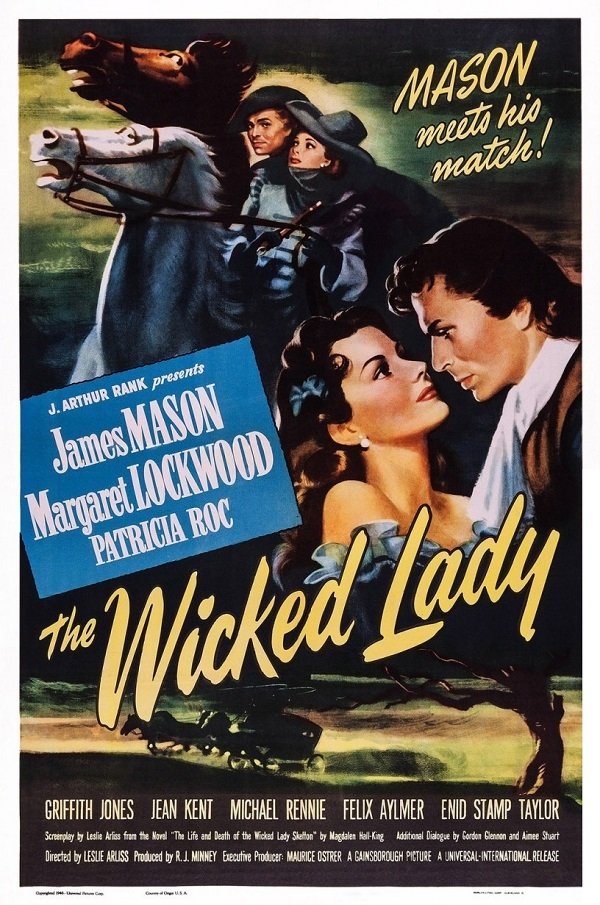
Our film begins with Caroline (Patricia Roc) preparing for her marriage to Sir Ralph Skelton (Griffith Jones). They do not truly love each other but they have a deep kinship and both need marriage partners. The night before their marriage Caroline invites her dear friend Barbara (Margaret Lockwood) to their home. She being a treacherous, scheming woman immediately sets her eyes on Sir Skelton and uses her feminine charms to win him away from Caroline. They soon marry, leaving Caroline in the lurch.

Barbara assumed Sir Skelton’s riches and station would bring her happiness but soon finds herself bored. Country living doesn’t suit her and Sir Skelton does not like venturing into the city. When she learns that one room in the mansion has a secret passageway leading to the gardens she moves in and quickly begins sneaking out at night acting as a highwayman – robbing coaches in a mask. From there she meets Jerry Jackson (James Mason) a notorious highwayman and the two begin working together. Barbara loves the life of crime and becomes cutthroat about it. Jackson might be a thief, but he has a code. He never uses real violence. Barbara is willing to kill.

One of the things I love about this film is that Barbara is not a good woman who has temporarily lost her way. She’s not some bored housewife who went looking for a little excitement and got into a spot of trouble. She is a lost woman. Irredeemable, and loving it. She enjoys the crime, she likes the violence. I’m not sure what that does to my theory that this is a liberating, feminist film.

I feel like I’m making this movie sound better than it actually is. Honestly, I found it rather dull. Margaret Lockwood is a lot of fun to watch, she seems to be loving playing this character who is joyously evil. But James Mason seems out of place and Patricia Roc and Griffith Jones are a bit bland. The action is mostly off-screen (the actual robberies we do see are dully filmed) so what’s left is a lot of people talking about them and various romances that don’t have any heat.

It isn’t a bad film, and it is interesting for the reasons I describe. Obviously, people at the time just loved it. They actually remade it in 1983 with Faye Dunaway and Alan Bates. I’d be interested to see how they updated it.

Great British Cinema: Against the Wind (1948)

against the wind

When I decided the theme of this month would be British Cinema, I had no idea I’d wind up watching so many World War II films. It makes perfect sense that the British film industry would make a lot of these types of films as it was an extremely important part of their history. They lived through it. They were there from the beginning. I just didn’t realize I’d enjoy them so much.

What I’m loving is how different British war films are from their American counterparts. As Americans, I think we tend to believe the war started with the bombing of Pearl Harbor in the South Pacific and D-Day on the European front. That’s nonsense of course, but we Americans are a selfish lot and we care about things only when they affect us. Or at least our movies tend to focus on the war efforts directly involving Americans. They also tend to be more action-oriented, more about actual warfare than the behind-the-scenes things.

British films are often about spies and more personal battles on the home front. Americans sent soldiers across the great seas to fight, England was right there, close to the front lines from the beginning. They were being bombed right at home.

I’m digressing, I’m also way behind on writing about all the British films I’ve been watching. The thing is I’ve wound up watching a lot of World War II-era films, and I wanted to think about why that was, and also warn you all that more reviews along the same lines are coming.

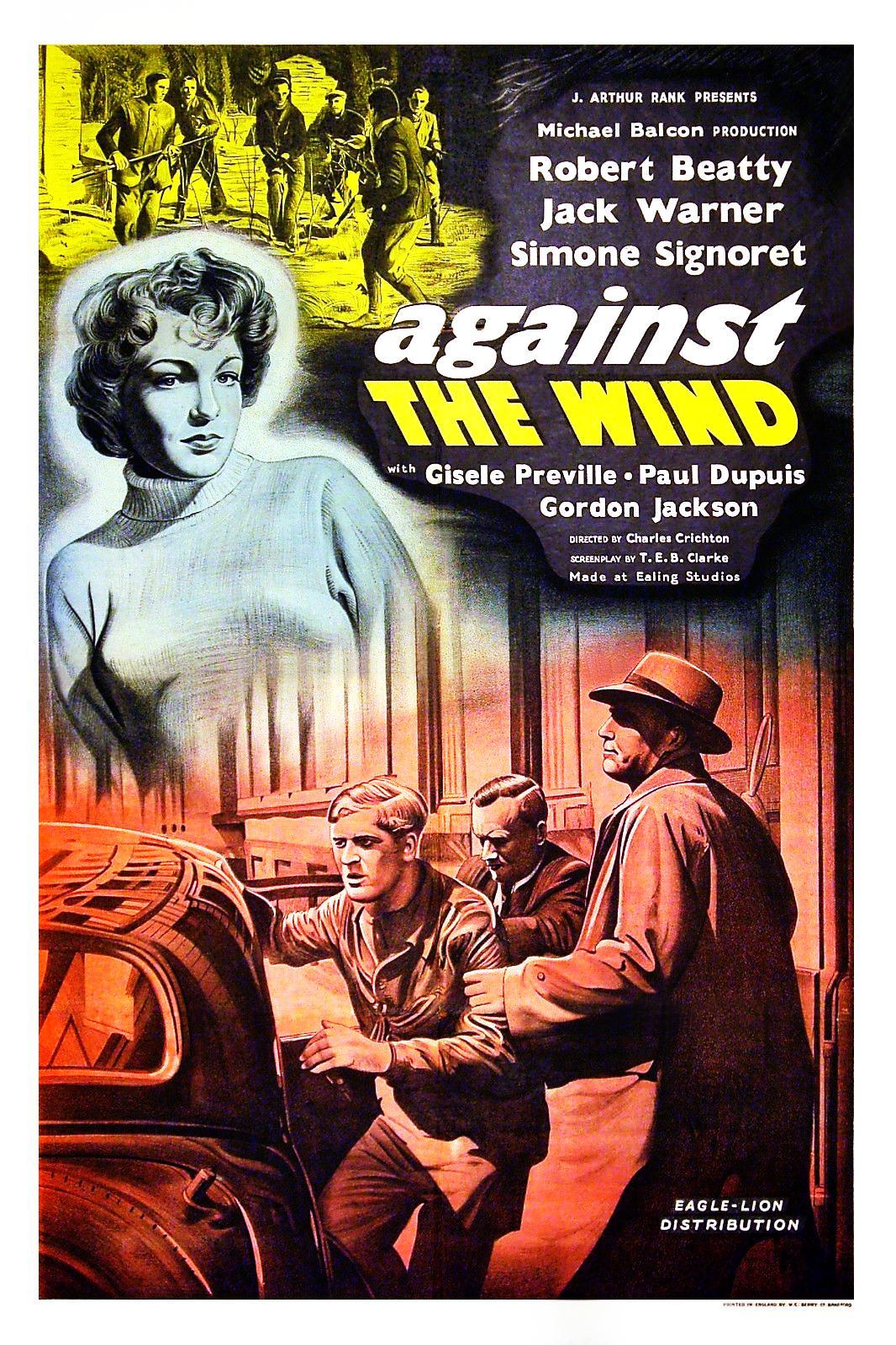
So, Against the Wind is a spy film set (obviously) during World War II. It takes a nuts-and-bolts approach to spycraft (something else I love about these British war films is how they tend to approach things like war and spying, life and death, in such a practical, no-nonsense way).

We spend time in Belgium with our characters as they are trained to be spies and then follow a few of them into enemy territory as they work to complete their mission.

This is the point where I admit that I watched this film a couple of weeks ago, that I’ve watched a dozen films since then – several of which were British spy films – and that I no longer really remember the details of this one.

It stars Robert Beatty as a Catholic Priest turned spy, Simone Signoret in her first English language film, and the always reliable Jack Warner. It is also very good with some terrifically taut scenes.

The Friday Night Horror Movies: The Purge: Anarchy (2014) & The Purge: Election Year (2016)

the purge

I’ve watched several old British films for my Friday Night Horror the last few weeks so I wanted to watch something more modern and the first two Purge sequels fit the bill.

So, The Purge Franchise is set in a dystopian future. At some point in the past America was overrun with crime and violence. To curb this violence it was decided that one night a year, for a 12-hour period all crime, including murder, will be made legal. The thought is that this will allow everyone to get it out of their system, and for the rest of the year everyone will be chill.

Though the films lean on the idea that we aren’t all that far off from something like that actually happening, the concept is actually completely ridiculous. For real life I mean. For a movie, it’s really pretty cool.

The first film, simply titled The Purge (2013) focused on one (rich, white) family trying to survive the night. Things get complicated when they allow a stranger into their home and give him protection and a group of crazies come to say he is the very person they want to Purge. It isn’t a bad little thriller but it tends to lose focus on its conceptual idea and winds up focusing on the more generic base under siege aspects of the story.

I had minor hopes the sequels would spend more time on the bigger ideas. They sort-of do. While The Purge focused on one family inside their house The Purge: Anarchy and The Purge: Election Year expand the stories to larger groups of people and allow us to see more of the outside world.

The problem with all three of these films is that they all have a vague political message that boils down to The Purge is run by rich white people who benefit from the violence, while poor people of color suffer the most. A relevant message, but not one they hit on very hard, nor make very specific.

A concept like The Purge could make for a really great science fiction film with all sorts of allegories, but these films want to be money-making franchise machines in the horror genre and they don’t seem to have the stomach for more direct political messaging.

Yet they rarely nail the thriller/horror aspects either. If you are going to make a horror film about a period of time in which all crime is legal, then you should really go all in. Give us some Tobe Hooper-style insanity.

There is one really great scene during The Purge: Election Year that nails what I’m talking about. A car decked out in Christmas lights pulls up to a locked-up and barricaded convenience store. A group of women dressed in sexy Halloween costumes and carrying swords, saws, and machine guns get out and demand they be let inside, for the leader of the gang wants a candy bar. The subsequent battle is just as nuts. It is a well-staged sequence and it totally worked for me because it leans into the absolute insanity of the concept. The rest of the film doesn’t work nearly as well.

Thus far, the films have only had one character carry over from one film to the other. In The Purge: Anarchy we find Leo Barnes (Frank Grillo) on a mission to seek out some revenge on Purge Night. Along the way, he stumbles on several people who are clearly out of their depth and need help. By the film’s end, he’s become a reluctant hero.

In The Purge: Election Year he’s become head of security for Senator Charlie Roan (Elizabeth Mitchell) who is running for President on a ticket that promises to outlaw The Purge. Honestly, he’s kind of a generic action hero which is kind of my problem with the whole franchise thus far. My problem with most of the Blumhouse films I’ve seen, to be honest. They lack a specificity that can turn a high concept like this one into something great. Movies need a particular point of view, they need to find interesting ways to tell their stories. Otherwise, they wind up feeling generic, and just like a million other films.

These three The Purge films lack that specificity, that point of view. They take an interesting idea and turn it into something just average. That doesn’t make them bad films. I mostly enjoyed watching them. But it keeps them from being truly great or interesting.

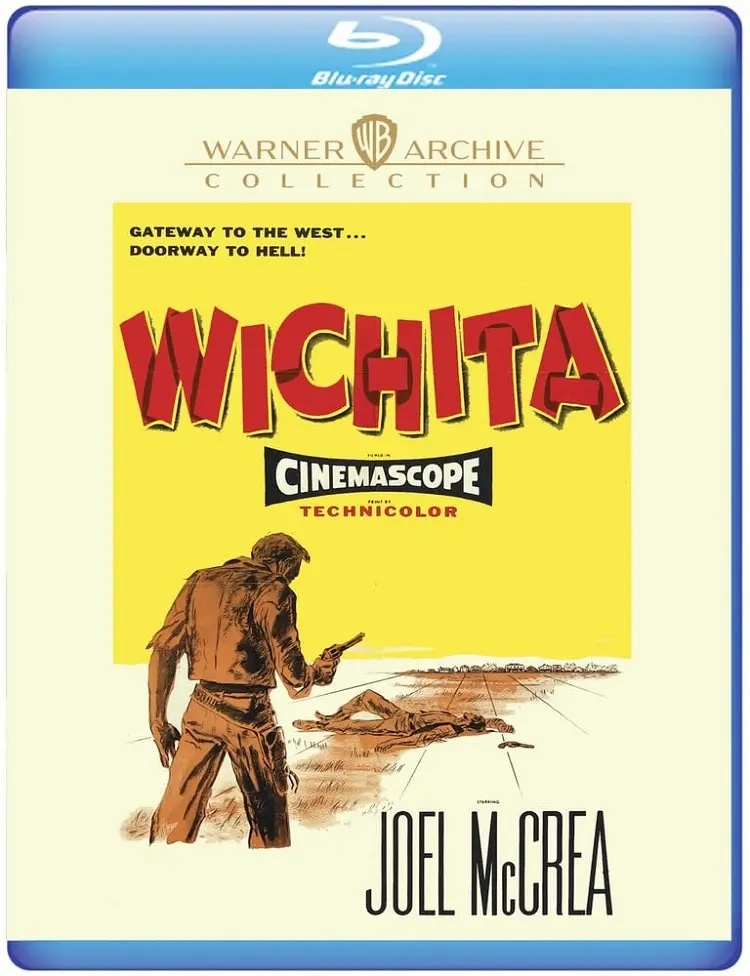
Wichita (1955)

wichita movie

Wyatt Earp stands tall amongst figures of the Old West. He’s one of America’s great old legends. There have been a lot of movies made about his life. Wichita is kind of an origin story for the legend as it begins before he became a lawman and tells the story of how he wound up being a Marshall.

It isn’t particularly good, but if you like westerns I’d recommend it. You can read my full review here.