Awesome ’80s in April: 2010: The Year We Make Contact (1983)

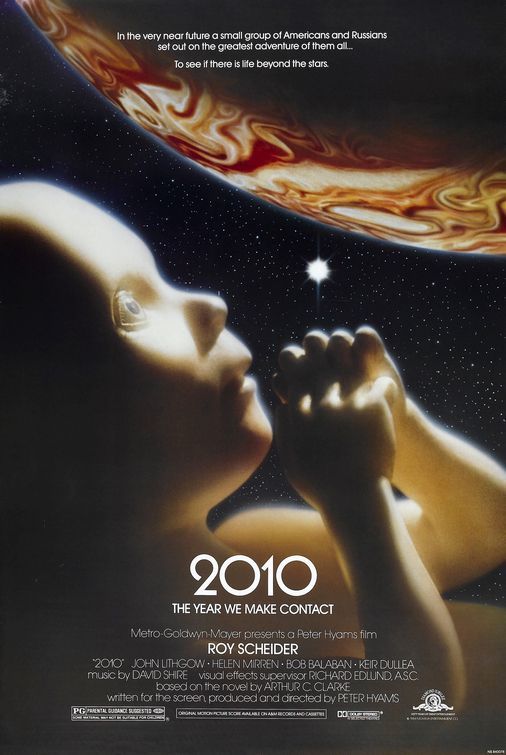
2010 the year we make contact poster

2001: A Space Odyssey is arguably one of the greatest movies ever made. Certainly, it is one of the greatest science fiction films ever put on celluloid. It was made by the visionary auteur Stanley Kubrick. One of the many astounding things about the film is that it is almost entirely told through visual language. Great swaths of the movie contain no dialogue whatsoever. This is also one of the reasons the film is endlessly discussed – it never tells you what’s happening, it shows you.

A sequel was made in 1984. Directed by Peter Hyams 2010: The Year We Make Contact is a pale imitation of the original. As a sequel, it is not great. Where Kubrick’s film is mysterious, asking big questions and giving no answers, 2010 is all answers.

But if you can separate it from the original, and take it on by itself, it’s actually pretty good. Admittedly, that is a difficult task, as this film is basically an answer to the questions asked by the original. Its plot takes place right after 2001 ended and its characters spend their time hunting down what happened in that movie. But if you can get the original out of your mind and just let this one do what it’s doing, then I think you can find it enjoyable.

I said it begins right after the events of 2001, but really it begins 9 years after that movie (hence 2010 in the title.) At the end of the first film, the crew from the Discovery One spaceship which was on a mission to Jupiter are lost. The HAL-9000 computer, which controlled pretty much everything on board went a little crazy and killed most of the crew. Dave (Keir Dullea) the only survivor disappeared. As an audience, we know that he discovered a giant black monolith orbiting Jupiter and was sucked inside it. A long, psychedelic trip then turns him into a cosmic space baby. But in-film, the people of Earth have no idea what happened to him.

The Americans and the Russians are both planning missions to Jupiter to find out. There is a time rush as the Discovery One is slowly losing orbit and will soon crash. The Russians will have their ship ready faster than the Americans, but it is the Americans who have knowledge of the Discovery One and are the only ones who can reboot HAL. So, three Americans Heywood Floyd (Roy Scheider) who feels responsible for the entire Discovery One mishap, Walter Curnow (John Lithgow) who designed the Discovery One, and R. Chandra (Bob Babalan) who created the HAL-9000 computer, jump aboard the Russian ship.

All of this occurs during the height of the Cold War. During the mission relations between the two countries deteriorate with a Cuban Missile Crisis-type situation pulling them toward the brink of war.

The astronauts try to ignore the ongoing politics back home and instead concentrate on the mission. The film does explain what happened to HAL in 2001, but I won’t spoil that here. It explains further what the monolith is and what the aliens want, but again no spoilers. None of that is particularly thrilling or all that interesting. And if you want it to it can destroy all the mystery of 2001.

However, the design of everything is really quite good. I especially enjoyed the matte paintings and the various images of space, Jupiter and its moons and the placements of the ships within all of that. All of the space stuff is really interesting. I also enjoyed the relationships that develop between the various scientists (Helen Mirren plays one of the Russians and she’s always fun to watch, especially when attempting a Russian accent).

If this movie existed on its own, if 2001 had never been made I think 2010 would have been well-regarded. It might not be a classic, but It would definitely have a good following. I’d argue it should definitely be reconsidered, despite the Kubrick film always overshadowing it.

I wrote a different review of this film back in 2004. You can click here and read it if you like (spoiler alert, I hated it).

Awesome ’80s in April: Monkey Shines (1988)

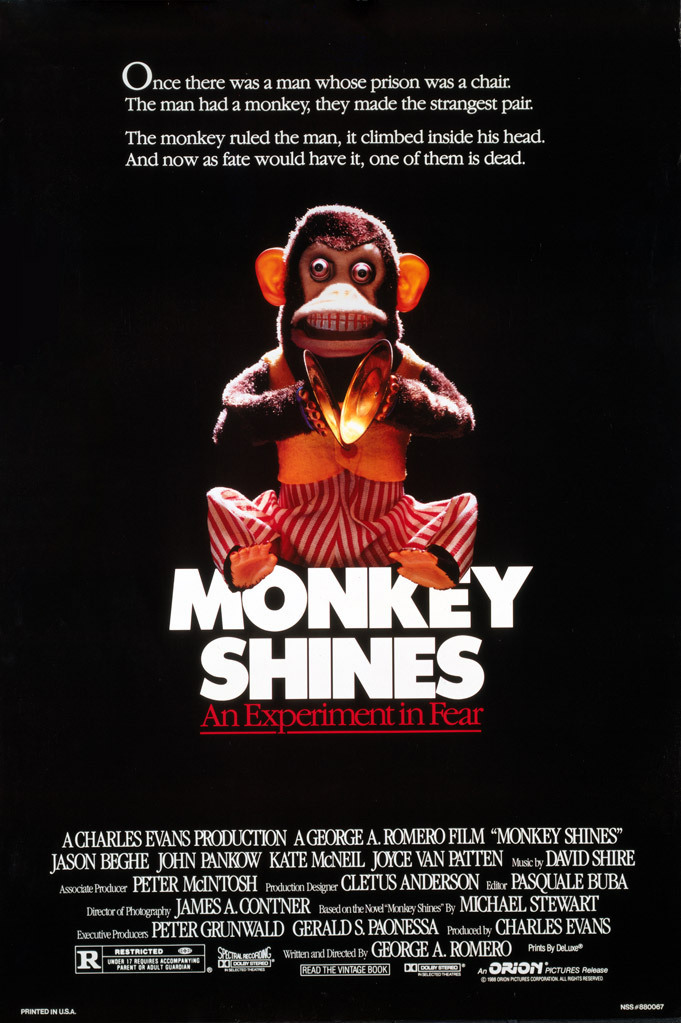
monkey shines poster

For some reason, I assumed this movie was based on a Stephen King novel. I think that was because the poster features one of those toy monkeys with cymbals in its hands. King wrote a short story featuring the same toy (which I’ve read part of, but didn’t finish because the audiobook had to be returned to the library). It is based upon a book, but not anything by King, but rather a British author named Michael Stewart. The film has nothing to do with a toy monkey either. But its plot does run into Stephen King territory.

At the beginning of the film we know something is going to happen to law student Allan Mann (Jason Beghe) because he is out running on a beautiful morning and all seems to be right with the world (and films don’t begin that way unless something bad is going to happen.) Since it features him running athletically and focuses on his muscular legs, he’s naturally hit by a truck which renders him a paraplegic.

He has a tough go of it in the beginning and tries to kill himself. But fails. His kooky scientist friend, Geoffrey (John Pankow) hooks him up with a helper monkey. Geoffrey doesn’t tell Allan that he’s been secretly injecting the monkey, named Ella, with a human brain cell-laden serum.

At first, things seem great. Ella is super helpful and seems to anticipate Allan’s every need. But because this is a horror movie, one directed by George A. Romero no less, things go sideways quickly. Actually, quickly isn’t the right word here, because the film takes its time to get to the psychotic monkey killing people. But they do eventually get there.

Basically, the monkey forms a psychic connection with Allan and it especially attaches to Allan’s anger, and unlike people who might think they’d like to kill someone in a fit of anger, the monkey translates things literally and does some bad, bad things.

There are a few too many side plots involving, among other things, Geoffrey’s boss (who doesn’t like his experiments, and is played by Stephen Root in his first film role), Allan’s Nurse Ratched-like healthcare worker, and Allan’s wife having an affair with his surgeon (Stanley Tucci in his third film role – the wife is played by Janine Turner). There is also a romance with the monkey’s trainer that includes a very interesting sex scene (one of the few on-screen sex scenes involving a paraplegic.)

Romero handles the material well, but this is definitely one of his lesser films. It isn’t exactly boring, but I was very much ready for the monkey to turn psycho much earlier than it did.

Awesome ’80s in April: The Presidio (1988)

the presidio poster

It is funny what you remember from your childhood. Until this week I’d never seen The Presidio, but I remember that my cousin Clifton has. I remember him telling me how awesome it was and that James Bond beat a guy up using just his thumb. That was enough to make me want to watch it, but I wasn’t even a teenager in 1988 and my mother was much more strict about what she let us watch than Aunt Sandi was for Clifton. When I was old enough to watch it I had already moved on to other movies. But I still remember wondering how a guy could beat another guy up with just a thumb.

That guy is Colonel Alan Caldwell (Sean Connery) the provost marshall of the Presidio Army Base in San Francisco, California. He’s a hard-nosed guy who doesn’t take too kindly when Jay Austin (Mark Harmon), a police detective shows up at his door trying to solve two murders. One murder was committed on the base, but another, seemingly by the same criminal, was committed in the city. That means it is SFPD jurisdiction.

Turns out Austin used to be an Army man, stationed at the Presidio, under the command of Caldwell. They didn’t get along too well, but are forced to team up to solve these murders. This sets up our buddy cop film with one tough, old, by-the-books officer and a younger do whatever-it-takes to get the job done detective.

It is all pretty standard 1980s cop flick fare. Connery is great and the mystery is pretty good. The action is mostly average although I did enjoy one scene inside a warehouse full of giant water bottles that get shot up pretty good. Meg Ryan plays the love interest who is also Caldwell’s daughter. She’s basically a Meg Ryan type but not given much to do.

All in all a pretty good way to spend a Saturday afternoon at the movies.

Oh and that scene where Connery takes down a dude with his thumb? That’s worth the price of admission all on its own.

I almost forgot to mention, there is a scene in which Mark Harmon’s character meets a woman with a bunch of Grateful Dead posters on her office wall. He needs something from her so they have a hilarious chat about the Dead and which shows they’ve seen. It ends with him promising to send her a Dylan bootleg.

Awesome ’80s in April: Flash Gordon (1980)

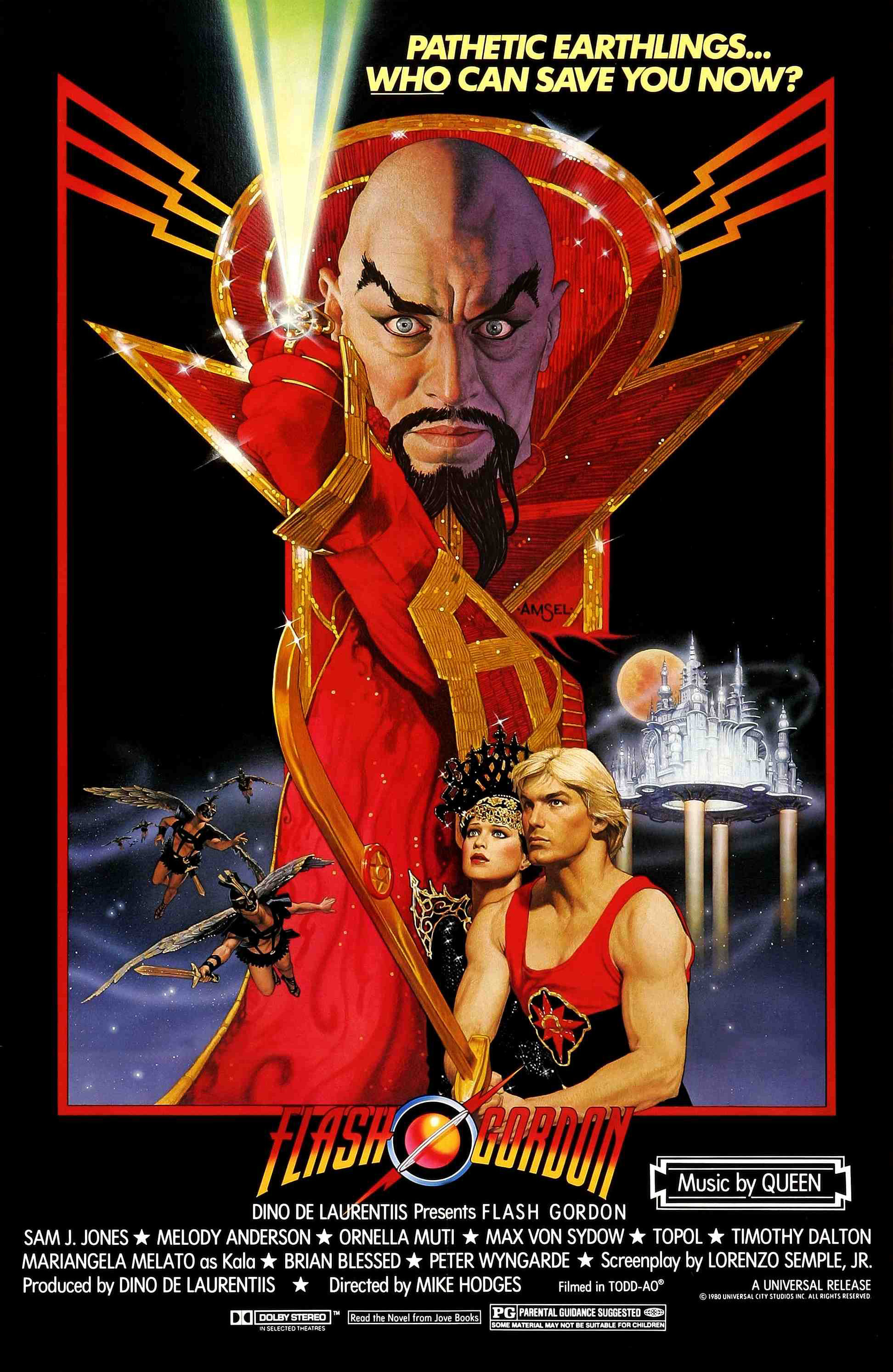
flash gordon movie poster

After moving away for college and staying away for some twenty years, I moved back to my hometown a while back and started working in the family business with my father and brother. I wasn’t exactly thrilled with either of those things. Still aren’t if I’m being honest.

However, it has been really nice to get to know my brother better. We’ve always gotten along, but he’s four years older than me. He left home just about the time I was getting interested and by the time he moved back I was gone. So it has been wonderful forming a relationship with him as an adult.

We are both movie nerds so we spend a lot of our time talking about the various films we’ve recently watched. Since moving back he has told me many times of his undying love for Flash Gordon. This usually happens when a Queen song plays over the radio (and we tend to listen to the classic rock station so a Queen song often plays over the radio.) Queen, of course, wrote the soundtrack to the film.

Flash Gordon is one of those films that I was too young to have seen in the theaters, and have never really cared to catch at home. It bombed at the box office and the general consensus was that it was a stinker. That general consensus has stuck with me which is why I never bothered with it. But my brother’s love for it finally got me to track down a copy and I recently watched it.

I kind of loved it.

It is very silly and all kinds of cheesy, but intentionally so. His has more in common with the 1960s Batman television series than anything in the MCU. Of course, 1980 was a long way from the MCU or Christopher Nolan’s Dark Knight Trilogy, or even Sam Raimi’s Spider-Man movies. Christopher Reeve played Superman in 1978 but that was really the first big blockbuster superhero movie of the modern era.

At the time Comic Books were mostly kids’ stuff. Later in the 1980s, they would turn darker and grittier, but in 1980 they were still primarily for children. Flash Gordon was a newspaper comic strip that lent itself toward ridiculous situations, over-the-top villains, and general nonsense.

The movie follows in that same vein. It is bright and colorful, filled with outlandish sets, even more outlandish characters, and a plot that doesn’t pretend to be anything more than silly.

Sam J. Jones plays Flash Gordon, not a superhero but a football star. He boards his private jet and finds travel agent Dale Gordon (Melody Anderson) has snuck aboard. She’s pretty so he allows her to stay. Not long after they are in the air the plane is hit by a meteor and they crash land near mad scientist Dr. Hans Zarkov’s (Topol) laboratory.

He believes that the crazy weather they’ve been having (including massive earthquakes, volcano eruptions, and hurricanes) is part of an extra-terrestrial plot to destroy the Earth. He’s not wrong as it is Ming the Merciless (Max von Sydow – and I really would like to hear the story of how they talked him into starring in this film) who has wreaked this havoc on the planet – he gets bored easily and likes to destroy planets just to see how they react.

Zarkov has a space jet at his disposal and the three humans take off hoping to save the day (well Zarkov hopes to save the day, he pretty much kidnaps the other two). They fly through a time warp, or a wormhole, or something or other and wind up on Ming’s planet.

There they meet some men with wings, a young Timothy Dalton in a mustache, a dude in a golden Destro-looking mask, Ming’s very attractive daughter (Ornella Muti), and an assortment of other oddballs. Flash beats off Ming’s men by basically playing football with a metal ball against them. He plays a deadly game of don’t-get-bit by a deadly scorpion thingy with Timothy Dalton. He flies some cool-looking ships, gets lost in a swamp, and has all sorts of adventures.

Again, the whole thing is ridiculously silly but a whole lot of fun. And yes, that score from Queen is pretty darn great.

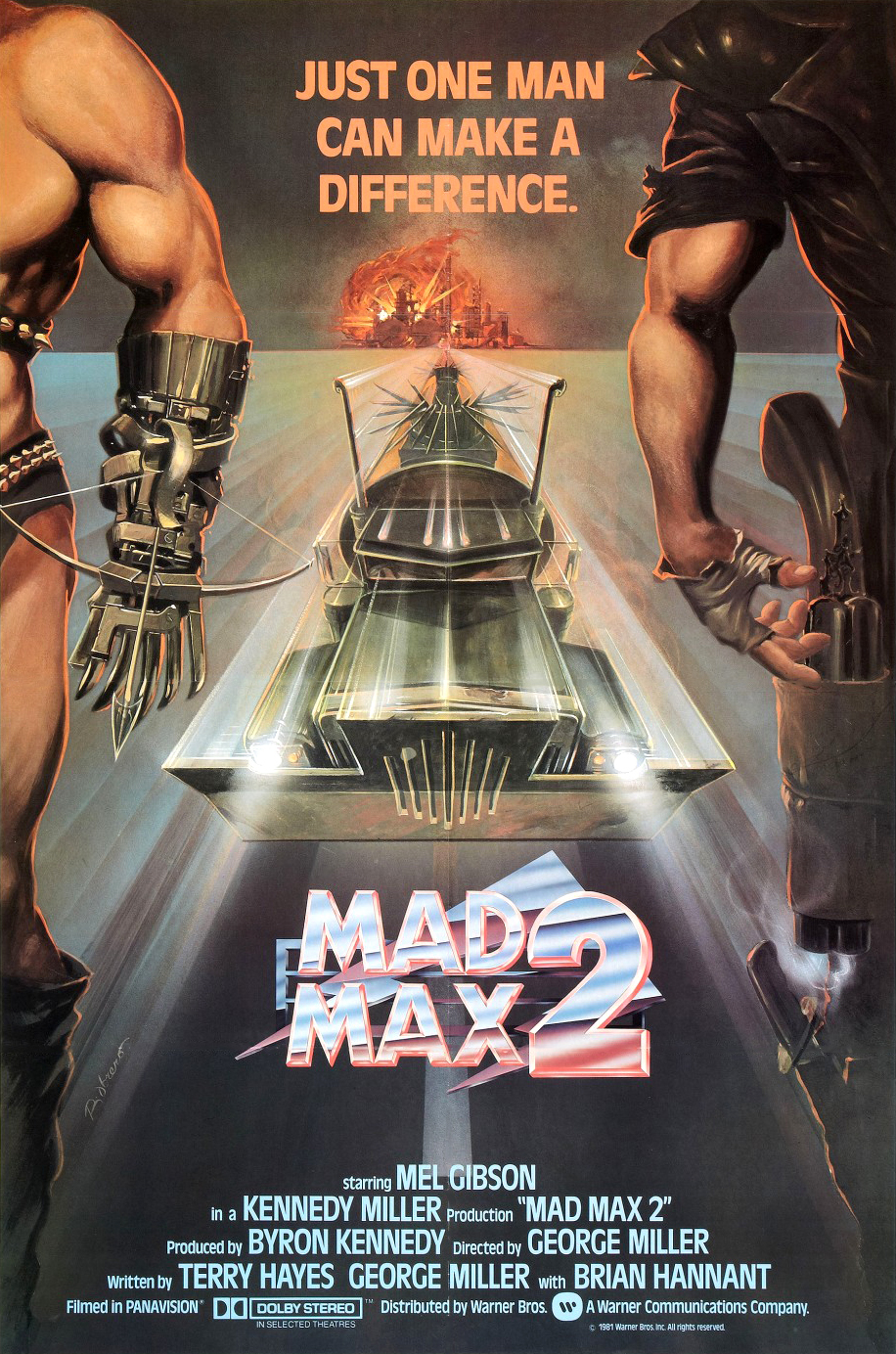
Awesome ’80s In April: Mad Max 2 (1981)

mad max 2 poster

While watching Mad Max Fury Road (2015) in the theater, just about the time when the guy strapped to a truck loaded up with speakers started playing his guitar that spits fire, I turned to my wife and said, “you have to look past the utter ridiculousness and enjoy the ride.”

That remains a helpful hint when your watching The Road Warrior, also known as Mad Max 2. In these two films (and presumably the other two in the series, though I’ve never seen Mad Max (1979) and barely remember Mad Max Beyond Thunderdome (1985)) writer/director George Miller has created a fascinating post-apocalyptic world in which souped up cars are the currency and gasoline is worth more than gold.

After the exploits of Mad Max, Max Rockatansky (Mel Gibson) has become a mythic figure (and there is a reading of Fury Road in which the Max in that movie (played by Tom Hardy) is not the same Max in the other films but has just carried on the name, or is a part of a larger mythology). An opening narration both sums up what happened in Mad Max, and gives us insight into the legend that has become Mad Max.

Our film begins proper with Max once again on the road. He is a loner. He is haunted by the death of his family in the first film. He cruises the streets in a super charged black car. He fights off a group of marauders and outsmarts a strange gyrocopter pilot (Bruce Spence). To keep from getting killed or left behind the pilot tells Max of a place that has fuel. Lots of it. It is an old oil refinery and a group of people have made it work again.

Max tricks his way inside but then finds himself captured. Before anything can be done with him the group of marauders that attacked Max in the beginning is laying siege to the refinery. They are way outnumbered and there is no way they can keep the enemy out forever. Max declares he can scavenge a large truck that can drive a tanker full of gasoline out of the compound and into safety.

What follows is a nearly twenty minute action sequence that feels like a dry run for most of Fury Road. Director George Miller is completely at home with the action. It isn’t quite as fluid here as it is in Fury Road but it is just as thrilling. The stunts are all practical as well, there was no CGI back then. One wonders just how dangerous it was all to perform. One marvels at the technical skill involved. It is one of the great action sequences in all of cinema.

Getting to that sequence isn’t quite as thrilling, but its still pretty darn great. The world Miller has created is an interesting one. I’m a big fan of post-apocalyptic cinema and they’ve done a great job of creating this world. Filmed in the deserts of Australia it looks like a world gone to hell. Mel Gibson is great as Max, I know he’s fallen out of favor of late (and with good reason) but there was a reason he was one of the biggest stars in the 1980s and into the 1990s and you can certainly see that here.

Mad Max 2 has certainly whetted my appetite to be back in this world. I’ll probably give the other films a spin this month even though I’m fully aware their reputations aren’t nearly as good.

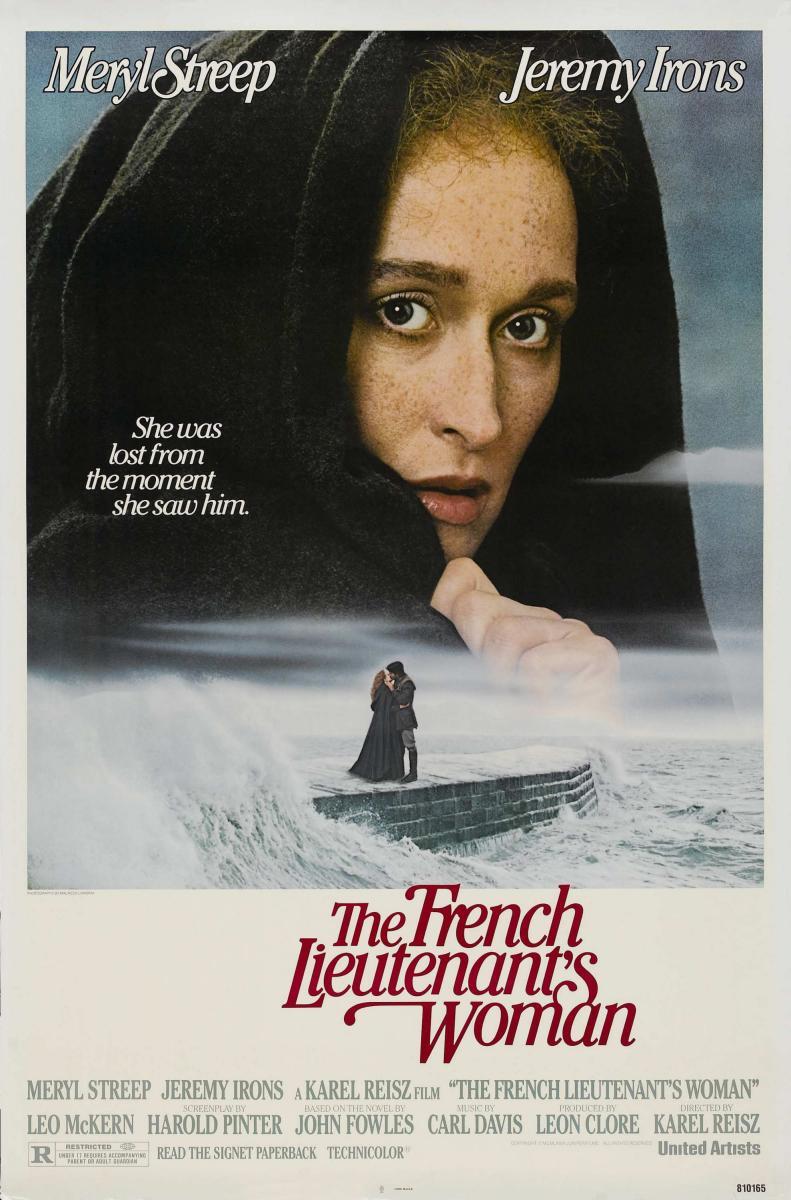
Awesome ’80s in April: The French Lieutenant’s Woman (1981)

the french lieutenants woman movie poster

The opening scene of The French Lieutenant’s Woman has Meryl Streep dressed in period garb standing on the street of an old village near a great bay. The shot is from far away so the details are difficult to see. A makeup woman touches up Meryl’s face and someone snaps a clapperboard.

Thinking this was supposed to be a period movie I turned to my wife and asked if I had maybe accidentally pressed play on a behind-the-scenes featurette. She hit the menu key on the remote control, but no, I had played the correct thing. This was the movie.

Streep is playing Anna, an actress who is starring in a movie called The French Lieutenant’s Woman. In that film, she plays Sara Woodruff a fallen woman in Victorian times who had an affair with a French Lieutenant and was left by him without marrying her. Anna is having an on-set affair with Mike (Jeremy Irons) who plays Charles Smithson in the movie-within-a-movie. In that movie, he falls in love with Anna.

If that wasn’t confusing enough the movie (I mean the one I watched not the movie-within-a-movie) presents both of these stories – Mike and Anna two actors making The French Lieutenant’s Woman – and Sara and Charles existing within The French Lieutenant’s Woman’s story – as real. Or at least they are filmed realistically. When we are watching the events of the story-within-the-story we don’t catch glimpses of cameramen, the actors never flub a line, etc.

But the film does play with the two timelines. At one point Anna and Mike are rehearsing a scene for their movie. They are dressed in street clothes and are inside a modern house. They go over the scene a couple of times and then suddenly we are transformed into the older storyline – Sara and Charles live out the scene we just watched Mike and Anna rehearse. This type of thing happens several times where one event is doubled in the other timeline.

Based on a book by John Fowles the movie completely makes up the Anna and Mike story. Apparently (for I haven’t read it) the book offers multiple endings and includes a narrator who often intervenes with a personality of his own. The modern story is then the film’s attempt at making that bit of metafiction work cinematically.

It worked for me. Though it took me a little bit to figure out exactly what was happening, once I got into the groove I found it to be a fascinating way to make a film. I enjoyed both stories and the way the enveloped each other.

Both are love stories with the two characters falling for each other though in both cases their love is socially unacceptable (Charles is engaged to another woman and Sara is disgraced/both Anna and Mike are married to other people). The differences in social norms for their time periods make their stories go in different directions and conclude in ways you might not expect.

Streep and Irons are wonderful as you would expect. I could watch Meryl Streep’s face all day long and never grow tired. After watching the film I immediately took the book off my shelf and put it in my “to read” stack.

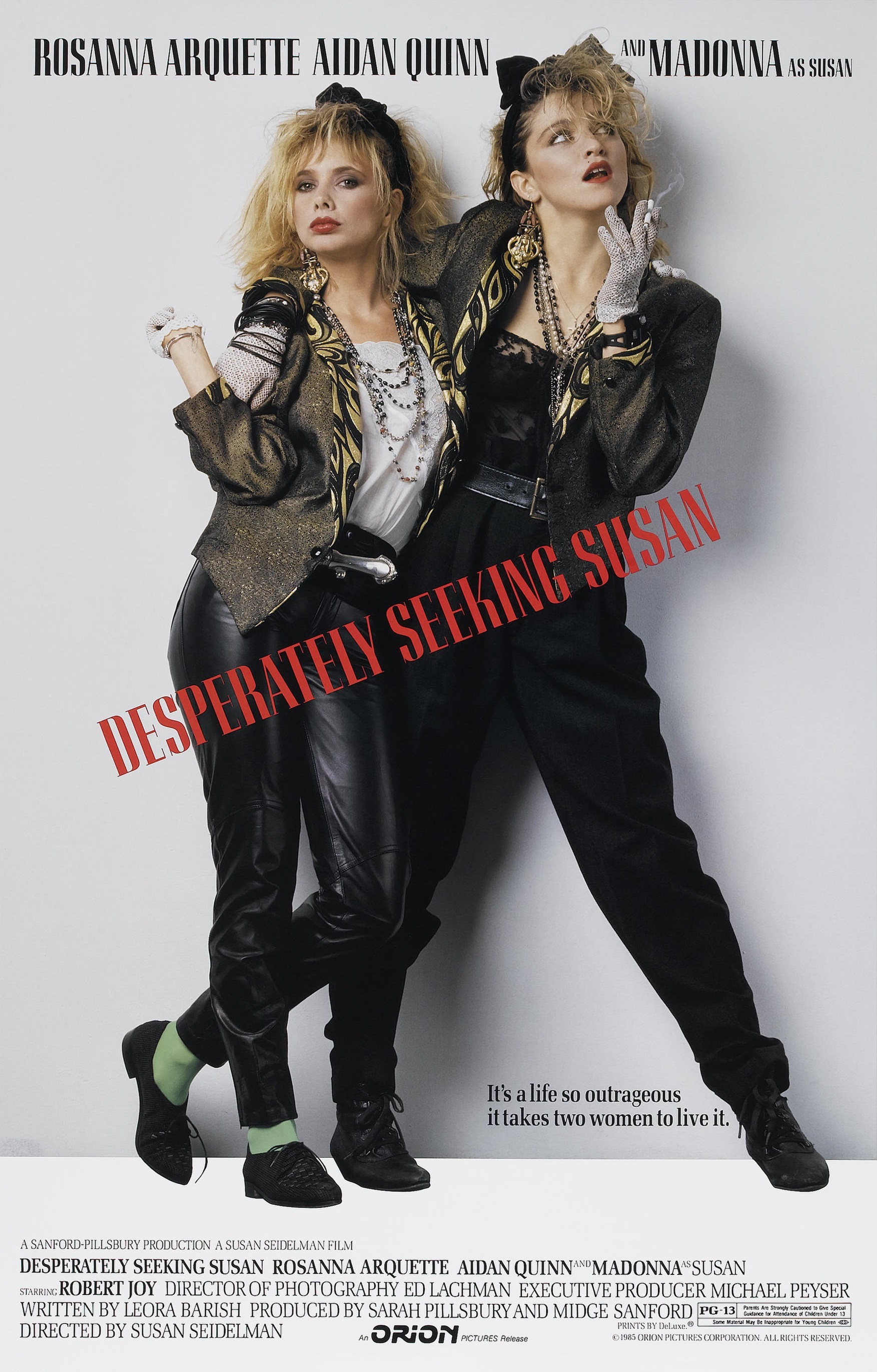
Awesome ’80s In April: Desperately Seeking Susan (1985)

desperately seeking susan movie poster

I feel like I’m going to spend the first few paragraphs of every review I write for this Awesome ’80s in April segment discussing the various memories I have associated with each film. I really had no idea these movies would bring back such memories, but here we are.

If you didn’t live through the 1980s it is hard to explain just how big of a star Madonna was. She was everywhere. She had a ton of radio hits that were in constant rotation on the airwaves. She made great videos that were repeatedly playing on MTV. She was on magazine covers and on talk shows. Madonna and Michael Jackson were the 1980s.

Desperately Seeking Susan was her first film role. She’s basically playing herself. Or at least the public persona she was presenting at the time. She’s the Susan of the title, a free spirit, punk rock sort of girl. We first meet her at a hotel where she’s just spent a free night of spirit-making with a mobster. Right after she leaves some other mobsters throw that guy out the window. Thinking she might be a testifying witness, mobster Wayne (Will Patton) spends the film looking for her to rub her out.

But first, we meet Roberta Glass (Roseanna Arquette) a bored, middle-class housewife who spends her days getting her hair done and reading the personal ads. She’s intrigued by one that says “Desperately Seeking Susan” and lists a time and a place to meet. She’s seen similar ads before and figures Susan and the desperate guy must meet regularly via the personals.

She thinks that’s romantic and decides to go to Battery Park and spy on the lovebirds. Through a series of rather silly events Roberta is mistaken for Susan and due to a bout of amnesia she winds up thinking she’s Susan too.

She meets a nice guy, Dez (Aidan Quinn) and they get into a series of adventures together. Meanwhile, the real Susan is looking for Roberta because she’s got the key to the storage locker where she’s got all her stuff. (The key was accidentally left in her jacket pocket which she sold to a thrift store and Roberta purchased after Roberta followed Susan around the city – I told you things got silly).

The plot isn’t really the point of this movie. It is something like a modern take on the classic screwball comedy. It wanders around some cool old sections of New York City and meets some wonderful characters (played by a who’s who of just getting their start New York actors including Laurie Metcalf, Stephen Wright, Jon Turturro, and Giancarlo Esposito).

Madonna is great in it. She really does seem to be playing herself, or to put it another way, this role feels like it was made specifically for her (though it wasn’t she had to beat out such wonderful actors as Goldie Hawn, Susan Sarandon, and Jennifer Jason Leigh. Her wardrobe is full of that classic early ’80s New York City style that Madonna was famous for.

Arquette is great as well. It is really her movie and it follows her character as she changes from this bored housewife who is just going through the motions to someone finding her own sense of style and self. Madonna gets lauded for having her own unique sense of self, but Arquette holds her own. She’s such a unique performer.

Desperately Seeking Susan is another film that I’ve known about since it came out. It has been on my list of things to watch for ages, but for whatever reason, I never got around to it. The film is really fun, silly, and full of style. It is a time capsule of New York City as well and works as a perfect embodiment of the 1980s.

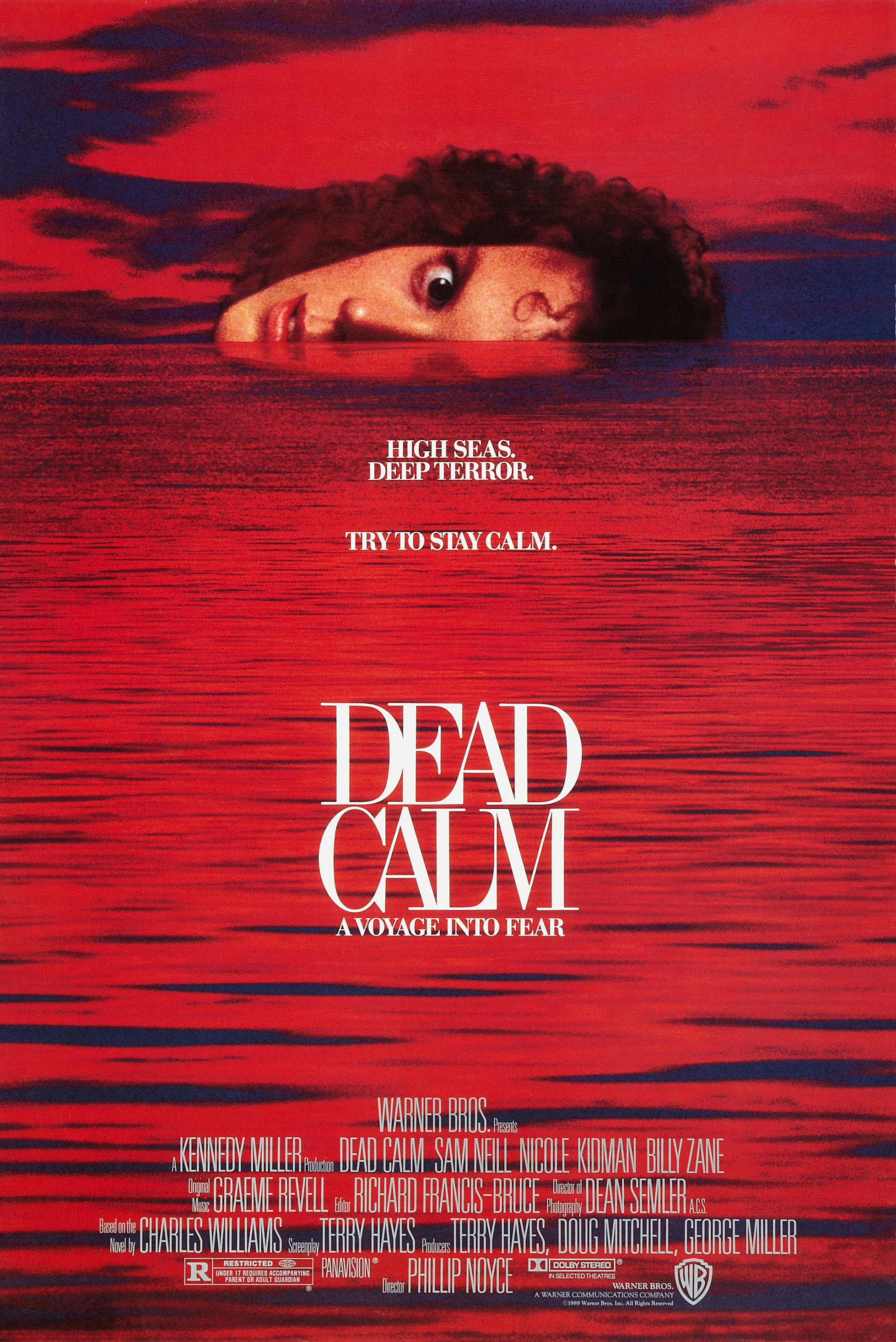
Awesome ’80s in April: Dead Calm (1989)

dead calm movie poster

When I was a young teen, probably sometime in the late 1980s my mother’s friend Beverly had a satellite dish and all of the premium cable channels like HBO and Showtime. We only had basic cable at the time so I was in awe of all the movies she had access to. She was kind enough to allow me to send her requests of films I was interested in watching and she’d record them for me onto VHS tapes. I used to scour the TV Guide looking for movies for her to record.

When I got older and was living on my own I used to set the VCR to record old movies off of TCM and other cable channels. I had quite a collection of films dubbed off onto VHS tapes.

One film in that collection was Dead Calm. Unlike Firestarter this was a film I didn’t really know much about. Nicole Kidman was not yet a star and I didn’t know who Sam Neill or Billy Zane was. It is an Australian film and I don’t remember how much publicity it received in the USA. But at some point, I must have seen a trailer or read a synopsis and decided it sounded interesting. Thus I recorded it onto VHS tape.

But I never did watch it. It sat in that collection of tapes for years and years. When I’d go looking for something to watch I would see it, think to myself “I should watch that sometime” and then skip right past it. Many years later I got a digital copy of the film and yet I continued to put off watching it. One of the things I’m loving about this Awesome ’80s series is that I’m finally getting around to watching those sorts of films.

I should have watched this one much sooner as it is pretty terrific.

Kidman and Neill play Rae and John Ingram, a married couple who recently lost their only son in a terrible accident. They have taken off in their sailboat to sail the Pacific Ocean and forget about their troubles.

One day they spy a schooner that seems to be in some distress. They hail it to no accord. Before they can make their way over to see what the trouble is they see a man, Hughie (Zane) furiously rowing toward them in a dinghy.

He says that his boat is slowly sinking and that all the other crew is dead of food poisoning. But something seems off about him. When John indicates he’d like to sail over and check out the boat, Hughie becomes very agitated. He generally seems over-excited and behaves somewhat erratically.

When he finally crashes and falls asleep, John takes the dinghy over to the boat to investigate. What he finds is disturbing. But before he can come back to his boat, Hughie has knocked Rae unconscious and taken control of the boat.

The film becomes a tight thriller with Rae trying to escape from Hughie and John trying to survive the sinking boat long enough to be rescued. I loved the gender reversal of that. Typically in movies like this, the woman would be trapped helplessly by the villain and the male hero would rush in to rescue her. But here John must be saved by his wife after she subdues the villain.

Director Phillip Noyce keeps things moving briskly and the tension held tightly. The two boats, thousands of miles from anything but the ocean create a wonderful setting where the characters must survive on their own cunning and wits.

This was Kidman’s breakthrough role and she’s terrific. She gives her character confidence rarely seen from female characters in this type of movie, but she never loses her femininity. Sam Neill is great as well. He spends a great deal of the film alone on that sinking ship and he allows his character the fear that comes from such a situation but also a determination to survive. I’m not a huge Billy Zane fan and he doesn’t quite have enough crazy menace here, but he’s still effective.

I’m surprised this film hasn’t received more love. I’m really glad I finally decided to watch it.

Awesome ’80s In April: Firestarter (1984)

firestarter poster

One of my aims for this series is to watch films that I knew about as a kid during the 1980s but for whatever reason have never bothered to watch. All kinds of films were floating around the cultural ether – films that I’d seen trailers for or seen on Siskel & Ebert, or that my friends were talking about, but that didn’t appeal to me for some reason. Or that I just never wound up seeing. As an adult, a lot of these films have some kind of appeal, but not enough to usually make me sit down and watch them.

Firestarter is a good example of this. It starred Drew Barrymore, who was the biggest child star at the time. I was actually too young to watch the film when it came out in 1984, but she had something of a career resurgence in the 1990s by taking on more mature (and sometimes scandalous) movies like Poison Ivy (1992), The Amy Fisher Story (1993), and Boys on the Side (1995). I was a fan of the actress as a teenager and though Firestarter was a few years old at that point it was still very much part of the culture. It was often shown on cable television and the video stores still had copies of it on their shelves.

I guess what I’m trying to say is that Firestarter was part of my cinematic memory, even though I never did watch it. It is that kind of thing that fascinates me and those are the types of movies I’ll be trying to watch this month.

The film is based on the Stephen King novel of the same name and follows one of his more regular themes – that of people with psychic ability and the secret government agencies that want to exploit it.

Barrymore plays Charlie a girl with pyrokinetic powers. She and her father Andrew (David Keith) are on the run from those secret government agents. Years before Andrew and his wife were given experimental drugs by that agency which gave her the ability to read minds and him the ability to control them. The agency killed his wife and kidnapped Charlie. He got her back and that’s why they are on the run.

Eventually, they get caught and the Agency director (Martin Sheen) and his hitman (George C. Scott pretending to be Native American and sporting the most ridiculous-looking ponytail) attempt to befriend Charlie so they can get her to master her powers.

Writing all that out makes the film sound pretty good, but I’m afraid I have to tell you it is mostly a snore. The government plot is dull as can be, George C. Scott’s performance is just plain odd, and for a more about a girl who can start fires with her mind (and is titled Firestarter), it sure takes its time letting the girl start fires with her mind. It finally gets going in the last fifteen minutes or so and that scene is a real corker with tons of action and blazing fire action. But getting there takes a lot of effort.

Oddly enough it did make me want to read the book. The bones of the plot are good, and exactly the sort of thing King is good at writing. There is a scene in the film where Charlie and the father are picked up by an old man and taken back to his home where the man’s wife fixes them lunch. It is a perfectly fine little scene in the movie, but you just know King expanded it for multiple chapters allowing these characters to really bond and for us to get to know them. That’s the sort of thing King excels at, but that tends to get shortened down to nothing on the big screen.

Awesome ’80s in April: Night of the Comet (1984)

night of the comet poster

While working on my list of movies I wanted to watch during the Awesome ’80s in April I headed over to Letterboxd, turned on their giant list of all films, filtered out everything but movies made in the 1980s, sorted it by highest rated, and systematically made my way through the entire list. I was looking for movies I had never seen, but had always wanted to watch. Or movies I’d never heard of but that looked interesting (one of the cool things about Letterboxd is that it lets you see how your friends rated any film, and read any reviews they might have written).

Night of the Comet falls into the latter category. I’d never heard of it before, but it was rated pretty highly by people whose thoughts on movies I respect and the plot sounded interesting.

Honestly, even after all of that, I expected something much cheesier. The plot synopsis sounds like Buffy the Vampire Slayer meets Night of the Living Dead at the end of the world. But what I got was something more thoughtful, and well-made than that synopsis makes you expect.

An opening salvo tells us that a huge comet will be passing by Earth for the first time in millions of years. Everybody is excited. Parties are being held outside to watch the comet pass. The whole world is outside watching. The whole world except for Reggie (Catherine Mary Stewart) and Larry (Michael Bowen). They work at a movie theater and Larry has convinced Reggie to help him rent out a reel to some guys who will illegally duplicate it. Reggie really wants to see the comet pass by, but Larry is willing to pay her a whole $15 bucks and that’s hard to turn down.

They wind up spending the night in the steel-lined projection booth. The next morning they wake up to find that the comet has turned everybody (well, almost everybody) into red dust. A few people did survive but they seem to have been turned into brain-eating zombies. Larry meets his end pretty quickly and Reggie returns home to find her sister Samantha (Kelli Maroney) is still alive. Turns out that after an argument with her mother Sam slept in the steel-lined shed.

Together, they do what any red-blooded American teenager would do after a zombie apocalypse – they head to the mall. Actually, they head to the radio station first because a DJ’s voice can be heard playing records and they figure finding another human alive would be a good thing. The DJ is actually just a recording on a tape, but they do discover Hector (Robert Beltran) at the radio station. Hector almost immediately leaves the girls as he needs to find out if his mother is still alive (he’ll come back to the movie a little later). That’s when the girls go to the mall.

There are some scientists types who survived by hiding in an underground bunker. They must now try to rebuild humanity and that begins by running tests of the few other humans who survived to see if there is a chance at finding a vaccine to counteract the effects of the cosmic rays.

Night of the Comet does a great job of blending comedy with horror and thriller elements. The Buffy mixed with Night of the Living Dead elements I mentioned at the beginning of this post are more apt than I thought. Although it is more like Dawn of the Dead since a great portion of the movie is spent inside a mall. But it is a much better film than that synopsis might indicate. It was made on a tiny budget, but they put every dollar they had to good use. It is funny and thrilling, and has a nice sense of what it’s trying to do.