Foreign Film February: The Magician (1958)

the magician poster

The Magician often gets overlooked when it comes to discussing the films of Ingmar Bergman. Part of this is due to timing. Made just a year after the duo masterpieces The Seventh Seal and Wild Strawberries it feels small and lesser in comparison. He followed it with The Virgin Spring, Through a Glass Darkly, and Winter Light, three deeply felt films that wrestle with the existence of God and human suffering.

But while The Magician certainly is a lesser film when compared with those movies, I wouldn’t skip it when taking in Bergman’s filmography. Were it made by a lesser director, or perhaps if it had even fallen somewhere else in his oeuvre I suspect The Magician would be talked about much more.

A traveling troupe of performers who sometimes sell themselves as magicians or spiritualists, and sometimes work as healers selling various medicinal concoctions are on the run from the law.

When they arrive in a small village in Sweden they are immediately stopped by the police and taken to a large house where they are questioned by the Police Superintendent (Toivo Pawlo), Dr. Vergerus, the Minister of Health (Gunnar Björnstrand), and Consul Egerman (Erland Josephson). Egerman, who is fascinated by the occult makes a wager with Vergerus, a skeptic, about the veracity of the troupe’s supernatural abilities.

After answering some questions the troupe agrees to perform their act the next morning. The troupe is ostensibly led by Tubal (Åke Fridell) who is the talker, the showman of the bunch, but the Magician is Vogler (Max Von Sydow) who pretends to be mute for much of the film. He is assisted by his wife Manda (Ingrid Thulin) who dresses as and pretends to be a man. There is also an old lady, simply called Granny (Naima Wifstrand), and their driver Simson (Lars Ekborg).

Because this is a Bergman film he is interested in the tension between the supernatural and science, faith and unbelief. It plays a little with whether or not the troupe has real powers before they admit they are frauds.

At the evening meal, Tubal tries to sell some of Granny’s potions. One of the maids is very interested in a love potion. She happily buys it from him then sly admits she doesn’t want it, but rather she wants him. Another maid (Bibi Andersson) drinks the potion and uses it as an excuse to seduce Simson. Everyone uses superstition to get what they want.

One of the other reasons I suspect this film doesn’t get its due is that tonally it is working in a few different playgrounds. It is sometimes a farce, playing the situation for laughs, and then it will switch into something more dramatic, towards the end it gives us a ten-minute scene that is pure horror. Those things don’t always gel well, but it mostly worked for me. The horror segment especially. It isn’t particularly scary, but Bergman, working with cinematographer Gunnar Fischer are such great technicians the scene works perfectly on a technical level.

The cast is as good as you would expect. I love when Von Sydow works with Bergman and he’s as wonderful as ever. It is a beautifully shot and constructed film. I’m always in awe of how gorgeous Bergman’s films look and this is especially beautiful, even though most of it takes place indoors.

It isn’t Bergman’s best film by far, but it proves that even when his films aren’t masterpieces, there is still plenty to enjoy and ponder.

Foreign Film February: Certified Copy (2010)

certified copy poster

Certified Copy, Abbas Kiarostami’s 2010 drama is a strange, beautiful, perplexing film that puts a giant question mark up in the middle of its story and then never bothers to give the audience an answer.

It begins with a lecture. James Miller (William Shimell), a British writer is giving a talk about his new book, Certified Copy, which argues that copies of art – reproductions of paintings, sculptures, etc. – are themselves unique and therefore authentic art.

The film gives him space for the argument. In most films, whenever a lecturer stands before a class, we only hear a few moments of what they are saying before the bell rings, they are interrupted, or the film moves on. We only need to know they are a person with knowledge who is capable of passing that knowledge on to others. What they’re actually saying isn’t important. But here we spend quite a long time with the focus on Miller and what he is saying.

I got so caught up in his lecture that when a woman (Juliette Binoche, whose character name is never given) came in late and then fussed with her belongings, and quietly mimed to her young son I was annoyed at her interruption. How rude, I thought, can’t this woman sit quietly and let me hear what this man is saying? I had to remind myself I was watching a film and that this woman’s actions were what the movie was focussing on and thus I should pay attention to her, not the lecture.

Later he’ll find himself inside her antiques shop. It is filled with originals and copies. He’s delighted seeing that this will give them plenty to talk about. She’s irritated and notes that she only owns the shop by accident and that she doesn’t care for any of it.

They go for a ride. They talk about his book. They argue over art. She hated his book, yet asked him to sign multiple copies of it for her. She takes him to a museum and shows him a piece that was, for hundreds of years, thought to be an authentic bit of ancient Roman art. When they discovered it was a forgery, they kept it on display and added the story. Even the fake has meaning.

In a coffee shop, the proprietor will mistake them for an old married couple. She’ll run with the idea, creating an entire back story for them. I don’t want to spoil where the film goes from there, but it continues to toy with the idea of identity. Of what is real and what is fake, and whether or not the distinction really matters.

I suspect it is the type of film that critics love and the average moviegoer is either perplexed by or outright hates. I landed somewhere in the middle. I appreciated the discussions on art and that the film was taking some big swings toward something original and meaningful. My wife and I had a lovely little chat about the film after the credits rolled.

But I found it more of an intellectual exercise than an entertaining one. I tend to fall on the side of movies should be an enjoyable viewing experience over wanting movies to challenge me or stimulate my mind. They can do both, of course, and I’m not against challenging films, but these days I mostly want something I find enjoyable to watch.

I will say this is a film I’d like to see again. Knowing where it goes plotwise would help me concentrate on the other things it’s doing and I suspect I’d like it a lot more on a second viewing.

Foreign Film February: Hokuriku Proxy War (1977)

image host

I continue to sing Radiance Films praises. They are carving out a nice little niche market in the larger Boutique Blu-ray landscape. Their focus seems to be on foreign language arthouse films that are lesser known. The type of film that would be skipped by Criterion but are generally still quite good.

Hokuriku Proxy War is a fun little Japanese Crime Drama that is a bit confusing in the story department but more than makes up for it in its action. You can read my full review here.

Foreign Film February: Keep An Eye Out (2018)

keep an eye out poster

Louis Fugain (Grégoire Ludig) discovers a bloody corpse outside his apartment complex and calls the police. At the police station, he is questioned by Commissaire Buron (Benoît Poelvoorde). Quickly we realize two things 1. Fugain is the main suspect. 2. Buron is an idiot of the Inspector Clouseau variety.

We first see them together at the station. Fugain is seated, waiting impatiently for Buron to get off the phone. His conversation is mundane, trying to set a date with someone for dinner. It lasts a long time. It seems a strange thing for a Commissiare to be doing in front of a man he thinks may have just committed murder. It is a strange movie.

After a few questions, Buron leaves to go speak to his son and eat a hotdog. He leaves Fugain with Phillippe (Marc Fraize) a one-eyed rookie who regularly ends his sentences with “Actually.”

A terrible accident occurs which Buron tries to cover up.

While Buron questions Fugain the film flashbacks to the scene. Sometimes Phillippe, or his wife, or Buron appear in those flashbacks and interact with Fugain even though they were not there in those scenes in the past.

The film plays it half-serious while regularly winking at the audience in its absurdities. It is difficult to explain just how ridiculous, how absurd, how French this film is. I won’t spoil how it ends, but to say it is utterly surprising and yet somehow fitting.

Foreign Film February: The Third Murder (2017)

image host

Our second film in this year’s Foreign Film February is a Japanese legal thriller that starts out strong but quickly gets muddled and ultimately wound up kind of boring me.

In the opening scene, we see a man bludgeon another man to death and then set him on fire. Then the film moves forward in time with the killer, Misumi Takashi (Kōji Yakusho) under arrest and being questioned by his defense attorneys.

He fully admits to killing the man but his story regularly changes in regards to what actually happened and why he did it. His attorneys argue over the best way to defend their client and keep him from being executed.

The devil, they say, is in the details, and while there are a lot of details in this film, I had a difficult time caring about them. This is a film that makes quite a to-do over whether he should be charged with Robbery-Murder or Murder-Robbery. The difference being in his intentions. If his intentions were robbery and the murder came after then his motive is greed, but if he murdered him for some other emotional reason (such as anger over being fired – for the dead man was his boss) and robbed him afterward then the jury might be more sympathetic.

That’s an important legal distinction, I guess, but not one that makes for compelling cinema.

It is well-acted and well made and some of the revelations are interesting, but overall I found myself ready for it to be over long before it actually was.

Foreign Film February: The Vanished Elephant (2014)

the vanished elephant

Welcome to Foreign Film February 2025. I started the month off with a bang, watching three movies over the weekend. Then I got busy and distracted and forgot to actually write about them. Here we are nearly one week into this, the shortest of months, and I have neither watched any other movies nor written anything.

Hopefully, the rest of the month will go better. But considering…well *waves hands frantically in all directions*…everything else going on in the world, I wouldn’t count on it.

The Vanished Elephant is a beautiful, strange, moody, and confounding neo-noir mystery that questions the very fabric of the story it is telling the longer it is spun.

Edo Celeste (Salvador del Solar) is a successful crime writer who has decided to end his long-running detective series. Naturally, as these things go, a real-life mystery forms. New clues have come to light which might let him understand what happened to his fiancee who disappeared several years prior.

He keeps finding packages full of photographs which, when placed together in a certain order will reveal a much larger picture. There is a whole complicated procedure that I did not at all understand that led him to figure out in what order to place the photographs.

Some murders happen. He investigates on his own despite the real police constantly telling him not to. Eventually, he will become a suspect.

As the film progresses this fairly standard mystery formula begins to dissolve to be replaced by an even bigger mystery about the nature of story and reality. To say more would be to spoil its many surprises.

Ultimately, it didn’t work that well for me. I found it more unintelligible than mysterious. It is definitely a film that will work better for the viewer on a second viewing as you’ll likely discover details that will help you understand what it is doing. I’m just not sure I care enough to give it another go.

It is well-made and quite beautiful to look at. It reminded me a bit of David Lynch’s movies, but that might just be because he just died and I’ve been thinking about him of late. But it does have that beautiful weirdness about it.

Foreign Film February: Les 3 Boutons (2015)

les 3 boutons

Agnes Varda was a titan of French cinema. She was a member of the French New Wave and a pioneer of using location shooting and non-professional actors. She made narrative films and documentaries. I’ve only previously seen Cleon From 5 to 7 but it is a masterpiece. My wife adores The Gleaners and I.

I keep telling myself I need to watch more foreign language films this month, and I keep finding other things to watch, but before February comes to a close, I wanted to watch something. Something short. Because it has been a long day and I’m tired.

Luckily the Criterion Channel has a bunch of short films and they even categorize them by their time frames – Under 60 minutes, Under 30 minutes, Under 15 minutes…

Les 3 Boutons (The Three Buttons) is an eleven-minute film from Agnes Varda. It was commissioned by the fashion house Miu Miu. It stars Jasmine Thiré as a young goat farmer who goes on a magical journey.

A postman brings her a package. Inside the package is a large red-looking tarp. When she unfolds it the tarp becomes an enormous red dress. The girl walks inside the dress and finds herself in a cave. When she spies some school girls walking down a lane her own clothes turn into the same dresses they are wearing. Suddenly, she’s on a city street. When she spies some kids having ice cream she reaches inside her pocket and finds her own cone. It is a stream-of-consciousness fable.

Varda infuses this very simple story with a playfulness and joy that is a delight to behold. There isn’t much to it, and so I don’t have a lot to say about it. But if you have the Criterion Channel (or Mubi) and you have 11 minutes to spare I don’t think you’ll be disappointed.

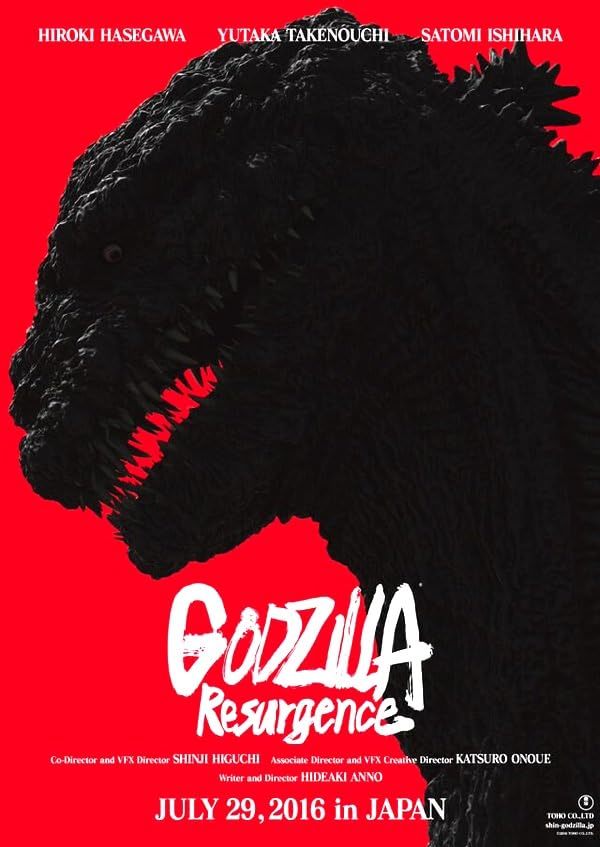
The Friday Night Horror Movie: Shin Godzilla (2016)

shin godzilla
My daughter has started to get into Japanese culture, including Anime so I got her a subscription to the Crunchyroll streaming service. I noticed that Shin Godzilla was included in that service so I gave it go. I’d say I am a fan of the Godzilla movies, but I’m not hardcore about it. I’d been meaning to watch this one since it came out, and the reviews for the new one – Godzilla Minus One have been really good, so today seemed like a good day to watch a lizard monster attacking Japan. Godzilla Minus One isn’t a true sequel of Shin Godzilla but I still wanted to watch it before Godzilla Minus One.

Crunchyroll had two audio options. I could watch it in the original Japanese with English subtitles or I could watch an English dub. In general, I prefer to watch movies in their original language and so I chose that option. Unfortunately, the sync was off which meant I got the subtitles appearing on my screen about three seconds before the characters actually said them. This was especially true during the more frantic action sequences in which the dialogue is rapid-fire. It was very confusing so after about an hour I switched to the English dub. It was a very bad dub, but somehow I survived.

Made in 1954 the original Godzilla served as a metaphor for Japan’s post-war fears of another nuclear holocaust. Shin Godzilla is at least partially concerned with the ways in which bureaucracy stalls decisive government action in a time of crisis. Making it a metaphor for the Japanese government’s response to the Fukushima nuclear disaster.

Just off the coast of Japan, an eruption of some kind occurs in Tokyo Bay. The water begins to boil and an underground tunnel ruptures sending water flooding into traffic. The government meets to discuss the issue, they call in top scientists to figure out what is causing the eruption, but they do nothing.

Soon a tail emerges then a large lizard thing (with hilarious googly eyes. But not to worry, the scientists say, it probably can’t come on land. It’s legs are too small. Then it does come on land and mutates into something more Godzilla-like. More government discussion, but little action. They have to have meetings, you see, and decide what the laws say they can and cannot do during this crisis that no one in the history of the world is prepared for.

Some low-level agents form a secret board of folks willing to actually do something, and they (eventually) save the day. But not before Godzilla destroys most of the city with his super-awesome fire breath and lasers that shoot out of his scales and tail.

It is a curious mix of dudes in offices arguing over the correct procedures, other dudes in other offices actually trying to find a real solution, and some crazy Godzilla action.

Honestly, I was mostly bored during the office scenes. I got what it was trying to do within the first ten minutes or so and after that, it just felt redundant. But the Godzilla attacks stuff is pretty great.

Mademoiselle (1966)

mademoiselle

I reviewed a couple of Blu-rays for Cinema Sentries this past week and I’ll be linking to them today. First up is a British film set in France that stars a French woman speaking English (with a French accent) an Italian actor who speaks both English and Italian, and a bunch of other Europeans who all speak English with various British accents. All of which I find very funny for a film that is supposed to be made up of a bunch of French people.

But I’m not sure if I get to call it part of my Foreign Film February or not.

Also, it’s quite good. You can read the review here.

Foreign Film February: The Ear (1970)

the ear

I’ve been a little slack in my Foreign Film February watching. It seems like I’m always slack these days in whatever I’ve decided is the movie theme of the month. I still like the idea of the themes, but some days (most days) I like to watch whatever I’m in the mood for.

I do love foreign language films, but they can be difficult to watch. I don’t mean difficult thematically or that the style is obtuse or whatever (though that can be true), butthe act of reading subtitles creates extra work. Normally, I don’t mind that little bit of work, but increasingly my eyes are going bad. I used to have excellent eyesight but as I get older that is less and less true. These days they are dry and tired. That little extra work of reading what I’m watching is sometimes just too much. When I watch a film at the end of a day I want to relax, to rest, not have to give my eyes a workout.

Weekends are better and this is when I watched The Ear. It is a Czechoslovakian film that was made in 1970 but was banned by the Communists until the Iron Curtain fell in 1989. It was part of the Czechoslovakian New Wave, and I realize I don’t think I’ve seen any of those films. I’m not sure if I’ve ever seen a movie from Czechoslovakia. This is why I love Foreign Film February.

A married couple, Anna (Jirina Bohdalová) and Ludvik (Radoslav Brzobohatý) return home from a political party to find their gate unlocked and their front door open. The power is out and the phone doesn’t work.

Ludvik becomes increasingly convinced he is about to be purged by the government. He is a mid-level bureaucrat and in flashback, we see that his boss and several others were disappeared at the party. His wife, drunk and belligerent, continually speaks loudly about things she ought to keep quiet about.

It is well known by everybody that the government is listening. The omnipresent “Ear” has been placed in various rooms in everybody’s house. Rumors abound about it. They say that they won’t listen to you in the bathroom or the kitchen (but they love to listen to what you do in the bedroom).

They see men standing outside the house across the street. Ludvik begins flushing notes he took at various meetings. Things that might not look good to the new administration. When the toilet clogs he burns them, destroying his toilet seat in the process.

As the night rolls on the tensions increase. As do the cracks in their marriage. It is clear they haven’t been happy in a long time. Anna doesn’t seem to understand how serious it all is. She yells at the ear and continues drinking. Ludvik is convinced he’s going to prison or worse.

Reminiscent of 1984, The Conversation, and even Whose Afraid of Virginia Woolf, The Ear is an intense, meticulously crafted bit of paranoia. The stark black-and-white photography increases the fear by not allowing any warmth in. In the flashback sequences, we often get POV shots from Ludvik’s perspective which increases the paranoia as really we’re seeing what he sees from his memory, and he’s increasingly convinced things are as bad as can be.

It ends almost ironically. I won’t spoil it, but it is a slap of reality as to how truly insane totalitarian governments can be.