
2001: A Space Odyssey is arguably one of the greatest movies ever made. Certainly, it is one of the greatest science fiction films ever put on celluloid. It was made by the visionary auteur Stanley Kubrick. One of the many astounding things about the film is that it is almost entirely told through visual language. Great swaths of the movie contain no dialogue whatsoever. This is also one of the reasons the film is endlessly discussed – it never tells you what’s happening, it shows you.
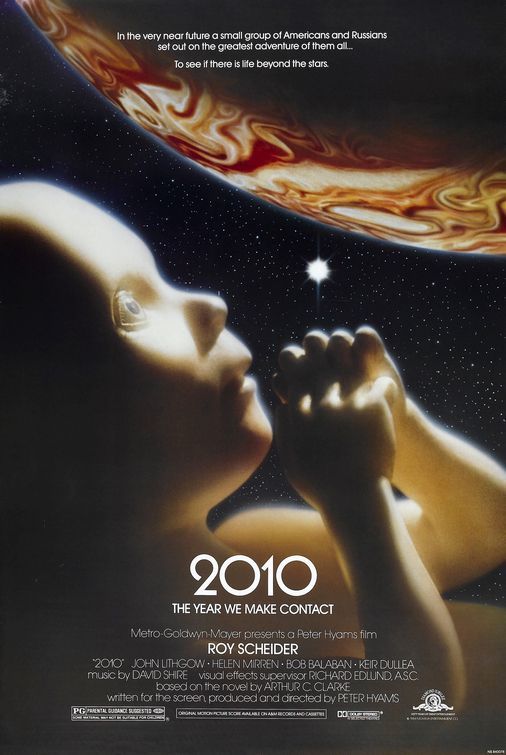
A sequel was made in 1984. Directed by Peter Hyams 2010: The Year We Make Contact is a pale imitation of the original. As a sequel, it is not great. Where Kubrick’s film is mysterious, asking big questions and giving no answers, 2010 is all answers.
But if you can separate it from the original, and take it on by itself, it’s actually pretty good. Admittedly, that is a difficult task, as this film is basically an answer to the questions asked by the original. Its plot takes place right after 2001 ended and its characters spend their time hunting down what happened in that movie. But if you can get the original out of your mind and just let this one do what it’s doing, then I think you can find it enjoyable.
I said it begins right after the events of 2001, but really it begins 9 years after that movie (hence 2010 in the title.) At the end of the first film, the crew from the Discovery One spaceship which was on a mission to Jupiter are lost. The HAL-9000 computer, which controlled pretty much everything on board went a little crazy and killed most of the crew. Dave (Keir Dullea) the only survivor disappeared. As an audience, we know that he discovered a giant black monolith orbiting Jupiter and was sucked inside it. A long, psychedelic trip then turns him into a cosmic space baby. But in-film, the people of Earth have no idea what happened to him.
The Americans and the Russians are both planning missions to Jupiter to find out. There is a time rush as the Discovery One is slowly losing orbit and will soon crash. The Russians will have their ship ready faster than the Americans, but it is the Americans who have knowledge of the Discovery One and are the only ones who can reboot HAL. So, three Americans Heywood Floyd (Roy Scheider) who feels responsible for the entire Discovery One mishap, Walter Curnow (John Lithgow) who designed the Discovery One, and R. Chandra (Bob Babalan) who created the HAL-9000 computer, jump aboard the Russian ship.
All of this occurs during the height of the Cold War. During the mission relations between the two countries deteriorate with a Cuban Missile Crisis-type situation pulling them toward the brink of war.
The astronauts try to ignore the ongoing politics back home and instead concentrate on the mission. The film does explain what happened to HAL in 2001, but I won’t spoil that here. It explains further what the monolith is and what the aliens want, but again no spoilers. None of that is particularly thrilling or all that interesting. And if you want it to it can destroy all the mystery of 2001.
However, the design of everything is really quite good. I especially enjoyed the matte paintings and the various images of space, Jupiter and its moons and the placements of the ships within all of that. All of the space stuff is really interesting. I also enjoyed the relationships that develop between the various scientists (Helen Mirren plays one of the Russians and she’s always fun to watch, especially when attempting a Russian accent).
If this movie existed on its own, if 2001 had never been made I think 2010 would have been well-regarded. It might not be a classic, but It would definitely have a good following. I’d argue it should definitely be reconsidered, despite the Kubrick film always overshadowing it.
I wrote a different review of this film back in 2004. You can click here and read it if you like (spoiler alert, I hated it).
 themidnightcafe.org