Great British Cinema: Slaughterhouse Rules (2018)

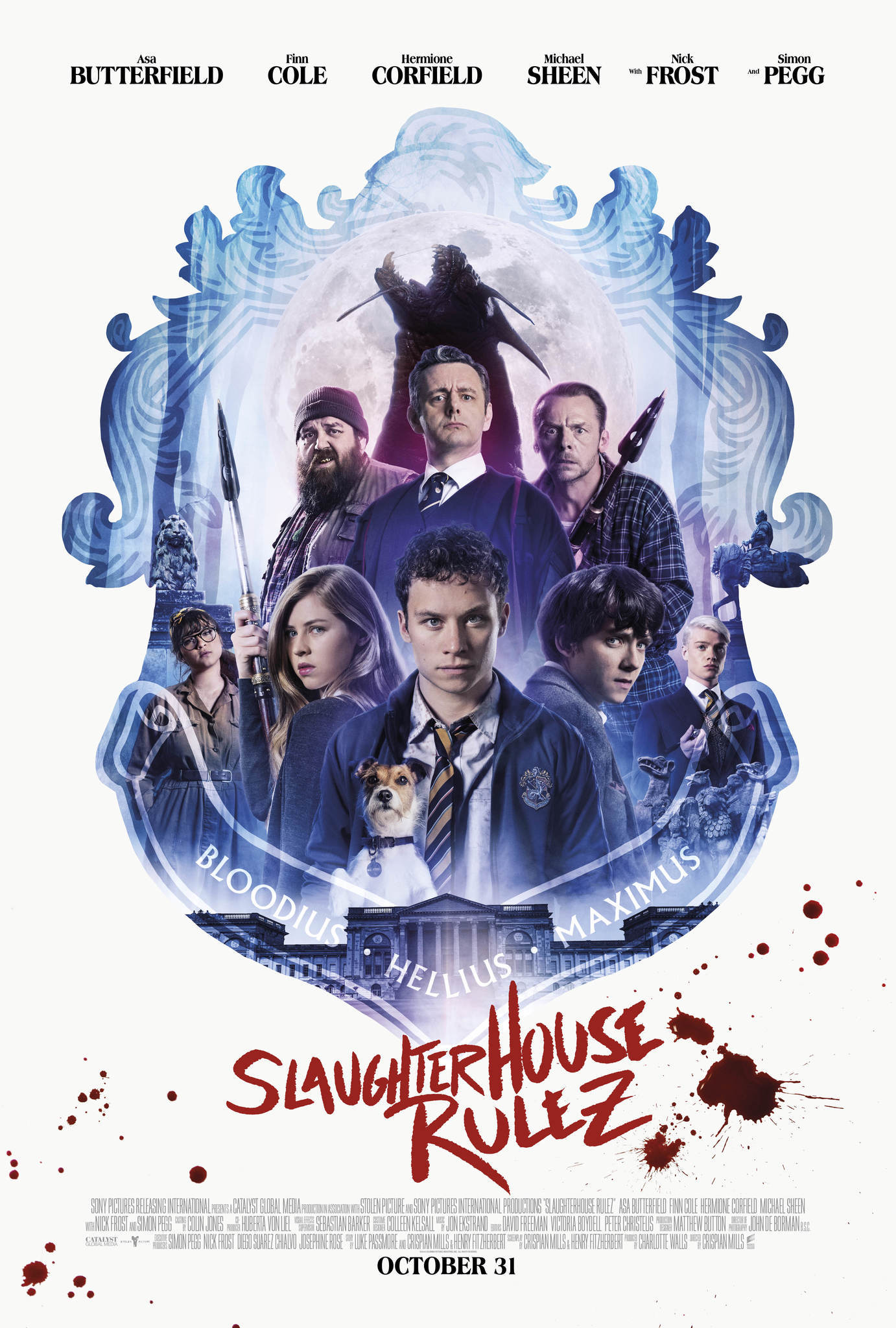
slaughterhouse rulez

My tendency with this theme is to look to the past, to choose very old movies. I don’t know why exactly that is, beyond the fact that I just like old movies. But there is something about older English films that just feel British, more than modern ones do. But of course, Britain still has a large and lively film industry. So I did want to watch some modern British films in this series as well.

I more or less picked Slaughterhouse Rulez at random. I’d never heard of it before finding it on my streaming service. But it stars Simon Pegg, Nick Frost, and Michael Sheen (who I’ve very recently been thoroughly enjoying in the new season of Good Omens) and I’m always on board with those guys.

I want to say that it is like Harry Potter but without magic and with more monsters, but I don’t know if that’s fair. I mean it is like Harry Potter in that it is about a bunch of kids at a posh boarding school and there are things like houses and head boys, but I don’t know that this concept is exclusive to Harry Potter. Rather it feels very much a part of British culture.

Anyway, Finn Cole plays Donal Wallace, a working-class boy whose mother has found a way to get him into Slaughterhouse School, an exclusive boarding school. At first, he feels out of place since everyone seems to know each other and other are lots of strange rules, but he quickly makes a few friends, a few enemies and meets a pretty girl (Hermione Corfield).

But before it becomes a British John Hughes-style dramedy, some nasty creatures start killing people off. They seem to be coming from a giant sinkhole that was created by a fracking company working on school grounds (and sanctioned by the Headmaster (Michael Sheen)).

It is a perfectly enjoyable little horror comedy, that never really quite scares or makes me truly laugh. It is the type of film that after watching I said to myself, “that was nice” and then moved on to something else. There is a touch of political commentary with the fracking stuff, but it never goes very far with it.

Simon Pegg is one of the school professors who is rather preoccupied with his wife (played by Margot Robbie for some reason) who recently left him to work in some overseas, war-torn country.

Nick Frost is a former student who now heads a guerilla group in opposition to the fracking company who also sells drugs on the side.

It is funny, just not overly so, and the horror is well done, just not exactly terrifying. It is worth watching if you like that sort of thing, just keep your expectations manageable.

Great British Cinema: Quatermass and the Pit (1967)

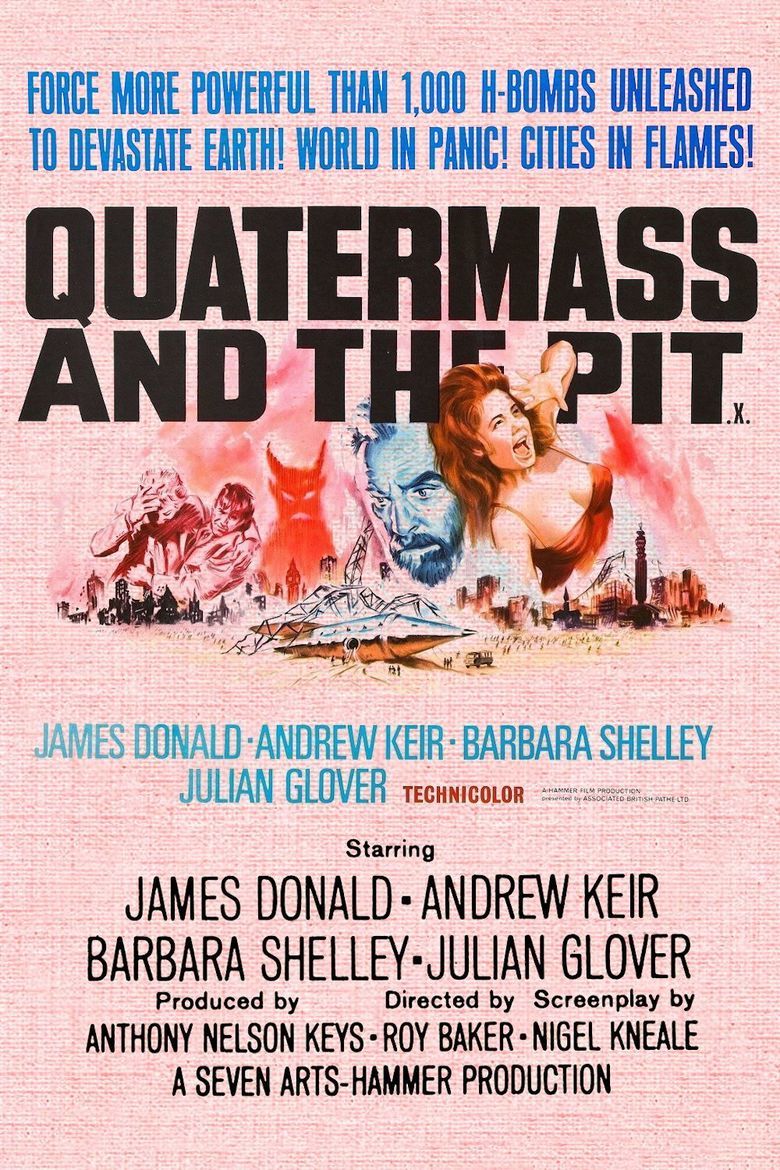
quartermass and the pit

I’m obviously a fan of Hammer Studios’ horror productions of the 1950s and 1960s as I’ve talked about them numerous times on these pages. I’ve also talked about how my wife doesn’t like horror films and that I usually watch them without her. She does like Hammer Horror as they usually aren’t too scary or gorey and so when my daughter is away I’ll sometimes throw one of their films on.

So it was with Quatermass and the Pit. My wife was actually busy doing something else when I put it on, but when I hollered down to her that I was watching a Hammer movie she came right up. Quatermass and the Pit is actually the third film in a loose trilogy. The first film The Quatermass XPeriment came out in 1955, Quatermass 2 followed in 1957 and then this third film came out in 1967. I’ve seen the other two but I couldn’t for the life of me tell you anything about them now. This isn’t to say that they were bad, but perhaps they just weren’t all that memorable.

All three films follow Professor Quatermass (played by Brian Donlevy in the first two films, and Andrew Keir in this one) a brilliant scientist who keeps finding himself involved in strange occurrences and alien invasions.

Quatermass and the Pit begins with some scientists down inside a London Tube station. Some construction workers had been digging out a new tunnel and came across some strange ape/man-looking skeletons. After some more digging, they come across a smooth, roundish object. Fearing it is a leftover Nazi bomb they call in the military. A little more digging shows it to actually be some kind of alien ship.

That’s when Quatermass is called in. There is a lot of silly sci-fi nonsense that comes after and the inevitable clashes between science and the military. The Quatermass films always remind me a bit of Jon Pertwee-era Doctor Who in that he’s this brilliant scientist who is amazed at new discoveries and alien lifeforms, and he winds up butting heads with military forces that just want to shoot things and blow them up.

The whole thing is a bit ridiculous and wonderful in the way science fiction films often were in the 1950s. The fact that this was made in the late 1960s makes it somehow even more awesome.

Great British Cinema: An Inspector Calls (1954)

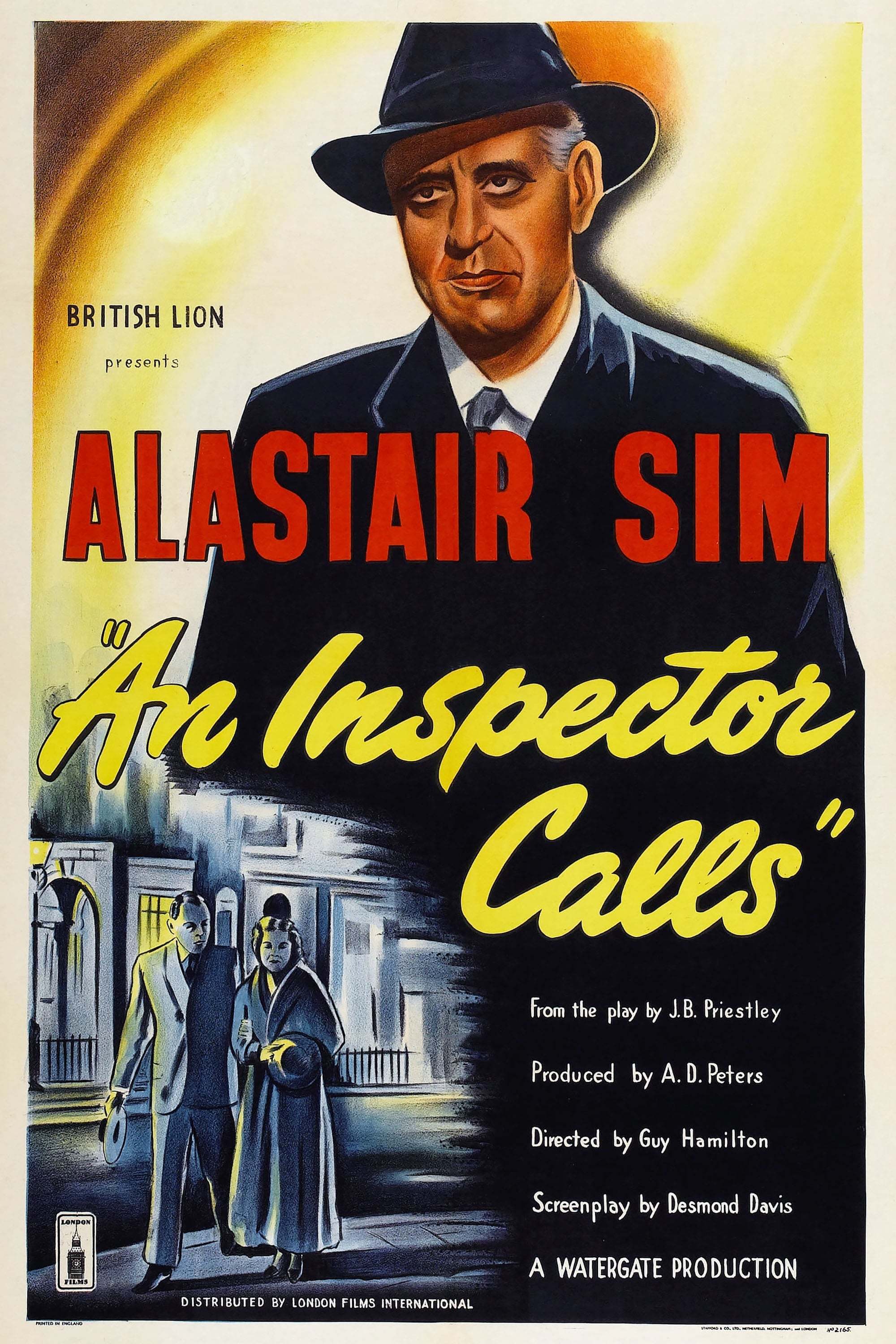
an inspector calls

The Birlings, an upper-class English family sit down to dinner. They are celebrating the engagement of the daughter Sheila (Eileen Moore) to Gerald (Brian Worth) a young man of good stock with great prospects. The father Mr. Birling (Arthur Young) a man of some standing in the community is ever so pleased with this match. The prim and proper Mrs. Birling (Olga Lindo) who dedicates her time as head of a charity organization designed to help destitute young women, is also pleased. Even young Eric (Bryan Forbest) who perhaps drinks too much and is not yet ready to become a serious young man, is happy for his sister.

Into this scene of merriment enters Inspector Poole (Alastair Sim) who tells the family a tale of a young woman, Eva Smith (Jane Wenham) who just that night swallowed some poison and died an excruciating death.

As the family begins to wonder what all that has to do with them the Inspector begins to question them one by one and as it turns out each of them knows the young girl independently of the other. And each of them ultimately treated her quite poorly due to her class and station in life.

Mr. and Mrs. Birling stand by the idea that they did nothing wrong. They treated a woman of her class and station as she should be treated. He fired her for demanding a raise, she denied her charity because she was too uppity and should be able to find means elsewhere.

But the younger people, Eric and Sheila become appalled by their (and their parents) behavior. They treated the poor girl terribly and could therefore be seen as responsible for her death.

In the middle of this is the Inspector. He is from the lower classes which puts him beneath the Birlings in social standings, but as an inspector, he is granted certain powers. He is allowed to question the family but is expected not to push. When he does they push back.

Alastair Sim is magnificent. You can tell the actor was having a glorious time and we do too, just watching him. He seems to know the answers to all of his questions before he asks them, but he wants the Birlings to answer them anyway. He wants them to understand how their behavior affected the young woman (and will continue to affect others.). He pushes just far enough to get their cackles up, but not enough to have them throw him out (or to call his superiors.). A sly little grin periodically appears on his face showing how much he’s enjoying himself.

It is a wonderful little film. As an American class distinctions of the type they have in England are fascinating to me. I love films like this that dig into those social standings and play with them.

I highly recommend seeking it out and watching.

The Friday Night Horror Movie: The Innocents (1961)

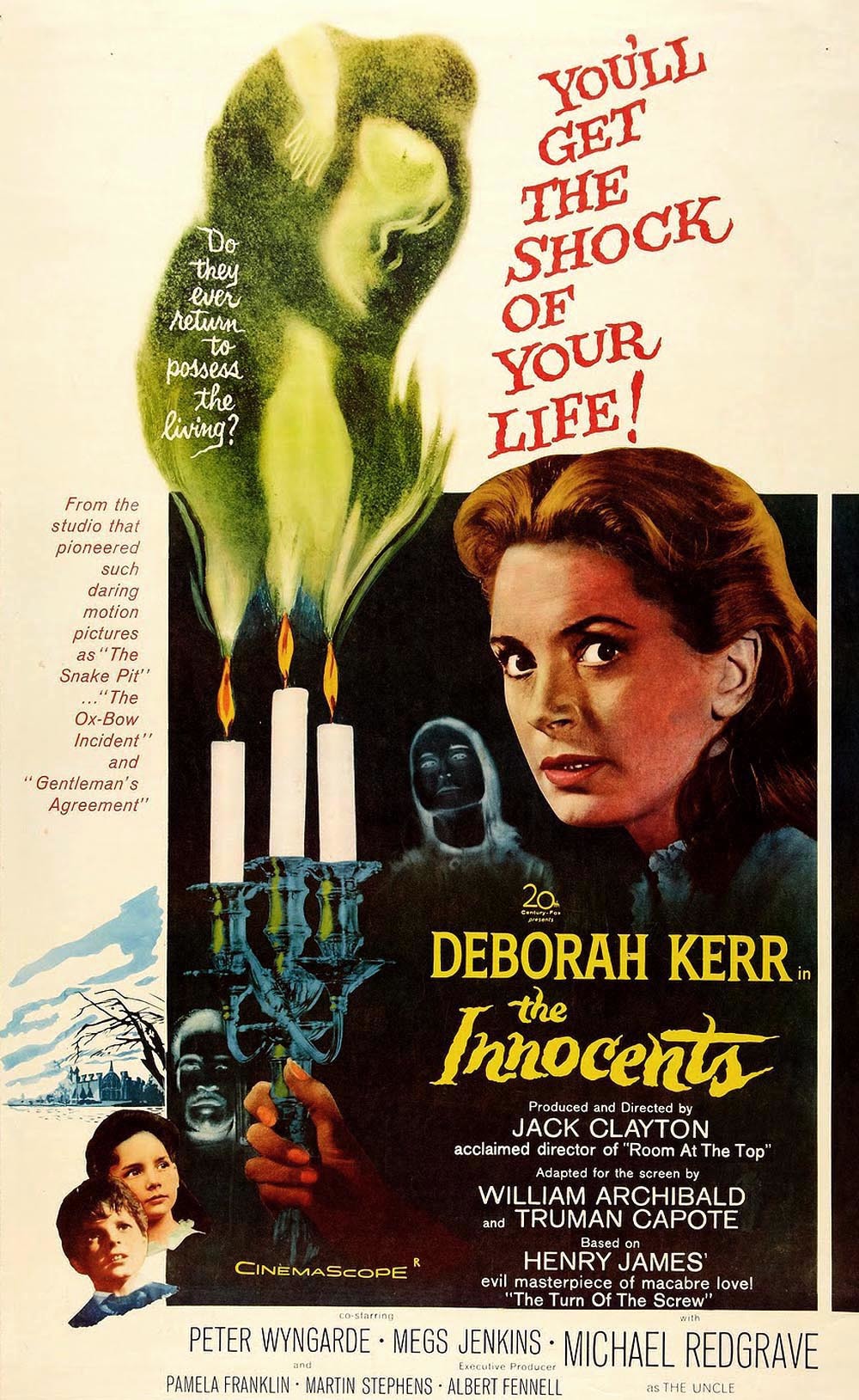
The Innocents

Based upon The Turn of the Screw by Henry James The Innocents stars Deborah Kerr as Miss Giddens a young woman who takes her first job as a governess for two children at a large country estate.

At first, things seem absolutely perfect. The estate is wonderful, the house is beautiful and there are lovely gardens and a pretty little lake that you can take a rowboat out on. Mrs. Grose (Megs Jenkins) the housekeeper is kindly and the children – Miles (Martin Stephens) and Flora (Pamela Franklin) are adorable.

She actually doesn’t meet Miles at first for he is away at school but Flora seems like an angel. They get along marvelously. Flora keeps saying that Miles will return home soon, but that can’t be correct for the term has just started. When he does arrive shortly thereafter – expelled from school – we know strange things are afoot.

Miss Giddens never seems to sleep well, she tosses and groans all night. She hears whispers echoing through the house. She sees visions of a man and a woman wandering about the grounds. When she describes them to Mrs. Grose she finds they look just like the former governess and groundskeeper both of whom died at the estate.

I won’t spoil where it goes from there, but it does go to some very interesting places. But what makes The Innocents so wonderful isn’t just the story but the filmmaking. It is shot in beautiful black and white that often uses a deep focus allowing people and objects in both the foreground and background to remain sharp. Director Jack Clayton uses this to great effect often placing a character very close to the camera while allowing someone much farther back to react.

It makes great use of light and shadow. The house is both enormous and claustrophobic, enchanting and terrifying. It has some of the best sound design I’ve ever heard in a movie. The musical score consists mostly of a hauntingly beautiful little melody that is played over and over, and sometimes sung and hummed by the children. The house is full of strange noises. There are footsteps and whisperings, creaks, and insects buzzing, and the constant howling of the wind. I’d love to see this film in a large theater with a great surround sound system for I know these noises would come from everywhere to great effect.

It isn’t a particularly scary film, but it is full of dread and a sinister mood. There is a lot of bubbling beneath the surface of the film. Miss Giddens comes from a small home in the country. Her father is a minister and she’s been quite sheltered. When she learns about the former governess having an affair with the groundskeeper she is quite shaken. When she finds out it was the children who caught them in the act she is completely shocked.

Quite a few people have pointed out that her visions of ghosts and her fear that the children are being possessed and need to be protected at all costs come from her own repressed sexuality.

I’m not smart enough for all of that, but I can say there is a lot to come away with and unpack.

This was a wonderful way to start my Great British Cinema month.

The Shout (1978)

the shout movie poster

I had planned to make this film last week’s Friday Night Horror movie, but about halfway through I stopped it to do some family things, and when I tried to pick it back up, my Internet was acting wonky and I couldn’t get it to play (it is currently on the Criterion Channel). But since it has been on my mind, I figure I’ll talk about it now.

A cricket game is being played at a mental institution. Patients and employees play alike, and a few outsiders are brought in as well. One such outsider, Robert (Tim Curry) takes score inside a covered wagon. A strange man (Alan Bates) joins him. This man begins to tell a story and the film follows.

In a small, seaside village live Anthony and Rachel Fielding (John Hurt and Susanna York). He’s an experimental composer who also plays organ for the local church. After services, one Sunday a stranger, Crossley (Alan Bates) begins talking to Anthony. Crossley has some odd ideas about theology and Anthony pushes him away stating that he has to go home. Instead, he meets with his mistress for a tryst.

When he does arrive home he is met at the door by Crossley, who slyly mentions how long it took Anthony to get to his home. Crossley then invites himself for dinner. He says that he spent fifteen years living in the Australian outback with the Aboriginal people where he learned their magic. He professes to know a shout that will kill anyone within listening distance.

At first, the Fieldings are put off by him, but then he seems to hold power over them. Rachel is seduced by him and Anthony does whatever he says. The film is somewhat vague on whether or not he does have supernatural power. It seems to be real, but it could also be a hallucination.

The entire film could be a hallucination, come to think of it. We periodically cut back to that cricket game. Crossley is there telling the story, at least I think it is Crossley. It is someone played by Alan Bates but I don’t believe he ever gives his name. Anthony is there, too, playing cricket. But again, is that Anthony, a different character played by John Hurt?

Are these two characters at the cricket match patients? Has the storyteller been telling the truth, or is he just making up a story? Is the cricket player actually Anthony? Is he now a patient at the hospital? Or do we see that person as Anthony inside the story because the storyteller just happens to be watching him play cricket?

The film doesn’t let us know any of the answers. It is enigmatic and strange. British films in the 1960s-1970s were often enigmatic and strange. They often dealt with the supernatural and relied more on mood and eeriness and plot. So it is with The Shout. Don’t expect the film to tell you anything and you might find yourself enjoying it.

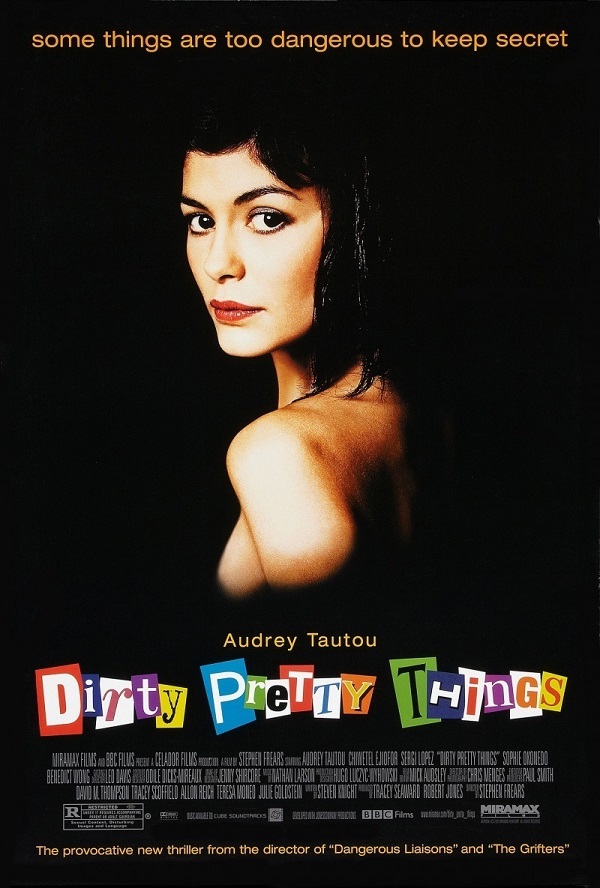
Dirty Pretty Things (2002)

dirty pretty things poster

Amelie speaks English.

My favorite Audrey Tautou speaks my very own language. There is a god after all.

She speaks very odd English with some kind of accent, in a rather dark, disturbing film.

Over the last year I have become more and more (enamored? mystified? let’s just say) intrigued with British culture. This began while I was living in France. I became friends with a number of folks from England and we had many conversations about the differences between American and British cultures.

French movie theatres also show a great deal more British films than their American counterparts. An ongoing writing friendship with some of my Blogcritic companions residing in Great Britain has also engulfed me in the interesting world of British rock. Great bands like Babyshambles have come to my attention across the great blue sea.

It is a fascinating thing to see how very much similar we all are, and yet how completely different we remain.

Dirty Pretty Things takes place in the dirty, back streets of London. It concerns the dark world of illegal immigrants and the sometimes shady deals they make trying to stay.

It opens with a mysterious man who works by day as a cab driver, nights as a motel watchman, and in between as some kind of underground doctor. It’s all unexplained, mysterious, and weird.

We find that he is an illegal working multiple jobs all of the time so that he may stay in England because he cannot return to his homeland. It all remains unexplained, mysterious, and weird.

This man, called Okwe (Chiwetel Ejiofor), is a good, honest man. Through the course of the film, he must do very bad things in order to stay in the country and not be turned in. The movie works as a competent thriller while trying to say something about the current state of British immigration. Like US immigration there is a myriad of problems, not the least of which is the underground black market that revolves around illegals.

Stephen Frears does a good job of keeping the politics in the background and the suspense right up front. It isn’t pleasant looking, for it delves into the back alleys and dark corridors of a city, but it tells that story with a true eye.

‘Tis not a perfect film by any means. The plotting by its end is a little heavy-handed and it tries to say more about society than it is really able to. And even my beloved Audrey speaks in an accent that makes me cringe, but it is a film well worth watching. If nothing more than to give me more pleasure from my newfound English fixation.