
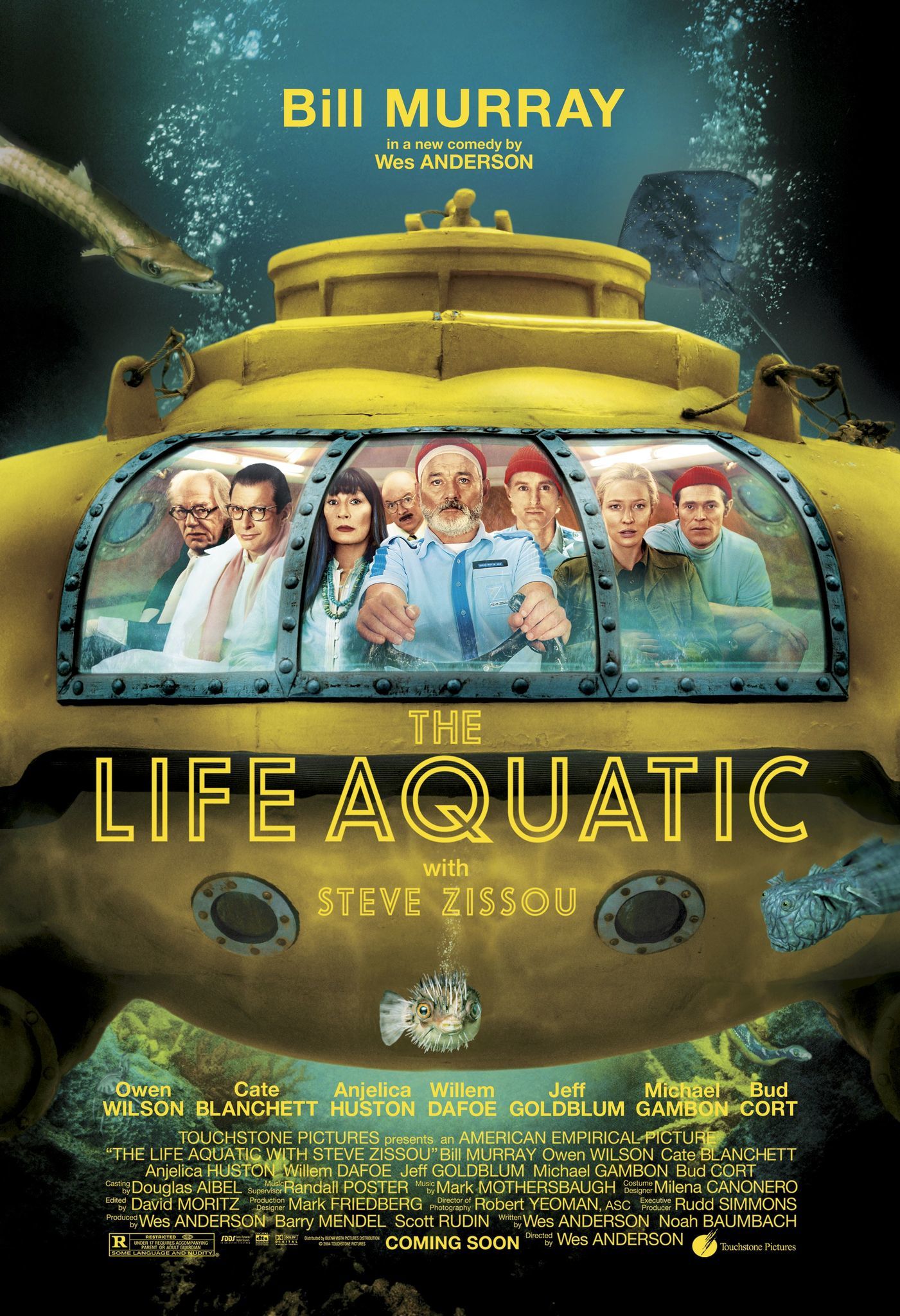
The Life Aquatic with Steve Zissou (2004)

the life aquatic poster

Wes Anderson pictures are always an event. His first three pictures (Bottle Rocket, Rushmore, and the Royal Tenenbaums) have all been brilliant bits of quirky genius. I have waited not so patiently for his fourth picture, The Life Aquatic with Steve Zissou, to make it to France. Though I tried to read little in the way of reviews, I couldn’t help but notice quite a bit of negativity being garnered it’s way. After viewing the film, I too, couldn’t help but feel a little letdown, but this has more to say about my expectations of a Wes Anderson picture, than the actual picture itself.

Bill Murray proves once again that he is a better actor post 50 than anyone could have imagined. He plays Steve Zissou, a Jacques Cousteau-esque oceanographer who has seen better days. He has spent the last decade scrounging harder and harder to find the funding for his voyages and the subsequent documentaries from them. It seems the critics have been harsher as his fans have become increasingly few. The film opens with Zissou showing his latest documentary to a bored audience. He is attempting to find funding for a second voyage, one that will allow him to exact revenge upon the jaguar shark that killed his friend. He finds the money through Ned Plimpton (Owen Wilson) who may be Zissou’s son, but no one is really quite sure.

Zissou and his might-be son, are accompanied by a ragtag crew and a reporter, Jane Winslet-Richardson (Cate Blanchett) who forms some kind of love triangle with Zissou and Plimpton. Aboard the rusty, ancient Belefante all hands set out to find the mythical shark. Though before they find the beast they encounter many adventures such as found in any road trip film.

Anderson fills his film once again with plenty of quirky, oddball characters. This time he seems to have filled the action as a means to pay homage to various movies and television shows from the 70s and 80s. There is an action sequence towards the middle that is straight out of a Charlie’s Angels or A-Team episode. The much-discussed animated fish seem to be copied from the Incredible Mr. Limpett. Many of the camera movements, including extensive use of close-up zoom on a single character only to zoom out and zoom out again to find the character surrounded by others, seem to be out of some classic television director guidebook. Before I realized Anderson was mimicking that style I was annoyed with the whole thing. Once I caught on I found a few of these moments to be brilliant put-ons, but often I felt like I was watching the last 15 minutes of Adaptation. Where yes I get the joke, and yes I find it funny, but it got tiresome rather quickly.

One of the joys of The Royal Tenenbaums is that each character is fleshed out to some degree. It is a large ensemble picture, but even the smaller roles have moments in which to give them some dimension, to make them real. The Life Aquatic similarly has a large cast, but all but the major characters are never given a chance to become three-dimensional. Why, for instance, does the navigator spend most of the film topless? If this is to present that she is a free spirit, why does she argue with Zissou over sailing over unprotected waters? Or why is she so upset with him for stealing the equipment? Her character is given no reasoning behind her behavior, and her actions only force the plot along without any purpose. She is not the only character like this. Either Anderson is again mimicking the plotless plotlines of classic television, or he has done a poor job of filling in the details of his characters.

Many things work in The Life Aquatic. Bill Murray proves again he is more than just a funny, funny man. The characters that are filled out, are aptly acted. Though just what is the deal with Cate Blanchett’s accent? She sounded like she was still hanging onto a bit of Katherine Hepburn. Anderson has again made a fun, funny, quirk of a movie. Yet, when compared to the rest of his output, I can’t help but feel a little disappointed. Here’s to his next film, and hoping his brilliance continues to shine for a little while longer.

Movie Review: The Aviator (2004)

the aviator poster

I have been a fan of Martin Scorcese since I have been serious about film. His films are intelligent, technically brilliant, and artful. He causes us to meditate on characters we’d rather forget, or shuffle to the back of society and our minds. His movies are often tough, meaty films that take a great deal to work through. His films have never been as popular as contemporaries like Spielberg or Lucas. But he doesn’t seem to mind, nor do his fans. While these other filmmakers soar to the heavens and look for the good in people, Scorcese seems to dig into the trenches and inhabit the rough sticky worlds that inhabit the low lives of troubled men. He seems interested in why people live violent, hurtful lives. He is…well many other people have praised his work far better than I can.

I have seen every Scorcese picture in the theatre since Kundun. Each time I venture into his films I come with high expectations. I know an excellent Scorcese picture is a true treasure, something to behold and love. I was well pleased to see that the Aviator was playing here in France in version originale, or with an English language track.

Scorcese pictures are always a technical marvel. And the aviator does not disappoint in this category. In post-production, he manipulated the colors of the film to mirror the production scales of the time period being represented. In early scenes the colors are “two-tone Technicolor” and then evolve into “three-tone Technicolor” and on to full-scale color by the end of the film. The flight sequences are spectacularly shot. Scorcese is such a master of the technical aspects of filmmaking that he makes even the most difficult shots look easy.

I have been a closet Leonardo DiCaprio fan for many years. It is difficult to admit this in mixed company because of the general distaste for the actor. Since Titanic drove a million adolescents wild, it seems no serious fan of the cinema can admit admiration of the actor (except for people like Steven Spielberg and Scorcese who keep putting him into their pictures). Yet, I continue to find him to be an actor of excellence. He does a marvelous job here, portraying a complex, fascinating human.

Cate Blanchett does a pitch-perfect job as Katherine Hepburn, one of the many Hollywood romances of Howard Hughes. Ms. Hepburn was such a caricature herself, portraying her must have taken plenty of guts. It is a fine, outstanding performance.

Many people carry only a vague notion of Howard Hughes. We know that he was quite rich, lived a glamorous, flashy life as a young man, and became a maniacal hermit in his old age. Pictures of a hunched, old man with long, white hair; an unkept beard; unclipped, yellow toenails, and boxes on his feet come to mind instantly whenever Hughes’ name is mentioned. This is the Howard Hughes we have become fascinated by. Yet this aspect of Hughes’ life is barely dealt with in Scorcese’s picture. Yes, we catch many glimpses of the demons inside him, and we even capture a few weeks of isolation, but mostly Scorcese dwells on the younger man, full of life.

Though Scorcese is often fascinated with eccentric, crazed lives, it is rare for him to give any reason for the lives of his characters. We can tell that loneliness helps to bring Travis Bickel, in Taxi Driver, over the brink. We see greed and violence begetting more violence in films such as Goodfellas and Raging Bull. But these things are only the beginnings of why they behave in such reprehensible ways. Preferring to allow his films to be questions, Scorcese never fully gives us answers. The Aviator, also, gives us hints to what may have driven Howard Hughes to such madness, but it never fully explains his actions. We see hints of a protective mother, and surely his drive to control every aspect of his life helped him become obsessive-compulsive. Yet these things are not answers, more symptoms of the overall problem. Scorcese is more interested in the behavior of his characters. The nuances of their actions, and the subsequent damage it causes. You won’t find cookie cutters to make you feel better about life in this film, but you’ll find a meditation on a brilliant, troubled man. If you care to dig a little deeper, you might be moved.