Originally written on September 20, 2006.
Nudity in the United States is an odd thing. We tend to love our nudity, yet are mostly ashamed of our love and try to hide it. Well we try to hide what we determine is actual nudity while plastering near nudity everywhere we can.
From TV to magazines to print ads, on beaches, sidewalks, and shopping malls, flesh reigns king. Skimpy bikinis, short skirts, and tight shirts are all acceptable, admired, and loved. Yet again, flash a nipple or pubic hair and there is an outcry from the same public that so adored the near nudity.
As a lad, I could often get my mother to allow me to watch the newest Arnold Schwarzenegger action flick filled with bloody battles, but as soon as a movie showed a bit of nudity and it was off to play Monopoly.
The nudity didn’t even have to be sexual. A girl walking out of a shower was reason enough to turn it off. Strangely we could often get away with a film full of innuendo or engaging in physical nuances that hid the nudity.
I don’t want to knock my mother too hard here, certainly, the culture she was raised in had a great deal to do with how she parented us. She tried her best to do the difficult job of guarding our television and movie viewing habits. A difficult job with no official rules to what is acceptable
It also must be said that we often baited her and pressured her constantly to allow us to watch the newest action flick while staying mostly mum about the nudity. As a kid, I didn’t mind complaining that it was just fake violence and wouldn’t affect me, but there was no way I was going to beg for boobies, no matter how much I secretly longed for them.
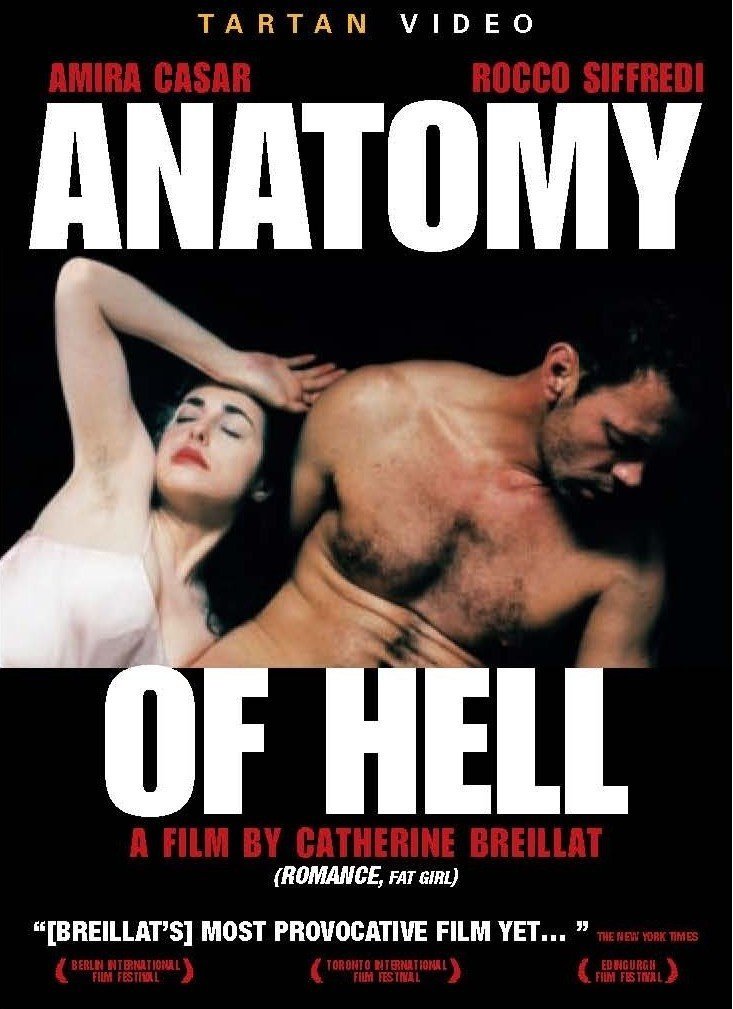
Funny how some 12 years after I’ve left home I’m still worried about what my mother will say having watched and reviewed a picture such as Anatomy of Hell.
The film starts with a warning which looks like the typical FBI copyright warning but which reminds the viewer that film is not real, but an illusion and informs us that the most intimate moments do not belong to the main actress, but a stand-in.
It then moves into two men involved in a little back alley oral action.
No kids, this isn’t going to be your typical night at the cinema.
The plot involves a woman (Amira Casar) on the verge – she is first seen in a nightclub where she promptly slits her wrists in the bathroom – and a young gay man (Rocco Siffredi) who rescues her from suicide.
The woman invites the man to her secluded home for four nights to “watch her where she is unwatchable.”
The film then concentrates on four nights of sexual exploration and philosophy.
It is not a film for the prudish, or squeamish, or for those looking to get their jollies off.
It is full of explicit nudity and sex, but also of graphic imagery that exposes both man and woman for everything that they are physically – from urinating to coitus to pulling out bloody tampons. It is anything but sexually stimulating.
It tries to do the same emotionally but is all too often obtuse with its imagery and symbolism.
In one scene the woman talks of her pubic hair and vulva as a newborn bird lying in its nest. The film cuts from a close-up of the woman’s nether regions to such a bird. The bird is then plucked from its nest by a young boy who sticks it in his pocket. Moments later blood on the shirt reveals the bird is dead and the boy then throws it to the ground and stomps the bird with his boot.
Not exactly subtle. But not exactly poignant either.
The dialogue is similarly robust. The man discusses disgustedly at the horridness of the female body while the woman remarks that all men despise women and if they could would murder them all.
There are lots of long, languid shots where the camera rests upon the couple laying in bed, or pouring a drink without music, sound, or dialogue. As if the image brings some meaning to its story.
If you look closely, beyond some of the more pompous turns of phrase, there is a deeper meaning to be found. Despite the hamfistedness, the director does have something to say.
There is a scene towards the end of the film after the couple parted ways where the man sits in a bar, angry at the previous night’s actions. Like many a man, he displays that anger by playing the braggart making like he devoured the poor woman and split her apart with his maleness, while it is he that has been torn down by those events.
No, Anatomy of Hell is not a film for everyone. Nor does it reach the lofty heights it aims for by breaking so many boundaries. Yet, for those willing to try, there is some truth to be gleaned, some treasure buried beneath its repulsiveness and pomp.




 themidnightcafe.org