
I’ve previously mentioned how The Silence of the Lambs helped me to become a lifelong reader. Well, Michael Crichton was no small slouch in that regard either. He became the first author that I really followed. I have fond memories of a couple of friends and me discovering his books and fighting over who would get to check one of the books from the school library first and who would have to wait.
The first book of his that I read was The Andromeda Strain – about an alien virus that crashes to Earth aboard a satellite and the scientists that study it. I loved it. I loved its realism and attention to detail. Just now I’m realizing that the Hannibal Lecter books by Thomas Harris and the stories of Michael Crichton appealed to me in the same way. Harris dug into the details of forensic and behavioral science – why serial killers behave the way they do and how the F.B.I. catch them. Crichton also leans heavily into his science background. Both authors lay out science in an organized and detailed manner. That appealed to me in some way.
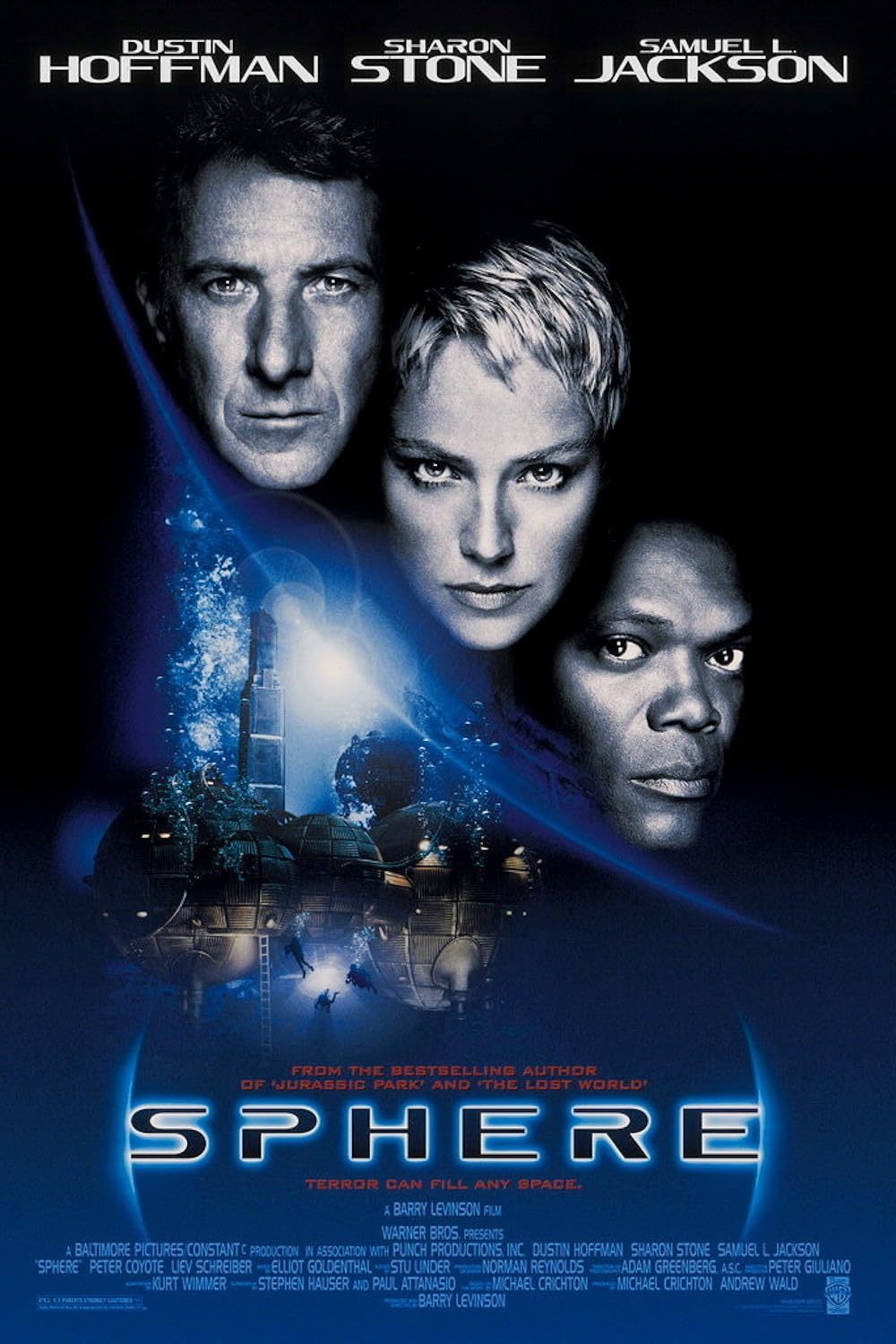
I don’t remember much about Sphere. I remember reading it on the bus – slouched down, knees on the seat in front of me. But I don’t remember much of the actual story. Except that, I was disappointed in it.
I was even more disappointed by the movie which took quite a few liberties with the book, though again my memories are fuzzy.
But it has been many years since I saw the film, and sometimes movies I was disappointed with as a college kid become better with age. Since this is Sci-Fi in July and that film stars Dustin Hoffman, Samuel L. Jackson, Sharon Stone, and Liev Schreiber I decided to give it another try.
Friends, it has not gotten better with age.
The basics of the plot are pretty good, especially in the beginning, but then it does a deep dive into stupidity and never recovers.
So, a ship is discovered at the bottom of the ocean. Several inches of coral have grown over it. Coral grows at a specific rate which indicates the ship has been down there for three hundred years. Since humankind didn’t have spaceships 300 years ago it is determined that this ship is extra-terrestrial in origin.
A few years prior psychologist Dr. Norman Goodman (Hoffman) was tasked by the Bush administration to write a paper detailing what should be done if aliens were discovered on Earth. He filled in some procedures and proclaimed you’d need an astrophysicist (Schreiber), a mathematician (Jackson), and a marine biologist (Stone).
That’s a very Michael Crichton setup. He loves putting together a crack team of smart people to solve a crisis. But in this story (or at least this adaptation of this story) Goodman half-assed that paper. He needed the money and didn’t think anyone would read it. All of the scientists he claimed they’d need were just people he knew. Some of these folks are super smart, but they aren’t exactly the elite group of people one might actually ask for.
The military has already established a sea station on the ocean floor next to the spaceship. Our heroes take a sub down and investigate. Inside the ship they discover a few things I won’t spoil but also a large CGI sphere. It reflects everything around it except for the humans suggesting it is an intelligent life form.
One of the characters later goes inside the sphere but when he comes out he can’t remember anything. Soon after strange things start happening like the base station is attacked by a giant squid and strange sea snakes come out of the sink. Meanwhile, up above a huge storm has rolled in causing the Navy ships to have to leave for a few days, stranding our heroes down below.
At some point, the alien starts talking to our heroes through text messages on the computer. It is friendly at first and then it begins acting like a petulant child. Luckily, our psychologist knows how to talk to angry children. For a little while at least
For a little while I enjoyed the film. The basic setup is solid and I like the actors, but the longer it rolled the sillier it becomes. And stupid. As I said one of the things I liked about Crichton is that he took science seriously. He loved to get into the details without letting the story get bogged down. He probably made some stuff up, but he did it well. The film takes a lot of shortcuts with the science and it makes the film worse.
Director Barry Levinson is known for his character-driven dramas and he is clearly out of his depth with this blockbuster-fueled science-fiction horror story.
Sometimes it is best to remember that a movie is bad, and not try and prove those memories as faulty.
 themidnightcafe.org