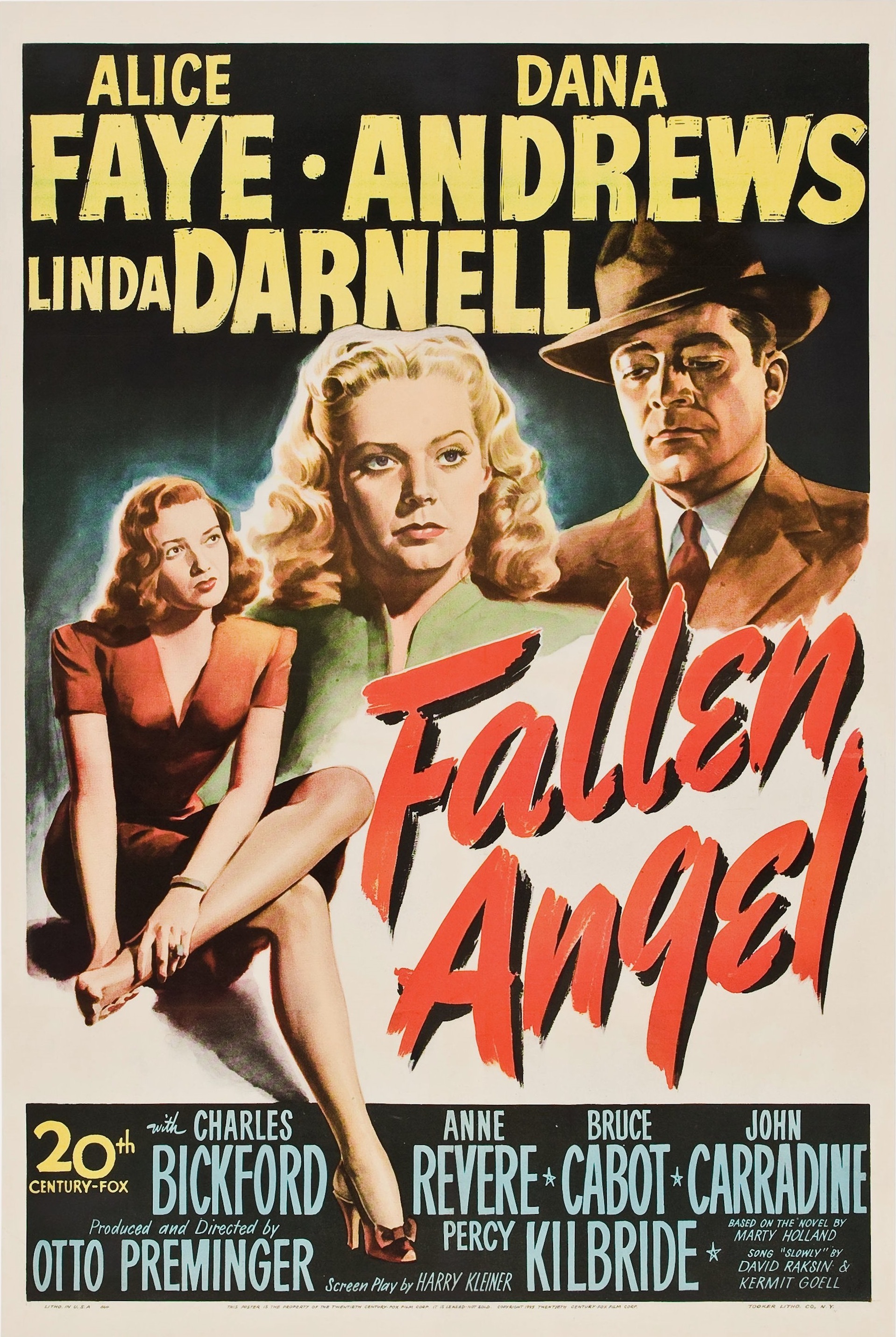
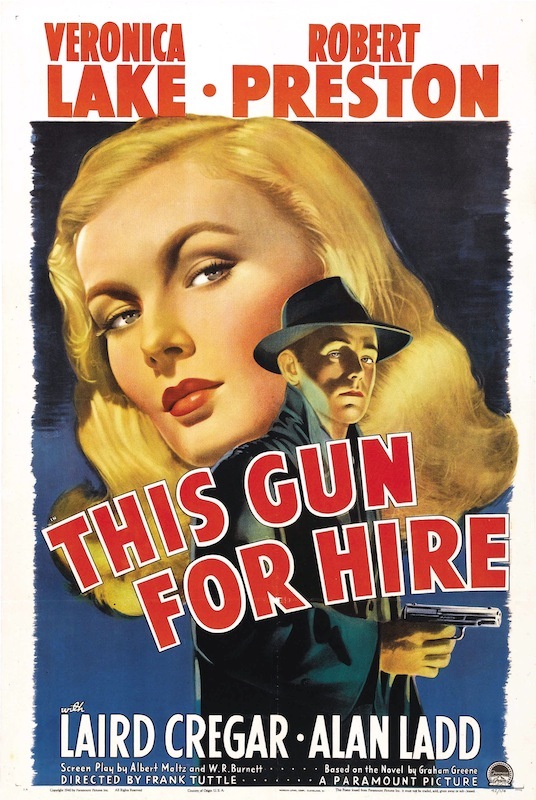
Noirvember #6: This Gun For Hire (1942)

this gun for hire

I had forgotten I had seen this before, but once I got started it was too good to turn it off.

Alan Ladd, in his first real role (he’d been in other films before but they were bit parts, so small he gets an “introducing” credit here) stars as Raven, a sadistic killer-for-hire. But he’s so good in it, he brings such emotional complexity to the role that you can’t help but root for him. He’s hired by Willard Gates (Laird Cregar) to bump off a chemist and steal some papers. Raven doesn’t ask questions, he doesn’t care what’s in the papers. He just does his job and takes his pay.

Gates double-crosses him by paying out in marked bills, ones that he claims to the police were stolen from his company. Detective Michael Crane (Robert Preston) is put on the case. He’s in love with Ellen Graham (Veronica Lake) who was just hired by Gates as a performer in one of his nightclubs. She accidentally winds up on a train next to Raven. Gates sees them sitting next to each other, thinks they are in cahoots, and calls the cops. Raven holds Ellen hostage in order to get away from the cops. Though she isn’t in cahoots with Raven she is working with a local senator who believes Gates is selling secrets to foreign agents.

As you can see, it is a complicated, convoluted plot. Director Frank Tuttle keeps things moving at a quick pace but still manages to more or less keep all the convolutions understandable. Veronica Lake is lovely as usual though she isn’t given much to do. She sings a couple of songs while doing some pretty fun magic tricks and makes googly eyes with Detective Crane. Her scenes with Ladd are good, but mostly she’s just there to look pretty. Preston has even less to do. He’s top-billed but he’s in the fewest scenes out of the three main cast members and when he is on screen it is just to move the plot along.

This is completely Ladd’s film and it is easy to see why he became a star. He really nails the nuances of the role and makes us feel sorry for a guy who kills for a living.

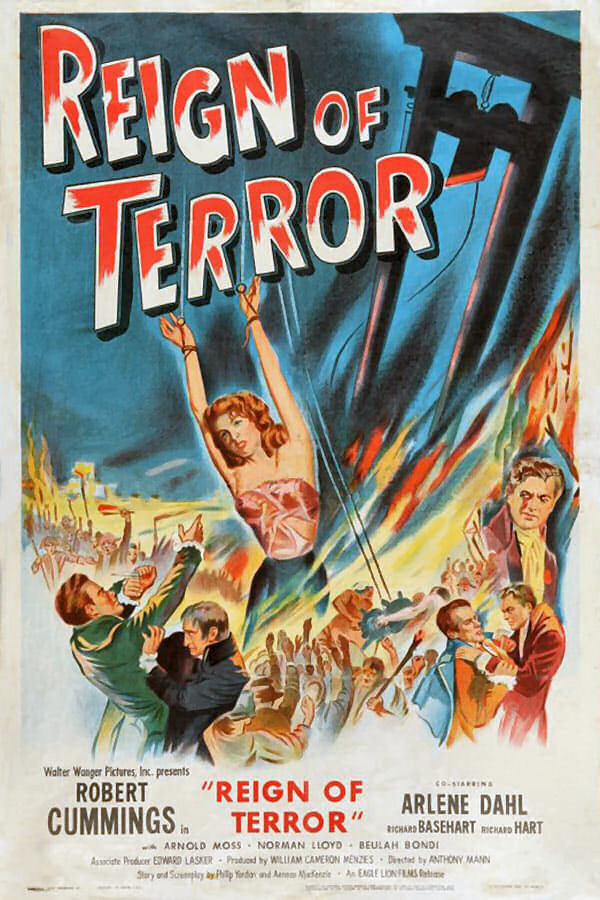
Noirvember #5: Reign of Terror (1949)

reign of terror

The thing about film noir is that nobody really agrees on exactly what makes a film noir a noir. The plots for this genre are all over the place. But the one thing everybody agrees upon is that a film noir has a certain style, a certain look. It is all about the light and the shadows. Noir had a way of lighting a set and a character like nothing else.

Normally you wouldn’t say a movie about the French Revolution could be a film noir, but director Anthony Mann who was no stranger to the genre having directed He Walked By Night, one of the great noirs, films Reing of Terror just like it was a perfect fit.

In this version of events, Maximilian Robespierre (Richard Baseheart) is not satisfied with having led France into a revolution, overthrowing the King and instilling a reign of terror by beheading anyone who opposes him, he wants to be dictator for life as well. Charles D’Aubigny (Robert Cummings) is tasked with infiltrating the Jacobin Party in order to find a Black Book. In this book written all the names, Robespierre intends to kill at one time or another. Since nobody knows whose name is in the book, everyone is afraid to oppose him. But if the book is opened to the people then the people may decide the time has come for Robespierre to face the guillotine.

Or something. The details of the plot get a bit muddled as it goes along. But it looks fantastic. The sets are brilliant and the lighting is full of bold, dark shadows. It is the sort of film where you can forget what is happening in the actual story because you are so mesmerized by how it looks.

Cummings is good but it is Arnold Moss who steals the show as one of Robespierre’s henchmen who wouldn’t mind seeing him at the wrong end of a guillotine if it helps line his own pockets and gains him a little more power.

Reign of Terror is definitely worth the watching.

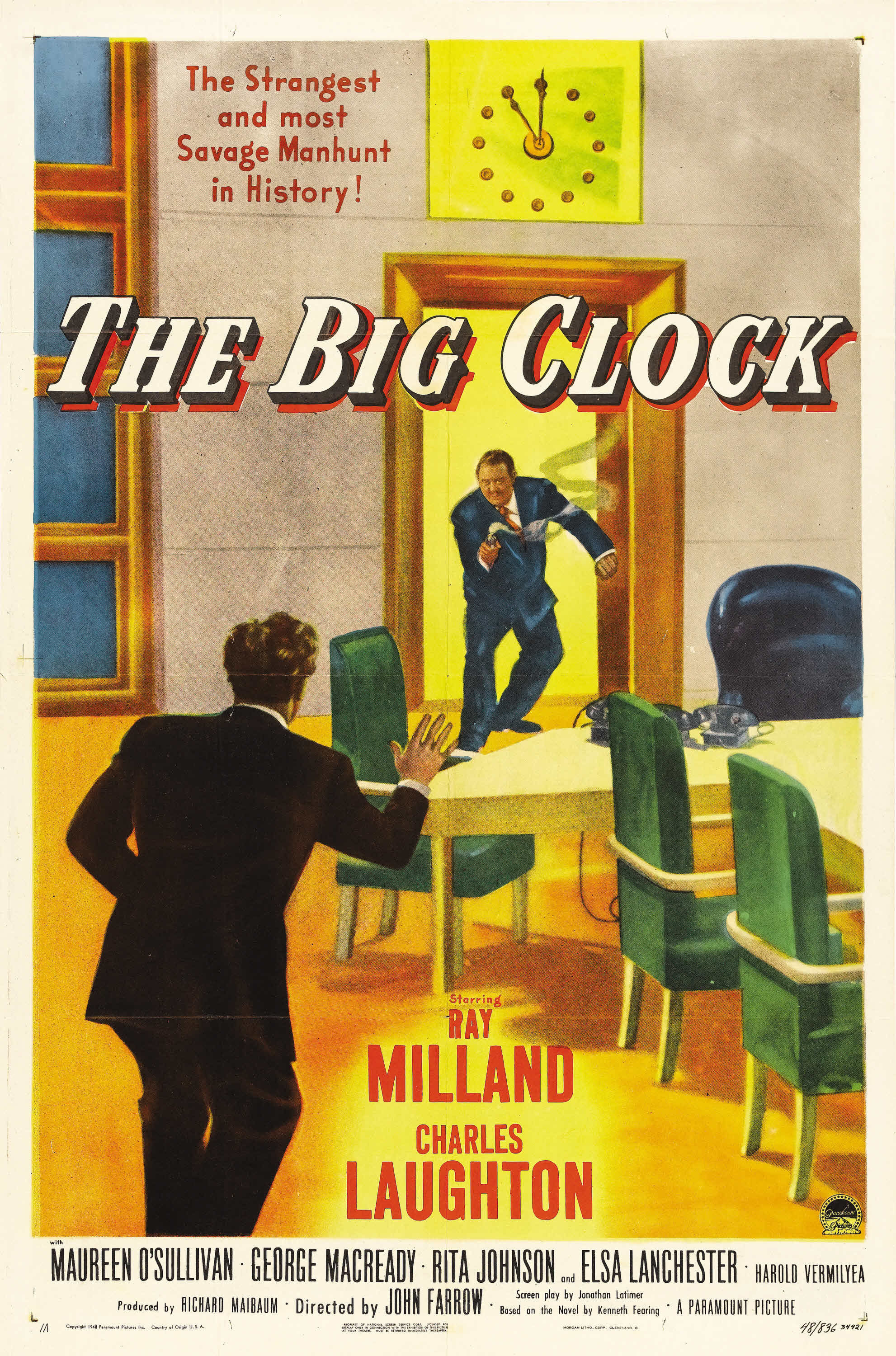
Noirvember: The Big Clock (1948)

the big clock poster

Knowing that I’m a big film noir fan, my wife recently bought me a bunch of postcards with film noir posters on them. Some of them I’ve seen, some of them I haven’t. A big chunk of my list of films to watch this month comes from those postcards. This is one of them.

Ray Milland plays George Stroud an editor at a big magazine in New York City. His boss Earl Janoth (Charles Laughton) is tyrannical. He’s the type of guy who calls a meeting to yell at everybody because subscriptions are down, then demands they come up with immediate solutions only to berate them when they respond. He doesn’t berate George because he’s just got a major lead on a missing person’s case. Janoth demands that George stick with the case even though he has a vacation planned for the next day.

George can’t miss that vacation. He’s missed too many vacations with this job, including his honeymoon. His wife is none too happy with him. He quits the job, but still misses his train. A glamorous woman, Pauline York (Rita Johnson) overhears his predicament and sees it as an opportunity. She’s Janoth’s secret lover and she’s ready to sell him out. She wants George to tell the story.

She gets herself murdered. Janoth learns that someone was seen leaving her apartment not long after the time of death. He forces George to supervise a team of reporters to figure out who that man was.

Spoiler alert: that man was George. He spends the rest of the movie trying to find himself.

The Big Clock is a lot of fun to watch. Milland and Laughton are terrific. Elsa Lanchester, in a tiny role, steals the show. It is one of those films that’s really quite good, but there is some little something that keeps it from being great. Still, it is a swell time at the movies.

The Accused (1949)

the accused

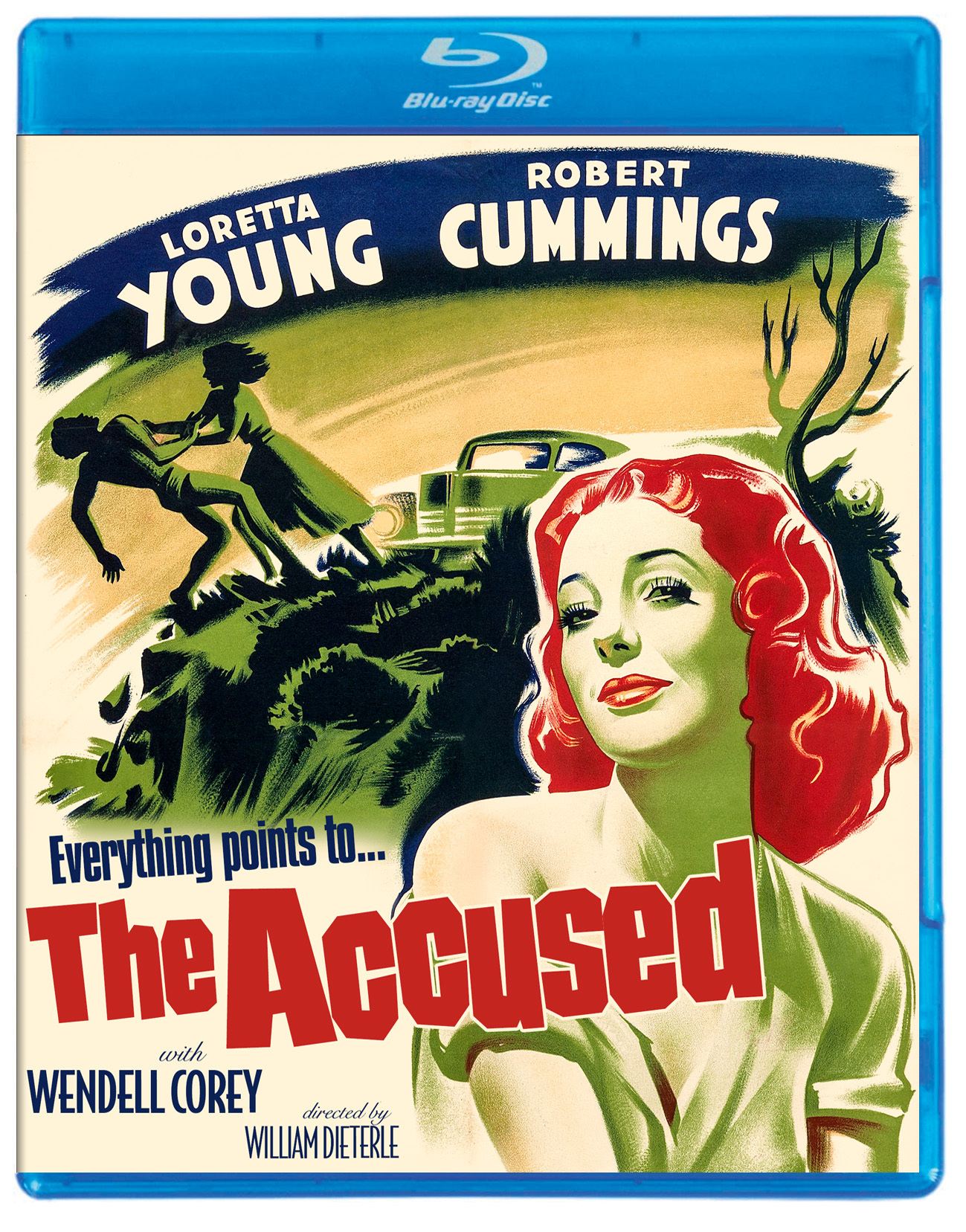
If you are growing tired of #31Daysof Horror then feel some relief in knowing that #NoirVember is coming in just a few short weeks. That’s when I’ll be talking about a lot of film noirs. But until then you can enjoy my review of The Accused, a rather good film-noiresque drama starring the always wonderful Loretta Young. You can read my review here.

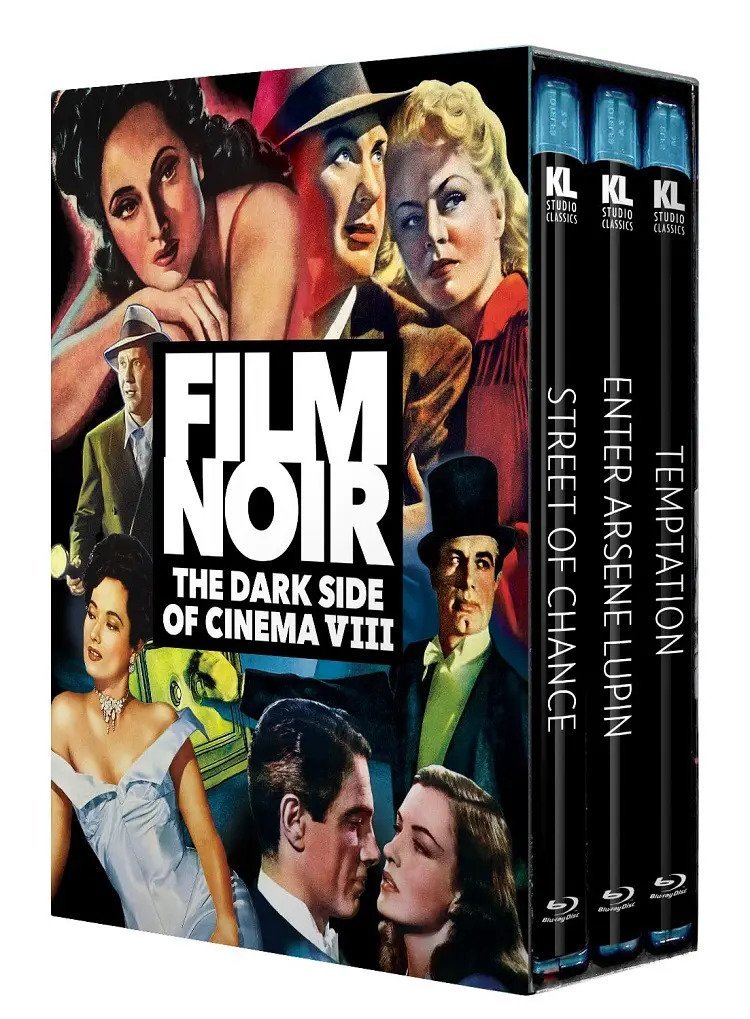
Film Noir: The Dark Side of Cinema VIII

film noir

Beyond horror, I am a huge fan of film noir. That’s a particular type of crime drama was made in Hollywood in the 1940s and 1950s. They use expressionistic black and white photography, a dark, cynical point of view, and usually a hard-boiled detective and a beautiful femme fatale.

Kino Lorber has been regularly putting out nice boxed sets of film noir featuring lesser-known titles in the genre. I recently reviewed one of those sets for Cinema Sentries and you can read it here.

The Postman Always Rings Twice

the postman always rings twice posters

Unlike the other classic masters of crime fiction (Hammett, Chandler, and even Christie if you must) James M Cain wrote not from the perspective of the cop, or the detective, but from the side of the criminal. He wasn’t really interested in the methods of detection, but in the methods and reasons crimes were committed.

There is no Phillip Marlowe or Hercule Poirot out to solve the case in Cain’s fiction. The righteous bringers of justice are regulated to a secondhand role in his stories and are often as slimy and unrighteous as the criminals.

In his first novel, The Postman Always Rings Twice, Cain weaves a complicated plot in a very simple manner. This was never meant as anything more than a pulp novel, its aim was to titillate, shock, and most important of all, sell gobs of books.

Though told in the first person by a main character, the book is all action. There is some internal dialog, but it sheds very little light on who the characters are, and what motivates them.

It is in fact, perfect for a screen adaptation. This is probably why it is credited as the story at least 5 times on the Internet Movie Database. The lack of complicated internal thought processes, and the predilection for talking and doing, make it the ideal movie. That, and great lumps of sex and violence.

The two most famous screen adaptations are the 1946 Lana Turner/John Garfield version and the steamier Jack Nicholson/Jessica Lange released in 1981. Everyone refers to that one as a remake of the 1946 version which gets me riled up for some reason. To me, it is simply another version of the novel, rather than a remake of the old film. There are about 8 million versions of Hamlet out there, but no one refers to the next one as a remake of an earlier film. It’s simply another version of the play. But perhaps this is because I’m a fan of the novel, and I probably shouldn’t make too big a deal out of it.

The plot takes on several turns but is essentially about lust and violence. Drifter Frank Chambers lands a job at a roadside diner owned by Nick Papadakis (Smith in the 1946 version). Chambers falls immediately in lust with Nick’s unhappy wife, Cora. They cook up a plot to kill Nick making it look like an accident. Complications ensue.

The biggest difference between the two pictures is that the 1981 version has got more sex. The book is loaded with sex, or should I say simulated sex or rather off-screen (or off-page) sex. Due to the prevailing censorship at the time the novel was written the sex had to be hinted at, double entendre’d, and written in such a way as to let everyone know what they were doing and not get banned from bookshelves. Even with that, it was still quite controversial at its time.

The 1946 version hints at all the deep-seated passion going on without actually showing us anything more than a few kisses. (Though on a side piece of trivia, audiences were shocked that Garfield obviously used his tongue in one of the kisses) By 1981 Hollywood was no longer under the strenuous Production Code and morals had loosened up more than a bit through the 60s and 70s and the new version of Postman all the sex was brought out front.

The kissing gets more passionate, there is touching, rubbing, and a good deal of nakedness. The steamy sexuality of the characters now scorches off the screen. They even added a new sex scene that wasn’t in the book, just for kicks.

But even with all the nakedness and sexing, this newer version doesn’t have all the lust of the original. Though Cain was unable to fill in all the sexy details of their affairs, the raw sexuality burns through each page. The characters are led by their passions and you can feel it in every word and deed. In the same way, though nary a thigh is even shown in the 1946 version, the passions full of lust are ignited on screen. Turner and Garfield exude sensuality without any sex that far surpasses what Nicholson and Lange can manage with a movie filled with on-camera love scenes.

The violence remains pretty much the same in both versions. As a culture, we Americans have always seemed to have less of a problem with violent deeds than with any amount of sexuality. Neither film is particularly graphic in its violence, though murder and attempted murder appear throughout both plots.

My biggest problem with the 1981 version is that first-time screenwriter, David Mamet, tries to fill out the characters and give more story to the story. In the book, Nick is not a bad man, and we are given no real reason why Cora would be unhappy enough in the marriage to kill. Mamet offers a few small scenes to try to show the darker side of Nick, not enough for the audience to truly hate him, but enough to give some justification for his murder.

Likewise, Frank is a pretty worthless drifter in the novel but is given a more tender side through the pen of Mamet. Both of these additions serve to lessen the story, not give it greater depth. Cain wrote characters full of selfish lust. Frank and Cora’s passion for each other moves them to do horrible deeds, not out of any love for each other, but for reasons all their own. While it seems admirable that Mamet would attempt to bring human reasons for the character’s actions, it only serves to muddle the story. The local news and true crime shelves are filled with real-life atrocities committed for no real reason at all.

The 1941 version sticks very close to the novel’s plot. There are a few minor changes, I’m sure, and some things left out due to the time restraints of the film. But mostly it sticks closely to the book.

Sadly the great ending of the novel is removed from the 1981 version. This makes the end a little more sad, but the great irony of Cain’s closing is all but lost.

I wrote a more detailed review of the 1981 version when a new Blu-ray of it was released, for Cinema Sentries which you can read here.

The Harder They Fall (1956)

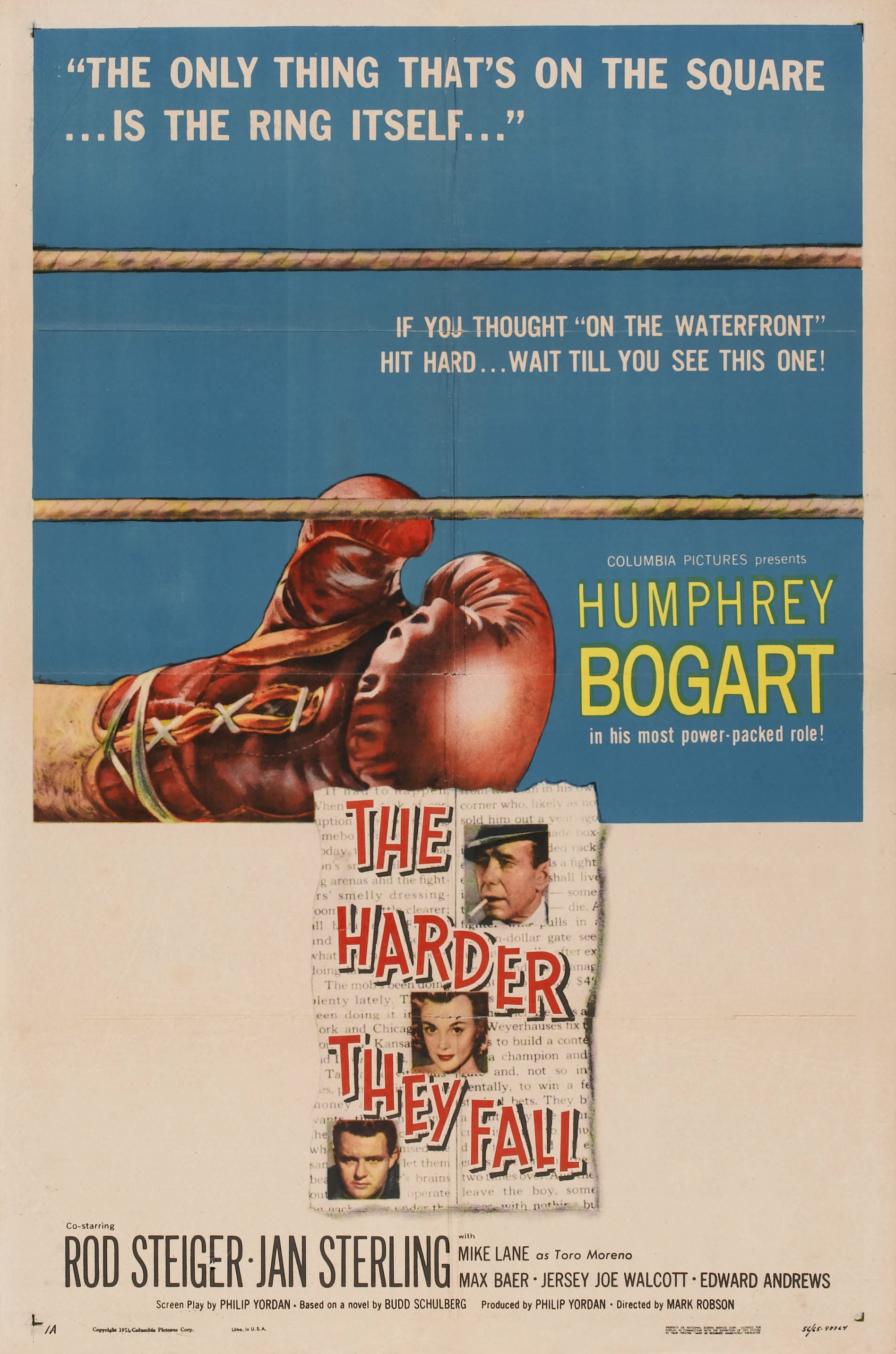
the harder they fall

I friggin’ love Humphrey Bogart. In fact, he tops my Top 10 list of greatest actors. He played cold-blooded villains, cynical but good-hearted tough guys, down-on-his-luck schmucks, and romantic leads with the same grace and passion. It doesn’t hurt that he’s been in some of the greatest movies ever made. With a resume that includes Casablanca, The Maltese Falcon, The Big Sleep, the Treasure of the Sierre Madre, and the African Queen it’s no wonder Bogart comes out as the actor starring in the most films on the AFI top 100 films list.

In fact, until now, I’ve loved all of the films I’ve ever seen starring Humphrey Bogart. I do my very best to catch any film in which he had a role. Being that he acted in some 74 movies during his career, I’ve still got a bit to go.

It was with great anticipation that I watch any Bogart film. You just can’t go wrong with a Bogie movie, I often say. Recently, I grabbed a worn-out VHS copy of his last film, The Harder They Fall. It pains me to say, but I can no longer claim that I’ve never seen a Humphrey Bogart picture that was less than wonderful.

It’s not that The Harder They Fall is a bad film. In fact, there were some rather good moments. It’s just that when compared to the other Bogart films I have seen this one falls well below the bar.

What pains me, even more, is that some of its failures lies in the hands of Bogart himself. Yet before we take the man off of his pedestal, I must remind the reader that at this point in his life, he was dying of cancer. It had not been diagnosed yet, but there is little doubt that Bogart’s insides were being eaten alive during filming. Legend has it that a sound-alike dubbed his lines during post-production.

His illness shows through the performance. He looks tired, and haggard throughout.

But you say “The character is tired and haggard, so shouldn’t the actor act that way?”

“Yes,” of course, I’ll answer, “but Bogart practically made a career of tired, haggard characters yet in films like Casablanca or Treasure of the Sierra Madre he embodied the characters and made them look tired.” Here, you see an actor who is a master craftsman performing at a much lower level than we’ve come to expect.

But, look, I spit on no man’s grave. Remember a fine actor’s better performances; let a dead man have his dignity.

There is a film in there, besides a Bogart performance. The plot concerns a down-and-out sportswriter, Eddie Willis (Bogart) hired as publicity man for an up-and-coming boxer (Mike Lane) who can’t actually box. The boxer, Toro Moreno, is a giant of a man who looks menacing but punches like a girl (and not a girl like Maggie Fitzgerald in Million Dollar Baby). You see Toro is mob-connected boxing promoter Nick Benko’s (Rod Steiger) fighter. Benko plans to buy every fight Toro boxes all the way up to a championship bout in which, betting on the other fighter, Benko will make a bundle.
The story is actually a good one, and with a little tweaking it could have been a great film. But the writing never really sparkles, and the direction never rises above the material.

Steiger’s performance is the films saving grace. He manages to come off completely ruthless, and immoral while still making the audience love the character. He out acts Bogart in every scene, and even with a tired, sick Bogart that is still quite an accomplishment.

Bogart may look tired on the screen, but his presence is still a formidable one. His lines don’t shine like they might in The Big Sleep, and his character isn’t quite as iconic as Rick in Casablanca, but he still manages to outperform most of the actors who’ve put their faces on a theatre screen.

I’ll take an average Bogart performance over Tom Cruise’s best roles any day.