
31 Days of Horror: Day of the Dead (1985)

day of the dead poster

George A. Romero didn’t invent the zombie movie with Night of the Living Dead, but he certainly popularized it and solidified the tropes of the genre. I remember watching it when I was just a kid – maybe 13 or 14 years old – and absolutely loving it. I didn’t even mind that it was in black and white, something I usually hated at the time. It was one of the first films that made me realize that movies could be more than just mindless entertainment. They could be art. They could make you think.

I didn’t see the other two films that made up Romero’s original zombie trilogy until years later. I first watched Dawn of the Dead in a large theater in Strasbourg, France. It was dubbed in French and I don’t speak the language. I missed a lot of the nuance of that film in that first viewing but I still loved it.

I don’t remember when I first watched Day of the Dead, but I remember being disappointed with it. I suppose that’s only natural as Night of the Living Dead was so formative in my cinematic development, and that viewing of Dawn of the Dead was so wild, whatever other reasons there were I’ve long since forgotten but I haven’t watched the film since.

It is streaming on the Criterion Channel as part of their visual effects in horror series and I decided to give it another go. I’m glad I did as I quite loved it on this viewing.

Like the first two films in this loosely connected series Dawn of the Dead drops our characters into an isolated, static setting and surrounds them with zombies. Once again two factions form within this setting and they two debate, and scream at each other over what’s the best way to come out alive.

The setting is a World War II-era, underground Army base. The two factions are scientists who want to find a cure for zombie-ism or at least figure a way to make them less brain-hungry, and a bunch of military dudes who just want to blow the zombies away. Trouble is they are vastly outnumbered and limited in ammo.

As always Romero’s view of humanity is bleak. We are the true monsters in these scenarios. To drive that point home one of the scientists, mockingly called “Frankenstein” (a name that isn’t too far off for as we will see, he’s gone a bit mad) has trained a zombie to realize some basics of its humanity. He seems to remember how to use a razor and seems to enjoy music. In doing so it has become less brain-hungry. Meanwhile, the Army dudes just want to blow it up. They also regularly threaten to kill the scientists if they don’t obey orders. In a wonderful bit of irony, one of the army dudes is later killed by the trained zombie in the same place they chained him up.

The underground setting creates a wonderfully claustrophobic environment, while still giving the characters plenty of places to run and hide. It is a great set design as it feels very much carved into the depths of the Earth. Some walls are made of concrete blocks, others have been left as solid rock. The deeper they go the more cavernous it is.

Romero creates a wonderful sense of mood and tension. We can almost smell the desperation of these characters. And he’s expanded his ideas on what it means to be living in a zombie apocalypse. In the previous films, there was a sense that things were somewhat under control. That the zombie outbreaks were isolated. Sure these particular characters were screwed, but maybe no humanity. Here, these people may be all that’s left.

The script could be a little tighter, especially the dialogue, and the acting leaves a little to be desired. There are a lot of scenes where everybody is just shouting at each other and it is exhausting. But overall it is a thrilling bit of cinema.

And those gore effects by Tom Savini are some of the best there’s ever been. My favorite is when one character has his head pulled off, as his larynx is stretched his scream gets pitched higher and higher.
Awesome ’80s in April: Monkey Shines (1988)

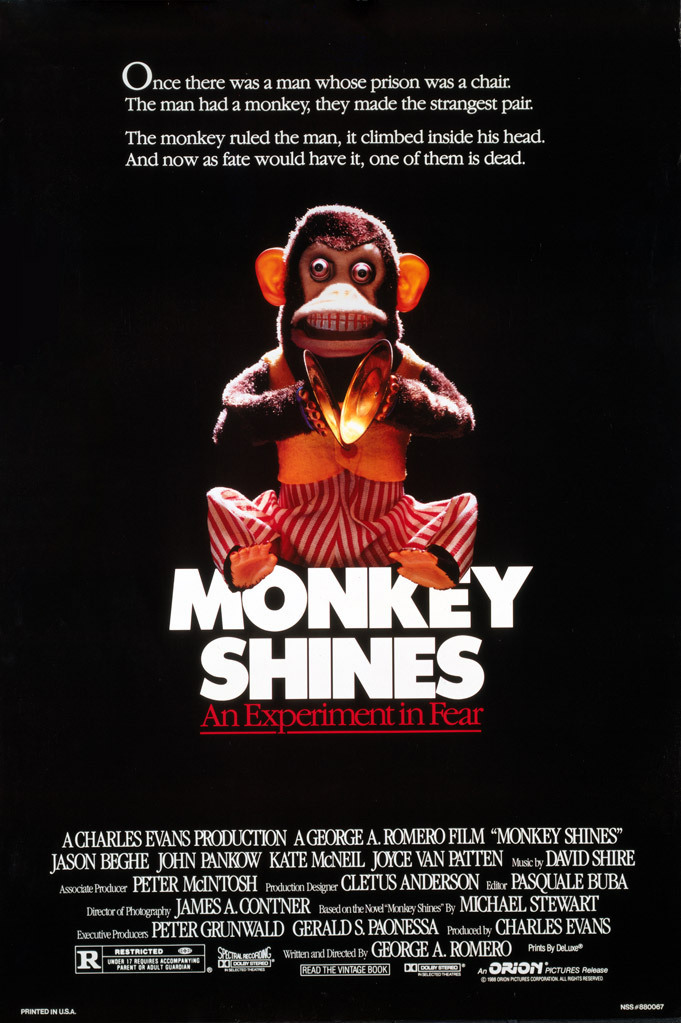
monkey shines poster

For some reason, I assumed this movie was based on a Stephen King novel. I think that was because the poster features one of those toy monkeys with cymbals in its hands. King wrote a short story featuring the same toy (which I’ve read part of, but didn’t finish because the audiobook had to be returned to the library). It is based upon a book, but not anything by King, but rather a British author named Michael Stewart. The film has nothing to do with a toy monkey either. But its plot does run into Stephen King territory.

At the beginning of the film we know something is going to happen to law student Allan Mann (Jason Beghe) because he is out running on a beautiful morning and all seems to be right with the world (and films don’t begin that way unless something bad is going to happen.) Since it features him running athletically and focuses on his muscular legs, he’s naturally hit by a truck which renders him a paraplegic.

He has a tough go of it in the beginning and tries to kill himself. But fails. His kooky scientist friend, Geoffrey (John Pankow) hooks him up with a helper monkey. Geoffrey doesn’t tell Allan that he’s been secretly injecting the monkey, named Ella, with a human brain cell-laden serum.

At first, things seem great. Ella is super helpful and seems to anticipate Allan’s every need. But because this is a horror movie, one directed by George A. Romero no less, things go sideways quickly. Actually, quickly isn’t the right word here, because the film takes its time to get to the psychotic monkey killing people. But they do eventually get there.

Basically, the monkey forms a psychic connection with Allan and it especially attaches to Allan’s anger, and unlike people who might think they’d like to kill someone in a fit of anger, the monkey translates things literally and does some bad, bad things.

There are a few too many side plots involving, among other things, Geoffrey’s boss (who doesn’t like his experiments, and is played by Stephen Root in his first film role), Allan’s Nurse Ratched-like healthcare worker, and Allan’s wife having an affair with his surgeon (Stanley Tucci in his third film role – the wife is played by Janine Turner). There is also a romance with the monkey’s trainer that includes a very interesting sex scene (one of the few on-screen sex scenes involving a paraplegic.)

Romero handles the material well, but this is definitely one of his lesser films. It isn’t exactly boring, but I was very much ready for the monkey to turn psycho much earlier than it did.

The Friday Night Horror Movie: Two Evil Eyes (1990)

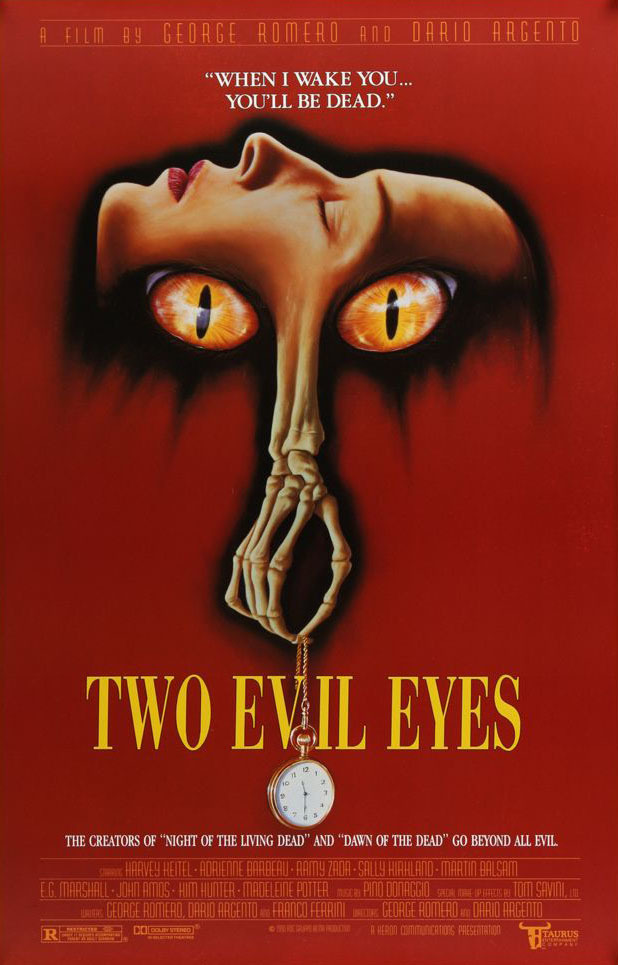
image host

When my daughter was much younger, and we were living in a little apartment we used to have what we called sleepover nights. Regularly, on a Friday night, my wife and I would drag our mattress into the living room and we’d make up the couch into a little bed for the girl. We’d make some popcorn and stay up late watching movies. Then we’d all sleep together in the living room. It was always a very fun time.

Then we bought a two-story house. The bedrooms were all upstairs so it was impossible to drag a mattress downstairs to the living room. Luckily, we have a television in our bedroom so we’d make a palette for the daughter on the floor and continued our sleepovers there.

Eventually, my daughter decided my wife and I snored too loud and she stopped sleeping in our room. But we’d still stay up late on Friday nights watching movies. One Friday night I realized our local college TV station was playing Tom Baker-era Doctor Who stories and I started watching them each week. My wife likes classic Doctor Who as well so she’d join me. My daughter loves Nu-Who, but she’s never quite got the appeal of the classic series. Still, she’d bring in her toys and play while we watched the TV show.

Eventually, this turned into us just watching the new series so my daughter could enjoy it with us. At some point, I started going downstairs after the show was over and my wife and daughter would stay in our bedroom watching YouTube videos.

I’d usually turn on a movie downstairs, usually falling asleep on the couch. Eventually, random movies turned into horror movies. Friday has become my favorite night of the week as we order a pizza, watch Doctor Who and then I watch a horror movie late into the evening.

I thought it might be fun to make a regular post of my Friday Night Horror Movies, so here we are.

The thing is, I haven’t actually watched the movie yet, and this will be true of every Friday night posting. Like I said I usually fall asleep on the couch watching the movie and so I won’t be able to actually talk about what I’ve watched until Saturday. But it seems silly to have a post called The Friday Night Horror Movie when I’m writing it on a Saturday morning.

What I’d like to do is start the post on Friday Nights and then maybe sometime on Saturday edit in a review.

This week’s movie is Two Evil Eyes, which is actually two movies in one. Originally planned as an anthology movie with multiple directors it turned into two one-hour films with Dario Argento and George A. Romero taking a stab at adapting an Edgar Allan Poe story. I’ll let you know what I think of it tomorrow.


Ok, it is Sunday now, so obviously I forgot to tell you what I thought “tomorrow.”

And now I’ve seen like five movies since watching this one so my memory is a little blurry. Basically, I liked this movie pretty well. I’m not well read in Poe’s books. I’ve read one or two stories and of course “The Raven” but that’s about it. I have seen several different cinematic adaptations of The Black Cat, two of which were adapted by Argento’s Italian compatriots Sergio Martino and Lucio Fulci. So that story is quite familiar to me even if I haven’t read the book.

The Romero story, The Facts in the Case of M. Valdem, is completely unfamiliar to me. It involves a woman who married an old, rich bastard in order to get his money. But he’s taking too long to die so she and an ex-boyfriend hatch a plan to hypnotize him, get him to sign over all his wealth to her, and then murder him. Everything goes to plan except after he’s dead he keeps on living.

Or something. It isn’t very clear whether he turns into a zombie or a ghost or something else. It has Romero’s typical social commentary (rich people are both horrible and weird), some nice gore, and little else.

Argento’s Black Cat adaptation doesn’t do anything new with the material. A crime scene photographer (played with gusto by Harvey Keitel) kills his girlfriend, ties her corpse to some coat hangers then builds a wall around her. A black cat helps get him captured by the police.

It has some of Argento’s typical style (there is a POV shot of the cat and some great extreme close-ups) and lots of blood-soaked violence. The opening scene is basically the aftermath of Poe’s story The Pit and the Pendulum.

All in all neither film is particularly great, but if you are a fan of either director there is enough here to make it worth your time.