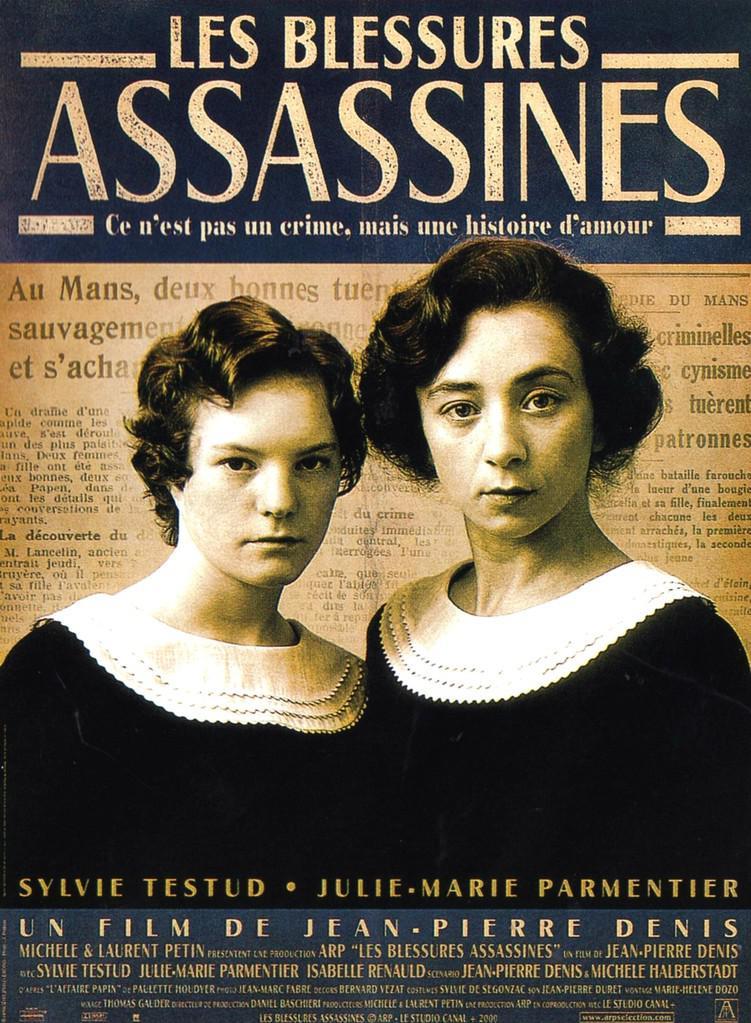
Two sisters, chambermaids for a wealthy French family, brutally murdered their employer, Mrs. Ancelin, and her daughter Geneviève, one February evening in 1933, in the small French town of Le Mans. This incident rocked French society for weeks.
Well, I say it rocked French society, but really, I have no idea if it had any effect whatsoever. It would be some 40 years after the murder that I would be born, and I’ve seen no information about its effect on France other than the publicity material associated with the film based upon the events, The Murderous Maids, and other reviews of said movie.
If it is true that this incident did rock French society at the time, and I’ll accept them as such, it is ponderous that it is so. Though certainly brutal, and laced with the peculiarity of having been committed by insane and incestuous sisters, it still seems strange that such an event would be anything more than curious to a culture whose history is laced with violence and brutality.
I wonder similar things when I watch the national news in America. Certain events, for whatever reason, capture the news and become so saturated that they permeate our whole culture. Millions of people have had to make the decision to “pull the plug” on a loved one, so why did Terry Schiavo’s case get national attention?
Countless murders are committed in this country every year, yet for months in 2004, the only one that mattered was that of Laci Peterson, at least if the news had anything to say about it.
It is an amazingly strange and unanswerable thing to me why some stories capture the attention of the media, and thus my nation, while so many others slip away into obscurity.
In the case of the murderous maids, Christine and Léa Papin, the media hype seems to surround the horror (Oh, the horror!) of two lower-class maids striking out against their upper-class masters. As if it might start another revolution.
The film is a slow-burning affair. It tries to get into the heads of these sisters and give us a glimpse into why two seemingly meek and mild maids could explode and commit such atrocities.
Honestly, I spent the first 20 minutes of the film, confused as to who was what, and what exactly was happening. The opening scene involves the sisters at a young age. Christine wants to become a nun, like her older sister but is forced into servitude by her mother. We fast forward several years without warning and see the older sister only once more, and that briefly. Maybe I was a bit sleepy, or maybe I was too busy trying to remember my rusty French to compare it to the subtitles but with the changes in time and the disappearance of characters I spent a good bit of the first half utterly confused.
Once the film settles into the lives of the two sisters it begins introducing moments that ultimately contribute to their murderous madness. Their mother is shown as greedy and selfish, taking Léa’s money and manipulating her through emotional blackmail. The masters of the homes are cruel and unforgiving.
The only kindness and semblance of love the two can find is from themselves. This love turns incestuous and further turns their situation into an “us” versus “them” scenario. Christine is clearly the leader of the two, while Léa is shy, quiet, and easily lead.
After numerous jobs, they finally land one where the two of them can serve. They seem happy at first, finding some praise from their strict master while at the same time, she puts on white gloves for perpetual inspection of their cleanliness.
It is when Léa burns out a fuse for the second time that things go haywire. Fearing severe scolding from their masters, they instead beat them to a bloody pulp.
In jail, Christine begins receiving visions, goes into holy fits, writes crosses on the walls with her tongue, and continuously wails out for her sister. Despite this, the incestuous relationship, the troubled family life, and the extreme violence of the crime fitted with lack of a clear motive, the French court decides to allow none of this in as evidence and their psychiatrists find both mentally stable.
Though its English title and even plot description reads as a B-movie exploitation flick, the film unravels in a slow, methodical method. The sex and violence are both graphically photographed, but in between such titillating moments, the scenes are tediously paced. It is all artfully made, professional to a tee, and really rather dull.
It makes no decisions as to why the sisters did what they did. There is no judgment placed upon the mother, upper-class society, or even the sisters. It is told in a documentary style, allowing events to unfold as they are without extemporaneous commentary. In fact, there is not one note of music played throughout the entire film. The viewer is left to decide how to feel, and what to think.
Murderous Maids is a character study of two historical women who have captured the consciousness of French society. It is a fascinating story about how two seemingly downtrodden and simple women can be turned murderous. It’s too bad the film couldn’t have been more interesting itself



 themidnightcafe.org