The Friday Night Horror Movie: Wicked City (1987)

poster

Renzaburō Taki has been chatting up Makie at a Tokyo bar for months. Finally, she agrees to take him home with her. As soon as they arrive she strips off her clothes and they have passionate sex. As soon as he is finished she shows her true colors. She’s a demon. She morphs into a spider-like creature with long appendages and a mouth-like vagina that’s full of teeth. He manages to pull out before she chomps his member off and she flees out the window.

Outside, in the dark edges of the city live the creatures of the Black World. They are demons from an alternate dimension who can look like humans when they need to and live among us. Centuries ago a truce was made between the humans and the demons and they’ve lived peaceably together. Within a few days, a new pact must be signed, but there are rebel factions on both sides who want to stop that treaty from being signed.

Taki is a member of an elite organization known as the Black Guard designed to keep the peace between humans and demons. He’s assigned to protect Giuseppe Mayart, a 200-year-old mystic who signed the last treaty and will be instrumental in ensuring the new one is signed as well.

Taki is teamed with Makie a Black Guard from the Black World. They go through a series of adventures battling an assortment of demons trying (and often failing) to protect Giuseppe.

Wicked City is an inventive, beautifully designed bit of animated horror. Taki acts like a gumshoe out of some old film noir. Makie is cool as a cucumber. She’s not exactly a femme fatale, but she has that ice-cold attitude. The look of the film is a mix between neo-noir and steampunk. The demons are pure Japanese tentacle monsters.

I loved most of it. The story is good, the characters interesting, and the filmmaking is mostly spot-on. I love a good mix of crime stories and fantastic monsters.

However, if I may issue my first-ever trigger warning in a movie review the film is quite misogynistic. Nearly every man oggles Makie and whenever she is sexually assaulted (and she is sexually assaulted more than twice) the film lingers on her naked body. It is obsessed with her breasts. Even while being gang raped they make her moan with pleasurable noises.

Now I’m not against sex in cinema, and I’ve enjoyed the male gaze in more than a few movies. I’m fine with characters who do evil things and there are times when sexual assault and rape can serve a purpose. It sometimes does serve a purpose here. But the way those scenes are filmed made it more than a little gross.

If you can get passed that though, it is quite a good film. The world-building is excellent and some of the demons are truly terrifying, and weird, and imaginative. The animation is beautiful (and weird, and imaginative). Definitely recommend it for those who think they can stomach it.

The Friday Night Horror Movie: Phase IV (1974)

poster

Saul Bass was probably the only person to become famous for creating title sequences for movies. He did memorable title sequences for films such as The Man With The Golden Arm (1955), North By Northwest (1959), and Anatomy of a Murder (1959). His titles were innovative and beautiful, and they gave you a sense of the essence of the film you were about to see. The Criterion Channel once had a collection of films based on his title sequences alone. He also designed movie posters and was an award-winning graphic designer for commercial projects.

In 1974 he directed his first and only feature-length film. A science fiction/horror film about mutant ants that try and take over the world.

Phase IV is a meditative, art-house film tackling a subject that wouldn’t feel out of place amongst 1950s sci-fi b-movies such as The Blob, or The Fly, or The Brain Eaters.

It is full of extended, wordless scenes that concentrate on nature, or more often than not, insects – mainly ants. There are extreme close-ups of real-life ants, and beautifully rendered shots of hand-crafted miniatures.

There is some hard science fiction with scientists endlessly staring at computers and working with test tubes, and a lot of nonsense dialogue and character beats. It is incredible to me that Saul Bass chose this rather off-putting, strange little monster movie to be his directorial debut.

The story goes something like this. A strange cosmic event happens over Earth. Humans are all excited about it, but after a week with nothing extraordinary happening they all go about their lives. Except for one scientist, Ernest D. Hubbs (Nigel Davenport). He realizes that something strange is happening to the ants. They seem to be evolving – communicating with each other and working as one, towards some unknown goal.

The ants build these large monoliths in the Arizona desert. Hubbs convinces the government to build a science station next to them and recruits James R. Lesko (Michael Murphy) to help him. All nearby residents flee, leaving the scientists all alone. All residents except one small family.

Soon enough the family is attacked and killed by the ants. The only survivor is Kendra (Lynne Frederick) comes to stay with the scientists at the station.

The humans spray the ants with some kind of goo which deters them for a time, but soon enough the insects learn to cope. The humans destroy the monoliths. The insects build a reflective surface that sends the sun’s heat directly into the science station, drastically raising the temperature inside. The humans decipher some of the ant’s language. The ants infiltrate the station and start tearing up the machinery.

On and on it goes. Humans are against nature. It is an old story told in a beautiful, strange way. I don’t know how to explain this film, except that you should do yourself a favor and go watch it.

The Friday Night Horror Movie: Brightburn (2019)

poster

There is a Superman comic that wonders, “What if Superman was a communist.” Instead of landing in a cornfield in Kansas and being adopted by the wholesome Kent family baby Superman instead lands in Russia. In this version, Superman is still essentially a good man, a superhero of sorts, but his ideology is warped by 1980s Russian politics.

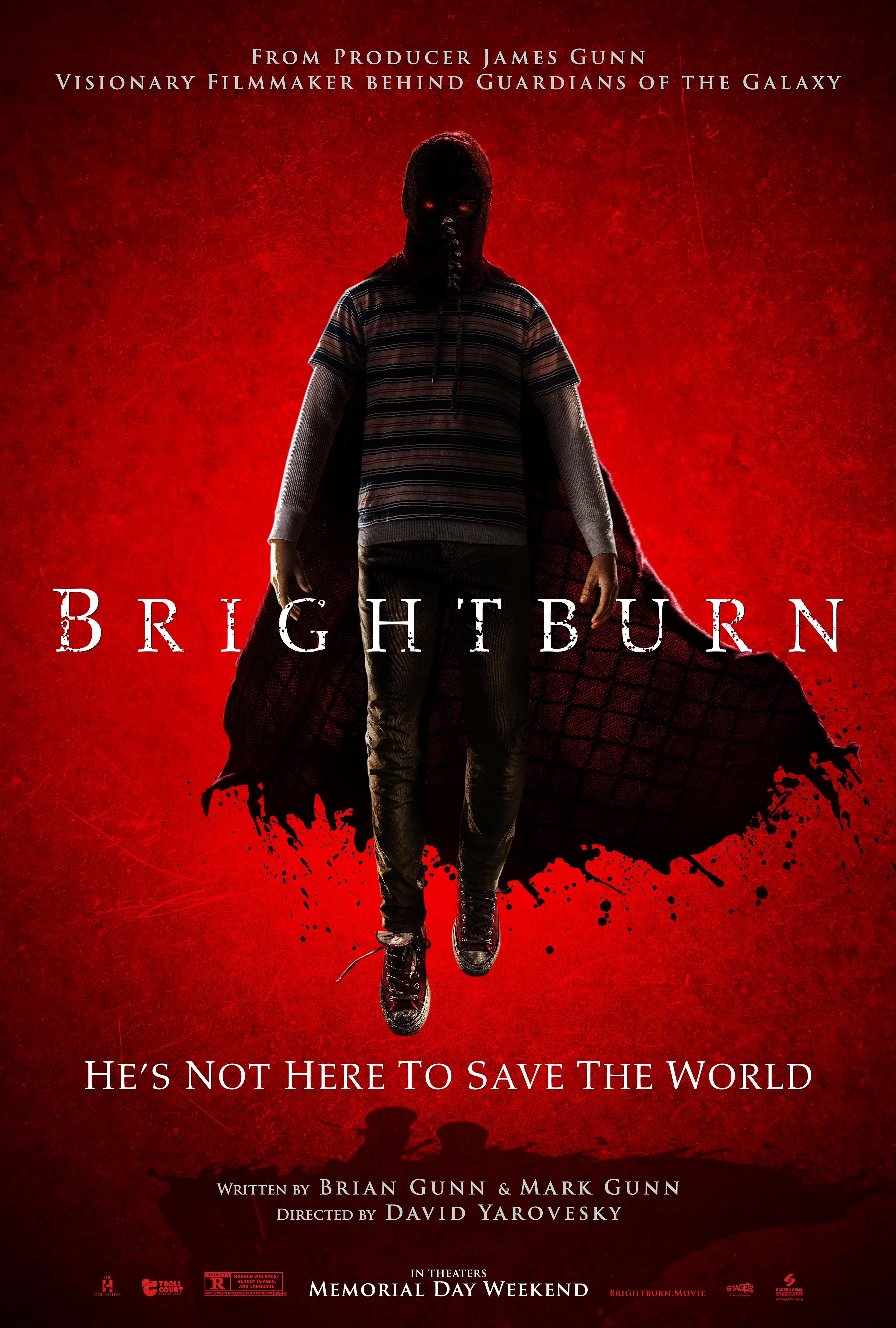
Brightburn keeps the idyllic Kansas setting but imagines “What if Superman was evil.” Technically it isn’t Superman, or even Clark Kent, he’s called Brandon here and he’s played by Jackson A. Dunn, but he is an alien baby that lands on a farm in Kansas and is raised by a wholesome couple. Superman’s origin story is so ingrained into our cultural membranes that those images immediately bring him to mind.

The film skips any scenes on the kid’s alien planet. It flashes pretty quickly through the growing-up stage. The couple, Tori (Elizabeth Banks) and Kyle Breyer (David Denman) have been able to conceive a child on their own so they are thrilled when a baby lands in their lap (even if he does crash in a spaceship). A quick montage brings us to him turning 13 and hitting puberty.

He’s an awkward kid, but smart. He thoroughly answers the teacher’s questions and is mocked by some bullies. But a pretty girl turns to him and says that smart people rule the world.

The spaceship, locked inside the barn, calls to him. It tells him he can rule this world. His powers come slowly. When that pretty girl later calls him a pervert (because she caught him spying on her in her bedroom) he breaks her hand.

Then he starts killing people. His parents are slow to recognize the signs. They love him after all. But when the bodies start piling up even they have to realize their son is evil.

There are some great ideas in Brighburn. I love the premise, but it sticks very few of its landings. There is no real sense of who he is, or where he comes from. The ship communicates to him somehow and tells him he can control this planet, but why? Was he sent there for that purpose? There isn’t any real internal conflict either. Sometimes he seems like a good boy who loves his family, and then something angers him and he starts killing.

You could read this as a metaphor for puberty and well, as someone who is raising a teenage daughter right now I can tell you the moods do swing for no apparent reason, and maybe that is enough here. But it didn’t work for me.

Most of the choices the film makes are pedestrian. Even the ones that don’t do what a typical superhero film would do are easily guessed at. So many times I wished the film would do something really surprising with its premise, and it never did.

Except for the kills. Those were pretty gnarly.

It isn’t a terrible film, it just isn’t as good as it could have been. That’s disappointing.

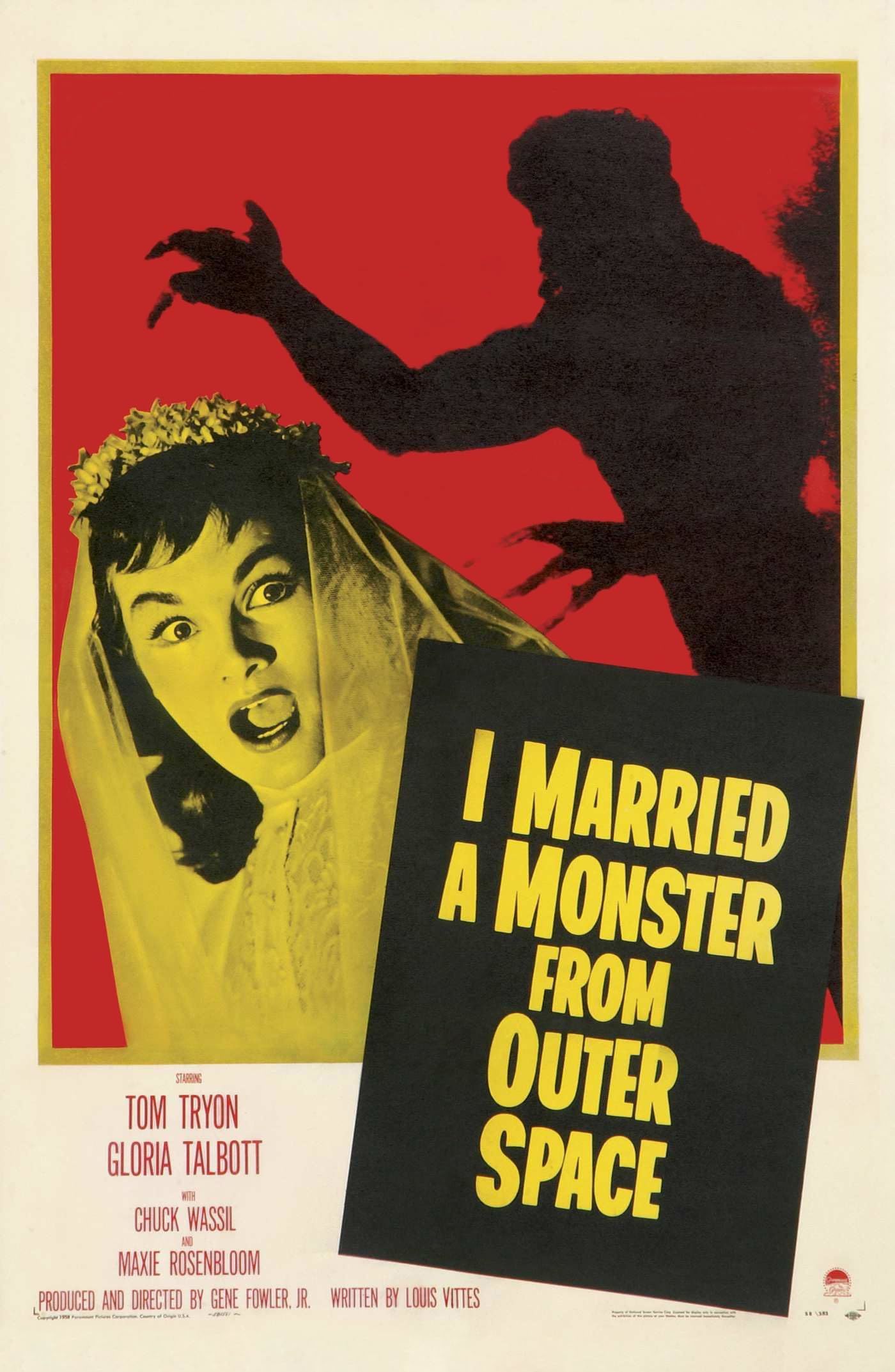
Sci-Fi In July: I Married A Monster From Outer Space (1958)

cover

They say that horror movies reflect the anxieties and fears of a culture at the time of release. If that’s true then I Married a Monster From Outer Space says a lot about America in the late 1950s. Made on a shoestring budget and initially run as the b-side in a double feature with The Blob, it nevertheless dips its toes in anticommunist rhetoric and the changing roles of women in the post-war decade.

Marge Farrell (Gloria Talbott) is a nice girl set to marry Bill (Tom Tryon) a nice guy. The night before their wedding he is attacked by an alien monster who then takes Bills form. The alien follows through with the wedding, but a year into their marriage Marge is beginning to suspect something is wrong.

Bill rarely goes out. He’s stopped drinking. Dogs bark at him, and cats hiss. Worst of all she’s still not pregnant. The doctor assures her it isn’t because anything wrong with her, but maybe Bill should come in for a few tests.

One night she notices Bill get out of bed and leave the house. She follows him down the road, into a field, where she sees him enter his spaceship and take his true form.

Marge runs to the chief of police who swears he believes her, but behind her back indicates she’s overworked, tired, or just plain crazy.

She confronts Bill who admits everything. His planet, along with all the women folk was destroyed by their son. They found Earth to be hospitable and hope to colonize it. They can apparently have sex with human women, but as yet cannot figure out how to impregnate them.

Marge runs to her doctor who makes comforting motions that he believes her, but he doesn’t do anything about it. Bill indicates there are more just like him, and they’ve taken over the bodies of other men in the town.

Fully realizing she cannot tell which men are aliens and which are human, she still runs to other men for help. Never once thought she could just form an army of women to destroy the aliens.

During World War II women had to fill the gaps left by the men in the workforce. They got jobs in factories, making weapons, and manufacturing goods. They made money and enjoyed an autonomy rarely found before the war. When the men came home some of them were reluctant to go back to the way things were.

This film seems to indicate that maybe they should.

It can also be read as an anti-communist film. The monsters look just like us, that’s the same line of fear Joseph McCarthy had been spreading for years.

If you take this a little further the men whom the aliens have taken over are mostly childless. They have failed the American ideal of masculinity. The men who destroy them are family men, good, old-fashioned manly men. True Americans. Marge is smart and tough, in today’s parlance she’s a badass. But she’s more than happy to take a backseat to the men and let them save the day. By the time the credits roll, she’s happy to go back to being a happy housewife.

Or maybe this is all a load of bollocks. Maybe it is just a silly little science-fiction horror film, riffing on Invasion of the Body Snatchers that came out a few years prior.

I’ll say this: the effects look good for what they are. At 78 minutes it doesn’t overstay its welcome. All of that stuff I just wrote is fun to theorize about, but I’m not sure it makes for an enjoyable watch. For a low-budget sci-fi flick from the 1950s, you could do a lot worse. But it isn’t the first film in that genre that I’d recommend.

Sci-Fi In July : The Girl With All the Gifts (2016)

cover art

A young girl sits counting in her cell. Suddenly an alarm sounds and the lights come on. Armed soldiers come calling. Though she can walk she sits down in a wheelchair. The soldiers strap her arms and legs down and her head so she cannot turn it. She is wheeled into a classroom with numerous other children likewise strapped to wheelchairs.

Soldiers look in on the classroom calling the kids names like “freaks” and “abortions.” Their teacher, Helen Justineau (Gemma Arterton) is the only adult who is kind to them. In a moment of grace, she touches the girl’s head. Immediately, the soldiers, led by Sergeant Parks (Paddy Considine) come in and chastise Helen for touching a student. He then spits on his hand and pushes it under one of the children’s nose.

Immediately, the kids go feral, writing in their wheelchairs and attempting to bite the soldiers. They are zombies. Or more correctly, they are zombie hybrids. They will attack with fury when they smell humans, but can also talk and think like normal people.

They may also be the key to a cure. The zombies in this film were caused by some sort of fungus that grows inside the brain. These kids were In Utero when the virus first came about (the film occurs some ten years after the beginning of the apocalypse). They absorbed the virus when their mothers got it which may have caused them to be…well not immune as they are definitely hungry for human flesh, but special. The scientists, led by Dr. Caldwell (Glenn Close) think this specialness may lead them to a cure.

I feel like I’m getting bogged down in the plot, but really what I’ve just described happens in the first ten minutes or so. But it is such an interesting setup for a zombie movie I wanted to dig into it a bit.

All of that occurs at a well-guarded military base, but just after those events, it is attacked by hundreds of zombies and overcome. Our heroes narrowly escape and the rest of the film finds them traveling into London in hopes of rescue.

That girl I mentioned is named Melanie (Sennia Nanua), she is smart chatty, inquisitive, and kind. In the time we spend with her on the base, she always says hello to the military people even when they are cruel to her. She always asked a lot of questions and was the top student in her class. This both endears her to her capturers and ingratiates them.

The look and feel of the film has a lot in common with the recent television series The Last of Us (the series came out in 2023 but was based on a game from 2014 game – the book this film was based on also came out in 2014 so I’ll let you be the judge of who created this look first). The landscapes are overgrown with vegetation while the city buildings and infrastructure are beginning to collapse. This creates a beautiful yet eery look to everything.

The plot is your basic quest scenario but it is well done. This type of movie often will involve a child but they are usually just there to add a sense of danger. Melanie is something different. Because she is a zombie the other do not sense her as food. She is safe from them. But when she gets hungry she is a force of danger. Yet she is also the human’s only hope. That makes the plot more interesting than your standard zombie fare.

This all worked for me quite well. I dug the the look of the film, the action scenarios, and all of the characters. If you like zombie films I highly recommend this one. It also has a fantastic ending.

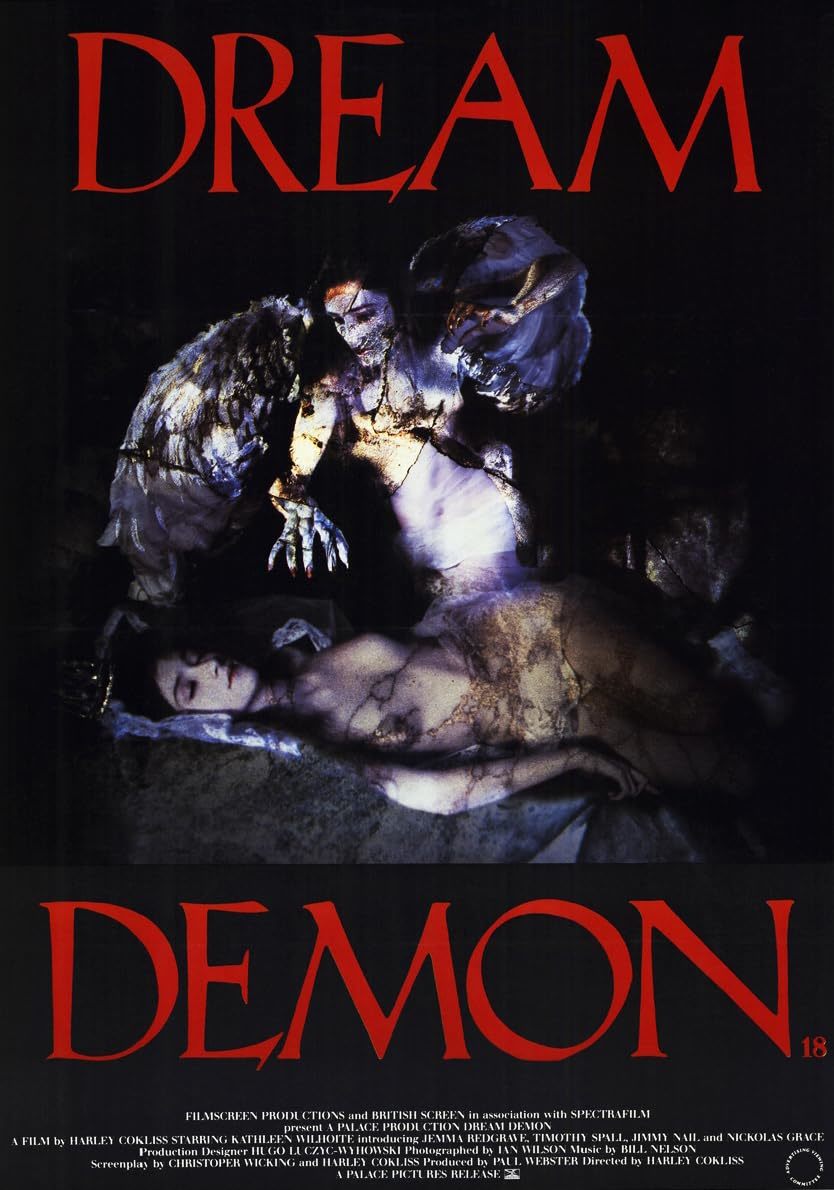
The Friday Night Horror Movie: Dream Demon (1988)

poster

A beautiful, upper-class schoolteacher prepares to marry her military hero husband. But instead of saying “I Do” she declares that she cannot marry him. He rebukes her with a slap to the face. She responds in kind and knocks his head plumb off of his body. She flees the church with her white wedding gown covered in bright red blood.

This is a dream of course. Diana (Jemma Redgrave) will have many more of them before the film ends. Many, many more of them. I’d say a good 2/3rds of the film is dream sequences.

The dreams aren’t particularly scary, or even all that inventive. While watching this I kept thinking that if someone like David Lynch had directed it, Dream Demon would be a true classic. He’d create nightmares that we’d be talking about for decades. Instead, we get a lot of long hallways, a creepy basement, and the occasional man on fire.

Despite all of this I still quite liked the movie. What the dreams lack in imagination they make up for in beauty and mood. They are all shot with dramatic, shadowy lighting and wonderfully moody colors. They are…well…dreamy.

The plot outside of the dreams involves Diana trying to understand why she is having these dreams. Is she just nervous about getting married like her therapist suggests, or is there something more nefarious happening? Despite the title of the film, there isn’t anything supernatural going on, although it does owe a great debt to A Nightmare on Elm Street made just a few years earlier. But sadly, there is nothing akin to Freddy Krueger stalking her dreams. The film could really use a good villain.

There are a couple of obnoxious paparazzi types hanging around and one of them (played by the great Timothy Spall) features in some of the dreams, getting more and more grotesque with each one. But they ultimately don’t amount to much.

She’s helped by Jenny (Kathlene Wilhoite) an American who says her biological parents used to live in Jenny’s house, but she was adopted as a young girl and has no memory of them.

The two begin sharing dreams, each living inside the other’s nightmares and they begin to be afraid that they will never escape them.

Unlike a lot of movies of this sort, neither girl makes any real effort to stay awake. They don’t drink coffee by the gallon or try to remain standing or anything. Diana falls asleep a the drop of a hat. She’s constantly nodding off while sitting on the couch or anywhere else. Despite the fact she’s terrified of what she might dream of.

The resolution is as unimaginative as the dreams, and yet again I still quite enjoyed the film. There is a mood that the film is vibing on that I found to be pretty great.

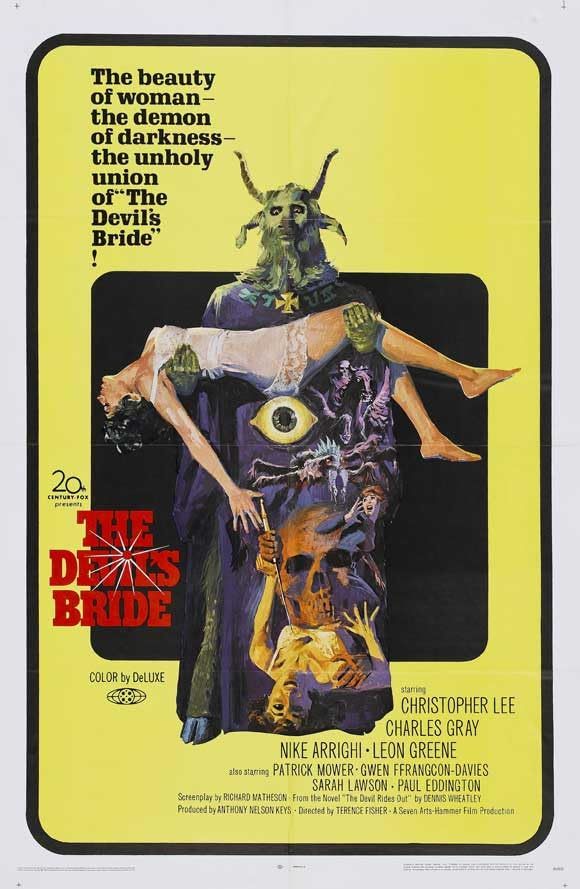
The Friday Night Horror Movie: The Devil Rides Out (1968)

poster

I am 100% a fan of Hammer Horror. I love the production designs, the sets and costumes, and the way their films looked. I love their stable of great British actors including Peter Cushing and Christopher Lee. I’ve watched something like 28 of the 70 or so films the studio made in the horror genre. So again I say I am a fan.

But I have to admit, that while I love a great many things about these films, I often find them rather dull. The films look gorgeous, and there is often a wonderful amount of sex and violence for a 1960s production, but the plots often have this staidness to them. There is a lot of boring talking and exposition that takes place that just causes me to nod off.

The Devil Rides Out (or The Devil’s Bride if you prefer) kept me completely enthralled from start to finish. It is quite wonderful throughout.

Christopher Lee stars as Nicholas, Duc de Richleau (who was apparently a recurring character in a popular series of novels from 1933 to 1970) a nobleman with a sturdy education and who is well-versed in the occult.

When his friend Rex Van Ryn (Leon Greene) returns home from a long voyage they decide to stop at their mutual friend Simon Aron’s (Patrick Mower) house. There they are met by a strange group of people Simon calls his Astronomy Club, but whom Richleau quickly deduces is a satanic cult.

They manage to rescue him from the house but almost immediately lose him again. They rescue him a second time, this time from a Satanic Orgy/Baptismal ceremony where a goat-headed Satan has been summoned. They also rescue Tanith Carlisle (Niké Arrighi) who was also supposed to be Satanically baptized that night.

Simon and Tanith are both somewhat under the spell of the head Satanist Mocata (Charles Gray). He can sometimes mind-control them into doing things for him (and sometimes he can’t depending on the needs of the script).

It is all a bit silly, but it won me over by the power of the performances (especially Christopher Lee who is always great, but especially wonderful here). Unlike a lot of Hammer films which tend to lean into their silliness, The Devil Rides Out is completely serious in its presentation and it is all the better for it.

There is a scene in the back half of the film in which Richleau creates a circle of protection that he and his cohorts must stand in to resist the power of Mocata. It begins with most of his friends being skeptical. It is a bit silly to think a chalk circle with some Latin written in it will protect them from anything. But then there is a loud knocking on the door and the sound of Simon yelling to be let in. Then a giant spider attacks, followed by Death riding a horse. The effects are cheap and goofy, but somehow effective. By the end, everyone is terrified, including me.

It is a scene that shouldn’t work. In the hands of less competent people, it wouldn’t work. And yet it is one of my favorite scenes in all of Hammer Horror. The entire film is like that. It shouldn’t be as good as it is, but somehow it is all pulled off magnificently.

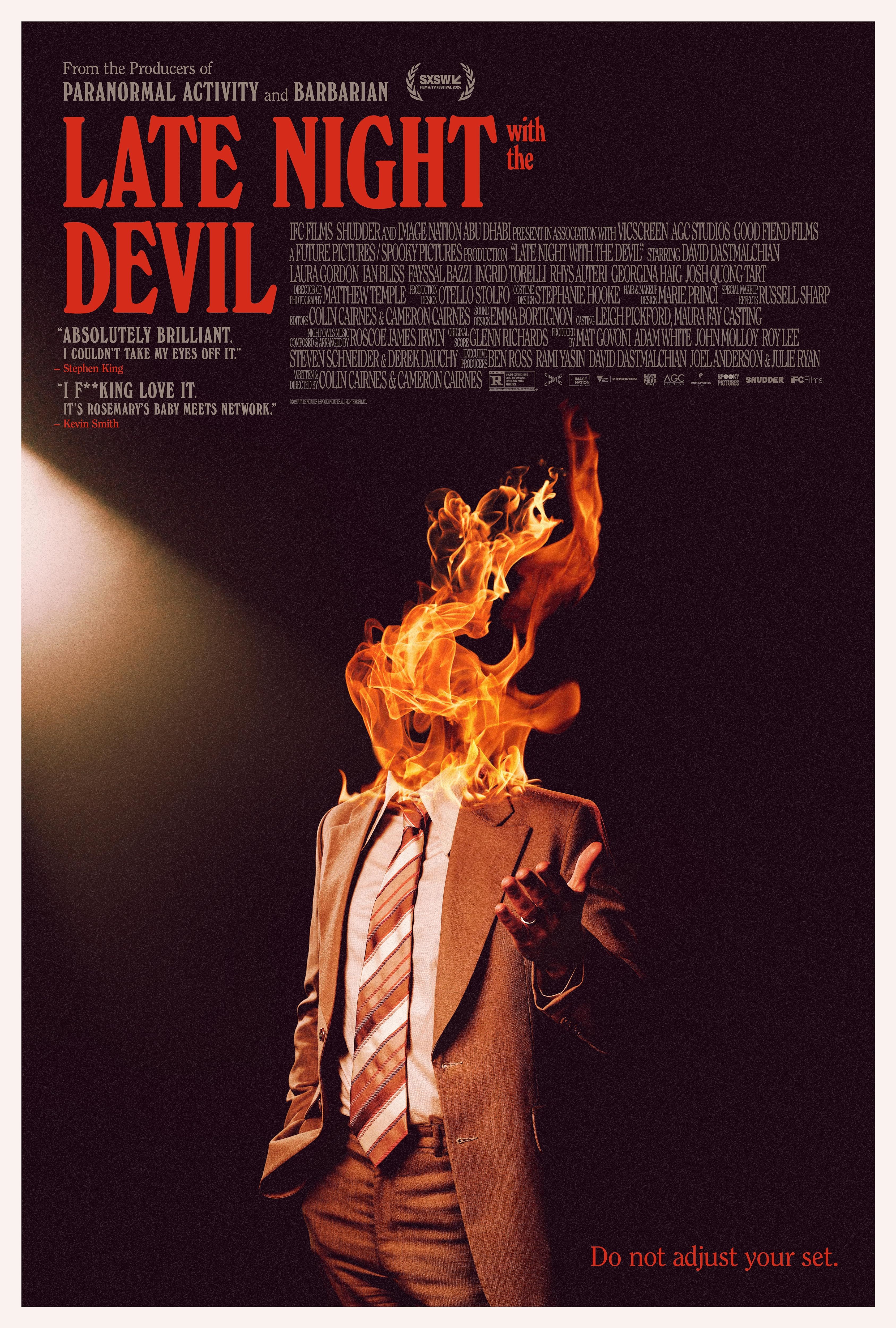
The Friday Night Horror Movie: Late Night With The Devil (2023)

poster

Late Night With The Devil is a sort-of found found-footage horror film about a late-night talk show that goes horribly wrong one Halloween night. Other than a short intro setting things up the entirety of the film takes place in real-time as we are watching tapes of the show from 1977. During what would be the commercial breaks we see behind-the-scenes footage as the host, guests, and crew relax, prep, and talk about the show without the cameras sending images to the world.

Night Owls with Jack Delroy is a typical late-night show from the 1970s. Think The Tonight Show with Johnny Carson a show the movie references several times as Night Owls is never able to gain the same ratings Carson does.

It is hosted by Jack Delroy (a terrific David Dastmalchian). The film’s introduction lets us know he’s incredibly ambitious and constantly let down that his show doesn’t get better ratings. After his wife dies of cancer (the episode in which she appears, clearly very sick and telling stories of their relationship gives the show its highest ratings to date) he is a changed man. The show never recovers and is on the verge of cancellation.

The Halloween Episode that we watch is a last-ditch effort to get the ratings they desperately need. Guests for the night include a hokey medium called Christou (Fayssal Bazzi), Carmichael Haig (Ian Bliss) a former magician turned skeptic, and June Ross-Mitchell (Laura Gordon) a parapsychologist who has brought with her Lily D’abo (Ingrid Torelli) a teenaged girl who survived a Church of Satan-esque cult and now is believed to be possed by a demon.

It is well made. The sets and costumes look very much like how a talk show circa the 1970s looks. They have the feel of everything exactly right. There are some nice jump scares but mostly it creates an increasingly creepy mood that eventually blows up into holy-crap territory.

I liked a lot of it, but I gotta admit I just don’t love this type of found-footage horror movie. I saw The Blair Witch Project in the theaters and absolutely loved it. But that film showed us edited versions of the found footage. Or at least they periodically stopped the cameras allowing us to jump forward in time, skipping the boring bits.

Films like this, which exist in real time become tedious to me. We see the opening credits to Night Owls and then we watch it unfold just as a real audience might have watched it from home. The behind-the-scenes footage during the commercial breaks is shot in black-and-white and breaks things up a bit, but it still unfolds in real-time.

There is an opening monologue filled with the types of dumb jokes all these shows have. There is a sidekick who riffs along with Jack. Cristou, the first guest talks like any of those so-called psychics you can find on late-night television and morning Zoo radio programs.

Obviously, any horror movie had to build towards the scares. You don’t start things immediately off with the horror or you have nowhere to go. But making me sit through a late-night talk show, something I have come to loathe in real life, just isn’t the way to go to win my heart.

It does get there in the end. It gets terrifically scary as the tension revs up and the demon possession seems more and more real. It is definitely worth watching, especially if you are a fan of found footage films. For me I can’t help but feel a little disappointed, even while recognizing the skill by which is it made.

Embrace of the Vampire (2013)

cover

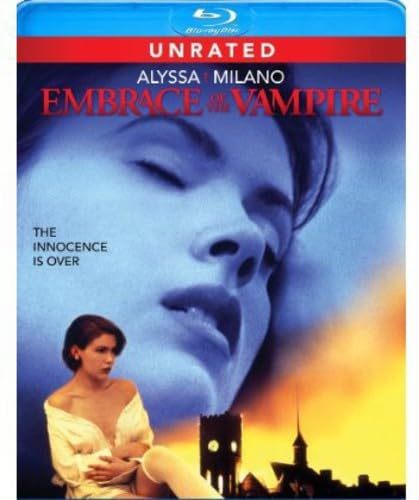
They remade that terrible erotic vampire movie starring Alyssa Milano. God knows why. The only reason anyone watches the original is because Alyssa Milano was in an erotic vampire movie. She’s not in this one, but the thing is, the remake isn’t all that bad, actually. I mean it isn’t good or anything, but unlike the original, the filmmakers here know how to tell a coherent story.

You can read my full thoughts here.

Embrace of the Vampire (1995)

cover

I respect women. I believe women. I think women should be cherished for their intelligence, wit, kindness, for their humanity, for all the wonderful things that make them women.

I’m also a big, dumb, man. A cis-gendered, straight man at that. I have a full-blooded sexual appetite. I find women attractive.

In my younger years, I was sometimes known to watch movies just to see beautiful, famous women in various states of undress. Oh, who am I kidding I’m still sometimes known to do the same.

I say this as a way to introduce my review of Embrace of the Vampire, a very dumb mid-1990s movie in which Alyssa Milano gets nekkid. This was just a few years after her turn in Who’s the Boss and she was clearly trying to shed that clean-cut teenage image. I was in college at the time and me and my pals rented the film because…well, you can probably guess.

I’m a little embarrassed by the review now. It was very much written with my tongue firmly planted in my cheek. I was trying to be funny. I’m not sure how well I succeeded. I debated whether or not I should even turn the review in at the time, but I couldn’t figure another angle on the movie. It is very much remembered now because Alyssa Milano got naked. I can’t imagine anyone would know it still existed if it weren’t for that fact.

Anyway, here’s the review, please take it as it was meant to be read – as a lark, a dumb joke, an acknowledgment of my own big, dumb maleness.