The Friday Night Horror Movie: Ju-On: The Grudge 2 (2003)

ju on the grudge 2 poster

The Criterion Channel is featuring a plethora of horror movies this month. They have at least three different horror themes going on, one of which is Japanese Horror. Naturally, I’ve seen almost all of them, but I’d never watched this sequel. I try to watch the originals again before I watch the sequel which is why you were treated to my thoughts on Ju-On: The Grudge yesterday.

This sequel is basically the same film with different characters. Once again it acts like a series of vignettes in which a bunch of people are haunted, terrified, and murdered by some evil spirits. The same evil spirits that haunted the house in the first movie (er, the third movie as there were two films before Ju-On: The Grudge). There is the creepy kid and the freaky girl who can twist her body in extreme ways.

This one does have more of a semblance of a plot and there is a bit of a through line, but it still jumbles up the chronology. It, more or less, follows horror film actress “Horror Queen” Kyoko Harase (Noriko Sakai) who is given a role in a paranormal television show. They “investigate” haunted houses and the like. For this episode, they visit the house from the last film.

Naturally, things do not go well. Nearly everyone involved in the shoot is haunted by the curse and killed. The kills remain quite effective and creepy. I might even give the ones in this film a slight edge over the last one.

There is an excellent sequence in which a woman keeps hearing a banging on her apartment wall at a certain time at night. The reasons behind it are quite clever and scary.

The way this film moves back and forth in time is much more effective than the previous one. I was often confused during the previous film, but here they will show a snippet of the same scene, albeit from a different character’s point of view, before moving on to something we haven’t seen before. Those connecting points allowed me to understand what was happening at all times. That worked for me much better than in the previous film.

But really, much like the other film, the plot in this one is just an excuse to move us from one creepy scene to another. And again this worked completely for me.

31 Days of Horror: Ju-On: The Grudge (2002)

ju on the grudge poster

A title card tells us that a Ju-On is a curse that is born when a person dies in a deep and powerful rage. The film will then spend the next 90 minutes showing us exactly what it means.

Ju-On: The Grudge was part of a cycle of Japanese horror films (collectively known as J-Horror) that came out in the late 1990s and early 2000s. Unlike their American counterparts (which were mostly self-aware slashers and other schlocky, gore-inflicted films) J-Horror tended to focus more on mood, and the psychology of fear, with plots that revolved around Japanese folklore. The violence was usually off-screen and not very graphic (though there were exceptions – I’m looking at you, Takashi Miike).

For a few years, J-horror became quite popular in America and several of them were remade by Hollywood. Someday I may do a theme where I review the Japanese horror films alongside their American remakes, but for now, we’re just talking about this one.

Ju-On: The Grudge was actually the third film in the Ju-On franchise (the previous two were straight-to-video releases) but it was the first one most of us watched (I’ve only seen this one and the first American remake).

The film is really a series of vignettes, each focusing on a different character, most of which are set in the same house located in Nerima, Tokyo.

I’ll be honest here, I just watched the film but if you paid me $1,000 to explain who each character was and what their relationship to each other is, I’d still be broke. Each vignette is so short, and each character is given so little to distinguish each other from each other I’m at a loss to tell you who is who.

They all do seem to be related to one another either by family or friendship or work. It begins with Rika (Megumi Okina) a social worker volunteer being tasked by her boss to visit an old lady at the cursed house (though neither of them realizes it is cursed at this point.) She enters to find the old lady in a daze, lying in bed. She picks her up to find that she has soiled herself.

After cleaning her up and doing a little housekeeping she hears a noise upstairs. In the bedroom, she finds a closet that has been taped over and she hears a cat meowing inside. Opening it she sees the cat and then a small, pale boy. She goes downstairs to call her boss and witnesses a black fog kill the old lady. Rika then passes out.

Others come to the house and most find themselves infected by the curse. They’ll become haunted by the boy, the cat, and the boy’s parents. Sometimes they’ll be killed inside the house, other times they’ll take the curse with them infecting their homes.

The film jumps around in time, making it a bit disorienting.

We will learn more about the boy and his family, and why they are haunting this house, but it really doesn’t matter. The plot isn’t really the point. Scaring the bejeebus out of us is the point and this film does that really well.

There are jump scares aplenty, and all sorts of creepy noises and visuals. These evil spirits appear out of nowhere – sometimes they attack, sometimes they just scare the characters, and sometimes they aren’t even seen by the character but by the audience giving us a jolt of fear. This happens so often that you’ll find yourself tensing up in anticipation, looking in corners and backgrounds half-expecting to see a ghost.

Quite a few of these sequences have become iconic for horror fans. The girl walking on all fours, contorting herself in unusual ways, the hand in the shower, the girl under the covers, etc. have all become part of our communal horror fabric.

I can’t say that Ju-On: The Grudge is a great film in any sort of artistic, cinematic sense, but it is a great one to put on late at night when you are all alone and scare yourself silly.

The Friday Night Horror Movie: Demon City Shinjuku (1988)

poster

One of the things I love about doing these monthly movie themes is that it not only allows me to watch movies I might not otherwise watch, but it gives me a greater understanding of the history of cinema. I learn things I might not otherwise come to know.

For example for Animation in August I’ve watched several Japanese animated movies and this has brought to my knowledge banks the term OVA or Original Video Animation. That’s basically a Japanese version of straight-to-video applied specifically to animation.

Like straight-to-video releases OVAs had more freedom than their cinematic or televised productions had in terms of length and mature content. An OVA could be as long as it needed to be and they were allowed more freedom in the amount of violence, adult language, and sex/nudity they could use.

Demon City Shinjuku is an OVA adapted from a novel of the same name. It follows a reluctant hero’s journey into the heart of Tokyo which has been overrun by demons.

It has more than a passing similarity to Star Wars, with some terrific animation, and some pretty cool demon designs. But it suffers from some terrible writing (or possibly a very bad translation).

In a prologue, we learn that an evil dude called Rebi Ra has allowed himself to become possessed so that he can wreak evil havoc upon the world. A good dude called Genichirou tries to stop him but is killed in the process. A giant earthquake happens during their battle wrecking the Shinjuku part of Tokyo. Demons quickly take over this area.

Ten years later Genichirou’s son, Kyoya Izayoi is tasked with going into the city and destroying Rebi Ra. He is accompanied by Sayaka Rama the daughter of the World President who has just been kidnapped by Rebi Ra. If they fail Rebi Ra will unleash all the demons and conquer the world.

Along the way, they obtain help from a short rollerblader who is just out for himself but ultimately finds his soul and a Dracula-esque mysterious goth dude. There is also Aguni Rai an ancient mystic who periodically offers advice.

They come across several demons before ultimately fighting Rebi Ra. There is a crab-like creature with a human head and a giant mouth full of teeth in its torso and a sexy redhead with tentacle arms.

All of this is pretty good. I enjoyed it. But the dialogue is rotten. Generally speaking, I watch foreign language films in their original language. I much prefer hearing the original actors’ voices even if I don’t actually understand what they are saying. With animation, I am a little more lenient since there is a realization that all actors are dubbing in their lines (it helps that most of the foreign language animated films I’ve seen are dubbed by really good English-speaking actors).

I started watching this film in the original Japanese with English subtitles, but something was wrong with the audio causing none of the film’s score or non-verbal noises to be heard. So I had to switch to the English language dub. It was…not good. And strange at times. The male characters were all very horny and they dropped F-bombs on a regular basis. I’m not necessarily opposed to either of those things but they often seemed out of place in this film.

For example, one night Kyoya Izayoi and Sayaka Rama find themselves in the same bedroom for the night. After Syaka goes to sleep Kyoya begins to look at her longingly. The camera slowly pans down her body so clearly some of this is in the original script, but in English, he goes on and on about how he wants to sleep with her.

And his dialogue is loaded with F-bombs in the oddest of places. He’ll throw one in the middle of an otherwise innocuous sentence. So much of it felt like some American scriptwriter trying to make the script more edgy.

It was bad enough that I turned on the subtitles just to compare. Gone was the hard-core cursing, but also quite a bit of the dialogue was tweaked to give it different meanings. It wasn’t the case of just some minor word changes, but entire sentences would be different. I think the gist was still there but it was clear the dialogue was translated with some different intentions than the subtitles. I also noticed there were times when the character’s mouth wasn’t moving, the subtitles weren’t indicating anything was being said, but the voice actors were talking. At first, I thought it was an internal monologue but now I think it was just the English language track adding in additional dialogue. There is a scene at the end where our two heroes are looking at each other longingly and then they kiss. His mouth doesn’t move, and there is no subtitle, but the English track has him thinking something really cheesy about how beautiful she is.

That’s far too many paragraphs of me discussing this film’s audio track. I don’t know what it all means. I just found it weird and distracting.

So, I recommend the film, but definitely try and find the original Japanese audio.

Foreign Film February: Re/Member (2022)

rememberposter

By now we all know the Groundhog Day Drill. Someone for some reason gets stuck in a time loop. The same day is played out for them over and over again. To stop it they must do something – make a life change, find a killer, stop a war, etc. whatever. There were time loop films before Groundhog Day, but that film perfected the concept and countless films have tried to repeat its success in various ways.

Re/Memory takes the basic concept and mixes it with a slasher horror film (something that has become something of a sub-sub-genre in itself) and a Japanese high school melodrama. Results are very mixed.

One of the many strange things the film does is that it kind of pushes many of the time loop elements to the side in order to focus on the relationship of its characters.

Set in a typical Japanese high school six students find themselves reliving the same day over and over. Eventually, they realize their task is to find the mutilated body parts of a young girl who was murdered many years ago. The ghost of the girl haunts them every day at midnight, stalking them until they are all dead, and the day resets. 

But it only happens after midnight. The day begins in the morning and they each go about their regular day – attending school, having lunch, playing sports, etc. Then at midnight, they are transported to the chapel inside the school where they must find those body parts before getting killed. Apparently, the various arms and legs aren’t available during the day.

It is so strange to see them acting like normal high school kids with all of their romances and social clicks only to find them at night running for their lives. The film never deals with the fact that being murdered every night and watching your friends get killed would be incredibly traumatic for these kids.

These six kids are all lonely in one way or another. Our main protagonist, Asuka (Kanna Hashimoto) is considered a loner. No one at school talks to her and they act like she’s some sort of freak. Some of the others are outcasts as well, but some seem to be popular kids. They have friends, but deep down they are just as lonely.

Through battling a vengeful ghost every night they become a tight group of friends. It is like The Breakfast Club, but with a vengeful, murderous ghost. This is handled fairly poorly. For the first two days, all the other kids still shun Asuka, but suddenly on the third morning, they treat her like a bestie. And she’s suddenly no longer this super shy kid, but outgoing and friendly.

The horror aspects aren’t handled any better. The film tends to skip over the hunting for the body parts scenes. The kids do eventually learn to handle the hunt systematically, but there is very little actual searching for anything. In the same way, it skips over most of the real terror of the situation. There are maybe one or two moments where the kids are hiding from the monster, hoping to escape its clutches, but mostly the film focuses on the capture. There is plenty of violence and (poorly rendered) CGI gore.

I was more interested in the daytime scenes, but I’ve always been a sucker for high school movies. If you are looking for a horror take on the classic Ground Hog Day scenario there are many other better choices. I recommend Happy Death Day.

The Friday Night Horror Movie: Noroi: The Curse (2005)

noroi the curse

For a very brief period in the early 2000s, Americans became obsessed with a certain type of Japanese horror (or J-Horror as it was known). We’d spent the 1980s watching slasher films, but by the 1990s those had grown stale. We didn’t seem to know what should take its place. So much so that in 1996 Wes Craven directed Scream which was essentially a self-aware slasher with hot TV stars. 

Whereas American horror tended to be filled with horrendous violence and jump scares, Japanese horror at the time was more foreboding. The violence was toned down and in its place was psychological horror and a brooding atmosphere.

The Blair Witch Project introduced Americans to the found-footage genre in 1999. That movie, which is about some independent filmmakers making a documentary about a mythological witch that is supposed to haunt rural Maryland. They go missing and the film is supposedly made up of their leftover footage. It is a mix of their professionally made documentary footage and a lot of handheld camera work created by the actual actors living for a few weeks in the woods. It created a craze of found-footage horror.

Noroi: The Curse is a mixture of J-Horror and found footage films. It begins with a voiceover telling us about the life of Masafumi Kobayashi (Jin Muraki) who was a journalist investigating paranormal activity across Japan. Recently his house burned to the ground, killing his wife, but his body was not recovered and he is presumed missing.

He left behind a series of videotapes full of his research. The film presents those tapes along with a series of newsreels and television footage of various occult specials and the like. It all creates a sort of documentary approach to this fictional story.

At first, his investigative reports seem unrelated. There is a young girl with psychic abilities. An actress (Marika Matsumoto) sees something spooky in a graveyard and collapses. Another woman hears a baby crying next door, but the family’s children are all much older.

Slowly all of these various stories connect and point to a demon that was released from a village that is now buried under water after a dam was built. It seems to have possessed someone and is causing nearly everyone connected to the story to die under mysterious circumstances.

The violence is mostly off-screen and there is essentially zero gore. Tonally it is filled with an eeriness and the creepy soaks right through. I’m not a big fan of hand-held camerawork in movies as it tends to make me dizzy. There is some of that here, but mostly it’s used quite effectively. The camera is framed so that there are often strange little things in the background or on the edges of the screen. It makes you pay attention.

Like a lot of found footage films in which the characters seem to always be carrying a camera, there are times when I wanted to scream at them to put the camera down and run, or fight, or at least help that person getting pummelled by a demon. At least here our hero isn’t the one carrying the camera, he’s actually got a cameraman (working for his documentary) to do that for him.

The film uses the various footage in interesting ways. The way in which it moves between stuff shot by Kobayashi, and various television crews keeps the movie moving in a manner that other found footage films cannot keep up with.

I was a huge fan of J-horror during its initial craze, but I somehow missed this one. I’m glad I found it tonight as it is a good one.

The Friday Night Horror Movie: The Vampire Doll (1970)

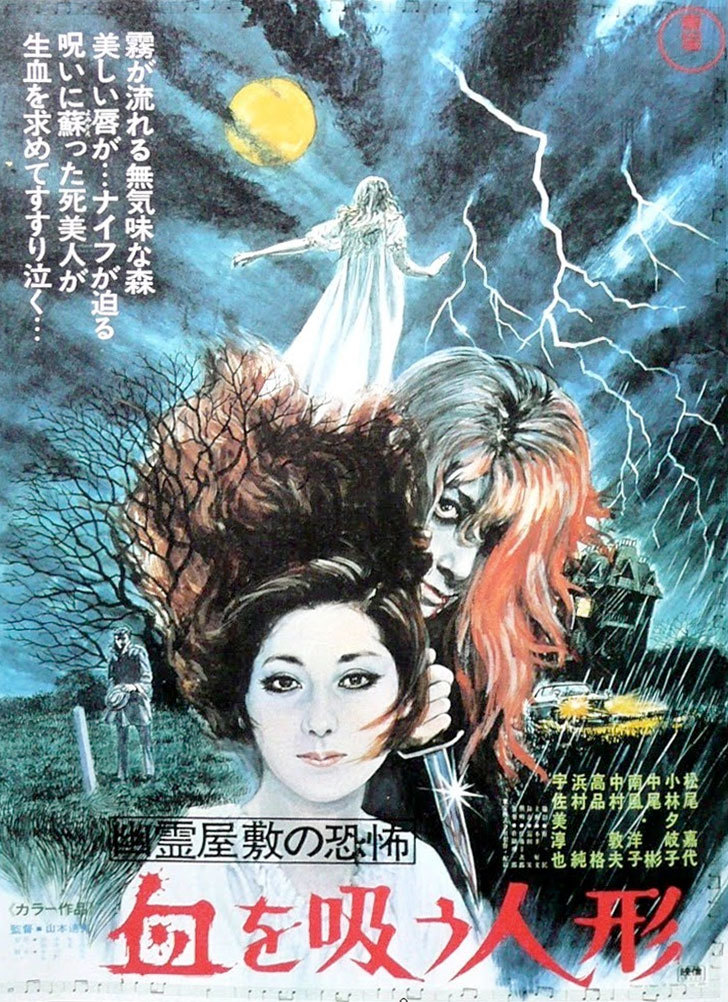
the vampire doll

I’ve talked about how the Criterion Channel is one of my favorite streaming services. Mubi is fast becoming a contender in that category. Mubi actually works as a kind of sister channel to Criterion. Where Criterion focuses on the world’s greatest films and lots of classic Hollywood films (and lots of other more esoteric themes like Snow Westerns and 1970s sci-fi) Mubi’s focus is on more modern art-house fair. They show films that premiere at film festivals like Cannes and Sundance, but that doesn’t necessarily reach a wider audience.

They also have a lot of what you might call cult films – genre movies that have been all but forgotten except by a small group of fans. The Vampire Doll is a good example of what I’m talking about. This was the Japanese film company Toho’s attempt at cashing in on the horror craze that so popular at the time.

It looks and feels like a Hammer Horror film with its creaky old mansion as a setting and its moody supernatural storyline. A man who has been traveling abroad for the last few months returns home to Japan. He immediately rides out to the country to see his girlfriend Yuko (Yukiko Kobayashi). Upon arrival, he is told by her mother (Yôko Minakaze) that Yuko is dead. She died in an automobile accident a few weeks prior.

That evening he sees a woman that appears to be Yuko. Flash forward a few days and the man’s sister, Keiko (Kayo Matsuo) and her fiancee Hiroshi (Akira Nakao) visit the old mansion because they have not heard from her brother in a while and that is unusual. Keiko immediately senses something is wrong and decides to stick around and investigate.

With a 70-minute run time, the plot moves along pretty quickly. Honestly, storywise the film isn’t great. It doesn’t do anything we haven’t seen before. But it works really well as a mood piece. The mansion is full of creepy shadows, and the music is particularly moody. I mentioned Hammer Horror earlier and that is fitting. If you’ve ever seen any of those old movies then you’ll know what I’m talking about. They have a particular look and feel to them that is perfect for this type of gothic horror.

And that’s why I love sites like Mubi. I’d never heard of this film before, but they spotlighted it and now I’ve seen it and I’m glad that I did.

Suicide Club (2001)

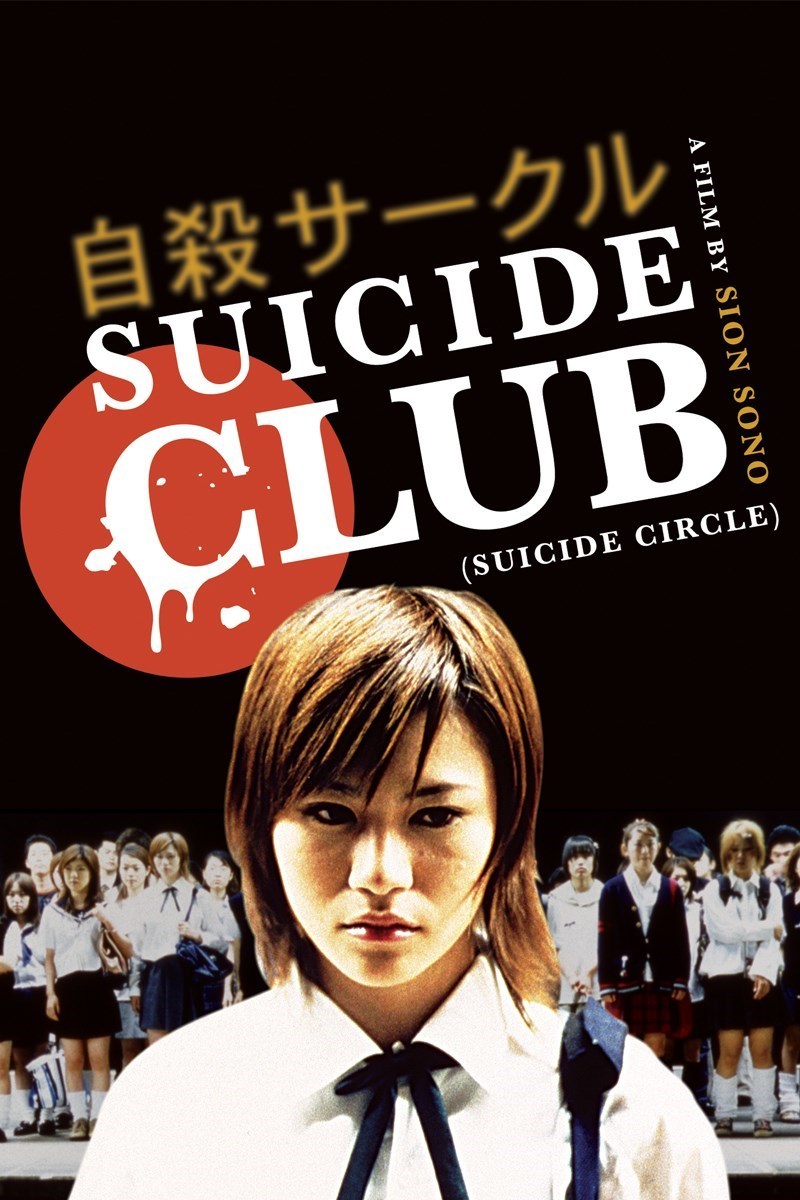
suicide club poster

Fifty-four Japanese schoolgirls stand on a train platform, holding hands, singing, and laughing. As the train approaches they clasp their hands tighter, and in sing-song fashion start to count. As the train arrives, the counting stops, and all 54 of them jump in front of the train. Buckets of blood and guts spray the train, the passengers, and the people passing by.

Later, another group of teenagers sits on the roof of a school building during their lunch break. They are eating and laughing and looking like happy schoolchildren. Conversations turn to the 54 and how cool it would be to form their own suicide circle. Amongst much joking and a good time having, a crew decides to end their lives then and there. Standing on the edge of the rooftop they hold hands and plunge their way to the bottom. Buckets of blood and guts spray all over the school grounds, teachers and students.

Amongst the bloodletting are some scenes about a pop group whose Britney Spearesesque pop wailings are irresistible to every teen. Adults everywhere do their best to quash any talk about the deaths being a part of a suicide club movement.  A theme develops about society’s herd mentality.

Call it Japanese horror with a message.

The cops have to rule all of these deaths as accidents for there seems to be no foul play involved. That is until a bag filled with little rectangles of skin sewn together shows up. Then the suicides become a matter of detective work.

The detectives begin getting calls from a cyber-savvy woman who seems to know more than she lets on, calling herself the Bat. She leads the detectives to an internet site keeping a count of the suicides before they actually happen. One of the detective’s kids finds another site with some peculiar type clues.

Call it a Japanese horror, detective thriller with a message.

Through all this shocking, blood-splattering suicidal carnage continues to occur.

The detectives find a suspect who acts like a cross between Ziggy Stardust and Graham Norton. He’s definitely a bad fellow, what with the squishing of animals, kidnapping, and the random sexing with girls wrapped in pillowcases lying in a bowling alley. But he may not be behind all the suicides.

Call it a Japanese horror, detective thriller by way of Asian MTV, with a message.

In the end, we’re left with nary an explanation of the suicides, but that’s not really the point anyway. There is lots of gory violence if you like that kind of thing. And let’s be honest if you are taking the time to search out a copy of a relatively obscure Japanese horror film called Suicide Club, you probably do. There are gobs of creepy, moody suspense, with some very dark humor thrown in. All mixed in with some pretty in-your-face, and spot-on social commentary.

What’s not to love?