Bring Out the Perverts: Don’t Torture a Duckling (1972)

poster

Lucio Fulci is sometimes called the Godfather of Gore. As one might assume from that name his films were often filled with gratuitous violence and loads of blood and guts. Honestly, his films are sometimes not much more than blood and guts. Some of his films feel like he thought up some crazy violent scenes that would be cool to film and then tried to piece a story around it. Even at his best, his stories aren’t all that well done.

He wasn’t a particularly good stylist either. His films rarely look great. There is often a kind of DIY approach to the way he shoots his films.

I’m making it sound like I don’t like his film, but mostly I do. I think The Beyond (1981) is quite good and Zombi 2 (1979) is fantastic. But I wouldn’t say that Fulci is a great filmmaker. There is a bluntness to his films that reaches right into your guts and pulls them straight out. That violence and gore created some truly memorable effects work and he could certainly create a scene that will stick in your memory banks.

But yeah, he’s not really known for his thought-provoking scripts.

Don’t Torture A Duckling then is a bit of an oddity in Fulci’s filmography. The gore is toned down a great deal, and there is a concentration on telling a real story. One with a social conscience even.

The story revolves around the murder of three young boys in a small Italian village. It shocks the citizens and creates a sort of moral panic. They must find the killer, even if it’s a scapegoat. The community must go back to normal.

The first pick on a simple-minded man, then when it’s clear he could not be the culprit they go after a wandering witch. Then they decide it could be Patrizia (Barbara Bouchet) a rich, classy woman from the city spending some time in the country. She talks funny and dresses in tight shirts and short skirts. Surely she has loose morals and could be a killer. Rumors and superstition lead the investigation, at least where the townsfolk are concerned. The police are relatively competent but it hardly matters.

This is a Lucio Fulci message picture. Rural Italy is run on superstition and religion, science and procedure take second place. Not even the Catholic Church is given a break.

I appreciate that he’s trying to do something more than his usual shocking violence and gore. I also appreciate that he spends more time than usual creating beautiful images. Most of the film was shot on location and there are some truly beautiful landscapes that he lovingly captures. But if I’m being honest it isn’t all that interesting to me.

I’m not entirely sure why this qualifies as a Giallo. Outside of it being a murder mystery, it has very few of the hallmarks of the genre. But whatever, it is worth watching just to enjoy Fulci paying attention to the story for once.

I previously reviewed Arrow Video’s Blu-ray release of Don’t Torture a Duckling for Cinema Sentries.
The Friday Night Horror Movie: The Devil’s Honey (1986)

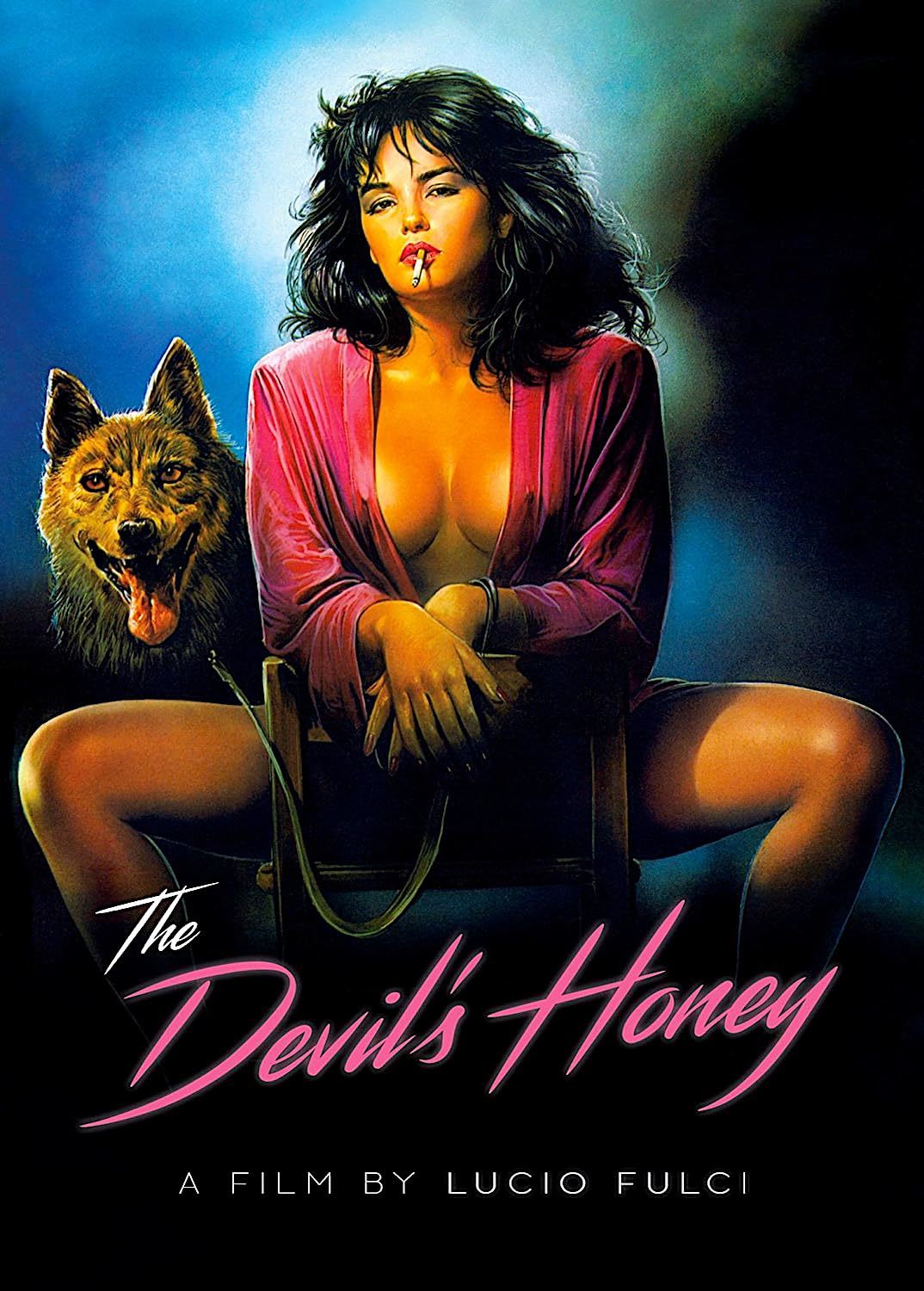
the devils honey

One of the things I miss about the old video rental stores is the ability to walk in and find something you’ve never heard of, that was completely obscure and weird. You’d take it home not knowing what to expect. Sometimes it was crap, but every now and then you’d find a real gem.

Sure, you can do that with streaming, but it just isn’t the same. 

Growing up, we had this wonderful video store. It had previously been a Burger King, and when it closed down a place called Mega Movies moved in. They removed the kitchen providing a huge space for videos. I used to wander around that place for hours. I loved digging into the bowels of that place looking for something really weird.

As a virile teenage boy something really weird sometimes meant something with a scantily clad lady on the cover. I have this very distinct memory of a single scene from one of these movies. A beautiful woman was wearing nothing but a pair of pantyhose. A man stood nearby watching. She is repairing a run in her tights with some red nail polish which turns the man on, and soon enough she’s rubbing the polish in places nail polish should never go.

I couldn’t ever remember anything else about the movie. I’ve often wondered what that movie was, but I wasn’t about to go Googling “woman masturbates with nail polish” so it remained a mystery.

Until tonight. I have a list of unwatched horror movies and digging through it tonight for something to watch I landed on this movie, The Devil’s Honey by Lucio Fulci.

I’ve written about Fulcio before, he’s a guy who made a lot of movies – most of them low-budget, a lot of them full of blood and gore. They aren’t always great, but they are usually interesting.

I went into this movie expecting some good old-fashioned violence. I was not expecting a half-naked woman with nail polish. Certainly not the half-naked woman with nail polish locked inside my memory banks for going on three decades.

That particular scene happens within fifteen minutes of the opening credits. Before that, there is a scene in which a man gets a woman off by placing the end of a saxophone on her crotch and playing her a song. 

This isn’t the Lucio Fulci the Godfather of Gore, this is Fulci’s erotic thriller. Except, that it isn’t particularly erotic or thrilling, but it is amazingly weird and I’m always down for that.

The saxophonist is Johnny (Stefano Madia) and the girl is Jessica (Blanca Marsillach). They are tempestuous lovers. He’s obsessed with sex (as one might suspect from the display with the sax). She wants something more than that, usually protests at his fondling, but usually gives in.

There’s also a surgeon, Dr. Wendell Simpson (Brett Halsey), who is uninterested in sex with his wife but likes to go out with prostitutes (one of whom is the girl with the nail polish).

One day Johnny takes a tumble and bangs his head on a rock. At first, he seems fine, but later he collapses and is rushed to the hospital where Dr. Simpson tries to save him. Tries, but fails.

Awash in grief Jessica begins calling the Dr. on the regular, asking him why he let Johnny die. Eventually, she kidnaps the man and does a little sadomasochistic torture on him while periodically flashing back to more idyllic times with Johnny.

Though I’ve seen 16 of his films and written about him at least five times, I’ve never thought Fulci was that particularly great a director. He can create some interesting imagery, and he’s a wizard with low-budget gore effects, but his stories are usually a mess and his camerawork is nothing special. A film like this where the gore is minuscule and the violence, no matter how psycho-sexual, is mostly sidelined or at least restrained (for a Fulci film) finds itself with not much of interest to say.

There is enormous amounts of gratuitous nudity, loads of misogyny, and the whole thing is ridiculously dopey. Yet I kind of dug it. It is so wild and weird in a way that only Lucio Fulci can be that I had to sit back and marvel at it.

31 Days of Horror: Murder Rock: Dancing Death (1984)

murder rock

Lucio Fulci is often called The Godfather of Gore, and it is true, he did make a lot of horror films with copious amounts of violence, buckets of blood, and tons of gore. But he worked in many other genres throughout his long career including westerns, sword and sandal epics, and even comedy. What one would not expect from him is a musical, which is exactly (well, more or less) what he made with Murder Rock: Dancing Death.

It isn’t technically a musical since the characters don’t actually sing, but there is a lot of music (which was written by Keith Emerson) and a whole lot of dancing. But it is really a horror movie. Actually, it is the best-looking Giallo Fulci ever made.

It takes place at a New York City dance studio where one by one the female dancers are being stabbed through the heart with a long, needle-like hairpin by a black gloved killed. The studio is so hardcore that after the first girl is killed, the instructor basically tells the other dancers to stop whining and get back to work.

Meanwhile, Candice (Olga Karlatos) begins having dreams of being murdered by a man she’s never seen before. When she sees the dream man’s face on a billboard she tracks him down only to discover he’s a disheveled drunk. Instead of shrugging it off or running away in terror, she decides to sleep with him.

The film is filled with red herrings and a cop (Cosimo Cinieri) who is both lackadaisical about the whole thing and rather sadistic. It is all a bit complicated and rather silly, but I really kind of loved it. I mean most Giallos are complicated and silly, but this one pushes it to the edge and then some.

But it is stunningly gorgeous to look at. Fulci and his cinematographer have lit the heck out of it and filled it with beautiful, colorful images. The music and dancing give it an unusual energy and it’s just a lot of fun to watch.

Foreign Film February: One On Top Of The Other (1969)

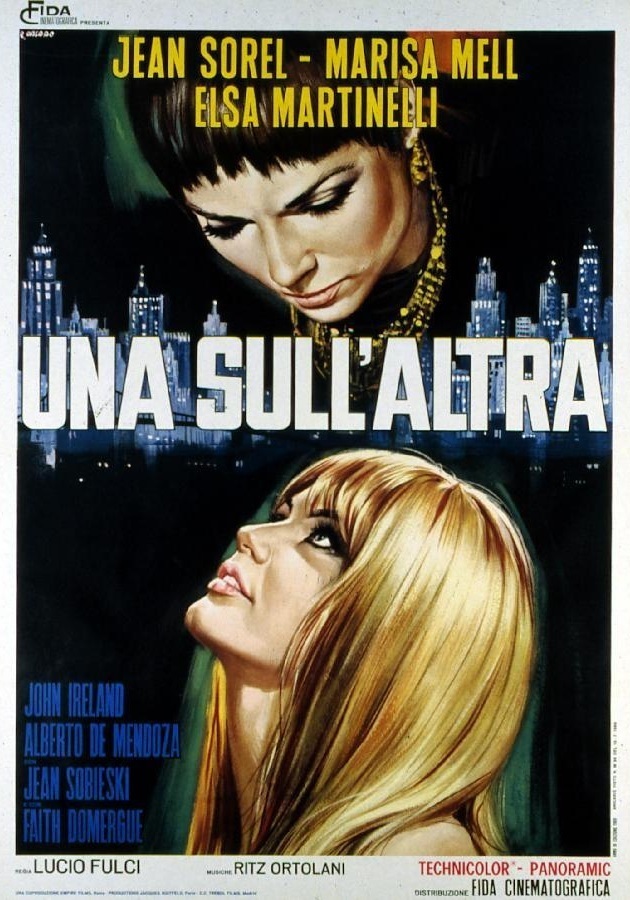
one on top of the other poster

While I obviously like horror films, I wouldn’t exactly call myself a super fan of the genre. I’m no horror hound who goes to see every horror film as soon as it is released. I’m not exactly a snob about it either, as there are plenty of really terrible horror films that I love. But for most of my life horror wasn’t necessarily something I set out to watch on a regular basis. I watched new horror films that were getting good reviews, and I tried to watch the classics, but weeks or even months would go by sometimes between my viewing of that genre.

Then sometime in the last few years, I started watching horror movies on Friday nights and that became the Friday Night Horror Movie and now I am seeking horror films on a regular basis. More than ever before I’m actually seeking out new horror films to watch. That’s allowed me to not only watch some of the classics that have been on my list for a while, but to find new films, or to dig deeper into certain directors’ catalogs.

Lucio Fulci is one of the godfathers of Italian horror. I’ve now seen 18 of his films. I wouldn’t consider any of them masterpieces. Some of them aren’t very good at all. They mostly slide into that good, but not great category, with bonus points being given to the great practical effects he uses for the large amounts of gore he likes to add to his films.

One On Top Of The Other is more of a crime film than a horror one. It feels like his attempt to remake Vertigo as a film noir with a copious amount of sleaze and a terrifically wonky jazz score.

A wealthy doctor has a sick wife and a pretty girlfriend. The wife dies and he gets a large insurance settlement. An anonymous tip leads him to a strip club where one of the dancers bears an incredible resemblance to his recently deceased wife. The police have been following him due to the insurance money and when they discover the doppelganger, well, things start to get hairy for our hero.

There are a lot of cool twists and turns in the story and it all looks and sounds good. But Fulci seems more interested in watching the women take off their clothes and get sexy with various men than he is in paying attention to the story. This is too bad because there is a pretty great film hidden underneath all the sleaze.

The House by the Cemetery (1981)

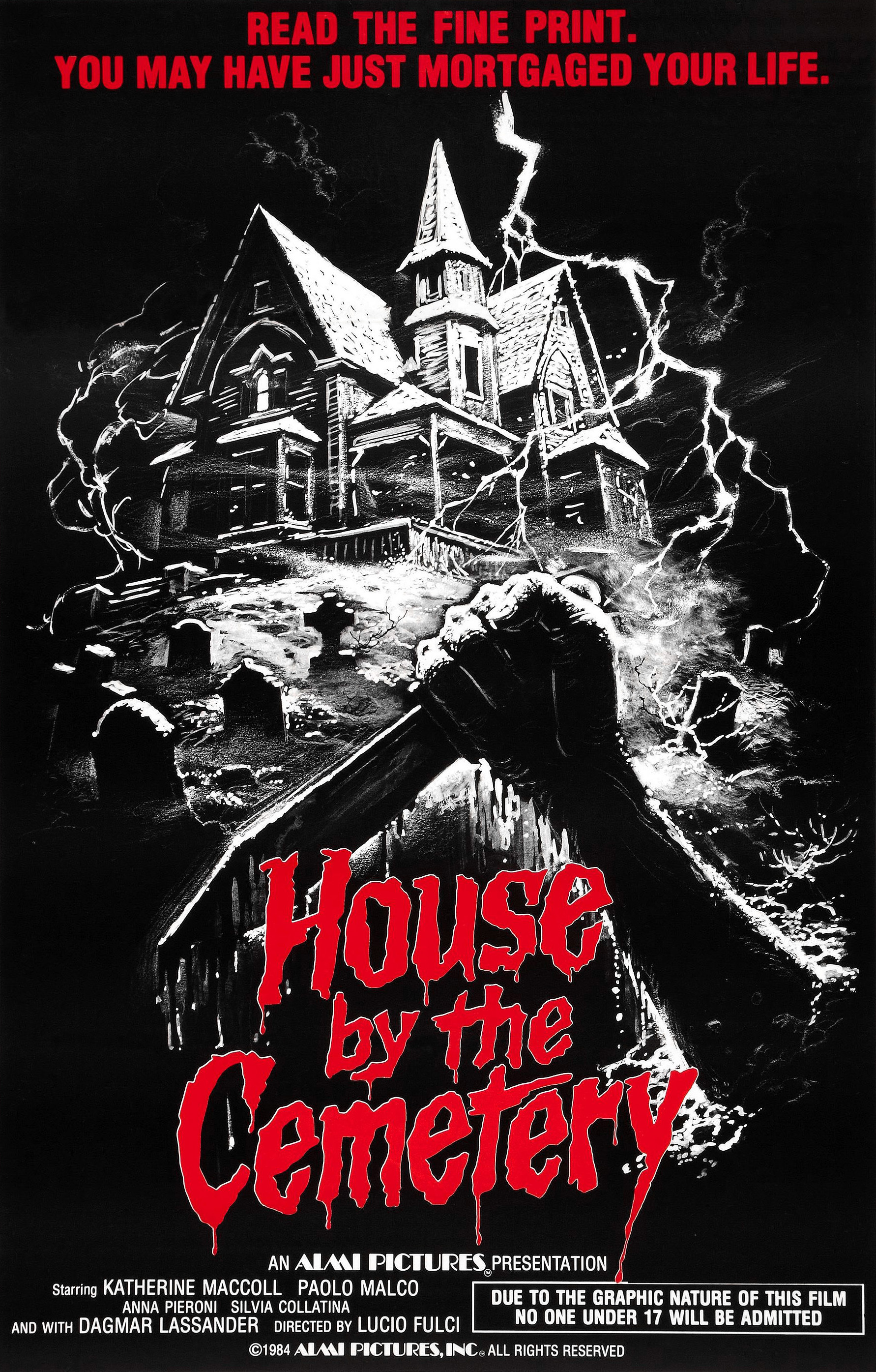
house by the cemetery poster

It is almost October which means it is almost Halloween which means I’ll be watching a lot of horror movies. I should be creating a list for my #31DaysofHorror and #Hooptober hashtags (more on that later) but for today I just watched an old Italian horror. Lucio Fulci was an Italian director who made lots of films in lots of genres but is mostly known today for a series of Giallo and Horror films, most of which included high levels of graphic violence (he is sometimes called the “Godfather of Gore”.)

The House by the Cemetery is not his best work, nor his worst, but it is a pretty good example of what he is about. The story is hard to follow and mostly nonsense. The screenwriter, Dardano Sacchetti, says he was inspired by Henry James and Fulci says he wanted to make a Lovercraftian story. I’ve not read anything by any of those authors so I can’t comment on that, but I can say little of what’s on the screen makes much sense.

The story involves an intellectual, Norman Boyle (Paolo Malco) who moves from New York City to a small town in New England. He takes his wife Lucy (Catriona MacColl) and young son Bob (Giovanni Frezza) with him. He’s there to continue the research of his mentor Dr. Peterson, who previously went a little crazy and killed his mistress and then offed himself. All of this was done in the titular house by the cemetery, the house Norman and his family are moving into.

It is a creepy old horror movie house – big and dilapidated, filled with shadowy corners and a scary basement. It is not only located next to a cemetery but also on top of one. Or at least when they pull back a rug they find a tombstone in the middle of one of the rooms. Norman says that lots of homes bury their loved ones inside their houses because it gets cold up there in the winter and the ground is too hard. Sure Norman, whatever you say. There are lots of cold places in this world and I don’t think any of them keep grandma’s corpse in the basement.

People keep telling Norman that they’ve seen him before, that he must have been up in that town a few months prior. Norman keeps denying this. The librarian is a creepy dude who seems to know more than he lets on. A babysitter (Ania Pieroni) shows up and is found trying to get into the locked basement. Then she gets brutally murdered down there. Bob befriends a young girl who no one else can see and who may actually be a ghost.

None of these things are connected very well. It feels like several scenes are missing. Or the screenwriter got drunk and forgot to write a few pages. But it doesn’t really matter. Nobody watches a Fulci film for a great story. They watch it for the gore and this film gives you plenty.

It is the type of film that not only includes a dungeon filled with bodies chopped into pieces but that quick zooms into the viscera and lingers on the gore. In the very first scene a woman gets a knife stabbed through her skull. If you enjoy handcrafted gore effects, and I certainly do, then Lucio Fulci is your man, and The House by the Cemetery is not a bad place to start.

It isn’t just blood and guts though, that make this worth watching. The story is a bit bewildering but Fulcio does a nice job of creating an eerie atmosphere and keeping things just enough off balance that your left feeling on edge for most of the film’s runtime.