The Friday Night Horror Movie: A Haunting In Venice (2023)

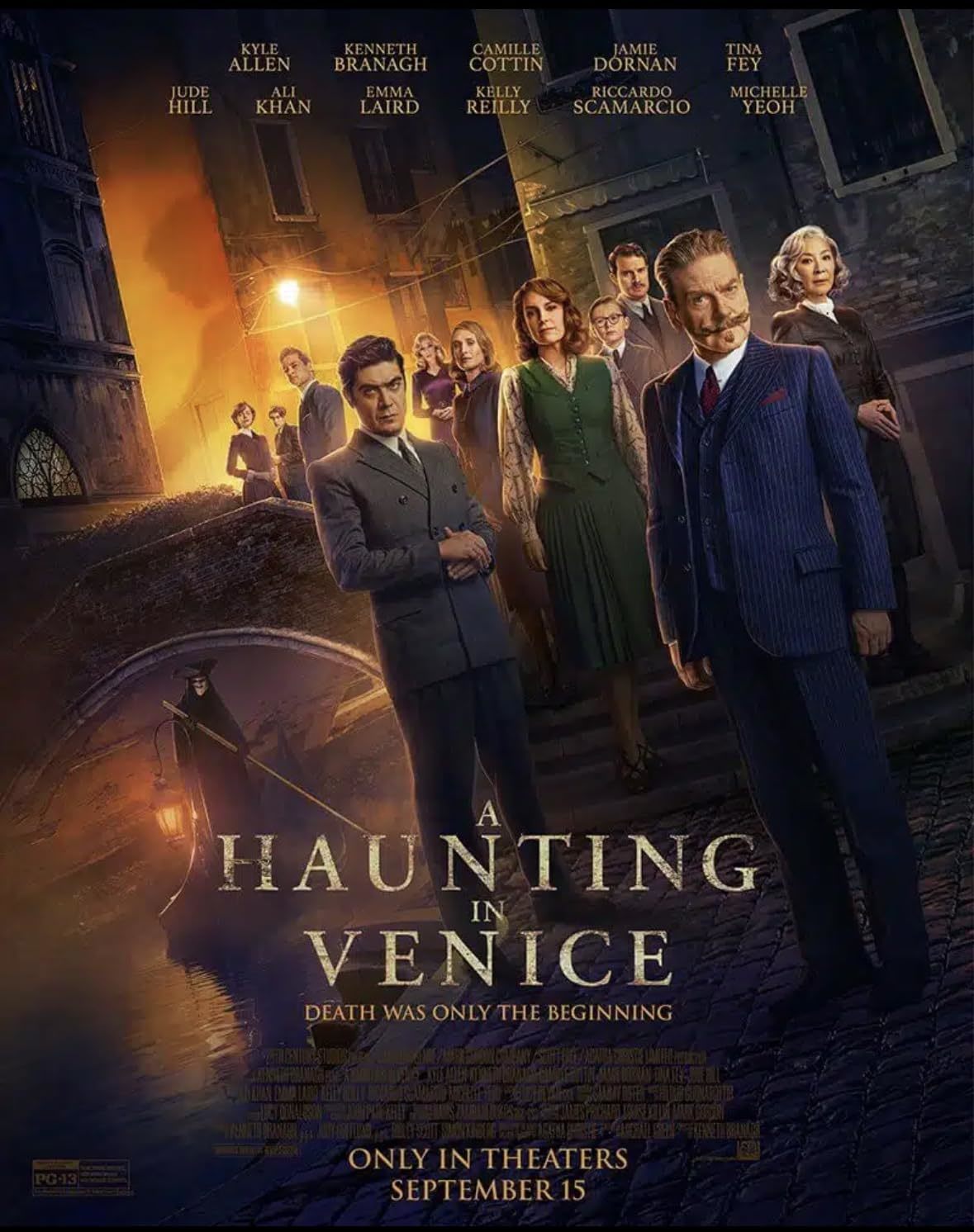
a haunting in venice poster

I follow a lot of film critics and culture writers on various social media platforms. Most of them like to periodically complain about the state of the movies. The Marvel Cinematic Universe has created a seismic change in movies, and more specifically the way movies are shown in theaters. Or rather how many movies are no longer shown in theaters.

The MCU has made billions upon billions of dollars. Their method of interconnecting their films into one giant universe (and making piles of cash in the process) has made every other studio chase those billions. In doing so they are no longer satisfied with smaller movies, where they can only make millions of dollars instead of billions, virtually erasing mid-budget films in the process.

These film critics complain and complain about how adult-oriented dramas, mysteries, and romances simply don’t exist at the movies anymore. They wax nostalgic about times in the past, two or three decades ago, when they could go to the movies and watch something that wasn’t based upon a comic book or a part of a larger franchise.

Yet, when those types of films do get made and do get shown in the theaters, these same critics tend to pan them and encourage others not to go see them.

Kenneth Branagh’s Hercule Poirot films are a good example of this. Based upon the novels of Agatha Christie, Branaugh has directed and starred in three films in which he plays the famous Belgian detective. I won’t claim that they are great films by any stretch, but they aren’t big-budget superhero films either. They are well-told mysteries with terrific casts and are made for adults. In a word they are exactly the sort of films that these types of critics complain don’t get made anymore. Yet when the movies come out, those same critics do nothing but grouse about them.

And that’s enough grousing from me. The latest Poirot film is probably the best one. As the title implies there is a supernatural element to it, and while it isn’t a straight horror it certainly contains elements of horror and that means I get to talk about it tonight. It also means that my daughter is having a sleepover and me and the wife had a much-needed date night and this is as close to horror as she’d let me get.

Hercule Poirot has retired into seclusion in Venice, Italy. There has been too much death and misery in his life and he simply cannot stand to tackle another mystery.

When his friend, Ariadne Oliver (Tina Fey), a novelist who writes thinly veiled Poirot mysteries, invites him to a seance he at first declines but her friendship wins him over.

The seance takes place on Halloween night in an old, decaying palazzo. It is being held by Rowena Drake (Kelly Reilly) who hopes to speak to her daughter who mysteriously killed herself in the palazzo one year prior. Also at the seance are an assortment of interesting people all of whom have a connection to Rowena and her daughter and, it will be found out, had a reason to murder her.

Poirot quickly exposes the psychic (Michelle Yeoh) as a fraud and is ready to leave, but when the psychic is murdered and someone tries to drown him in an apple bobbing bowl, he locks everyone inside the palazzo and finds himself once again back on a case.

This one is based on a much less famous book (Hallowe’en Party) than the other two films (Murder on the Orient Express & Death on the Nile). Apparently, it’s quite loosely based as well, which allows it to surprise you with its story rather than retell one that is quite familiar to casual fans.

The palazzo is reminiscent of all those gothic castles in those old haunted house movies that I love so much. It allows for plenty of creepy, atmospheric shots down long corridors, and shadowy rooms. The film has a lot of fun toying with whether or not the supernatural aspects are real or not, making it great fun to watch.

Kenneth Branagh clearly enjoys himself playing the famous detective and he’s become quite good at it. He’ll never replace David Suchet (who played Poirot in the long-running British television series) but he’s still quite entertaining. I love that he’s able to make these lavish adaptations with large, wonderful, casts. I hope he gets to make a dozen more.

Great British Cinema Cottage to Let (1941)

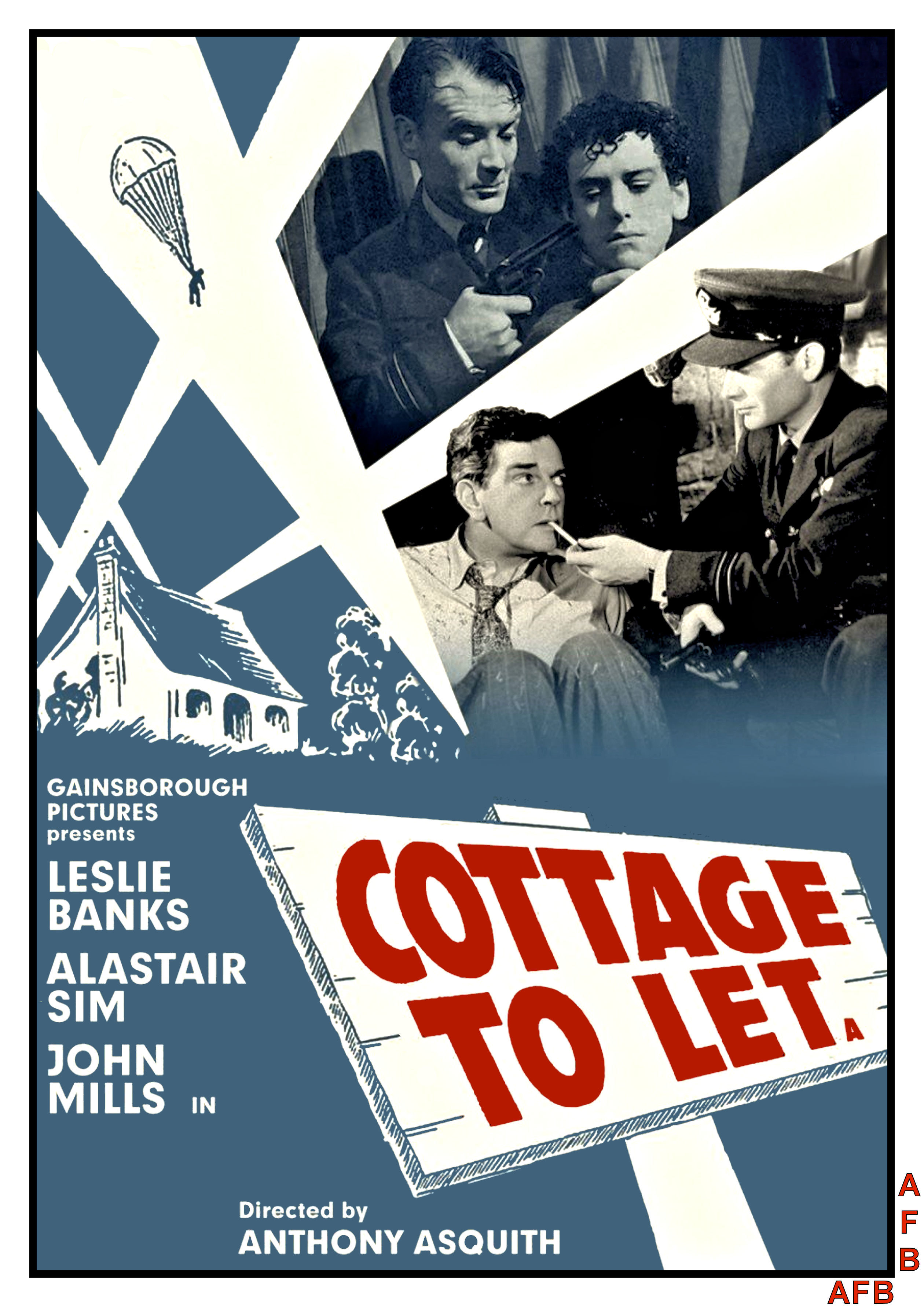
cottage to let

Mrs. Barrington, a kook of a woman (Jeanne de Casalis), has agreed to take in child evacuees from London during World War II. She’s also agreed to allow her cottage to become a military hospital. Naturally, she has forgotten to inform her leasing agent of any of this so besides the children and the infirmed she has let her cottage out to a strange man, Charles Dimble (Alastair Sim). Also living at her estate is her husband John Barrington (Leslie Banks) an inventor who is currently working on a new bombsight which is of great interest to the Royal Airforce and Nazi spies.

Cottage to Let is a wonderful little drama filled with mysterious and eccentric characters and enough twists and turns to keep everyone guessing.

Mrs. Barrington might be a bit dotty, but she’s smart enough to realize she only has so many rooms so she only takes one child evacuee, and one soldier in need of attention. Still, that amounts to a large cast of characters. Moreso when the British military higher-ups come into town when John Barrington refuses to come to London to clue them in on his work.

Early on we realize there must be a spy amongst this lot, but we aren’t sure who it could be. The film has a lot of fun insinuating various characters but never quite letting us know who it is.

It is suspenseful in the way Hitchcock’s films are often suspenseful – which is to say it creates some interesting tension while also letting you know no real harm is going to come to our heroes. It is also clever and quite funny.

I found it to be wonderfully delightful.

Great British Cinema: Murder She Said (1961)

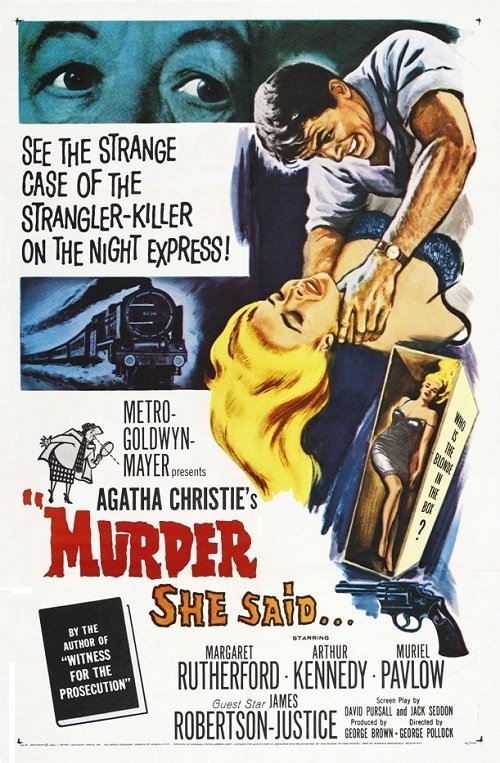
murder she said

I love me a good detective story. Though I write a lot about horror movies the genre I find myself watching more than others is crime stories. There is something pleasurable about watching someone solve a murder.

Officially, I am on the side of Raymond Chandler and the school of the hard-boiled detectives. I like my crime dark and dirty, violent and real. Bloodless murders happening in the parlor rooms of rich and genteel classes are a little bit too silly for my liking. Especially when they conclude with a rounding up of all our suspects into one room while the detective susses out the culprit.

But sometimes, that’s exactly the sort of thing I need.

I’ve only read a few Agatha Christie novels, all of them Poirot, but I’ve seen quite a few cinematic and television adaptations of her stories (most of them Poirot) and I consider myself a fan.

Murder, She Said was the first screen adaptation of a Miss Marple story, and it is delightful.

It begins with Miss Marple (Margaret Rutherford) on a train. Another train crosses on a parallel track. Miss Marple watches the other passengers on the other train – an elderly man embarrassed that she sees him, a young girl who sticks out her tongue, and a woman getting strangled to death.

Miss Marple immediately informs the conductor who, when he spies the mystery novel she’s reading, believes she’s made it up. She makes him notify the police anyway, but they find nothing. They stop the train at the next station and can find no corpse. No body equals no murder and so they drop the matter.

Miss Marple, naturally, investigates.

She grabs a friend, Jim Stringer – a local bookseller and mystery enjoyed – and they walk the tracks around the area where she witnessed the murder. When they see some tracks made by what could be a dead body being dragged across the ground and trace them to Ackenthorpe Hall, Miss Marple finds a job there as a maid.

What follows is your standard Agatha Christie-type investigation. The Ackenthorpes are an odd bunch. She must do her duties as a maid, while still asking discreet questions and wandering around the grounds. There is a cute, clever boy who helps her, and lots of clues to be found.

It is handled very lightly, and often very humorously. Margaret Wutherford is just wonderful. She reminded me a lot of Angela Lansbury in Murder She Wrote. And considering how close that series title is to this film, I expect that is no coincidence. Wutherford is bold and clever, strong but vulnerable.

It works as both a good mystery and a comedy of manners. I loved it.

Manhattan Murder Mystery (1993)

manhatan murder mystery

Originally written and posted on October 5, 2006.

I’ve been watching Woody Allen films lately and I don’t know how I missed so many of them. I mean how could I be thirty years old and never seen half of his oeuvre? I just don’t get it…I mean I used to watch his films on the USA network when I was a kid – Bananas (1971), Everything You Wanted to Know About Sex, But Were Afraid to Ask (1972), that one about the guy who takes a nap and wakes up a hundred years later and there’s no sex, and I loved them all. I used to stay up late and watch them with my dad. Then I just stopped. I mean I did watch Annie Hall (1977) of course, but so many others…I don’t know…they just slipped by. I think it was watching Deconstructing Harry (1997) that did it. That one…I don’t know it felt like an old man making dirty jokes for two hours…it sounded so good in the magazines, but…I don’t know I couldn’t take it. And then I decided I had seen all the Woody Allen I wanted to see. But now, lately, I’ve been watching the rest, and I can’t believe I ever stopped.

(So that was my written Woody Allen impression. It’s funny, maybe.)

Manhattan Murder Mystery isn’t top-notch Woody Allen, but it’s pretty stinking good. It is basically your classic murder mystery premise with Woody Allen jokes.

Woody plays Larry who is married to Diane Keaton who plays Carol. They live in Manhattan (and I know this sounds pretty much like every Woody Allen movie, but stay with me) and their kindly old neighbor dies. Carol is almost immediately suspicious because the dead woman’s husband, Paul (Jerry Adler),  is too chipper too quickly after the death of his spouse.

Carol enlists her friend Ted (Alan Alda) for the conspiracy while Larry thinks they are both nuts. Carol and Ted get deeper and deeper into trying to see how Paul could have done it and eventually (of course) realize that their little game has more truth to it than they could imagine. Soon everybody is knee-deep in a real death plot and must find a way to not only catch a crook, but stay alive as well.

The plot could have easily been lifted from Agatha Christie or Nancy Drew or any other of the millions of murder mystery writers. There is nothing original in the idea, but Woody Allen pulls it off masterfully, mixing the comedy and mystery in equal parts all in breezy, completely enjoyable way.

It may not be his best work, but it sure is fun to watch.

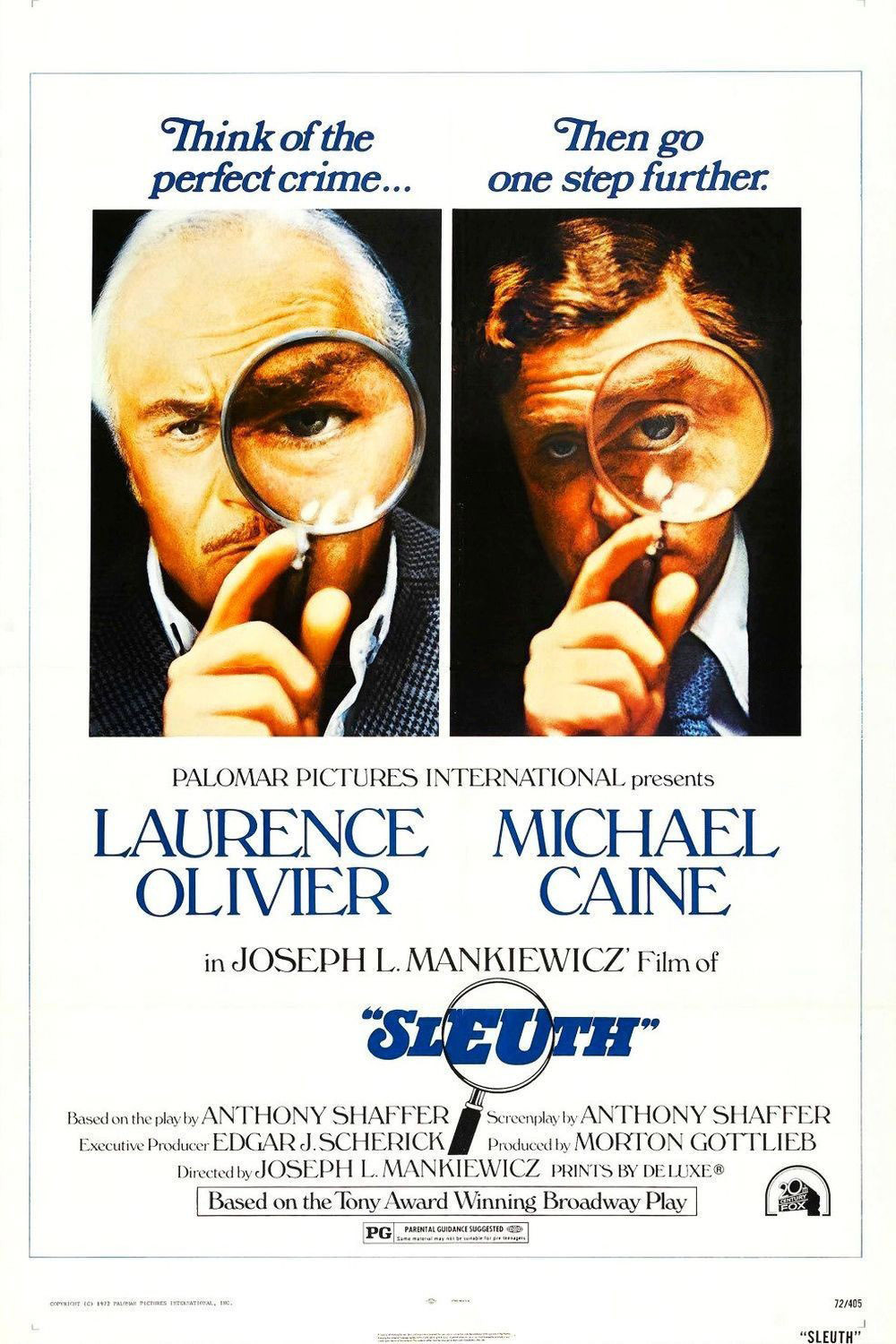
Sleuth (1972)

sleuth movie poster

This was originally written and posted on March 1, 2006.

A delightful plot-twisting mystery starring Michael Caine, Laurence Olivier, and nothing but Michael Cain and Laurence Olivier – albeit in two roles for Michael Caine. It is essentially a showcase for both actors, and it is quite a show they put on.

The plot gets complicated, but essentially Olivier plays a mystery writer in the vein of Agatha Christie. Michael Caine has been having an affair with Olivier’s wife. The two meet at Olivier’s house to discuss the state of things. Fiendish plot point after another and things get sinister and fun very quickly. There isn’t much more to say, for letting the twists and turns come as they are is half the fun.

Director Joseph L Mankeiwicz manages to adapt what was originally a successful stage play into the cinema very well. He uses his set pieces as supporting actors. There are dozens of games lying about Olivier’s house, and nearly all of them play some part of the plot.

Though the DVD seems to be out of print, Sleuth is well worth tracking down at the local library or video club.