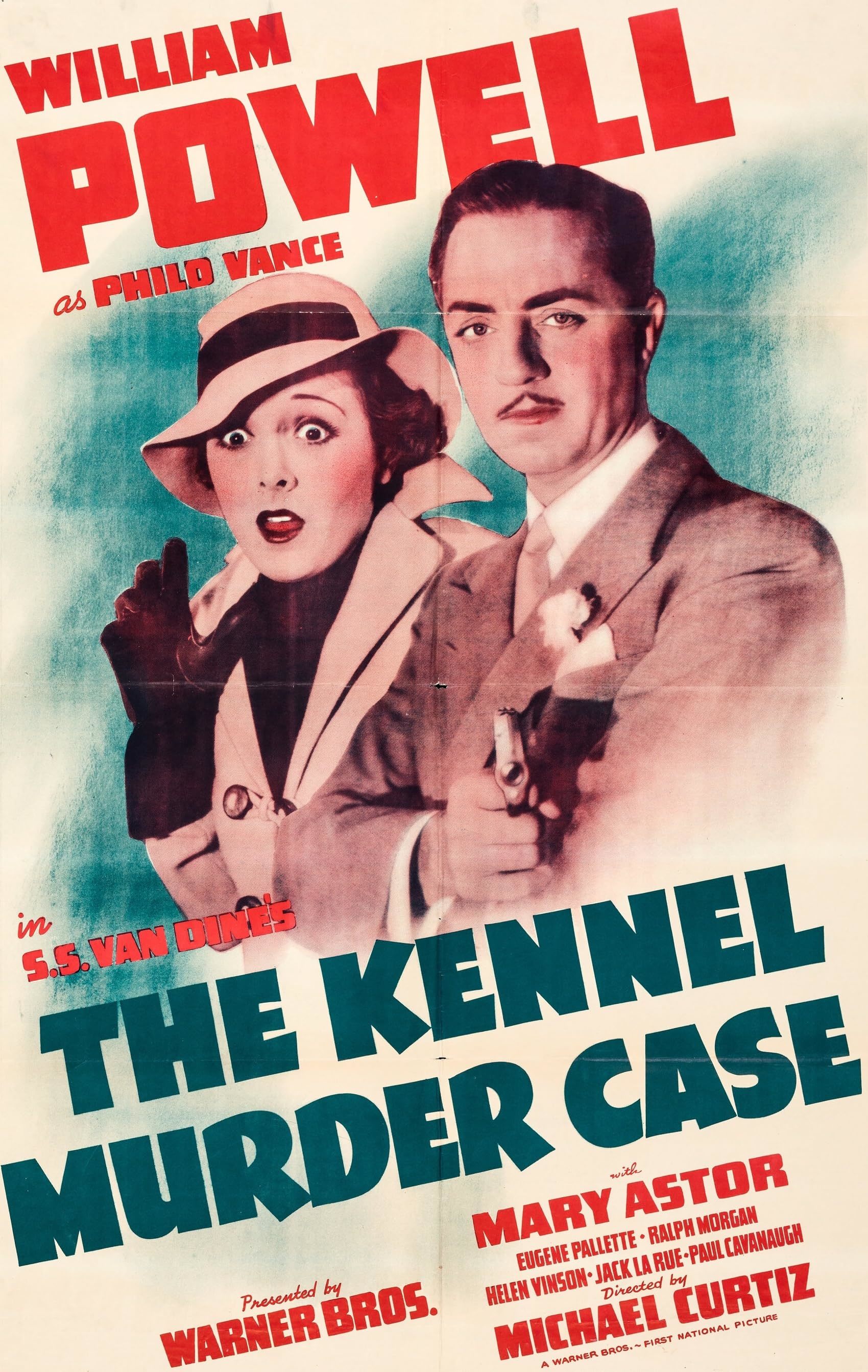
Murder Mysteries In May: The Kennel Murder Case (1933)

poster

I’m certainly not the only person who loves murder mysteries. Go to any bookstore and you will find shelves lined with them. Turn on the television to nearly any station and you’ll likely find one. Countless movies have been made in the genre. As I noted in my keynote it is an extremely malleable genre. It can be fitted to suit any audience’s needs.

As one might know from my yearly participation in Noirvember I am a huge fan of film noirs and the hard-boiled way of writing. It was actually the Coen Brothers who turned me on to such things. I’d heard their movie Miller’s Crossing was inspired by a couple of books from Dashiell Hammett so I went to the library and started reading him. That led me to Raymond Chandler and James M. Cain which led me to their movie adaptations and the rest is history.

But I’m getting away from myself. The Kennell Murder Case is based on a book by the same name by S.S. Van Dine. He was a conetemporary of Hammett, but his books have greatly fallen out of favor. They were getting that way by the time Chandler started writing a decade or so later. Chandler directly called Dine out in his essay on mystery writing The Simple Art of Murder in 1944.

Philo Vance was the name of Van Dine’s detective. Here he’s played by William Powell (who would find great success a year later in The Thin Man, written by Hammett). In the books, apparently, Vance is a bit of a dandy, an intellectual and aesthete who solves murders by picking up clues the police miss.

Powell (who had previous played Vance in three other films) plays the character like a prototype for Nick Charles in The Thin Man movies. He’s intelligent and upper class but not distinctly so. He’s witty at times but the script isn’t all that sharp.

The plot is basically a locked room mystery. A man is found dead inside his room. The door is locked from the inside, as are the windows. He was shot in the head and the pistol is laying by his side. Suicide is the obvious answer, but Philo Vance doesn’t think so. He just saw the man the day before at a dog race and he seemed perfectly upbeat. When the coroner realizes the cause of death was a blow to the head by a blunt object, and not the gunshot the case is on.

There are more murders and more mysteries that arise, but honestly I was bored from the begining. The pacing is sluggish. The dialogue comes with these odd pauses between lines and the scenes don’t cut out for several beats after everything that needed to be done is done. And as the dialogue isn’t all that clever, and the action not all that well done all of that slowness just makes the film seem like its longer than it actually is.

I always like William Powell, and he’s fine here, but the character is underwritten and the story so underwhelming, that I can only recommend this to die hard fans.
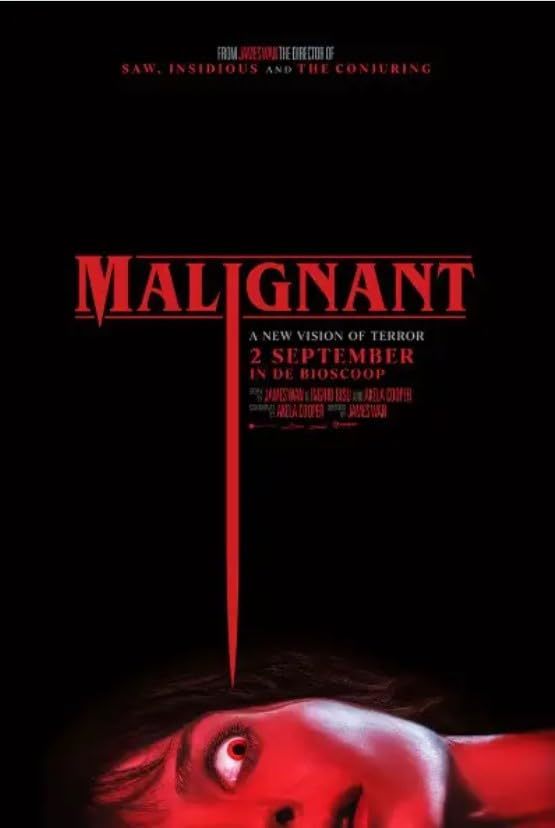

The Friday Night Horror Movie: Malignant (2021)

poster

It is time for both the Friday Night Horror Movie and Murder Mysteries in May. One would think it would not be difficult to find a film that fits both of those descriptions. Murder is horrific after all. But for tonight, I found it nearly impossible. The trouble, I’m realizing is that since mysteries and crime stories are some of my favorite genres, I’ve seen a lot of them. I wanted to watch something I’d never seen before and that proved difficult. I was probably using the wrong search terms.

I eventually landed on Malignant. It was directed by James Wan who has helmed several horror films I’ve enjoyed (namely The Conjuring and Insidious). Even when I’m more ambivalent about his films (namely the Saw franchise) I’m always impressed with his craft as a filmmaker. He definitely knows how to move a camera and create some true cinematic scares.

The basic synopsis of the film – woman begins having visions of terrible murders only to realize they are coming true – has been done many times before, but that type of thing can be effective and with Wan at the helm, I figured it would at least be interesting.

I was wrong. So very, very wrong.

In general, I’d say picking on a film’s plot holes (both real and imagined) is one of the lazier forms of criticism. A film is more than a plot and a great movie can overcome bits in the story that don’t make logical sense. But I also realize that when a film isn’t working for me I tend to get angry at those holes in the plot.

Malignant is a very stupid movie. So much of what happens either doesn’t make sense or is just completely bonkers. But the thing is Malignant is also a film that completely understands how utterly ridiculous it is. Few films from major studios are allowed to have such a ludicrous premise and are given the chance to just completely go for it.

Had I been in a better mood, had I been less tired, or had I been with some friends who enjoyed dumb, stupid, ridiculous horror films I might have allowed myself to just go with it and have a good time. As it is, I could barely make it through.

Frozen in January: Whiteout (2009)

whiteout movie

Sometimes you watch a movie knowing ahead of time it is going to be bad. You do so thinking maybe it won’t be that bad. Maybe it will at least be entertaining. And maybe, just maybe, it will defy expectations and actually be pretty good.

Mostly, you turn out wrong.

Or maybe that’s just me.

I knew going into it Whiteout wouldn’t be good. It actually has a kernel of an interesting idea – a lone US Marshall in Antarctica must solve a murder. But that’s also the kind of snappy idea that Hollywood all too often screws up.

I should have known not to watch it when I realized it stars Kate Beckinsale. I don’t actively hate Kate Beckinsale. I don’t think she’s necessarily a bad actress. She just has a habit of starring in a lot of bad movies. I don’t know if she just has bad taste, or she’s rarely offered anything any good or what. Maybe she has a terrible agent. But looking through her filmography I see very few movies that I either thought were good or that look anything like interesting.

But, like I said, this film has a setup that could be really cool so I took the plunge. 

The biggest problem with the film is that it doesn’t know whether it wants to be a mystery, a thriller, or a horror film. It even throws in a bit of World War II conspiracy for good measure.

Beckinsale plays Carrie Stetko, the sole US Marshall in Antarctica. Most of the base is preparing to fly out. Winter is coming and at the bottom of the world, winter is long and hard. Minimal staff is required.

Stetko usually stays but this time she’s leaving. As is her friend, the base’s only doctor, John Fury (Tom Skerritt). As an example of just how poorly this film thinks things through that is the base’s only law enforcement agent and doctor leaving for several months. There is no indication that anyone is being sent to replace them. While most of the personnel do leave for the winter, not all of them do. What happens when a crime is committed or someone needs healthcare?

But of course, the film doesn’t think about this because it knows those two characters aren’t going to be leaving the base. A crime will be committed and someone will need medical attention and they will stay.

A body is found lying face down in a remote part – a “no man’s land” of the continent. His face is smashed to bits so it is impossible to tell who he is. Stetko and Fury investigate. Stetko realizes he must have taken a great fall. She knows this because, as we see in a flashback she once shot a man causing him to take a tumble out of a high-rise building. 

The film loves its flashbacks. They pretty much all surround that one event in Stetko’s life, but the film doles it out like it is some great mystery that will reveal some insight into this current case. But really it is a pretty simple thing that lets us know what she’s doing in remote Antarctica in the first place.

The murder leads them to a remote station which then leads them to a WWII airplane buried in the snow. This should be an interesting mystery, a weird surprise for the audience. Except the film began with us watching the plane crash and showed us why. The only mystery left is what was in the box on the plane that everyone winds up fighting over. It might be old nuclear stuff which would be bad. Really bad. I guess.

Then Robert Pryce (Gabriel Macht), a United Nations security agent shows up. He’s there awfully fast for a guy who wasn’t in Antarctica before the movie began. Making us think perhaps he’s the killer. He’s not, but the movie likes throwing red herrings out like that. Anyone who has seen an episode of Law and Order will be able to figure out who the Big Bad really is before he’s revealed.

Oh, also, there is a huge storm rolling in causing the entire base to be evacuated in a few hours. Because this film doesn’t have enough going on, it needs to add that into the mix.

It is based on a graphic novel so maybe some of the script problems come from the source material. All of the plot twists and turns might work better in a comic. I’ve just started reading the book and it does seem to be more of a mystery than anything, and it definitely doesn’t begin with the plane crash so I’m prepared to say most of the film’s problems do come from the script. But only time will tell on that front.

Beckinsale isn’t bad. I don’t think she’s a particularly bad actress. But she doesn’t elevate the material either. And the material is bad. It is too much of everything and not enough of something specific.

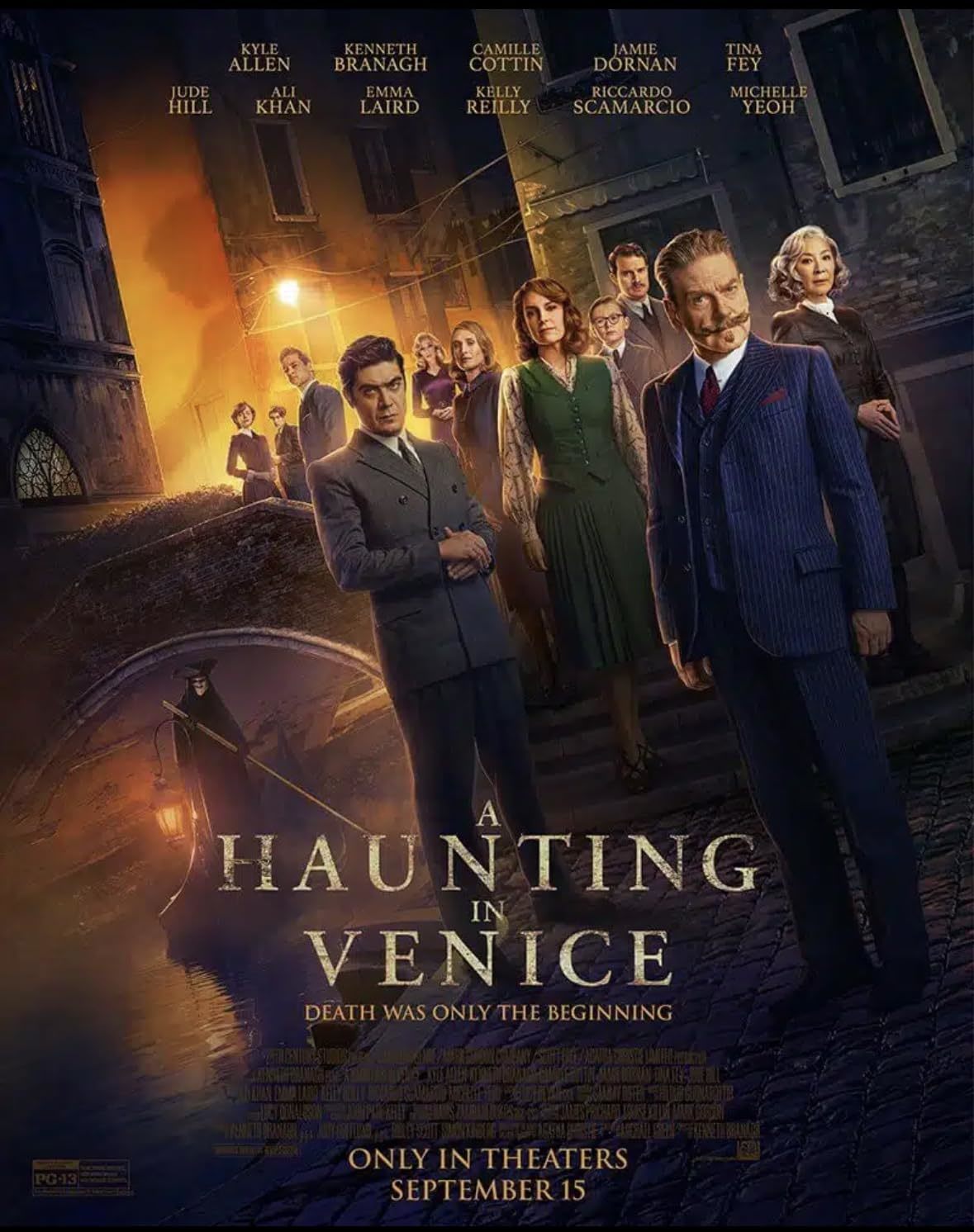
The Friday Night Horror Movie: A Haunting In Venice (2023)

a haunting in venice poster

I follow a lot of film critics and culture writers on various social media platforms. Most of them like to periodically complain about the state of the movies. The Marvel Cinematic Universe has created a seismic change in movies, and more specifically the way movies are shown in theaters. Or rather how many movies are no longer shown in theaters.

The MCU has made billions upon billions of dollars. Their method of interconnecting their films into one giant universe (and making piles of cash in the process) has made every other studio chase those billions. In doing so they are no longer satisfied with smaller movies, where they can only make millions of dollars instead of billions, virtually erasing mid-budget films in the process.

These film critics complain and complain about how adult-oriented dramas, mysteries, and romances simply don’t exist at the movies anymore. They wax nostalgic about times in the past, two or three decades ago, when they could go to the movies and watch something that wasn’t based upon a comic book or a part of a larger franchise.

Yet, when those types of films do get made and do get shown in the theaters, these same critics tend to pan them and encourage others not to go see them.

Kenneth Branagh’s Hercule Poirot films are a good example of this. Based upon the novels of Agatha Christie, Branaugh has directed and starred in three films in which he plays the famous Belgian detective. I won’t claim that they are great films by any stretch, but they aren’t big-budget superhero films either. They are well-told mysteries with terrific casts and are made for adults. In a word they are exactly the sort of films that these types of critics complain don’t get made anymore. Yet when the movies come out, those same critics do nothing but grouse about them.

And that’s enough grousing from me. The latest Poirot film is probably the best one. As the title implies there is a supernatural element to it, and while it isn’t a straight horror it certainly contains elements of horror and that means I get to talk about it tonight. It also means that my daughter is having a sleepover and me and the wife had a much-needed date night and this is as close to horror as she’d let me get.

Hercule Poirot has retired into seclusion in Venice, Italy. There has been too much death and misery in his life and he simply cannot stand to tackle another mystery.

When his friend, Ariadne Oliver (Tina Fey), a novelist who writes thinly veiled Poirot mysteries, invites him to a seance he at first declines but her friendship wins him over.

The seance takes place on Halloween night in an old, decaying palazzo. It is being held by Rowena Drake (Kelly Reilly) who hopes to speak to her daughter who mysteriously killed herself in the palazzo one year prior. Also at the seance are an assortment of interesting people all of whom have a connection to Rowena and her daughter and, it will be found out, had a reason to murder her.

Poirot quickly exposes the psychic (Michelle Yeoh) as a fraud and is ready to leave, but when the psychic is murdered and someone tries to drown him in an apple bobbing bowl, he locks everyone inside the palazzo and finds himself once again back on a case.

This one is based on a much less famous book (Hallowe’en Party) than the other two films (Murder on the Orient Express & Death on the Nile). Apparently, it’s quite loosely based as well, which allows it to surprise you with its story rather than retell one that is quite familiar to casual fans.

The palazzo is reminiscent of all those gothic castles in those old haunted house movies that I love so much. It allows for plenty of creepy, atmospheric shots down long corridors, and shadowy rooms. The film has a lot of fun toying with whether or not the supernatural aspects are real or not, making it great fun to watch.

Kenneth Branagh clearly enjoys himself playing the famous detective and he’s become quite good at it. He’ll never replace David Suchet (who played Poirot in the long-running British television series) but he’s still quite entertaining. I love that he’s able to make these lavish adaptations with large, wonderful, casts. I hope he gets to make a dozen more.

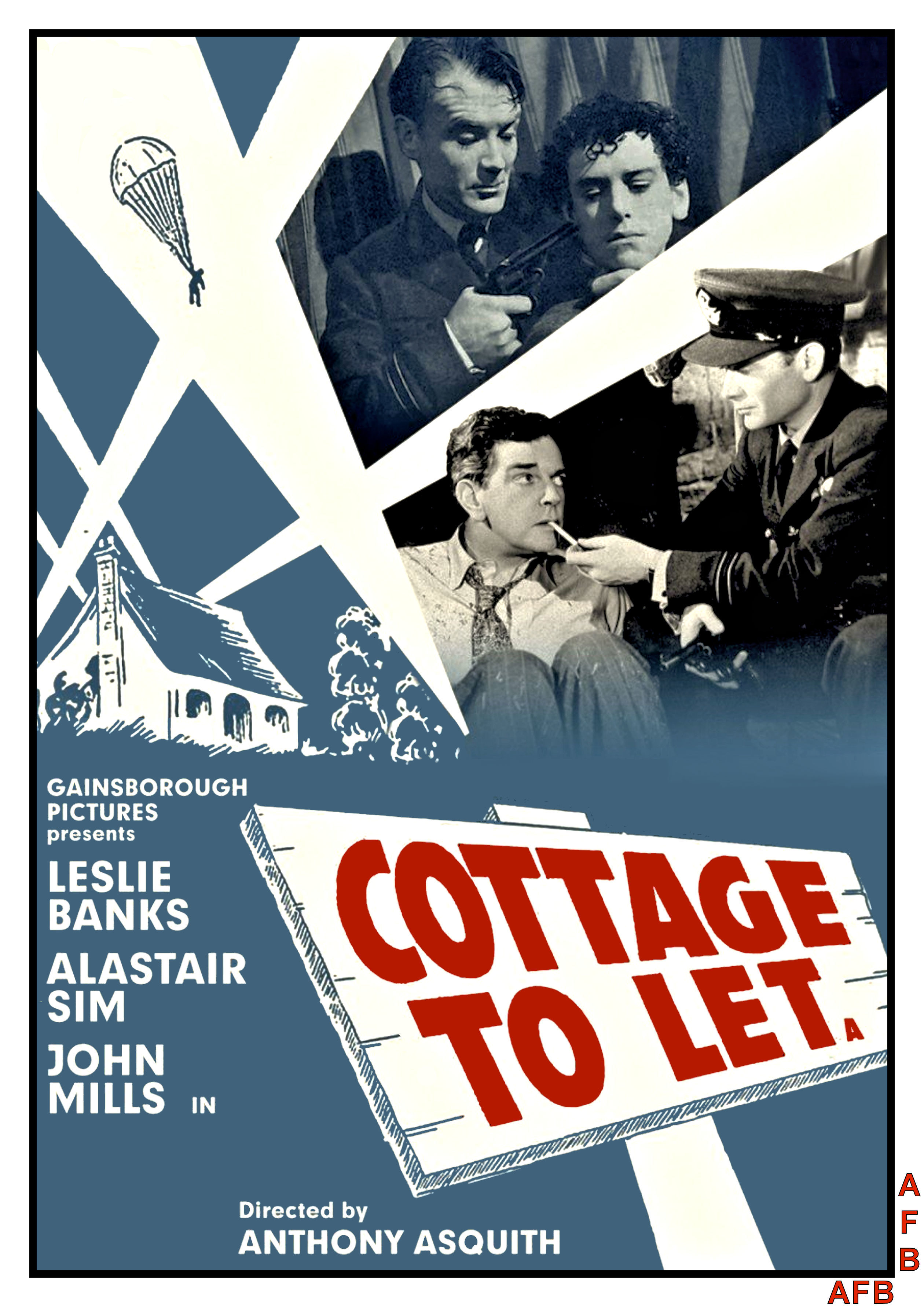
Great British Cinema Cottage to Let (1941)

cottage to let

Mrs. Barrington, a kook of a woman (Jeanne de Casalis), has agreed to take in child evacuees from London during World War II. She’s also agreed to allow her cottage to become a military hospital. Naturally, she has forgotten to inform her leasing agent of any of this so besides the children and the infirmed she has let her cottage out to a strange man, Charles Dimble (Alastair Sim). Also living at her estate is her husband John Barrington (Leslie Banks) an inventor who is currently working on a new bombsight which is of great interest to the Royal Airforce and Nazi spies.

Cottage to Let is a wonderful little drama filled with mysterious and eccentric characters and enough twists and turns to keep everyone guessing.

Mrs. Barrington might be a bit dotty, but she’s smart enough to realize she only has so many rooms so she only takes one child evacuee, and one soldier in need of attention. Still, that amounts to a large cast of characters. Moreso when the British military higher-ups come into town when John Barrington refuses to come to London to clue them in on his work.

Early on we realize there must be a spy amongst this lot, but we aren’t sure who it could be. The film has a lot of fun insinuating various characters but never quite letting us know who it is.

It is suspenseful in the way Hitchcock’s films are often suspenseful – which is to say it creates some interesting tension while also letting you know no real harm is going to come to our heroes. It is also clever and quite funny.

I found it to be wonderfully delightful.

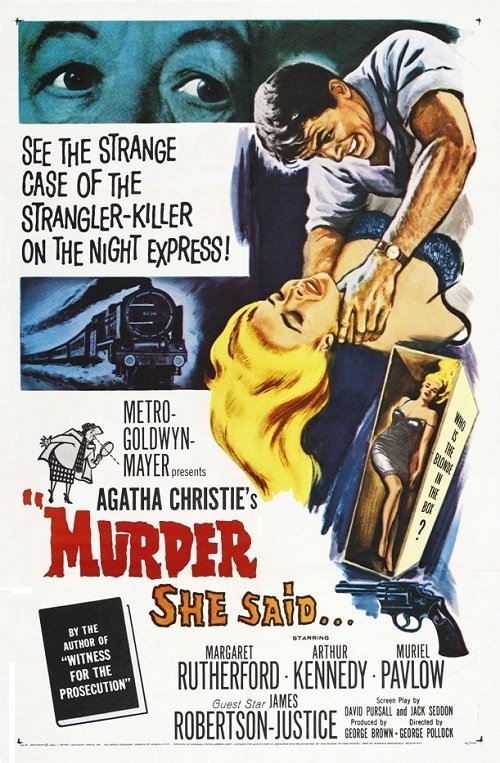
Great British Cinema: Murder She Said (1961)

murder she said

I love me a good detective story. Though I write a lot about horror movies the genre I find myself watching more than others is crime stories. There is something pleasurable about watching someone solve a murder.

Officially, I am on the side of Raymond Chandler and the school of the hard-boiled detectives. I like my crime dark and dirty, violent and real. Bloodless murders happening in the parlor rooms of rich and genteel classes are a little bit too silly for my liking. Especially when they conclude with a rounding up of all our suspects into one room while the detective susses out the culprit.

But sometimes, that’s exactly the sort of thing I need.

I’ve only read a few Agatha Christie novels, all of them Poirot, but I’ve seen quite a few cinematic and television adaptations of her stories (most of them Poirot) and I consider myself a fan.

Murder, She Said was the first screen adaptation of a Miss Marple story, and it is delightful.

It begins with Miss Marple (Margaret Rutherford) on a train. Another train crosses on a parallel track. Miss Marple watches the other passengers on the other train – an elderly man embarrassed that she sees him, a young girl who sticks out her tongue, and a woman getting strangled to death.

Miss Marple immediately informs the conductor who, when he spies the mystery novel she’s reading, believes she’s made it up. She makes him notify the police anyway, but they find nothing. They stop the train at the next station and can find no corpse. No body equals no murder and so they drop the matter.

Miss Marple, naturally, investigates.

She grabs a friend, Jim Stringer – a local bookseller and mystery enjoyed – and they walk the tracks around the area where she witnessed the murder. When they see some tracks made by what could be a dead body being dragged across the ground and trace them to Ackenthorpe Hall, Miss Marple finds a job there as a maid.

What follows is your standard Agatha Christie-type investigation. The Ackenthorpes are an odd bunch. She must do her duties as a maid, while still asking discreet questions and wandering around the grounds. There is a cute, clever boy who helps her, and lots of clues to be found.

It is handled very lightly, and often very humorously. Margaret Wutherford is just wonderful. She reminded me a lot of Angela Lansbury in Murder She Wrote. And considering how close that series title is to this film, I expect that is no coincidence. Wutherford is bold and clever, strong but vulnerable.

It works as both a good mystery and a comedy of manners. I loved it.

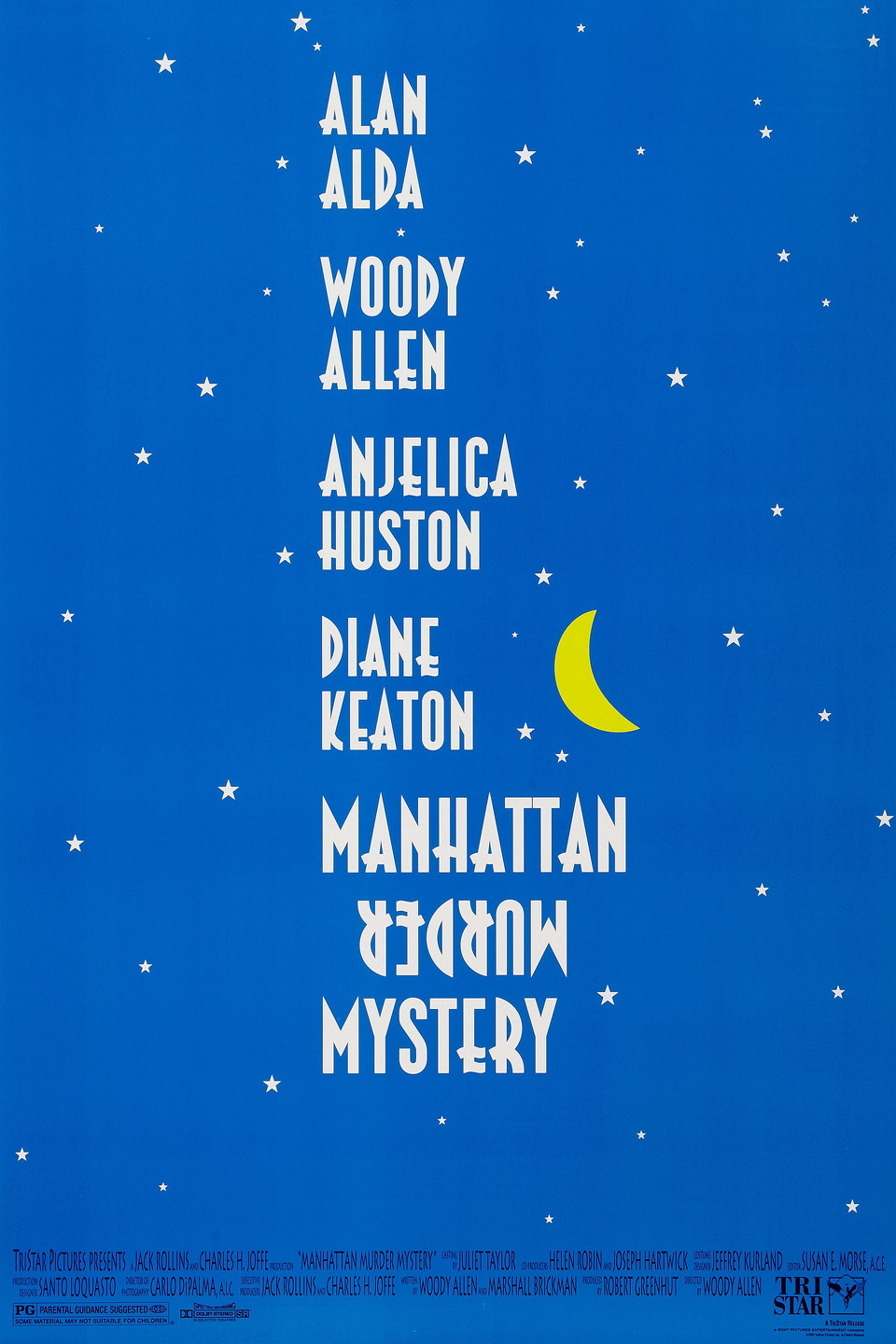
Manhattan Murder Mystery (1993)

manhatan murder mystery

Originally written and posted on October 5, 2006.

I’ve been watching Woody Allen films lately and I don’t know how I missed so many of them. I mean how could I be thirty years old and never seen half of his oeuvre? I just don’t get it…I mean I used to watch his films on the USA network when I was a kid – Bananas (1971), Everything You Wanted to Know About Sex, But Were Afraid to Ask (1972), that one about the guy who takes a nap and wakes up a hundred years later and there’s no sex, and I loved them all. I used to stay up late and watch them with my dad. Then I just stopped. I mean I did watch Annie Hall (1977) of course, but so many others…I don’t know…they just slipped by. I think it was watching Deconstructing Harry (1997) that did it. That one…I don’t know it felt like an old man making dirty jokes for two hours…it sounded so good in the magazines, but…I don’t know I couldn’t take it. And then I decided I had seen all the Woody Allen I wanted to see. But now, lately, I’ve been watching the rest, and I can’t believe I ever stopped.

(So that was my written Woody Allen impression. It’s funny, maybe.)

Manhattan Murder Mystery isn’t top-notch Woody Allen, but it’s pretty stinking good. It is basically your classic murder mystery premise with Woody Allen jokes.

Woody plays Larry who is married to Diane Keaton who plays Carol. They live in Manhattan (and I know this sounds pretty much like every Woody Allen movie, but stay with me) and their kindly old neighbor dies. Carol is almost immediately suspicious because the dead woman’s husband, Paul (Jerry Adler),  is too chipper too quickly after the death of his spouse.

Carol enlists her friend Ted (Alan Alda) for the conspiracy while Larry thinks they are both nuts. Carol and Ted get deeper and deeper into trying to see how Paul could have done it and eventually (of course) realize that their little game has more truth to it than they could imagine. Soon everybody is knee-deep in a real death plot and must find a way to not only catch a crook, but stay alive as well.

The plot could have easily been lifted from Agatha Christie or Nancy Drew or any other of the millions of murder mystery writers. There is nothing original in the idea, but Woody Allen pulls it off masterfully, mixing the comedy and mystery in equal parts all in breezy, completely enjoyable way.

It may not be his best work, but it sure is fun to watch.

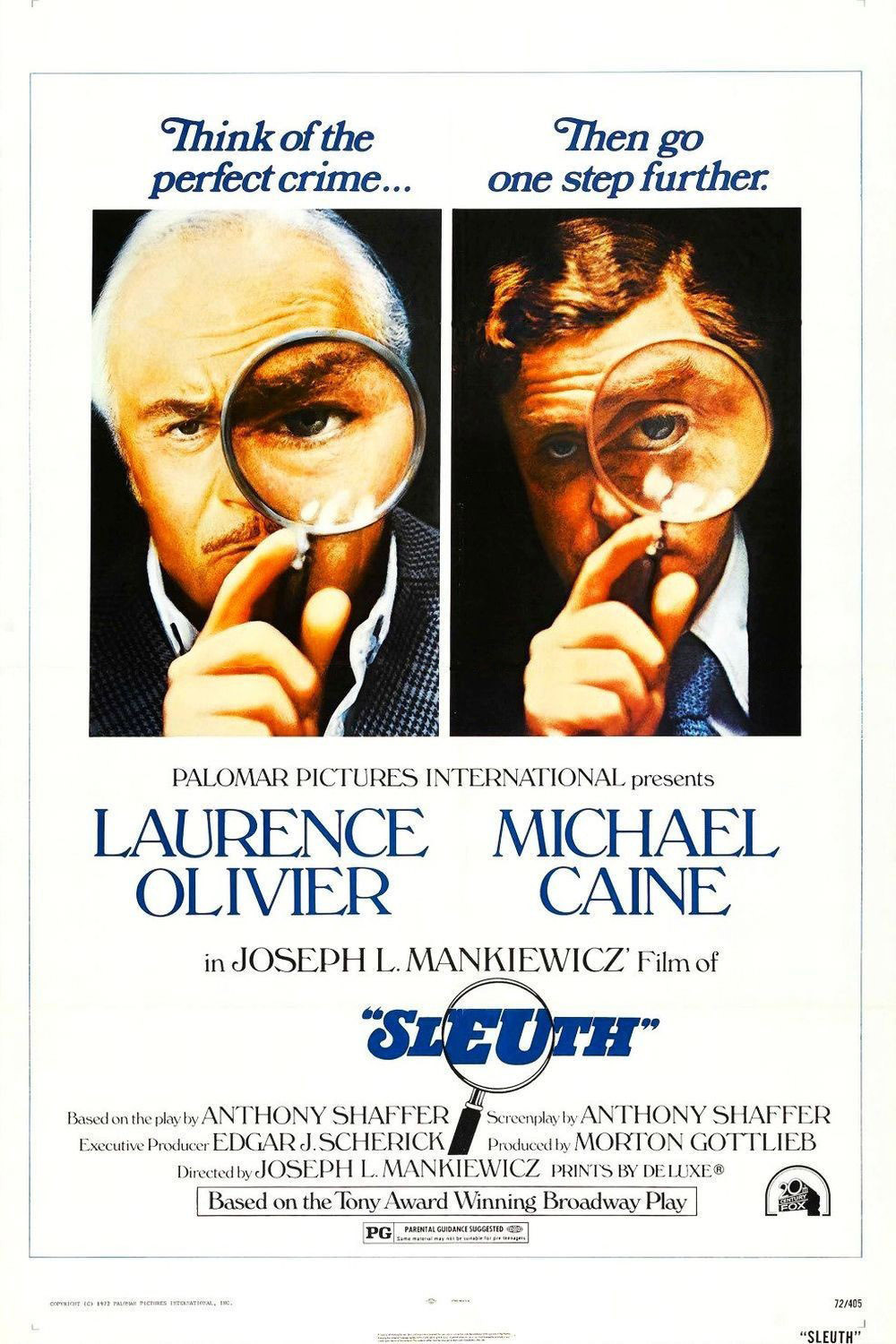
Sleuth (1972)

sleuth movie poster

This was originally written and posted on March 1, 2006.

A delightful plot-twisting mystery starring Michael Caine, Laurence Olivier, and nothing but Michael Cain and Laurence Olivier – albeit in two roles for Michael Caine. It is essentially a showcase for both actors, and it is quite a show they put on.

The plot gets complicated, but essentially Olivier plays a mystery writer in the vein of Agatha Christie. Michael Caine has been having an affair with Olivier’s wife. The two meet at Olivier’s house to discuss the state of things. Fiendish plot point after another and things get sinister and fun very quickly. There isn’t much more to say, for letting the twists and turns come as they are is half the fun.

Director Joseph L Mankeiwicz manages to adapt what was originally a successful stage play into the cinema very well. He uses his set pieces as supporting actors. There are dozens of games lying about Olivier’s house, and nearly all of them play some part of the plot.

Though the DVD seems to be out of print, Sleuth is well worth tracking down at the local library or video club.