Noirvember: The Night of the Hunter (1955)

night of the hunter poster

Apologies for not getting a Friday Night Horror movie up this week. I had planned to make this film that post as it blends both elements of film noir and horror, but Friday turned into a very long day. Work was a series of mistakes and irritations and then my daughter performed at the high school football game. I was happy to support her but by the time we got home, I was nothing but exhausted. I did manage to watch this, but there was no chance my brain could come up with something to write about it.

Four days later and here I am.

I think The Night of the Hunter was the very first film noir I ever watched. I can’t be quite sure of that because I didn’t always know what film noir even was so it is possible something else was seen earlier than this, but I don’t know what that would be. I don’t even know exactly when I first watched this film. I remember being spellbound by it, but nothing surrounds that memory to give me a clue as to what time frame it occurred. At a guess, I would say college or maybe just after.

It doesn’t really matter, but I like tracking these things. It was definitely early days in my life as a cinephile. I had started watching classic movies and understanding them as art, but not so early that watching a film like this was a revelation.

I hadn’t watched this in years and maybe it is a revelation. It’s just so damn good. So strange in some ways, and beautiful. It was the first and only film ever directed by actor Charles Laughton. It bombed at the box office and they never gave him another chance in the director’s chair. I weep at what we missed because of that.

Robert Mitchum plays Harry Powell a man who uses the veil of religion to lure women into his snare, marry them, kill them, then leave with their money. He’s got Hate tattooed on one hand and Love on the other. He loves to tell a flamboyant story about how Love conquers Hate which generally enthralls the listener.

While in prison for theft he meets Ben Harper (Peter Graves) a man sentenced to be hanged. In his sleep, Ben mumbles something about the $10,000 he stole and something else about his kids knowing where the money is hidden.

That’s all Harry needs to go on the prowl again. Once he’s out he finds Ben’s wife Willa (Shelley Winters) and quickly seduces her. Well, maybe seduce isn’t the right word. He woos her, talks her into marriage and then basically casts her aside. There is one chilling scene, their wedding night, where she comes in ready for the lovemaking and he lectures her that sex is but for childbearing, and since she’s already got two there is no need for them to consummate their marriage.

The kind veneer disappears for the children as well quite quick. At first, he acts as a loving father and gently works for them to spill the secret of the money, but wen that doesn’t work he gets angry and mean. The girl, Pearl (Sally Jane Bruce) dotes on Harry, but the boy, John (Billy Chapin) knows what’s up.

Soon enough the kids are on a skiff floating down the river, desperately trying to escape the murderous grip of Harry. They wind up at the home of Rachel Cooper (Lillian Gish) a widow who lost her own child to the Depression and has started taking in homeless children. There they find kindness, grace, and love.

But while the story is really good, the filmmaking makes this a true classic. It is very theatrical in its production. The sets look stagey. Even the supposed outdoor scenes have an artificiality to them. It is designed to constantly remind you that what you are watching isn’t real, it is a story. A morality play. But it is also gorgeously put together.

There is a scene that takes place in Harry and Willa’s bedroom. It is a strangely shaped room with a sharply angled ceiling and a high window. Light shines brightly through that window but shadows loom. The camera sits way back, through what would have to be a wall. blackness frames the room, again as if we were watching a play.

Another scene is shot inside a screened-in porch at Rachel Cooper’s house. She sits in a rocking chair with a shotgun in her lap. Outside stands Harry Powell, waiting. The light inside the porch is off. We see her in shadow. A streetlight illuminates the preacher. Then a young girl enters with a candle. Now we see Rachael more clearly but it darkens our view of Harry Powell. The candle is blown out and he’s gone. It is masterfully staged.

Everything about the film is masterful. Robert Mitchum has never been more menacing. Shelley Winters never more vulnerable. And Lillian Gish is an angel.

It is a great movie. A great film noir. One of the very best.
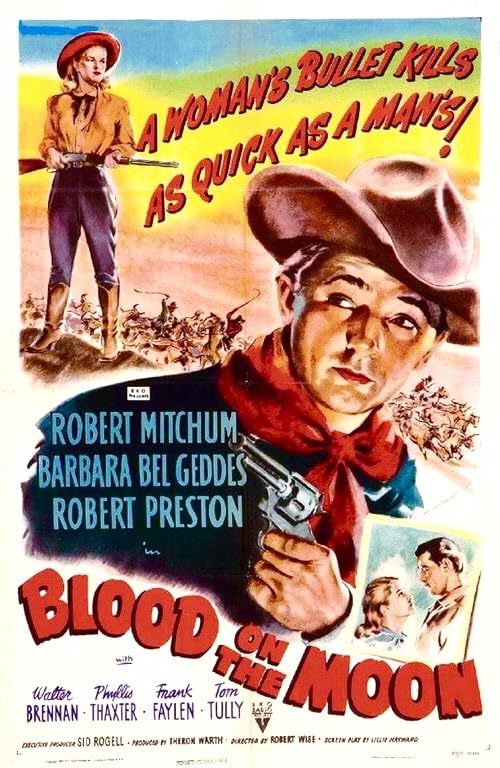
Westerns in March: Blood on the Moon (1948)

blood on the moon

On a surface level Westerns and Film Noirs have very little in common. Noirs tend to take place inside the big city. Westerns are all about the wide open spaces of the American West. Noirs usually occur in the present, whereas westerns (almost by definition) occur in a specific past. Noirs are filmed in black and white. They revel in shadows and light. They take place in smoky little bars and grubby flats. Westerns make great use of the widescreen format and technicolor. Classic Westerns are about good versus evil; the differences are plain. Noirs live in the grey, the morally ambiguous, the dark nights of the soul.

It is that last bit that sometimes allows the two genres that seem so far apart to grow a little closer. While Classic Westerns often do present moral absolutes with clear good guys and bad guys, as the genre grew older it began to change. Their heroes were sometimes morally grey. They wrestled with complex questions. Dealt with complex characters. Etc. They started to feel a little more like noirs. Not always, of course, the vast majority of westerns stuck to their lane, but some of them, some of the best of them, allowed themselves into murkier territory.

Blood on the Moon is a Western Noir. It is set in the Old West, its characters are old cowboys, and its plot involves cattle and Indians, but its hero is flawed and its cinematography is pure noir.

Robert Mitchum plays Jim Garrey, a man down on his luck. When his old pal Tate Riling (Robert Preston) offers him a job he takes it, no questions asked. He soon learns he should have asked questions because Riling is up to some shenanigans.

The plot (or I should say Riling’s plot) is convoluted and too complicated to get into here. Basically, he’s setting some homesteaders against a rancher in hopes of making himself rich. He needs Garrey as a mediator to arrange a deal over some cattle.

That part of the plot doesn’t really matter. It boils down to Riley using Garrey for some pretty shading dealings. Garrey is basically a good man, but he’s done some bad things which makes him feel like a scoundrel. He’s left with a decision on whether to do the right thing and go against an old friend, or stay the course and get rich in the process.

Honestly, I got a bit lost in the machinations of the plot but Mitchum is great as usual and cinematographer Nicholas Musuraca gets some great noir visuals out of his scraggly western landscape (and no wonder he shot a lot of great film noirs including Out of the Past and The Spiral Staircase). Preston seems a bit miscast to me. He’s great when he’s playing rascally con men, but he doesn’t quite exude the menace his character needs in this film.

Overall a decent example of both the Western and the film noir but there are better films in both genres.

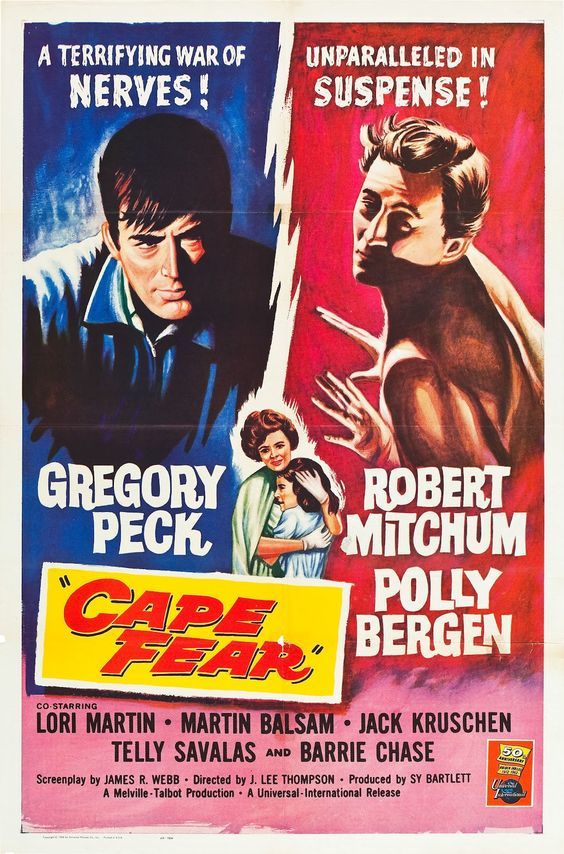
Cape Fear (1962)

cape fear poster

Gregory Peck is so linked in my mind to the simplicity and grace of Atticus Finch in To Kill a Mockingbird, that it is always surprising to see him in anything else. To find him in the gritty, dirty piece of film noir that is the original Cape Fear is something of a shock. Yet, as always he does a marvelous job, and some of that grace manages to shine through the grime.

The story is a pretty basic noir plot. Max Cady (Robert Mitchum) is an ex-convict who just got out of prison. He has come back to town to haunt Sam Bowden (Gregory Peck) who testified against Cady for attacking a woman. Cady has spent his time in prison studying the law. He manages to terrify Bowden and his family and still remain within the confines of the law.

Though Peck gets top billing, this is truly Robert Mitchum’s film. He plays Cady with a swagger and menacing smile that is simply magnificent. We can see inside his swarthy confident charm and see the evil, menacing psychopath. The brilliance of the role is that we rarely see the violence that hides just behind the mask. Yet it seethes and oozes out, ready to strike at any time.

Director J. Lee Thompson keeps the tension pumping throughout the 105-minute film. There is hardly a moment to relax before something else occurs to tense us right back up. Yet the tension doesn’t come from boogie men jumping out from behind closets. It is a slow, boiling tension that tightens as we imagine just what might happen. When the climax finally does occur it is almost a letdown.

The censors wouldn’t allow the bloodbath one might expect at the end of such a film as this, and so what we do get feels less exciting that I wanted.  Still, getting to the end is well worth the watching.