
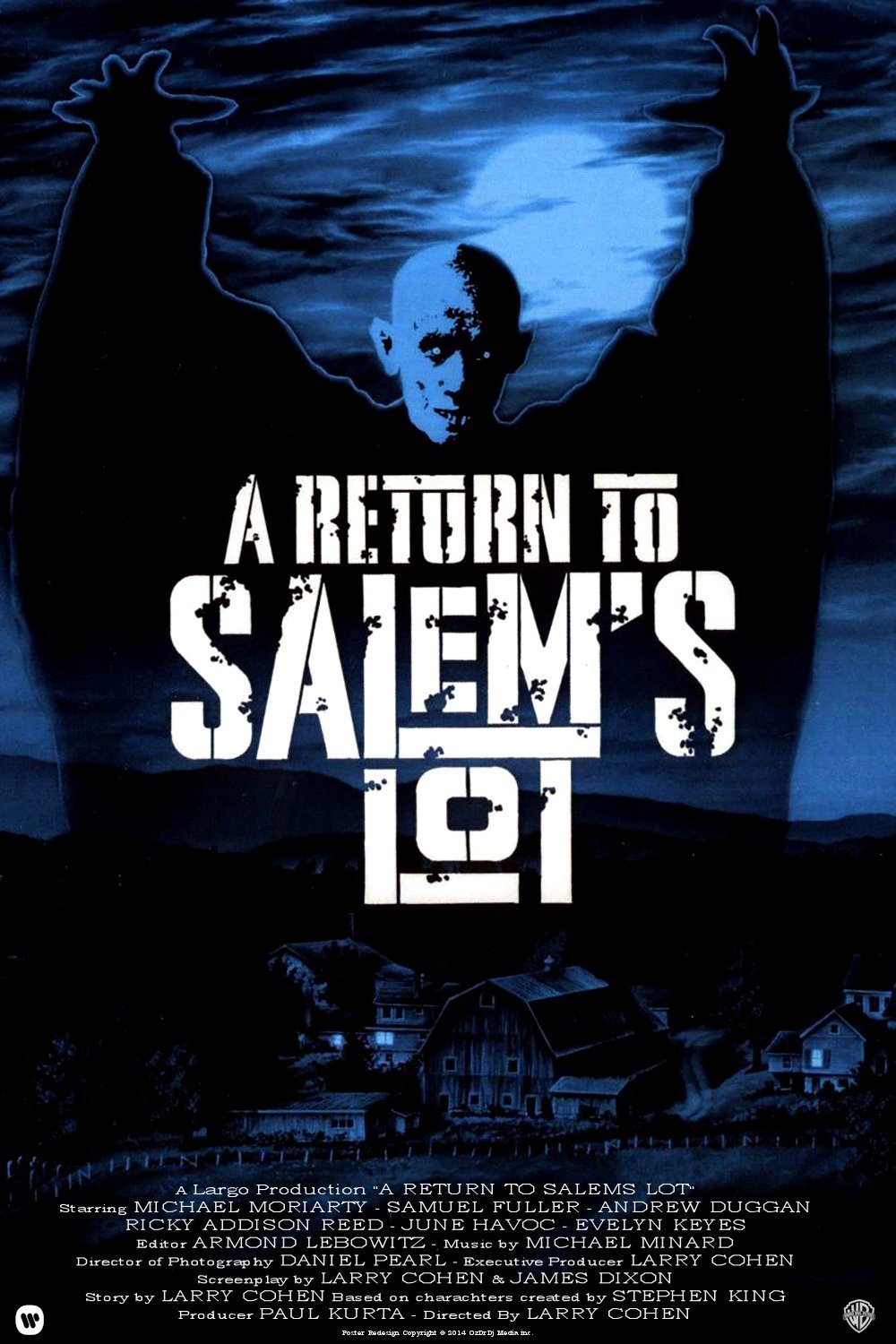
The Friday Night Horror Movie: A Return to Salem’s Lot (1987)

a return to salmes lot poster

‘Salem’s Lot was one of the first Stephen King novels I ever read. It remains one of my favorites. Tobe Hooper made a pretty good TV mini-series out of it in 1979. Apparently, Larry Cohen had originally been slotted to adapt the book, but the executives hated his screenplay and gave Hooper the job instead.

Years later Warner Brothers approached Cohen to direct a low-budget horror film for them and he pitched the idea of a sequel. Interestingly, the sequel was intended as a theatrical film and in fact, debuted at the Cannes Film Festival and saw a limited American release. But the reviews were terrible and the box office a dud and so it pretty quickly went straight to the VHS shelves.

Outside of a few gorey effects, a couple of naked breasts, and a lot of children swearing, the film feels very much like a made-for-TV movie. The budget was clearly small, the acting amateurish, and it is edited within an inch of its life.

It follows Joe Webber (Michael Moriarty), an anthropologist who is called away from studying a native tribe in the South American jungle to take care of his young, troubled son Jeremy (Ricky Addison). He takes him to a run-down house he’s inherited in the small New England town of Jerusalem’s Lot (or Salem’s Lot as it is sometimes called).

Pretty quickly he realizes the town’s inhabitants are either vampires or their human slaves. Actually, they pretty much straight-up tell them who they are because they want him to write a book about them. To convince him to do this they kidnap the boy and get a young vampire girl to sweet-talk him into becoming a vampire as well.

Joe figures this is a good time to hook up with his childhood sweetheart and do a little remodeling of his old homestead. Seriously, the film makes some really odd choices.

Soon enough a Van Helsing-like vampire hunter shows up (played by director Samuel Fuller in a rare acting role) and eventually our heroes get to some actual vampire slaying.

A Return to Salem’s Lot feels like it should have been a mini-series. There are a lot of ideas floating around in it, but few of them get explored. A lot of scenes feel like they were cut short, as if maybe a lot of footage was shot but due to time constraints they had to be cut. Or maybe they just didn’t have the budget to shoot everything in the script.

As it is it feels very disjointed, and unrealized. There are some interesting ideas. The original story is basically ‘what if Dracula showed up in a small American town’ and this one takes that concept and has the vampires take over the entire town. Yet here they are also a persecuted minority. They fled Europe with the Pilgrims for the safety of the new world. They are good Americans. They don’t even kill humans (well, most of the time) but breed cows for their blood needs – and it is quite a scene watching some elderly actors pretend to suck the blood out of cows lying in a pasture.

All of this creates some light satire of American consumer culture, but again it is pretty disjointed and cut to shreds.

Despite all of this I still rather enjoyed it. Cohen knows his way around a low-budget picture and he gives it enough oomph to make it not terrible. Fuller is having a blast playing the crotchety old hunter.

Not a great movie by any means, but a fun one to watch.
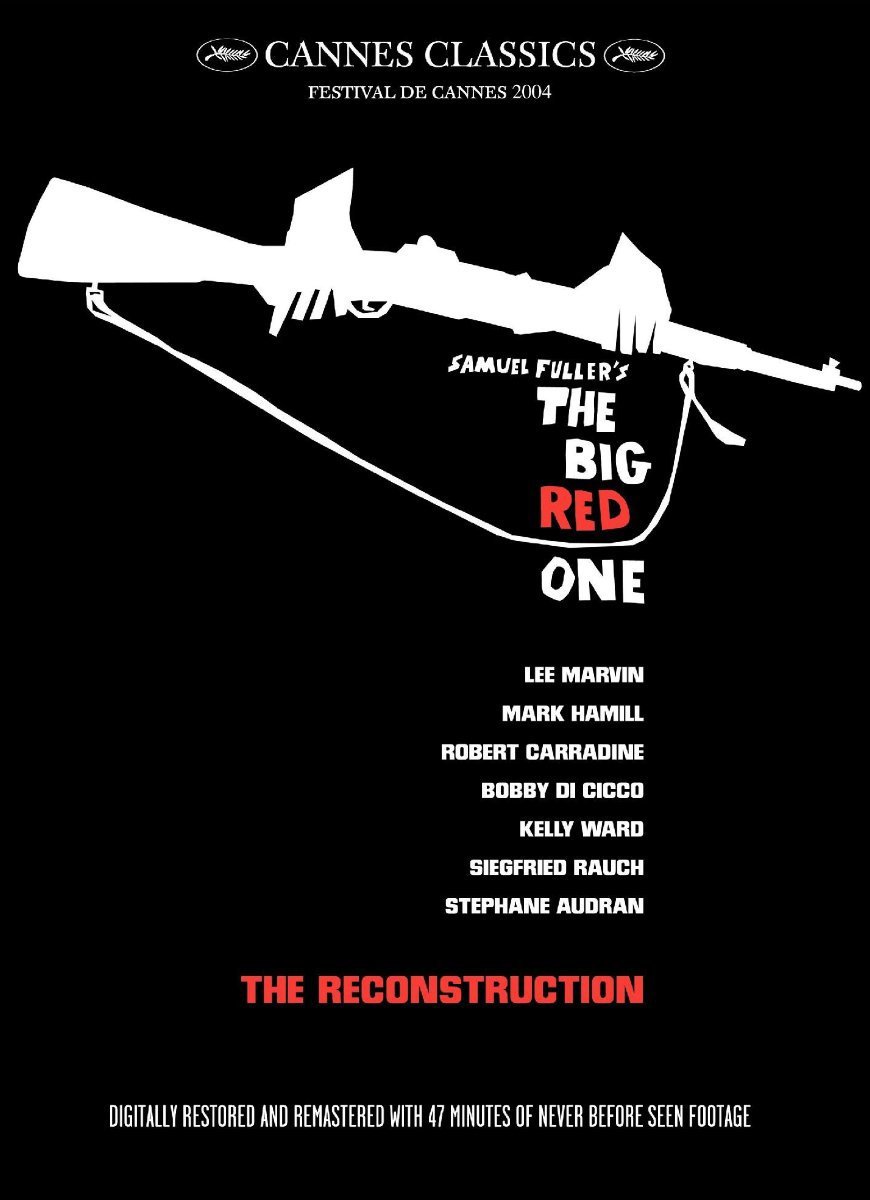
Awesome ’80s in April: The Big Red One (1980)

the big red one poster

I’ve talked a little in this series about memory and the movies. Or rather, how this series continually brings up memories of both me watching certain movies or just knowing about their existence in various ways. That probably isn’t interesting to anyone but me, but I find it fascinating, and this is my blog so I’m gonna keep talking about it 🙂

My first memory of The Big Red One, Samuel Fuller’s movie loosely based on his experiences in World War II, is of the DVD cover. I was in Walmart many years ago looking through their movie selection and came across a copy of The Big Red One. It was an evocative cover that was mostly black with a big white outline of a rifle and the title was all in white except for the word “red.” Well, you can see what I mean up above.

I immediately wanted it. I read the back cover and it promised to be a full restoration of Fuller’s lost film. It had lots of extra footage. It was a masterpiece. That sounded great.

I put the film back. I’ve been burned before. The film sounded interesting but I wasn’t ready for another blind buy.

I haven’t really thought about the film since. Oh, every now and again it would pop up on a streaming service or whatever and I’d think about watching it. Then I’d find something else. And now, I’ve finally seen it.

It is pretty good. Unfortunately, I wasn’t paying attention and I watched the original, non-director’s cut which is missing something like 45 minutes of footage. I might go back and watch that version someday. But not anytime soon.

The film follows a man only known as Sergeant (Lee Marvin) as he leads a squad of infantrymen from the 1st Infantry Division (who were known as The Big Red One due to the patch on their shirts.)

It reminded me quite a bit of the HBO series Band of Brothers as it follows this squad From North Africa to D-Day, the liberation of France to a concentration camp. They deal with battles and injuries, death, and replacements. In its own way, it is just as episodic as that series.

It was made on a low budget and unfortunately, it shows. The battle sequences aren’t particularly exciting. There are quite a few characters, but none of them are all that memorable. Mark Hamill is second billed but he gets very few lines of dialogue. His performance is mostly reaction shots. Most of the other characters are indistinguishable. I’d be hard-pressed to tell you any of their names or what they did. Marvin is great and he gets almost all of the screen time. He’s a hard-worn war veteran (in an early scene we see him as a private in World War I), but he’s kind to his men.

There are some really wonderful scenes. One inside a mental institution stands out. And the D-Day landing involves the Sergeant sending his men, one by one, across the beach to try and blow up a barbed wire fence keeping everyone from advancing. One guy goes, gets shot and he sends another. Then another. And another. He calls them out by number, not by name. It is harrowing to watch. These men are literal cannon fodder. More meat for the grinder.

It very much feels like an incomplete film. I’d like to see the longer cut (which was put together from surviving footage based on Fuller’s notes, he was dead when it was done). Forty minutes is a lot of time for these characters to be better filled out and their lives explored.

This version isn’t enough for me to be begging to see even more of this film, and the reviews of the extended cut don’t call it a masterpiece, so I expect it will be a few years before I decide to go back. But it is an interesting film, and I’d be interested to see if any of my readers have seen the longer version.