
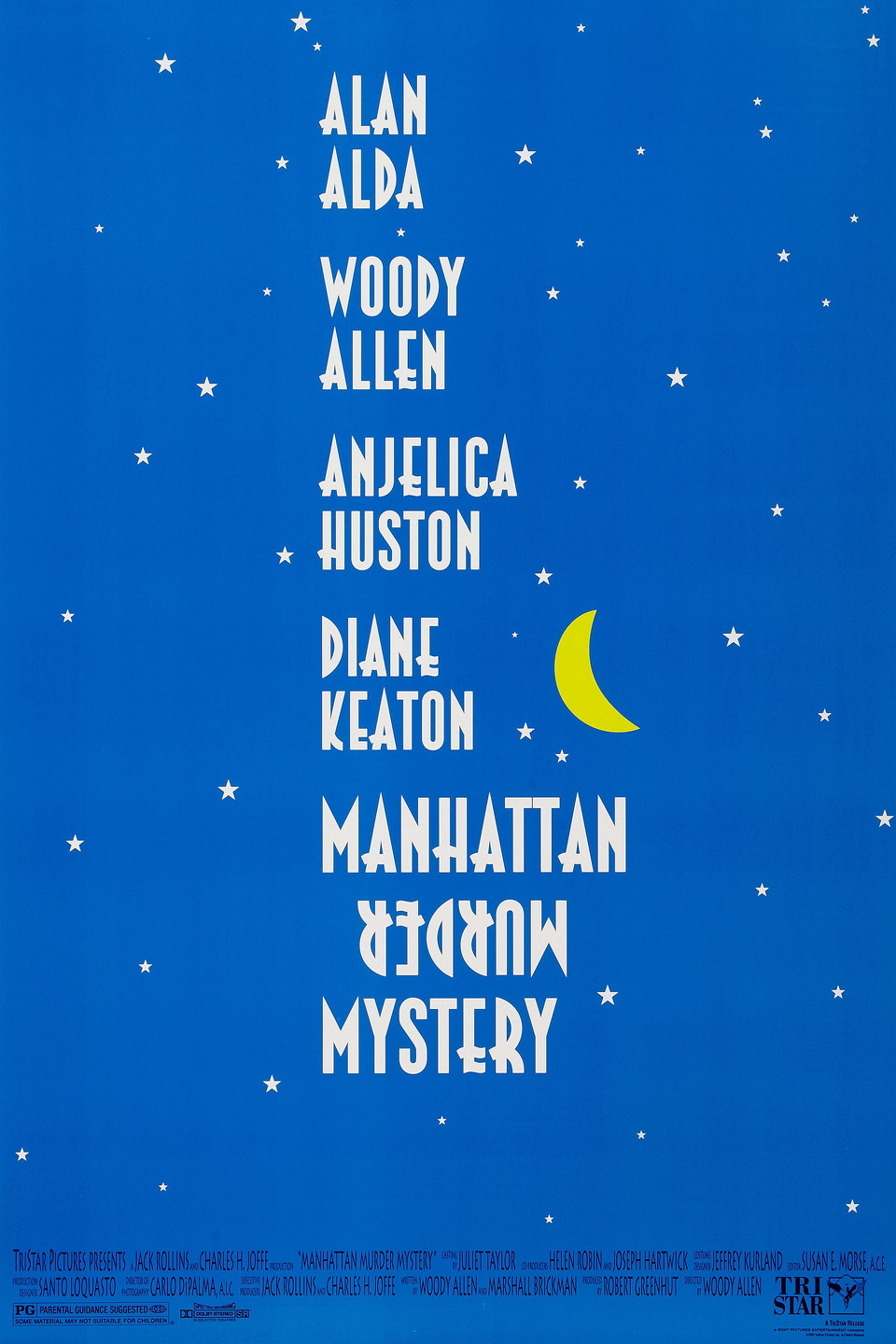
Manhattan Murder Mystery (1993)

manhatan murder mystery

Originally written and posted on October 5, 2006.

I’ve been watching Woody Allen films lately and I don’t know how I missed so many of them. I mean how could I be thirty years old and never seen half of his oeuvre? I just don’t get it…I mean I used to watch his films on the USA network when I was a kid – Bananas (1971), Everything You Wanted to Know About Sex, But Were Afraid to Ask (1972), that one about the guy who takes a nap and wakes up a hundred years later and there’s no sex, and I loved them all. I used to stay up late and watch them with my dad. Then I just stopped. I mean I did watch Annie Hall (1977) of course, but so many others…I don’t know…they just slipped by. I think it was watching Deconstructing Harry (1997) that did it. That one…I don’t know it felt like an old man making dirty jokes for two hours…it sounded so good in the magazines, but…I don’t know I couldn’t take it. And then I decided I had seen all the Woody Allen I wanted to see. But now, lately, I’ve been watching the rest, and I can’t believe I ever stopped.

(So that was my written Woody Allen impression. It’s funny, maybe.)

Manhattan Murder Mystery isn’t top-notch Woody Allen, but it’s pretty stinking good. It is basically your classic murder mystery premise with Woody Allen jokes.

Woody plays Larry who is married to Diane Keaton who plays Carol. They live in Manhattan (and I know this sounds pretty much like every Woody Allen movie, but stay with me) and their kindly old neighbor dies. Carol is almost immediately suspicious because the dead woman’s husband, Paul (Jerry Adler),  is too chipper too quickly after the death of his spouse.

Carol enlists her friend Ted (Alan Alda) for the conspiracy while Larry thinks they are both nuts. Carol and Ted get deeper and deeper into trying to see how Paul could have done it and eventually (of course) realize that their little game has more truth to it than they could imagine. Soon everybody is knee-deep in a real death plot and must find a way to not only catch a crook, but stay alive as well.

The plot could have easily been lifted from Agatha Christie or Nancy Drew or any other of the millions of murder mystery writers. There is nothing original in the idea, but Woody Allen pulls it off masterfully, mixing the comedy and mystery in equal parts all in breezy, completely enjoyable way.

It may not be his best work, but it sure is fun to watch.
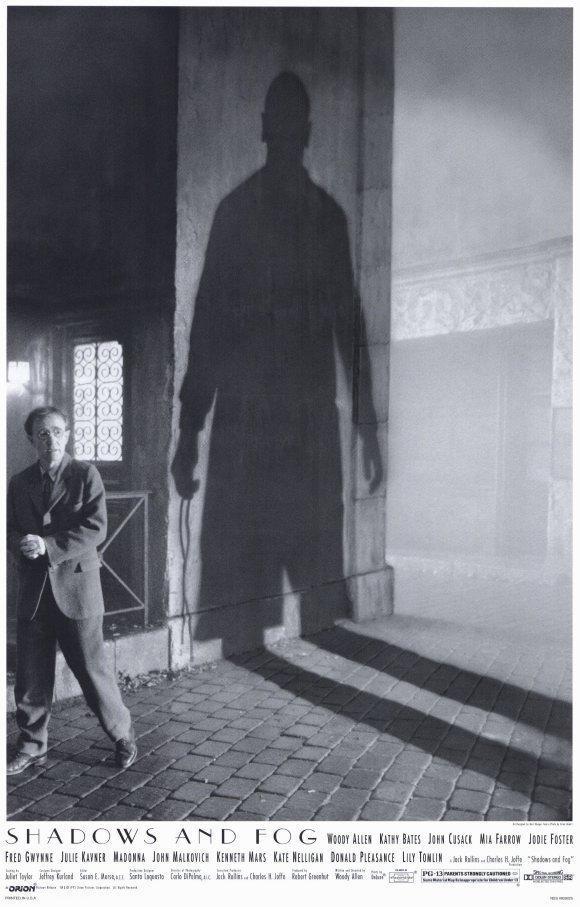
Shadows and Fog (1991)

shadows and fog poster

Editors Note: I wrote this long before I knew of the various accusations against Woody Allen. I have no comment to make about those allegations, but as I am reposting this review in 2022 I wanted to note that this is not any sort of endorsement of Allen as a human being, but simply a review of his film.


Woody Allen’s tribute to German Expressionism is better than most critics would have you believe. Sure there is very little plot to speak of, it’s more a series of vignettes and gags than a cohesive narrative. Sure, it ends rather abruptly, never solving the mystery, but none of this stopped my thorough enjoyment of this film.

As the title suggests the entire movie is designed in shadows and fog. Shot with beautiful black and white photography, Allen and cinematographer Carlo Di Palma create the look and feel of an unnamed East European city as seen in such films as M and Nosferatu. The lighting is set up so that in nearly every shot underlying shadows engulf the scene. In the exteriors, a vicious fog rolls across the night sky obscuring most details. Through the fog bumbles Kleinman (Allen is his typical neurotic schmuck role) trying to find his role in a vigilante mob’s plan to stop a serial killer roaming the streets. From dark night until dawn, Kleinman wanders from place to place meeting a wide variety of curious characters (played by an even more curious group of celebrities), the most endearing of which is a desperate sword swallower (Mia Farrow)who has wandered into a brothel after fleeing her cheating boyfriend/clown (John Malkovich).

It is a little unsettling to watch Allen do his normal schtick while the characters around him are murdered, subjected to racial prejudice, and beaten by the police while discussing such subjects as love, sex, and meaning. There is a subtext involving the plight of the Jews between the World Wars, foreshadowing the Nazis. Yet the gags remain as solid as any Woody Allen film. Amongst the seriousness of his subtext and the films he is paying homage to, Allen finds a way to bring full-bellied laughter. Though his quirky neurosis isn’t as resolutely hilarious as it is in such films as Annie Hall, it is still enough to fill the film with mirth.

The film ends rather abruptly with Kleinman having never learned his role in the plan, nor the killer having been caught. Yet as the credits role we realize the mystery was not so much the reason behind the story as a method of creating it.