
Author: Mat Brewster
Welcome to the Midnight Cafe group of sites.
The Friday Night Horror Movie: The Shining (1980)
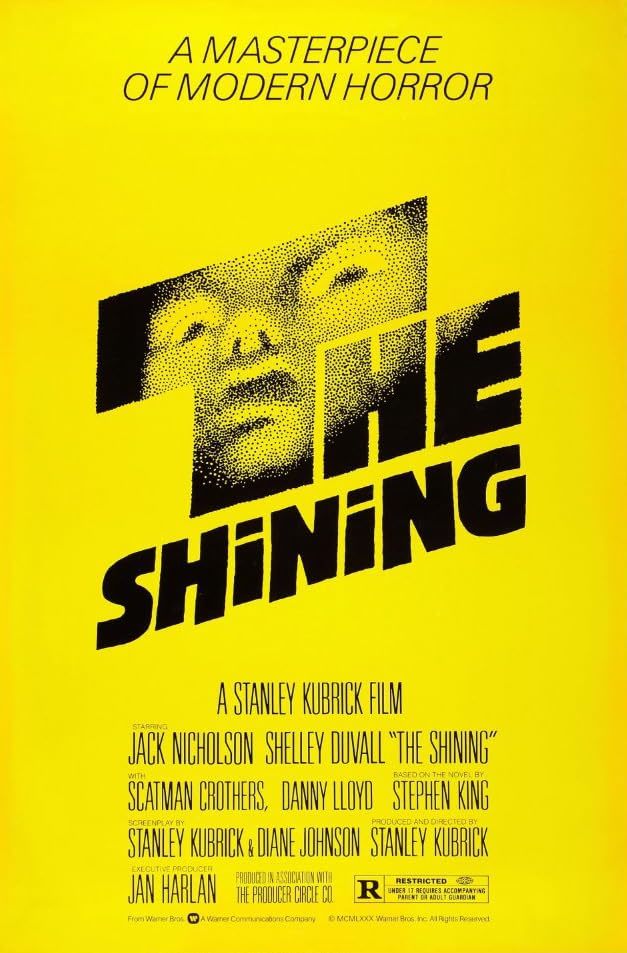
Though I keep saying that I love making these monthly movie themes and writing about them, I find it easy to slip out of that routine (especially in the writing department) and then quite difficult to slip back in. This time I have a pretty good excuse with Covid, but I’ve felt (more or less) well the last couple of days and yet have not had the energy to write any more Frozen in January reviews, despite having watched several more and (at least in theory) the desire to write about them.
Here’s hoping this Friday Night Horror Movie write-up will get me back in the spirit.
There is a documentary from 2012 called Room 237 which posits a number of theories about Stanley Kubrick’s The Shining (1980). Or rather it features a number of talking heads who all seem to think they know what The Shining is all about. What it all really means.
These range from the somewhat plausible – it’s about the assimilation of Native Americans and the destruction of their culture by rich white Americans – to the crack-pot – it is Kubrick’s apology for helping with the faking of the moon landing.
It is an interesting documentary, but what I really love about it is how it indicates just how malleable Kubrick’s film is. It is as if the director took Stephen King’s novel, and turned it into his own thing, and then when people ask what it all means, his answer is akin to:
It means what you want it to mean. Or it has no meaning. Or I don’t know what it means.
For those who don’t know The Shining is based on the Stephen King novel of the same name. Kubrick did make some significant changes to the book and King famously hates it. It tells the story of Jack Torrence (Jack Nicolson), a wannabe writer who is also an alcoholic, and abusive husband/father. After being fired from a teaching job he lands a job as the winter caretaker at the Overlook Hotel – a beautiful resort nestled deep within the Rocky Mountains. The long, meandering road into the hotel becomes too covered with snow to make it financially viable to stay open for five months in the winter so they hire someone to live there and keep it maintained.
Jack brings his wife Wendy (Shelley Duvall) and young son Danny (Danny Lloyd) who has some psychic ability (known as the Shining). The total isolation, the freezing cold (a huge blizzard traps them even further and isolates them more by knocking out the phone lines), and the ghosts push an already fragile Jack into psychotic territory.
The Overlook catered to the rich, powerful, and famous. People who make important decisions and devour depravity. Terrible things have happened there. Things the hotel is all too happy to cover up. In his initial meeting with the hotel manager, Jack is told of a previous caretaker whose cabin fever led him to murder his wife and two young daughters with an axe.
This violence and debauchery has left a psychic impressions on the hotel. Or perhaps, the hotel is a place of evil and it has left an impression on vulnerable people causing them to engage in horrible deeds. The film never gives an answer, it is a movie that wants you to come up with your own.
Kubrick films it in his usual technically proficient, yet emotionally detached way. His use of Steadicam (a fairly new technology) is masterful. Though the camera slowly wanders about the landscape of the hotel (truly making the setting a character unto itself) the geography of the place is disorienting. There are windows where there could feasibly be no windows, and doors that could only lead to nowhere. All of which makes the film deeply unsettling.
The performances while unanimously good, are cold and strange. Early in the film serious conversations are strangely monotone. Kubrick used many multiple takes (the scene in which Wendy swings her bat at Jack reported was shot over 100 times) to intentionally exhaust and unnerve the actors. The music is eerie and avant-garde.
It is nothing like a traditional horror film. While there are images of violence and horror – every character, especially Danny, flash on scenes from the hotel’s horrible past – the film unnerves you with its mood and calculating camera.
I love it. It is one of my favorite horror movies. I’m not alone in that assessment, and I’m sure many of you enjoy it as well. It works perfectly with this Frozen in January theme and I was happy to revisit it tonight.
Listen to J Mascis Sing The Breeder’s “Divine Hammer”
The 1990s were a great time for music. I freakin’ loved Dinosaur Jr. back in the day. Didn’t love The Breeders as much but I dug this song and a few others.
I heard this on this college radio station earlier this morning. Immediately recognized J. Mascis’s voice. Took me a minute to figure out what the song was, but I was then immediately taken to my happy place.
The Friday Night Horror Movie: The Thing (1982)
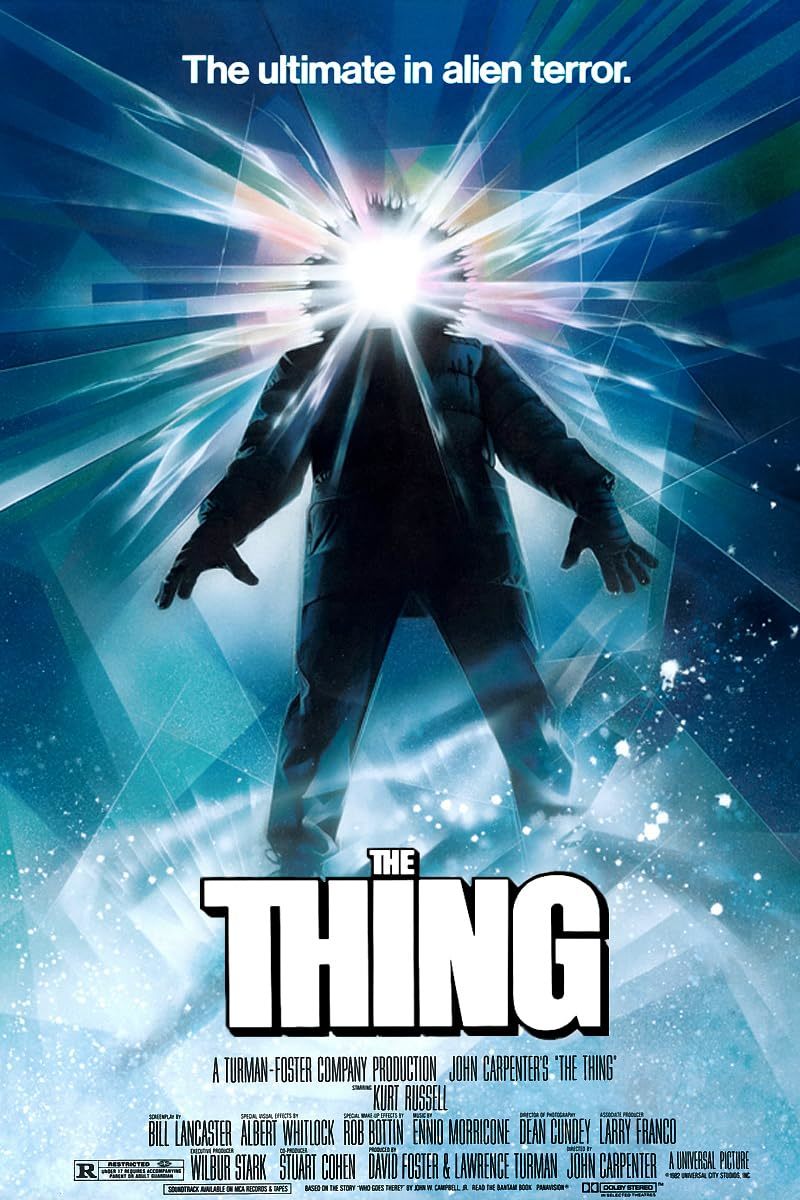
When I was first thinking about this month’s theme – Frozen in January – it was John Carpenter’s The Thing that came to mind. It is the perfect encapsulation of what I was going for. Its characters are trapped in an isolated place covered in snow and ice. An external force causes an already tense situation into turmoil. The weather and the cold, frozen setting aren’t just window dressing, they help inform the story. I actually didn’t love the movie the first time I watched it, but with each subsequent viewing, I like it more and more. Now I think it is just about perfect.
The Thing is based upon a novella by John W. Campbell entitled Who Goes There?. It was previously adapted into the pretty great film in 1951, The Thing From Another World.
Set in an American research station in Antarctica The Thing stars Kurt Russell (and Wilford Brimley, and Keith David, and T.K. Carter and others, it really is a great cast) as a group of men who are already pushed beyond their limits. The isolation and the freezing weather are getting to them.
This is why, when a helicopter from the Norwegian station flies in shooting at some dog, and then at our heroes, they don’t initially think something is really wrong. They just chalk it up to those guys going stir-crazy.
I’ve seen this movie several times and I always forget how long it takes to get to the scenes I remember. The scenes in which the shape-shifting alien starts wiping everybody out. But before that, there are long, tension-building scenes, in which they try to figure out what’s going on at the Norwegian base. You’d think I’d remember them finding an alien spacecraft but I never do.
I think that is a testament to just how incredible the back half of this movie is. One of the many things I love about The Thing is that, unlike most of the films I’ve watched in this series, it really uses the freezing, isolated setting to help build the tension. As things ratchet up with the alien, we fully understand how there is no escape. Nowhere to go. No one will come to their rescue.
The alien is a shape-shifter so it can look like any one of them. No one knows who is human or something else. Carpenter makes us feel every moment of that horror.
The practical effects do look a bit unreal. I think that’s a big part of what I didn’t like about it on my first watch. They aren’t natural or realistic looking and that can take you out of the moment. Now I find that part of the film’s charm. The alien isn’t supposed to look real, not when it’s shifting into a chest cavity that can chop your hands off. It is supposed to look, well, alien. And cool. They look so cool. I’d love to see a behind-the-scenes look at how they made them.
John Carpenter really was a master of horror for so many years. The more I watch his classic films (and I’ve seen most of them several times) the more I think he’s one of the best who ever did it.
Frozen In January: Death Hunt (1981)
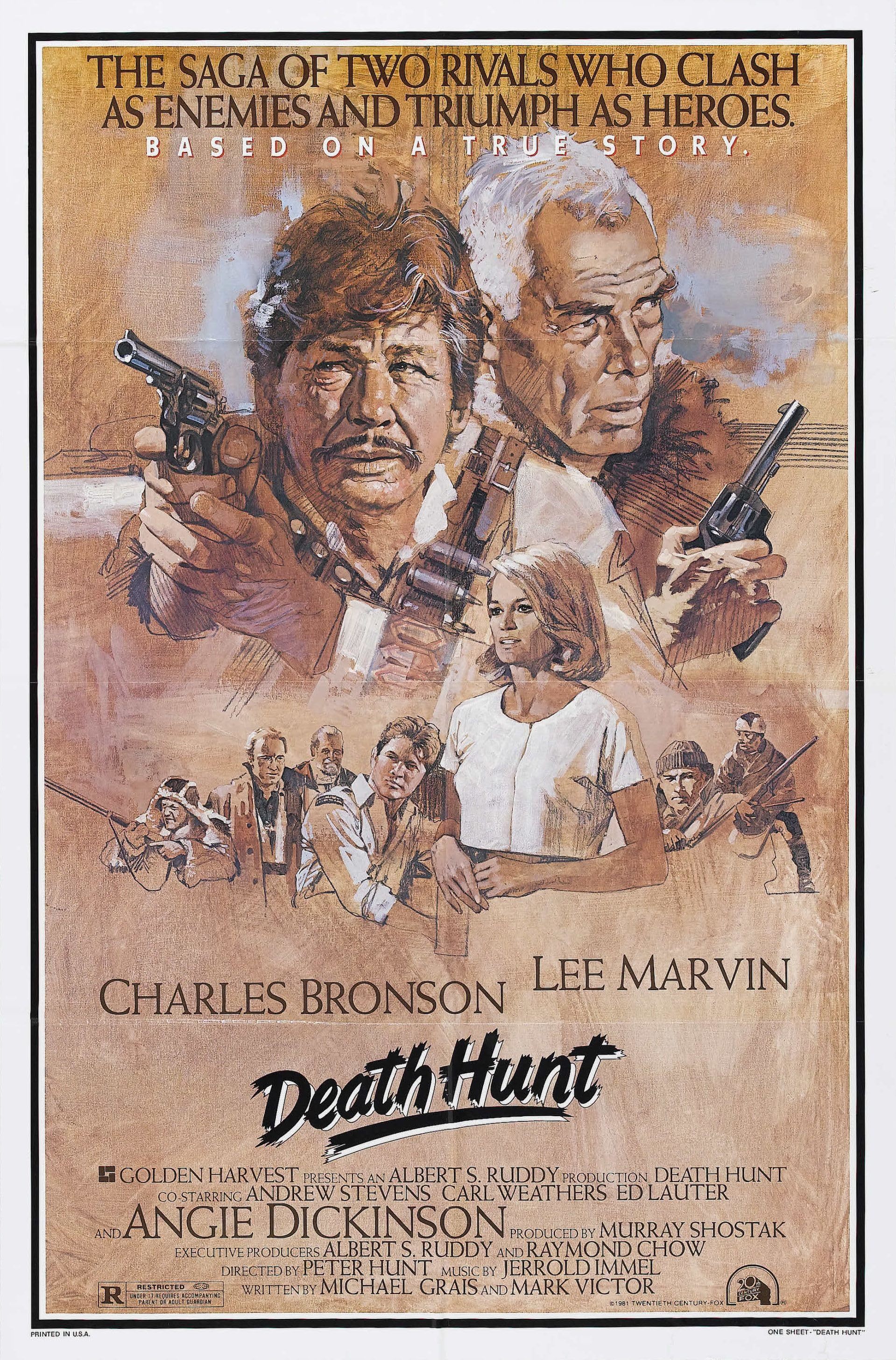
Whenever I watch a movie I inevitably go to Letterboxd to see what other people think of it. Letterboxd is like social media for movie nerds. You can log movies, see how many movies by an actor you’ve previously watched, check out stats (it is what I use to write all my movie journal posts), write reviews, and much more. You can also follow other users and when you do it will automatically show you their reviews.
I follow a lot of movie critics and various other users whose reviews I like to read, or who tend to have similar tastes as me. It is always interesting to see what others think of a movie I’ve just watched. It is especially interesting when their opinions differ from mine. It is fascinating to me to see when people hate a movie I loved for love a movie I hated.
I thought Death Hunt was dumb. It is the kind of movie they made a lot of in the early 1980s – silly action films with a couple of big stars, a little sexy, some comedy, and a lot of gunplay and explosions. I’m not necessarily opposed to that sort of thing as you can see from my reviews of various Burt Reynolds movies, but I have to be in the right mood.
I guess I wasn’t in the right mood yesterday when I watched Death Hunt because looking at Letterboxd most of the reviews I saw seemed to think it was a pretty fun movie. You can read between the lines that no one thinks it’s an actual good movie, but entertaining isn’t always good.
Anyway, the film is set in the Yukon Territory way up North in Canada in the 1930s. Albert Johnson (Charles Bronson), on his way home from a long stint in America, comes across an organized dogfight. The losing dog is badly injured and its owner, Hazel (Ed Lauter) is ready to do it in. Albert stops forcibly stops him then pays him $200 and takes the dog home.
With Albert gone Hazel finds his courage and reports the incident as a dog theft to Edgar Millen (Lee Marvin) of the local Canadian Mounties. Edgar is of the old and grizzled but fair and kind variety (in the Lee Marvin type).
Edgar knows Hazel and figures his story is bupkis, and tells him to go away. Hazel doesn’t like that and takes a group of his buddies up to Albert’s cabin to give him what for. Albert, being played by Charles Bronson, takes their what for and gives it back, leaving one guy dead on the ground.
Now that a man’s dead Edgar has to investigate, but instead of going to Albert alone and having a chat he takes an entire posse with him, including Hazel and his friend – all armed to the teeth with shotguns and rifles. His cabin surrounded Edgar walks up to Albert’s place to ask him to come alone peacefully. When he refuses Edgar lets the men shoot the cabin to bits. When that doesn’t work he throws dynamite at it, blowing the thing sky high.
It was probably at this point that I gave up on the film. Blowing a man’s house (and presumably him) to pieces isn’t good police work. Especially when you know that the killing you want to arrest him was probably self-defense. But the film wants them to have a chase and so that’s what it gives them.
Amazingly Albert survives the explosion and hits the road (or rather the icy mountain paths) with Edgar hot on his tail. The rest of the film becomes one long chase.
Made just a couple of years after Death Wish, Death Hunt is clearly trying to cash in on that film’s success. But Death Wish had a specific point of view. In those films, Charles Bronson is a good guy driven to revenge by evil criminals (don’t get me wrong that film’s morality is wonky as hell, but it does have a point of view). Here Albert is a rather dubious character and as noted Marvin isn’t exactly clean cut so there isn’t an obvious person to root for. Except the film clearly wants us rooting for someone, it just doesn’t seem sure as to who. This brings it all to a finale that just kind of whimpers where it ought to bang.
I’m putting way too much thought into all of this, more than the creators of the film seem to have done. It is all meant as a good time at the movies with a little comedy and some big action and good stars and nothing more. This is too many words already, but I should mention Carl Weathers plays Lee Marvin’s good time buddy. Oh, and Angie Dickinson plays Marvin’s love interest, who has so little to do I almost forgot about her.
I suspect if I had poured myself a couple of drinks and invited some friends over I would have had fun with it. But sitting alone on my couch while my wife is upstairs with Covid and my daughter is hiding out in her room I found it all kind of vapid and annoying.
Frozen in January: Whiteout (2009)
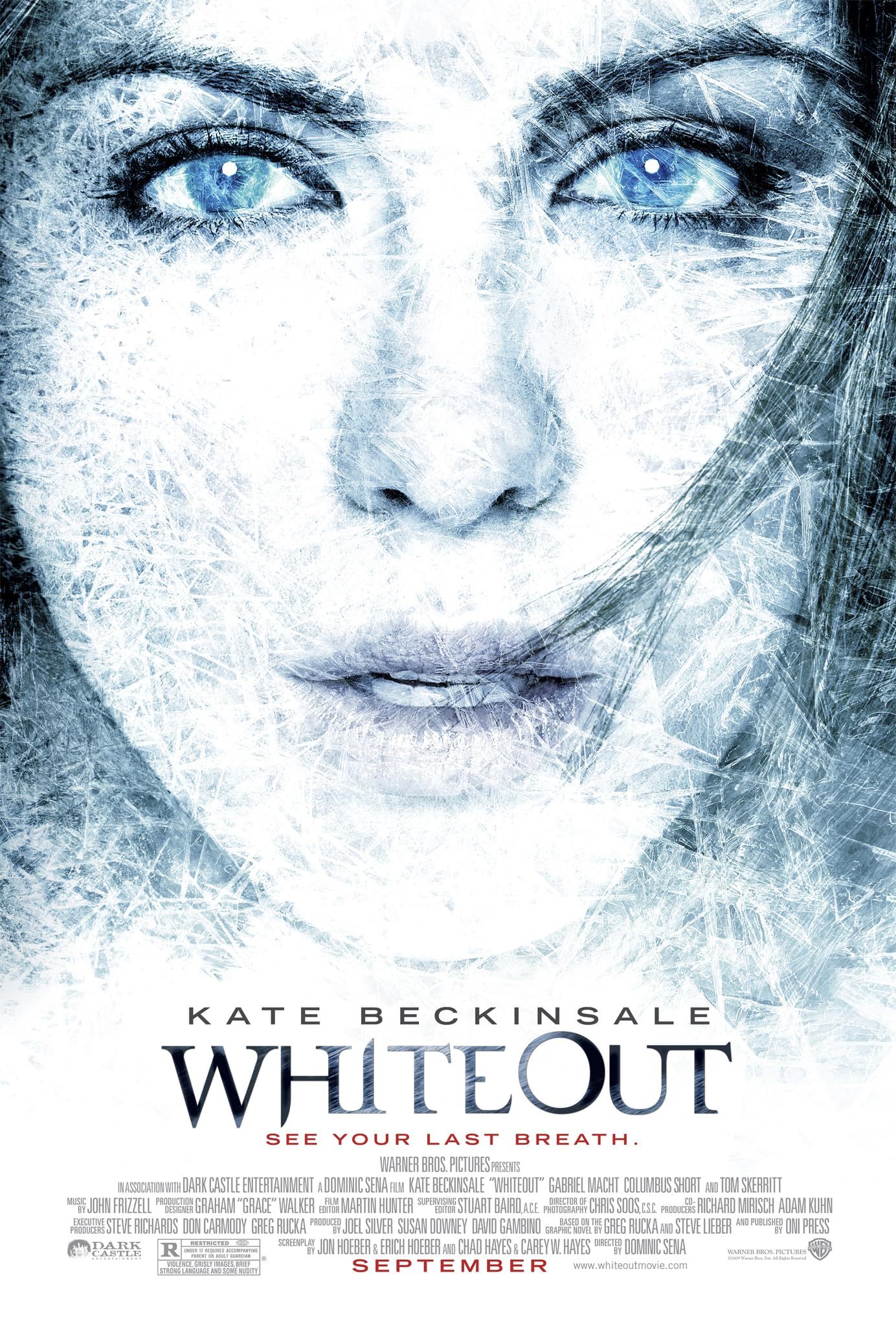
Sometimes you watch a movie knowing ahead of time it is going to be bad. You do so thinking maybe it won’t be that bad. Maybe it will at least be entertaining. And maybe, just maybe, it will defy expectations and actually be pretty good.
Mostly, you turn out wrong.
Or maybe that’s just me.
I knew going into it Whiteout wouldn’t be good. It actually has a kernel of an interesting idea – a lone US Marshall in Antarctica must solve a murder. But that’s also the kind of snappy idea that Hollywood all too often screws up.
I should have known not to watch it when I realized it stars Kate Beckinsale. I don’t actively hate Kate Beckinsale. I don’t think she’s necessarily a bad actress. She just has a habit of starring in a lot of bad movies. I don’t know if she just has bad taste, or she’s rarely offered anything any good or what. Maybe she has a terrible agent. But looking through her filmography I see very few movies that I either thought were good or that look anything like interesting.
But, like I said, this film has a setup that could be really cool so I took the plunge.
The biggest problem with the film is that it doesn’t know whether it wants to be a mystery, a thriller, or a horror film. It even throws in a bit of World War II conspiracy for good measure.
Beckinsale plays Carrie Stetko, the sole US Marshall in Antarctica. Most of the base is preparing to fly out. Winter is coming and at the bottom of the world, winter is long and hard. Minimal staff is required.
Stetko usually stays but this time she’s leaving. As is her friend, the base’s only doctor, John Fury (Tom Skerritt). As an example of just how poorly this film thinks things through that is the base’s only law enforcement agent and doctor leaving for several months. There is no indication that anyone is being sent to replace them. While most of the personnel do leave for the winter, not all of them do. What happens when a crime is committed or someone needs healthcare?
But of course, the film doesn’t think about this because it knows those two characters aren’t going to be leaving the base. A crime will be committed and someone will need medical attention and they will stay.
A body is found lying face down in a remote part – a “no man’s land” of the continent. His face is smashed to bits so it is impossible to tell who he is. Stetko and Fury investigate. Stetko realizes he must have taken a great fall. She knows this because, as we see in a flashback she once shot a man causing him to take a tumble out of a high-rise building.
The film loves its flashbacks. They pretty much all surround that one event in Stetko’s life, but the film doles it out like it is some great mystery that will reveal some insight into this current case. But really it is a pretty simple thing that lets us know what she’s doing in remote Antarctica in the first place.
The murder leads them to a remote station which then leads them to a WWII airplane buried in the snow. This should be an interesting mystery, a weird surprise for the audience. Except the film began with us watching the plane crash and showed us why. The only mystery left is what was in the box on the plane that everyone winds up fighting over. It might be old nuclear stuff which would be bad. Really bad. I guess.
Then Robert Pryce (Gabriel Macht), a United Nations security agent shows up. He’s there awfully fast for a guy who wasn’t in Antarctica before the movie began. Making us think perhaps he’s the killer. He’s not, but the movie likes throwing red herrings out like that. Anyone who has seen an episode of Law and Order will be able to figure out who the Big Bad really is before he’s revealed.
Oh, also, there is a huge storm rolling in causing the entire base to be evacuated in a few hours. Because this film doesn’t have enough going on, it needs to add that into the mix.
It is based on a graphic novel so maybe some of the script problems come from the source material. All of the plot twists and turns might work better in a comic. I’ve just started reading the book and it does seem to be more of a mystery than anything, and it definitely doesn’t begin with the plane crash so I’m prepared to say most of the film’s problems do come from the script. But only time will tell on that front.
Beckinsale isn’t bad. I don’t think she’s a particularly bad actress. But she doesn’t elevate the material either. And the material is bad. It is too much of everything and not enough of something specific.
The Apu Trilogy is the Blu-ray Pick of the Week

The week after Christmas is usually a time when those who make Blu-rays take a week off. Oh, they’ll release a handful of items, mostly junk that no one wants, but the general theory seems to be that everyone has spent their money on Christmas presents and the week (or two, or three…) after is a time to recover. This week certainly bears that out as I only count eleven total releases being put on the shelves. Surprisingly out of those eleven releases, five of them actually look pretty interesting. I had to really think about what I wanted my pick to be.
Satyajit Ray was a titan of Indian cinema. He was a master of world cinema. He is one of the most acclaimed directors of all time. His films have won every award imaginable. They are also one of the biggest holes in my cinematic knowledge. I have seen exactly one of his films, The Hero, which I enjoyed, but wasn’t blown away by. He remains someone whose films I continually tell myself I need to watch and that I continually put off dealing with.
The Criterion Collection is releasing this week a boxed set of three films (Pather Panchali, Aparajito, and Apur Sansa) collectively known as The Apu Trilogy. They tell the adventure of a young boy named Apu as he comes of age. They were each critically acclaimed and together are, perhaps, Ray’s most beloved films.
They come with new transfers and loads of extras and I’m excited to give them a watch and happy to make them my Pick of the Week.
Also out this week that looks interesting:
The Holdovers: Paul Giamatti stars in this acclaimed drama from director Alexander Payne as a private school teacher in charge of looking after a rebellious student who can’t go home for the holidays.
The Marsh King’s Daughter: Daisy Ridley and Ben Mendelsohn star in this thriller about a woman seeking revenge on the man who kidnapped her mother.
The Facts of the Murder: Radiance Films presents this blending of film noir with Italian Neo-Realism directed by and starring Pietro Germi as a detective trying to solve two separate crimes (robbery and murder) that happened on consecutive days in the same apartment complex. You can read my review at Cinema Sentries.
Please, Not Now!: Brigitte Bardot stars in this comedy from director Roger Vadim about a woman fighting to get her cheating boyfriend back by either winning his affections again or assassinating him.
Frozen In January: Jeremiah Johnson (1972)
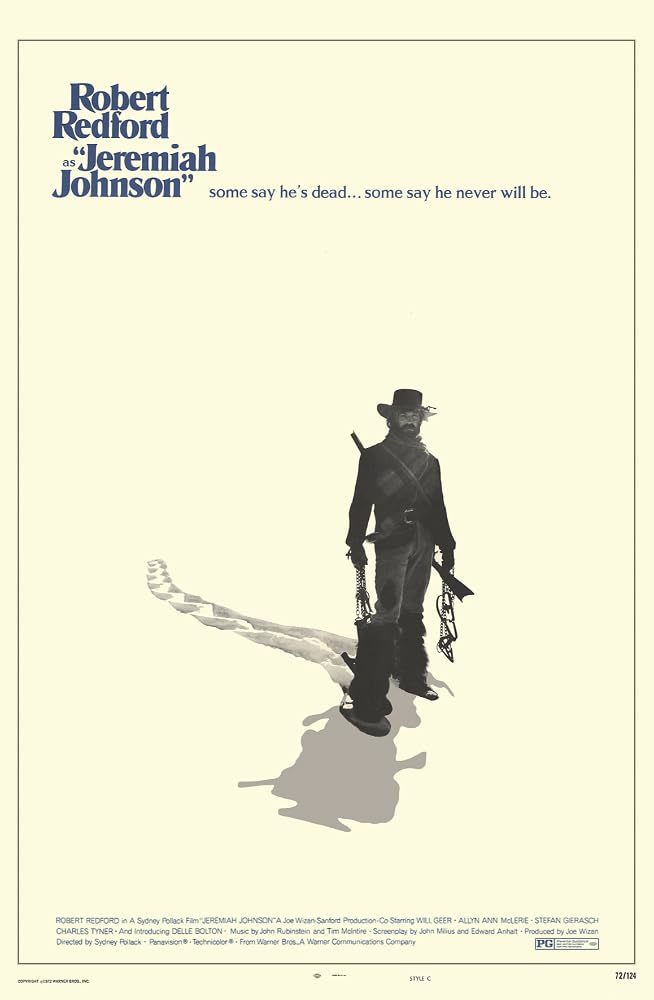
Jeremiah Johnson was a real mountain man who, as legend has it, killed, scalped, and ate the livers of some 300 Crow Indians. From what I’ve read he seems like a pretty rough-and-tumble guy. Director Sydney Pollack teamed up with Robert Redford and turned him into some kind of folk hero in their film based upon the legend.
Redford plays Johnson as a man who initially heads to the mountains to get away from society and truly become something, some kind of man. He isn’t naive or untrained like Chris McCandless from Into the Wild. He has some skills hunting and surviving in the wild. Just getting to the Rockies in the late 1800s was an adventure in itself.
But life in the mountains is different than life in the plains. Johnson find himself in trouble. He struggles making fire in the cold, wind, and snow. He can’t catch a fish in the mountain streams. He has better luck with wild game, but not much.
Cold and nearly starved, he stumbles across an old grisly bear hunter named Bear Claw (Will Greer). The old man teaches him how to survive in the mountains. He becomes good at it. He thrives. He learns the ways of the various Indian tribes in the area, but doesn’t befriend them. He’s a man who likes to be alone.
In time he comes across a cabin that has been attacked by Indians. A child was killed, and the husband is missing. A young boy has survived and his mother who has gone crazy from the ordeal. Johnson begins caring for the boy. Later Johnson makes a mistake in a trade with a Flathead tribe and finds himself with a wife.
This man of solitude now finds himself with a family. It is hard on him at first, especially since he does not speak his Crow wife’s language and the boy is mute, but he learns to love them and they make a life together.
Then tragedy hits and Johnson becomes the liver-eating man of legend.
Pollack and cinematographer Duke Callaghan film it like poetry. Pollack calls it his silent picture and there are long scenes in which not a word is spoken. Shot in and around the Rocky Mountains in Utah it is often stunningly beautiful. Redford does some of his best work. All of this is periodically puncturated by songs from Tim McIntire and John Rubinstein. They are sung in the Appalachian folk tradition and are a little too on the nose declaring the themes of the film. Also they are just bad.
It is interesting that they turned this story of a rugged mountain man, known for his ruthless slaying of countless natives into the story of a good man who just wants to be left alone, at peace in nature. He rarely takes action himself, the mountains or outsiders force him into it. Even in the end when he becomes the Crow Slayer, it is always them who attack him. It does feel like they are turning into a folk hero. I doubt that is where the truth really lies. But we’ll never really know the truth anyway, as the true story was turned into legend long ago and the facts have long since been lost.
Not that it matters. True or not the film is quite good, longing and beautiful. A tale of a time long past, but of mountains that still amaze with their grandeur.
Frozen in January
I truly do love coming up with movie themes for each month. They help focus my watching in the most interesting ways. Over the last couple of years, I’ve learned that I’m rarely going to really push the bounds of the types of cinema I’m apt to watch. I’m never going to watch a Danish documentary on wooden shoes or whatever, but these themes do help me focus my attention.
They do push me to watch movies I’ve been meaning to watch but keep putting off for some reason. And they help me stumble across movies I might not otherwise discover.
So for January, I thought I’d seek out winter movies. I’m looking for movies where the protagonists are trapped in a blizzard, or lost in some godforsaken wilderness, surrounded by ice and snow. My two touchpoints are John Carpenter’s The Thing (1982) in which a group of men find themselves in Antarctica being attacked by a shape-shifting alien, and Quentin Tarantino’s The Hateful Eight (2015) whereupon a group of travelers are stranded in a snowbound cabin in the woods.
I’m looking for isolation and the cold, cold, winter with characters surrounded by ice and snow.
What could be better to watch during the frozen, lonely days of January?
The First Movie of 2024: Miller’s Crossing (1990)

I always make a big deal out of the first film I watch in a given year. I guess I feel like it sets the theme for the year or some such thing. Or maybe I just like stats and the first anything of the year seems randomly important.
As I noted in previous posts we were supposed to be in Kentucky today, the first day of 2024. But Covid kept us home. That and a million other things kept me from really thinking about what movie I’d watch today. In fact, I spent most of the day not watching movies at all, but binge-watching the excellent Amazon series Fleabag.
But as night came I knew I needed to watch a movie and my mind completely randomly thought of Miller’s Crossing, the 1990 gangster film from the Coen Brothers.
I love the Coen Brothers. I have ever since I first watched Fargo in 2006. That movie blew me away. It was so quirky, and funny, and violent. I had previously watched Raising Arizona, but at the time it didn’t make much sense to me. I now consider it one of the funniest movies of all time.
After Fargo I started seeking out Coen Brothers movies. I think I first watched Barton Fink (didn’t get it at first but now consider it a classic). Then I watched Miller’s Crossing and absolutely loved it.
That movie single-handedly turned me on to the writings of Dashiell Hammett and Raymond Chandler and made me a fan of film noir. I owe it a lot.
I hadn’t seen it in years so this viewing was somewhat fresh. It is still absolutely perfect.
It is loosely based on Hammett’s novels Red Harvest and The Glass Key, but with plenty of Coen Brothers spin. Gabriel Byrne plays Tom Reagan the right-hand man to mob boss Leo O’Bannon (Albert Finney) who gets into a war with up-and-coming gangster Johnny Caspar (Jon Polito). There are lots of twists and turns making the plot a bit confusing on first viewing, but it is full of wonderful dialogue and that Coen Brothers humor. It looks great, the acting is great, and the music by Carter Burwell is beautiful. It remains one of my all-time favorite films.
I think that makes a good start to 2024.
 themidnightcafe.org